Theodosius Outlaws Paganism
The absolute closure of the classical mind.
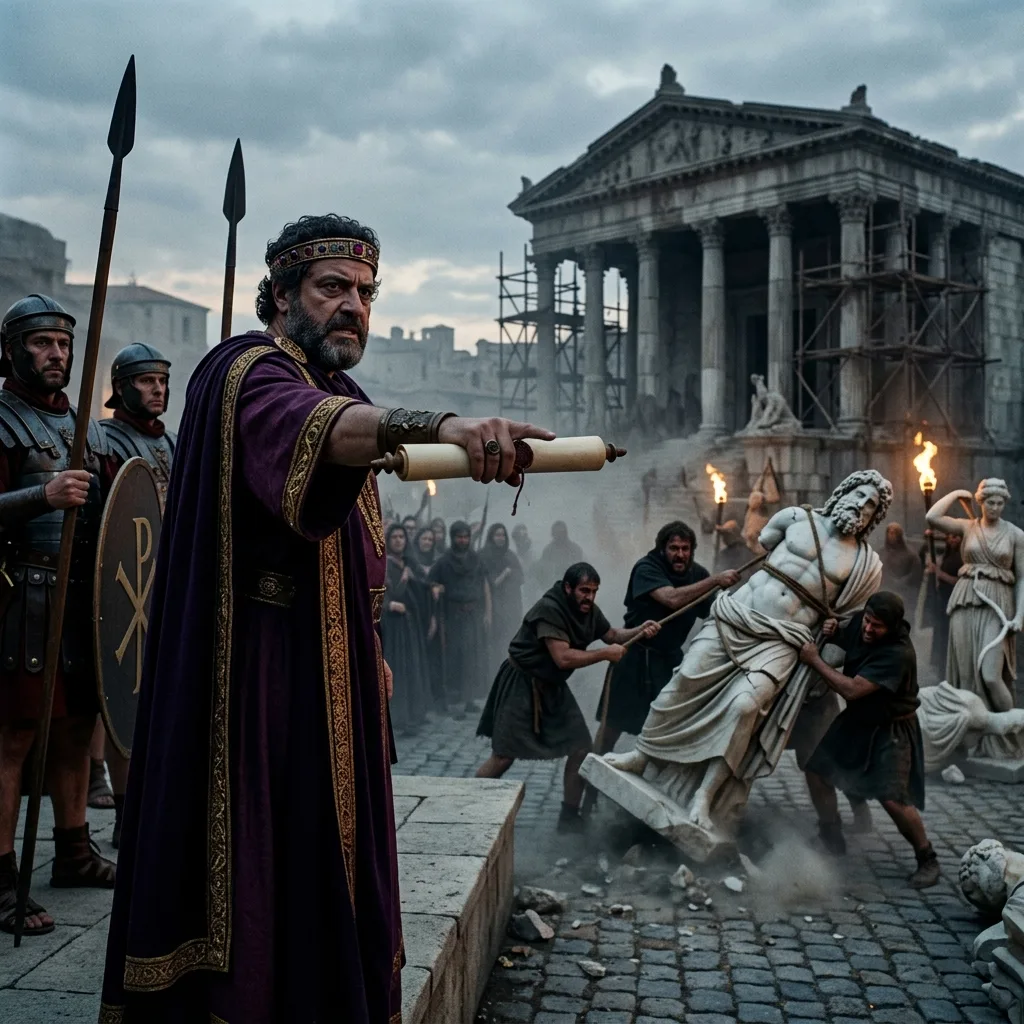
Emperor Theodosius I issues the Edict of Thessalonica, making Nicene Christianity the official state religion. By 391 CE, he bans all pagan rituals and closes the ancient temples, including the eternal fire of Vesta.
Open in interactive timeline →Key Numbers
- Key edict date
- Nov 8, 392 CE
- Span of decrees
- 380-392 CE
- Penalty for sacrifice
- Property forfeit / treason
- Serapeum's age at fall
- 600+ years
- Emperors on Thessalonica edict
- 3 co-rulers
Verified Facts
- The pivotal anti-pagan law was Codex Theodosianus 16.10.12, issued on 8 November 392 CE from Constantinople and addressed to the praetorian prefect of the East, the staunchly Christian Flavius Rufinus; it banned pagan worship in every form, public and private.
- The 392 law reached into the home, forbidding anyone to venerate the household Lares and Penates or one's personal genius with fire, wine, incense, lamps, or hanging garlands, a level of intrusion into private domestic ritual unprecedented in earlier legislation.
- The law classified illicit sacrifice as a quasi-treasonous offense (akin to maiestas) and threatened violators with confiscation of the house or property where the rite occurred; modern scholars note the West shows little or no evidence of its actual enforcement.
- Theodosius had built toward this with earlier decrees: in 391 he issued CTh 16.10.10 (24 February 391) to the prefect of Rome and a parallel rescript from Milan on 16 June 391 to the prefect and military governor of Egypt, banning sacrifice, temple visits, and reverence of cult statues.
- The 391 Roman edict (CTh 16.10.10) ordered, in its own words, that no person should pollute himself with sacrificial victims, slaughter innocent animals, approach the shrines, wander through the temples, or revere images formed by mortal labor.
- These laws built on the Edict of Thessalonica (Cunctos populos) of 27 February 380, jointly issued by Theodosius, Gratian, and Valentinian II, which made Nicene Trinitarian Christianity the empire's official faith and branded dissenters dementes vesanos ('demented and insane') heretics.
- Theodosius issued the Thessalonica edict roughly a month after being baptized during a serious illness by Acholius, the Nicene bishop of Thessalonica, the bishop's faith shaping the orthodoxy the edict imposed.
- The destruction of the great Serapeum of Alexandria circa 391-392, instigated by Patriarch Theophilus after Theodosius authorized it, became the era's defining image of Christianity's turn from persecuted minority to state-backed persecutor; the colossal statue of Serapis was beheaded and burned and the temple replaced by a church.
- The traditional claim that Theodosius formally 'abolished' the Olympic Games around 393 CE is not supported by any surviving edict; no law in the Theodosian Code mentions the Games, and many historians attribute their end to economic decline and the broader anti-pagan climate rather than a specific ban.
- Theodosius also relied on aggressive Christian agents and mobs rather than imperial troops alone to enforce these laws, and tellingly never restored the Altar of Victory to the Roman Senate house, a flashpoint the pagan senator Symmachus had fought to preserve.
The World at This Moment
The decrees of 391-392 fall amid acute imperial crisis. In the West, the general Arbogast dominated the boy-emperor Valentinian II, who died at Vienne on 15 May 392 in suspicious circumstances; Arbogast then elevated the rhetorician Eugenius, whose regime conspicuously tolerated traditional cult, setting up the showdown at the Frigidus (September 394). In Persia, Bahram IV (388-399) ruled a Sasanian state largely at peace with Rome after the 387 partition of Armenia. In China the Eastern Jin emperor Xiaowu reigned over a fractured, increasingly Buddhist realm. Within the church, Ambrose of Milan was consolidating episcopal authority over emperors—having compelled Theodosius's penance after the Thessalonica massacre (390)—while Augustine was ordained priest at Hippo in 391. The Serapeum of Alexandria was destroyed by a Christian mob under bishop Theophilus around 391-392, the era's most spectacular act of temple violence. Latin Christianity's intellectual apparatus was crystallizing: Jerome had settled in Bethlehem (386) to produce the Vulgate.
The Paradigm Shift
Theodosius's laws marked the legal inversion of religion in the Mediterranean world: cult that had been Rome's public foundation for a millennium was now criminalized, while a once-persecuted faith became compulsory orthodoxy. The Edict of Thessalonica (Cunctos populos, 380) had already defined Nicene Trinitarianism as the only legitimate Christianity; the 391-392 statutes (CTh 16.10.10-12) extended this by banning blood sacrifice, temple visitation, and even private household devotion to the Lares, Genius, and Penates. This severed the ancient link between civic religion and the state, displacing it onto an institutional church whose bishops—Ambrose pre-eminently—now claimed authority over emperors themselves. The legislation accelerated the conversion of sacred topography (temples closed, repurposed, or razed) and recast religious dissent as legal crime, seeding the medieval category of heresy. Though enforcement was uneven and traditional practice persisted for generations, the normative framework was fixed: the late-antique and Byzantine state would be confessional, and the West inherited the principle that secular power should enforce a single creed.
In Their Own Words
"No person at all, of whatever class or order of men or of dignities, whether he occupies a position of power or has completed such honors, whether he is powerful by the lot of birth or is humble in lineage, legal status and fortune, shall sacrifice an innocent victim to senseless images in any place at all or in any city, or shall venerate with fire the household deity, the genius with wine, the Penates with fragrant odors." — Emperors Theodosius I, Arcadius and Honorius, edict of 8 November 392, Codex Theodosianus 16.10.12 (trans. Clyde Pharr, The Theodosian Code, 1952)
In Depth
The Closing of the Temples: How One Emperor Ended the Ancient World
When Theodosius I issued his decrees of 391 and 392 banning sacrifice, divination, and even private veneration of the old gods, he did not invent a new religion so much as foreclose every alternative to one. The laws were terse and devastating: temples were shuttered, public worship of the gods criminalized, and officials threatened with fines and exile for non-enforcement. The act reads in the legal codes as administrative housekeeping. In the long arc of history it was a hinge — the moment Greco-Roman polytheism, a tradition reaching back through Hesiod's Theogony (sv-hesiod) and Homer (sv-homer) to the storytelling impulse first carved at Göbekli Tepe (sv-gobekli-tepe), lost the protection of the state and began its long death.
Deep Preconditions
Theodosius inherited a machine that Constantine had already retooled. Constantine's legalization of Christianity and convening of Nicaea (sv-constantine-legal) gave the faith imperial patronage and a defined orthodoxy; what had been a persecuted sect, defended a generation earlier by apologists like Justin Martyr (sv-justin-martyr) and systematized by Origen (sv-origen), became a court religion. The reversal under Julian the Apostate (sv-julian), who briefly tried to restore the temples in the 360s, proved the last serious counter-current. After Julian died on campaign, restoration had no champion. Theodosius's own Edict of Thessalonica (380) made Nicene Christianity the empire's sole legitimate faith; the anti-pagan laws of 391–392 were its logical conclusion. The universal citizenship granted by the Edict of Caracalla (sv-edict-caracalla) had already dissolved the old civic identities that local cults expressed, leaving religion increasingly detached from the city-state and available for imperial standardization.
What It Reshaped
The consequences were physical and cultural. Around 391, amid this legal climate, the great Serapeum of Alexandria — daughter institution to the Library (sv-library-alexandria) — was stormed and destroyed by a Christian mob, an event later historians treat as a symbolic close of the pagan intellectual world. The ancient Olympic Games, possibly suppressed under these same edicts, faded soon after. Theodosius refused to restore the Altar of Victory to the Roman Senate, snubbing the last pagan aristocrats. The philosophical lineage running from the Pre-Socratics (sv-presocratics) through Plato's Academy (sv-plato) would survive only in Christianized form, its synthesis achieved by Augustine of Hippo (sv-augustine), who wrote The City of God in the shadow of these very events.
Threads Forward
Theodosius was the last man to rule a unified Roman Empire. After his death in 395, his sons split East and West permanently — a division that shaped the eventual Great Schism (sv-great-schism) between Latin and Greek Christendom centuries later. The fusion of imperial authority and exclusive monotheism that he sealed became the template for medieval Christendom and, by contrast and rivalry, conditioned the world that the rise of Islam (sv-rise-of-islam) would enter. When Renaissance (sv-renaissance) humanists later "rediscovered" classical antiquity, they were recovering precisely the world Theodosius had legislated into silence.
It is worth tempering the drama with the historians' caution: enforcement was uneven, paganism persisted quietly for generations, and the "abolition" of the Olympics rests partly on inference. Theodosius did not extinguish the old world by decree alone. But he removed its legal scaffolding, and once the state withdrew its protection, the temples could not stand. The thread of belief did not break — it was re-spun, and the loom belonged, from then on, to the Church.
Causes & Consequences
What led to it
- Constantine's Edict of Milan in 313 ended the persecution of Christians and legalized the faith across the Roman Empire, beginning the legal shift that would let a later emperor invert the relationship between church and state.
- Constantine's own patronage, baptism, and convening of the Council of Nicaea in 325 made Christianity the favored religion of the imperial court and established the Nicene Trinitarian formula that Theodosius would later impose by law.
- Constantine's son Constantius II issued decrees in the 350s closing pagan temples and banning blood sacrifice under penalty of death, setting the legal precedent of an emperor actively criminalizing traditional cults that Theodosius escalated.
- Theodosius's own Edict of Thessalonica (Cunctos populos) of 27 February 380, co-issued with Gratian and Valentinian II, declared Nicene Christianity the only legitimate faith and branded dissenters heretics, providing the doctrinal basis for outlawing all rival worship.
- Bishop Ambrose of Milan's growing political influence, including his successful campaign to keep the Altar of Victory out of the Senate and his public confrontations with Theodosius, pressured the emperor toward ever harsher anti-pagan measures.
- The administrative apparatus of staunchly Christian officials such as the praetorian prefect of the East, Rufinus, and the prefect Cynegius who toured the East destroying temples in the late 380s, gave Theodosius the enforcement machinery to translate edicts into action.
What it set in motion
- The November 392 law to the prefect Rufinus prohibited every form of pagan worship, including private household offerings of incense and wine, effectively criminalizing traditional Roman religion for the first time in the empire's history.
- The campaign emboldened Patriarch Theophilus and Christian mobs to destroy the Serapeum of Alexandria around 391, one of the ancient world's greatest temples, symbolizing Christianity's transformation from persecuted minority to state-backed persecutor.
- Theodosius's victory over the pagan-sympathizing usurper Eugenius and his general Arbogast at the Battle of the Frigidus in 394 crushed the last organized pagan revival within the Roman state and was read by Christian chroniclers as divine vindication.
- The suppression contributed to the lapse of long-standing pagan institutions, including the extinguishing of the sacred fire and disbanding of the Vestal Virgins and the end of the ancient Olympic Games (last securely attested in 393), as imperial support for pagan festivals was withdrawn.
- The Theodosian model of legally enforced religious orthodoxy was codified in the Codex Theodosianus of 438 and carried forward into Justinian's Code, which underpinned his closing of the Neoplatonic Academy of Athens around 529.
- The fusion of imperial authority with a single mandated creed established the template of Christendom, in which church and state reinforced one another, shaping European political and religious order for more than a millennium.
The Live Academic Debate
The central debate pits a "conflict" model against a "gradualist" one. The older paradigm, traceable to András Alföldi (1934) and especially Herbert Bloch, cast Theodosius's measures as provoking a deliberate "pagan revival" among the senatorial aristocracy, with Eugenius's regime mounting "the last pagan army of the ancient world" at the Frigidus. Alan Cameron, in The Last Pagans of Rome (2011), demolished much of this construction, arguing that aristocratic paganism was already moribund, that figures like Symmachus and the Nicomachi were not militant resisters, and that the conflict narrative is largely a modern scholarly fabrication; the Frigidus, on his reading, was a political not a religious war. Cameron's revisionism drew vigorous rejoinder, notably from Stéphane Ratti, who maintains that genuine pagan resistance better explains fourth-century Latin literature. Others—Maijastina Kahlos on "incertitude," Rita Lizzi Testa, Michele Salzman—press a middle ground emphasizing negotiation, ambiguity, and slow Christianization over abrupt rupture, questioning how rigorously the 392 laws were enforced.
How This Event Connects
The reign of Theodosius I (379–395 CE) marks the definitive, irrevocable triumph of Nicene Christianity over both classical Paganism and rival Christian sects. While Constantine legalized Christianity, it was Theodosius who issued the Edict of Thessalonica in 380 CE, officially establishing Nicene Christianity as the exclusive state religion of the Roman Empire and outlawing Arianism.
Historiographically, Theodosius represents the aggressive fusion of church and state power. His subsequent decrees banned all pagan sacrifices, disbanded the Vestal Virgins, and led to the destruction of ancient temples across the empire. Furthermore, Theodosius was the last emperor to rule over both the Eastern and Western halves of the Roman Empire; his death in 395 CE resulted in the permanent bifurcation of the empire between his two sons. This division critically weakened the West, directly accelerating the geopolitical collapse that culminated in the Fall of Rome.
The Counterfactual
Had Theodosius not legislated so sweepingly—or had Eugenius and Arbogast prevailed at the Frigidus in 394—the formal criminalization of cult might have been delayed or softened into the gradual neglect many scholars argue was already underway. Alan Cameron's work suggests paganism was demographically waning before 391, so traditional religion would likely have continued declining regardless; the decrees ratified rather than caused a trend. But the legal posture mattered: an Eugenian West tolerating cult could have produced a more genuinely pluralist settlement, slowing the fusion of throne and orthodoxy. The deeper counterfactual concerns precedent. Theodosius's statutes furnished the template—secular enforcement of a single creed, dissent as crime—later wielded against pagans, Jews, and Christian heretics for over a millennium. Without that codified template, the conceptual machinery of medieval religious coercion would have required separate invention. Yet because Christianization had structural momentum under Constantine's dynasty, most historians treat the specific 392 law as decisive in form and timing rather than as the sole hinge.
Myth vs. Reality
Myth: Theodosius was the first emperor to ban pagan sacrifice; before him paganism was freely practiced and legally protected.
Reality: Imperial restrictions on blood sacrifice predate Theodosius by decades. Constantine the Great already legislated against aspects of sacrifice, and Constantius II went much further: a law of 341 ordered sacrifices to cease, and edicts of 353-356 prohibited sacrifice and the worship of cult images, in some cases threatening capital punishment, while also ordering temples closed. Theodosius's laws of 391-392 reiterated and broadened this existing tradition (extending the ban to private rites and household worship) rather than inventing the policy. Scholars treat his measures as the intensification of a fourth-century legislative trajectory, not its origin.
Myth: In 391-392 Theodosius issued a single sweeping decree that abolished paganism and shut down all temples across the empire overnight.
Reality: There was no one master edict abolishing paganism. Theodosius issued a series of laws (notably in 391 and a longer decree in 392) that banned sacrifice, forbade entering temples to worship, and outlawed even private pagan rites. But these were targeted prohibitions on practice, not a wholesale closure or demolition order. Temples were not uniformly destroyed; many survived, fell into disuse, were repurposed, or were only later converted into churches. The fact that later emperors (Arcadius, Honorius, Theodosius II, and even Justinian into the sixth century) kept reissuing anti-pagan bans shows the 392 laws did not eradicate paganism and were unevenly enforced.
Myth: Theodosius personally ordered the destruction of the Serapeum of Alexandria, the empire's great pagan temple, as part of his anti-pagan campaign.
Reality: The destruction of the Serapeum around 391-392 grew out of local violence in Alexandria, led by the bishop (patriarch) Theophilus, not from a direct imperial demolition order. After clashes in which both pagans and Christians died and pagans barricaded themselves in the temple, sources report that Theodosius declared the slain Christians martyrs and pardoned the pagan rioters, while sanctioning that the cult site be dismantled. The episode reflects the volatile mix of episcopal initiative, mob action, and imperial policy of the period rather than a campaign of temple-razing planned and directed from the throne.
Myth: Theodosius abolished the ancient Olympic Games in 393 because of his hostility to paganism.
Reality: This is a modern handbook claim, not a documented fact. No surviving edict of Theodosius I bans the Olympics, and an inscribed victor list shows the games still running into his reign; the poet Claudian still references the Olympics around 399, after Theodosius died in 395. Two Byzantine writers centuries later vaguely attribute the games' end to 'Theodosius' but disagree on whether they mean Theodosius I or his grandson Theodosius II, and historians now place the actual cessation in the fifth century, citing economic decline and the loss of state patronage as much as religious policy.
Myth: After Theodosius's laws, paganism rapidly vanished and the empire became uniformly Christian.
Reality: Paganism declined but persisted for generations. Prominent pagan senators in Rome openly advertised their priesthoods and initiations (at Eleusis, of Isis, Mithras, Hecate, and others) into the early fifth century, and pagans continued to hold high office in the imperial bureaucracy into the sixth century. The repeated reissuing and stiffening of anti-pagan legislation by later emperors, culminating in Justinian's sixth-century measures, is itself evidence that the old cults still had numerous adherents. Some regions, such as parts of Greece, saw the laws effectively exempted or simply unenforced.
Frequently Asked Questions
When did Theodosius outlaw paganism?
Theodosius I moved against paganism in stages rather than with a single decree. In 380 his Edict of Thessalonica (Cunctos populos) made Nicene Christianity the empire's official faith, and between 389 and 391 he issued the so-called 'Theodosian decrees' banning temple visits, sacrifices, and pagan holidays. A comprehensive edict of November 8, 392 went furthest, prohibiting essentially all public and private pagan worship throughout the empire.
What did Theodosius's anti-pagan edicts actually ban?
The edicts of 391 and 392 prohibited blood sacrifice, entering temples for worship, and the reading of entrails (haruspicy), and they abolished remaining pagan festivals. The 392 law extended the ban to private household devotions, forbidding veneration of the lares, genii, and penates, and outlawing acts such as burning incense on altars or hanging sacred garlands on trees. Many of these offenses carried heavy fines, confiscation of property, or in some cases were treated as treason.
Did Theodosius destroy the Serapeum and end the Olympic Games?
The Serapeum of Alexandria was destroyed by Christians in 391, after Theodosius's anti-pagan edicts emboldened Patriarch Theophilus to act, though the destruction was carried out by local mobs rather than by direct imperial order. The claim that Theodosius banned the ancient Olympic Games is widely repeated but not actually supported by the texts: as historian Ingomar Weiler noted, no surviving edict mentions the Games. The Olympics faded out in the early fifth century, under Theodosius's grandson Theodosius II, rather than by a clear ban from Theodosius I.
Why did Theodosius turn against the old Roman religion?
Theodosius was a committed Nicene Christian whose policy reflected both personal conviction and the growing political weight of the Church. The bishop Ambrose of Milan exerted notable influence, especially after he forced the emperor to do public penance for the 390 massacre at Thessalonica, where Theodosius had ordered the killing of thousands of townspeople in reprisal for a riot. Suppressing paganism also served to enforce religious uniformity as a tool of imperial cohesion, though scholars debate how far Ambrose actually drove the anti-pagan legislation.
Did Theodosius's laws actually end paganism in the Roman Empire?
No. Although the edicts stripped the old cults of state funding, property, and legal protection, paganism was not eradicated. Many adherents converted only nominally to advance their careers, while others continued practicing in diminished and increasingly private forms. Followers of the old religions remained visible into the early sixth century, so the edicts marked a decisive turning point rather than an immediate extinction.
What happened to the Vestal Virgins under Theodosius?
As part of the broader suppression of traditional Roman cult, the sacred fire of Vesta in the Roman Forum was extinguished and the College of Vestal Virgins was disbanded around 391 to 394. This ended a priesthood that had existed for over a thousand years and was deeply tied to Rome's civic religious identity. Its dissolution symbolized the formal end of state support for the old gods in the empire's ancient capital.
Sources & Further Reading
- Persecution of pagans under Theodosius I — Wikipedia
- Alan Cameron, The Last Pagans of Rome (Oxford University Press, 2011)
- Clyde Pharr (trans.), The Theodosian Code and Novels and the Sirmondian Constitutions (Princeton University Press, 1952), esp. CTh 16.10
- Neil B. McLynn, Ambrose of Milan: Church and Court in a Christian Capital (University of California Press, 1994)
- Maijastina Kahlos, Religious Dissent in Late Antiquity, 350-450 (Oxford University Press, 2020)
- Rita Lizzi Testa & Michele Renee Salzman (eds.), Pagans and Christians in Late Antique Rome: Conflict, Competition, and Coexistence in the Fourth Century (Cambridge University Press, 2016)
- Wikipedia: Theodosius I
- Wikipedia: Edict of Thessalonica
Cite This Page
AskHistoryAI. “Theodosius Outlaws Paganism.” AskHistoryAI — Interactive Timeline of Everything. Updated 2026-09-11. https://askhistoryai.com/event/sv-theodosius/
Every fact on this page is checked against the published fact ledger and methodology; sources are listed above.