Nanobots & Full-Dive VR
Microscopic robots enter your brain through the bloodstream and shut down physical reality.
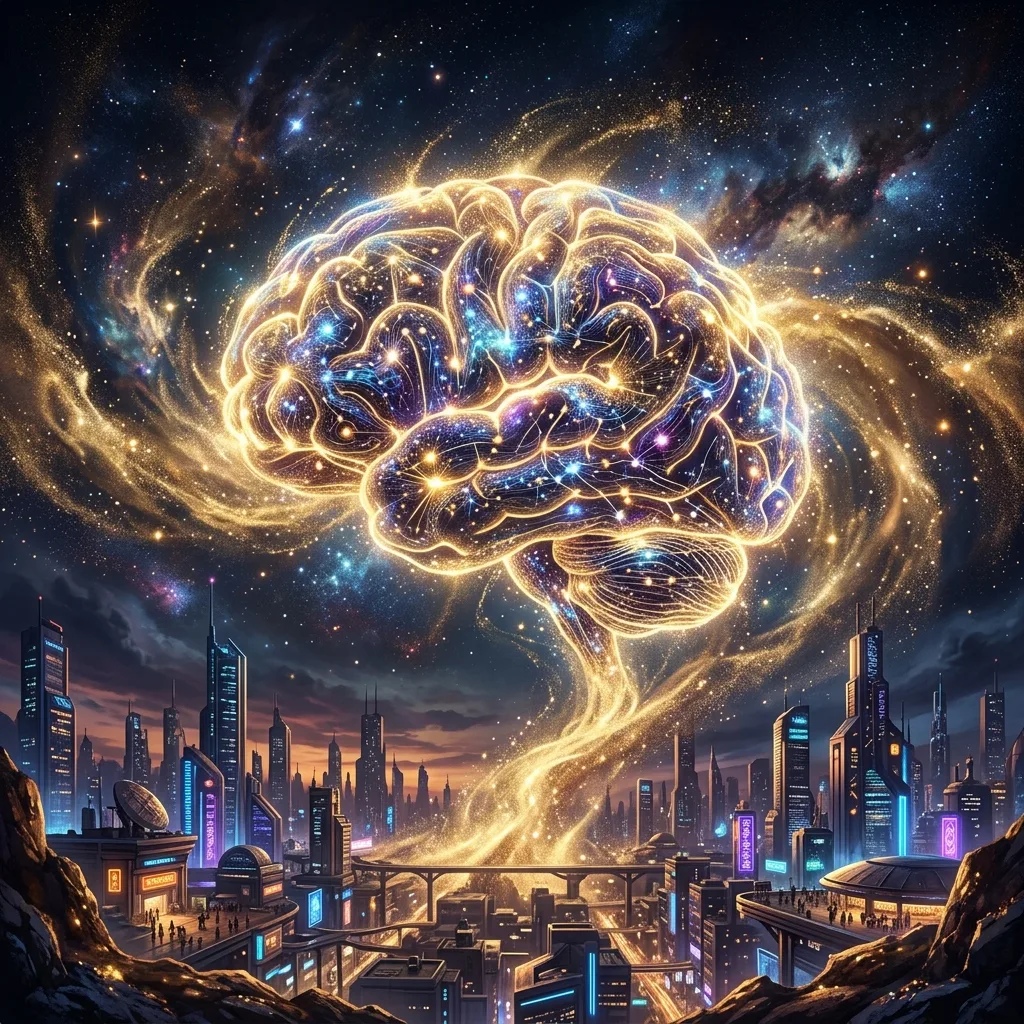
In the 2030s, Kurzweil predicts nanobots will enter the brain non-invasively through the capillaries. They will intercept and suppress electrochemical signals from your real sensory organs — eyes, ears, skin — effectively "shutting down" physical reality. Simultaneously, they will send synthetic sensory signals that create full-body virtual reality using your own biological nervous system. These same nanobots will connect your neocortex to synthetic neocortices in the cloud, expanding your intelligence a thousandfold.
Open in interactive timeline →Key Numbers
- Predicted timeline
- 2030s (brain-cloud link)
- Singularity / full merger
- 2045 (Kurzweil's date)
- Claimed intelligence gain
- Millions-fold
- Kurzweil's self-audited hit rate
- ~86% (advocacy-side)
- Status
- Prediction, not fact
Verified Facts
- This entry describes a DOCUMENTED PREDICTION, not an established fact: futurist Ray Kurzweil forecasts that by the 2030s, nanobots injected into the bloodstream will travel noninvasively through brain capillaries to wire the neocortex directly to cloud-based AI, with the full human-AI merger arriving by his long-standing 2045 'Singularity' date.
- Kurzweil's core mechanism is that nanobots would link the brain's top neocortical layer to a 'synthetic neocortex' running in the cloud, which he frames as the first major neocortical expansion since hominins gained extra cortex roughly two million years ago, this time enabling an intelligence increase he describes as 'millions-fold.'
- The 'full-dive VR' element comes from Kurzweil's claim that if the brain connects at sufficient bandwidth, sensory perception could be driven entirely by a gaming engine, and motor-cortex links would let a virtual avatar's limbs track your real limbs, immersing you in a computer-generated world from within the nervous system.
- Kurzweil also predicts the link would allow 'backing up' memories and thoughts to the cloud the way documents are saved, and sending emails or photos directly into the brain, ideas he developed across 'The Singularity Is Near' (2005) and 'The Singularity Is Nearer: When We Merge with AI,' published June 25, 2024.
- The 2045 Singularity is paired with his separate prediction that AI will reach human-level intelligence and pass a properly designed Turing test by 2029, a date he has publicly wagered on against Mitch Kapor.
- Kurzweil's credibility claim rests on a self-assessment of 147 predictions from his 1999 book 'The Age of Spiritual Machines': he counts 115 as 'entirely correct' and 12 as 'essentially correct' for an 86% accuracy rate, but this audit was conducted by Kurzweil and his supporters rather than neutral evaluators, so it should be read as advocacy, not independent verification.
- The prediction has a published scientific basis beyond Kurzweil's books: a 2019 Frontiers in Neuroscience paper (lead author Nuno R. B. Martins, with co-authors including nanomedicine researcher Robert Freitas) proposed neural nanorobots forming a 'human brain/cloud interface,' and was widely covered as the 'internet of thoughts' concept.
- Independent neuroscientists treat the 2030s timeline as highly premature: Johns Hopkins neuroscientist David Linden has flagged unsolved obstacles including powering the nanobots, evading the brain's resident immune cells (microglia, which mount inflammatory responses to foreign material), and avoiding damage to neurons.
- Researchers note the engineering hurdles compound: proposed neural nanorobots must navigate the vasculature, cross the blood-brain barrier, and self-position among or inside cells, all while remaining biocompatible, with certain carbon nanotube formulations known to trigger immune reactions, and FDA approval estimates for such devices range from 'a few years to never.'
- Kurzweil's framing carries a transhumanist, quasi-religious tone, neuroscientists and critics have noted his vision of nanobot-augmented humans becoming 'godlike' and ultimately immortal, which critics such as Michael Shermer have characterized as Singularitarian faith as much as forecast.
The World at This Moment
This is a documented prediction, not a dated event; its primary articulation is Ray Kurzweil's The Singularity Is Near (Viking, 2005), reaffirmed in The Singularity Is Nearer (June 25, 2024). The 2005 book appeared amid the U.S. National Nanotechnology Initiative (launched 2000) and intense public interest in molecular manufacturing following K. Eric Drexler's Engines of Creation (1986). It coincided with the early transhumanist movement (Nick Bostrom and David Pearce had founded the World Transhumanist Association in 1998) and with breakthroughs in brain-machine interfaces—Miguel Nicolelis's primate neuroprosthetics and the first human cortical implant trials (Cyberkinetics' BrainGate, 2004). The 2024 reaffirmation landed inside the generative-AI boom following ChatGPT (2022), as Elon Musk's Neuralink reported its first human implant (January 2024). Kurzweil situated his nanobot vision within his "Law of Accelerating Returns," extrapolating exponential trends in computing, genetics, nanotechnology, and robotics ("GNR") toward a 2045 technological Singularity.
The Paradigm Shift
Kurzweil's contribution was less a technical breakthrough than a reframing of human enhancement as an engineering inevitability governed by exponential curves. By proposing that "massively distributed nanobots" could noninvasively reach the brain through the capillaries and "interact with our biological neurons"—suppressing real sensory input and substituting synthetic signals—he fused three previously separate research programs (molecular nanotechnology, virtual reality, and neural interfacing) into a single roadmap toward "full-immersion virtual reality incorporating all of the senses." This crystallized the transhumanist thesis that mind and substrate are separable and that biology is an upgradeable platform. The vision shaped popular and institutional discourse: it informed Singularity University (co-founded by Kurzweil and Peter Diamandis, 2008) and provided a vocabulary—uploading, merger with machines, neocortex-to-cloud connection—that recurs in contemporary debates over Neuralink and brain-computer interfaces. Whether or not its timelines hold, it redirected futurology from speculative fiction toward quantified, falsifiable forecasting.
In Their Own Words
"In our brains, the massively distributed nanobots will interact with our biological neurons. This will provide full-immersion virtual reality incorporating all of the senses, as well as neurological correlates of our emotions, from within the nervous system." — Ray Kurzweil, The Singularity Is Near: When Humans Transcend Biology (New York: Viking, 2005)
In Depth
The Capillary Highway: When the Brain Goes Online
Among the milestones Ray Kurzweil lays out on his road to the Singularity, the nanobot prediction is the most physically intimate. As detailed in The Singularity Is Nearer (2024) and rehearsed for over a decade before, Kurzweil projects that during the 2030s and 2040s, molecule-sized robots — built, he speculates, from folded DNA strands — will travel noninvasively through the bloodstream and take up residence in the brain's capillaries. There they will wirelessly connect the biological neocortex to a vastly larger "synthetic neocortex" in the cloud, turning human thought into a hybrid of carbon and silicon. The same nanobots, by intercepting the signals streaming from our senses, could shut off baseline reality and replace it wholesale with a gaming-engine world — full-immersion virtual reality indistinguishable from the physical. It is, he argues, the next expansion of mind as consequential as the original arrival of the neocortex itself.
Deep Preconditions
This is not an isolated guess but the convergence of two of Kurzweil's other claims. It assumes the exponential cost-collapse of computation described in the Law of Accelerating Returns (sv-kurzweil-law), and it assumes that Biology Becomes Information Technology (sv-kurzweil-genome) — that we can read and reprogram living systems precisely enough to manufacture machines from DNA. Both of those depend, in turn, on the deep-learning breakthroughs that made machine cognition tractable: AlexNet (sv-alexnet-convnets), AlphaGo (sv-alphago), and the Transformer (sv-transformer-paper) architecture whose scaling laws now drive every frontier model. Without a "synthetic neocortex" worth connecting to, brain-cloud nanobots would be plumbing to nowhere.
The conceptual lineage runs far deeper than any chip. The idea that mind is fundamentally substrate-independent information — copyable, transferable, augmentable — reaches back to Democritus and the atom (sv-democritus), the first claim that everything, perhaps including thought, reduces to particles in motion. Descartes (sv-descartes) sharpened the mind-body problem that nanobots would dissolve, and Newton's (sv-newton) clockwork universe established the mechanistic confidence that a brain is, in principle, an engineerable machine.
What It Reshapes
Within Kurzweil's own framework, this event is the load-bearing bridge. It is the mechanism by which AGI by 2029 (sv-kurzweil-agi-2029) stops being an external tool and becomes an internal organ; it is how Longevity Escape Velocity (sv-kurzweil-lev) graduates from keeping the body alive to backing up the self. Most importantly, it is the literal hardware of The Singularity: Millionfold Intelligence (sv-kurzweil-singularity) — the cloud connection is what lets human cognition expand beyond the fixed neuron count of the skull, scaling instead with the exponential curve of the data center. From there the path runs to Epoch 6 (sv-kurzweil-epoch6), Kurzweil's vision of intelligence saturating ordinary matter.
Honest Caveats
These remain documented predictions, not accomplished facts. The 2030s timeline for cortical nanobots requires breakthroughs in molecular manufacturing, biocompatibility, and high-bandwidth neural readout that current brain-computer interfaces — still measured in hundreds of electrodes, not billions — do not approach. Critics note that Kurzweil's smooth exponential curves obscure enormous unsolved engineering and the blunt fact that crossing the blood-brain barrier with controllable swarms is, today, science fiction.
Yet the prediction earns its place in any long view of history because of what it claims to complete. From Göbekli Tepe (sv-gobekli-tepe) and the first reaching toward transcendence, through the printing press (sv-printing-press) and the World Wide Web (sv-www), the arc of human culture has been the steady externalization of memory and thought into ever-faster media. Kurzweil's nanobots propose the final inversion: not mind reaching outward to a tool, but the tool dissolving inward until the boundary between brain and network — between self and world — simply disappears.
Causes & Consequences
What led to it
- K. Eric Drexler's 1986 book Engines of Creation (with a foreword by Marvin Minsky) and his 1992 technical work Nanosystems established molecular nanotechnology as a field, explicitly imagining medical machines that could repair cells and clear capillaries atom by atom.
- Robert A. Freitas Jr.'s Nanomedicine (Volume I published 1999) and his designed nanorobots such as the respirocyte, a 1-micron diamondoid artificial red cell meant to float in the bloodstream, gave Kurzweil concrete engineering blueprints for the in-body nanobots his prediction relies on.
- Ivan Sutherland's 1968 head-mounted display (the 'Sword of Damocles') and Jaron Lanier's VPL Research, which popularized the term 'virtual reality' in the 1980s, demonstrated computer-generated sensory immersion that Kurzweil extrapolated toward full-immersion VR delivered from within the nervous system.
- Early brain-computer interface research, from Hans Berger's 1924 EEG recordings to the FDA-cleared BrainGate trials beginning in 2004 in which paralyzed patients controlled cursors and robotic arms via implanted electrode arrays, proved that neural signals can be read and written, supporting the idea of connecting the brain directly to machines.
- Kurzweil's own Law of Accelerating Returns, articulated in his 2001 essay and 2005 book The Singularity Is Near, generalized Moore's Law into a claim of exponential progress across all information technologies, providing the projection engine he used to forecast that nanobot-brain interfaces would arrive in the 2030s.
- The transhumanist framework of mind uploading and whole brain emulation, including Nick Bostrom and Anders Sandberg's 2008 Future of Humanity Institute roadmap for whole brain emulation, supplied the intellectual context of extending and externalizing the human mind that frames Kurzweil's neocortex-to-cloud vision.
What it set in motion
- Kurzweil's prediction, restated in his 2024 book The Singularity Is Nearer, popularized the specific projection that in the 2030s nanobots will enter the brain through capillaries to connect the neocortex to the cloud, expanding human intelligence en route to a 2045 human-AI merger.
- The vision helped frame and fund a wave of next-generation brain-computer interface ventures, including Neuralink (whose first human implant occurred in 2024 with a 1024-electrode device), Synchron, Precision Neuroscience, and Paradromics, all pursuing higher-bandwidth neural connection.
- It reinforced the transhumanist goals of digital immortality and mind uploading, lending a concrete technological pathway to whole brain emulation research that aims to let a person survive the death of the biological body as a computer emulation.
- Real laboratory progress toward programmable nanomedicine followed the broader nanorobot vision, exemplified by the 2018 Nature Biotechnology study in which Arizona State University and Chinese Academy of Sciences researchers used DNA nanorobots to deliver thrombin and shrink tumors in mice by cutting off their blood supply.
- The prediction became a touchstone in public debate over the technological singularity and human enhancement, prompting both enthusiasm and sharp scientific skepticism, since as of the mid-2020s no bloodstream health-monitoring nanobots exist and immersive VR remains headset-based rather than neural-level.
- Kurzweil's framing of a cloud-connected, exponentially expanding mind continues to shape speculative narratives about post-human intelligence and 'godlike' cognition, influencing how futurists, technologists, and writers imagine the relationship between human consciousness and artificial intelligence.
The Live Academic Debate
The core scientific debate concerns feasibility. The Drexler–Smalley exchange (2001–2003, culminating in Chemical & Engineering News) is foundational: Nobel laureate Richard Smalley argued that molecular assemblers face insurmountable "fat fingers" and "sticky fingers" problems, while K. Eric Drexler defended their practicability; Kurzweil sided with Drexler, devoting several pages of The Singularity Is Near to rebutting Smalley. On neuroscience, critics including biologist P.Z. Myers and neuroscientist-commentators argue Kurzweil drastically underestimates the brain's complexity and the gap between simulating and instantiating cognition. Philosophers split over the underlying "patternist" assumption that identity is substrate-independent—a premise contested in personal-identity debates (e.g., concerns about uploading as copying rather than continuity). A distinct historiographical strand, exemplified by John Horgan and other science journalists, reads Kurzweil's forecasting as quasi-religious "rapture of the nerds," questioning whether exponential extrapolation constitutes genuine prediction or motivated optimism. Defenders counter that several of his computing-trend forecasts have held.
How This Event Connects
This event covers a contemporary or forecast topic. The analysis below interprets a fast-moving subject; treat forward-looking claims as forecast, not settled history.
The conceptualization of Nanobots & Full-Dive VR represents a profound epistemological and ontological threshold, echoing the foundational philosophical inquiries of René Descartes. Descartes' formulation of "I Think, Therefore I Am" grappled with the reliability of sensory perception and the possibility of a deceptive reality. Kurzweil's nanobots actualize this Cartesian doubt by demonstrating the capability to intercept and synthesize sensory data directly within the nervous system, effectively creating indistinguishable, programmable realities that fundamentally sever the reliance on biological sensory organs.
Furthermore, these nanobots are not merely tools for experiential simulation but are the vital infrastructure bridging human consciousness with The Singularity. By wirelessly connecting the biological neocortex to synthetic neocortices in the cloud, nanobots facilitate a seamless integration of human cognition with vast, non-biological computational resources. This symbiosis serves as the pivotal mechanism by which human intelligence transcends its biological limitations, expanding its capacity a millionfold and enabling the continuous, non-destructive uploading of consciousness.
In the realm of physical preservation, this nanotechnological intervention functions as the crucial final phase in achieving Longevity Escape Velocity. While earlier medical technologies mitigate disease, molecular nanobots offer the potential to meticulously repair cumulative cellular damage at the atomic level. By replacing the rudimentary biological immune and digestive systems with programmable, highly efficient synthetic alternatives, nanobots effectively resolve the ultimate biological bottleneck, rendering the human substrate theoretically immortal.
The Counterfactual
Absent Kurzweil's specific, exponentially-grounded framing, the constituent ideas would still exist—Drexler had described medical nanorobots, J. Storrs Hall and others theorized "utility fog," and immersive VR traces to Ivan Sutherland and Jaron Lanier. But the distinctive synthesis of nanobots-as-VR-substrate, packaged with concrete dates and the "Law of Accelerating Returns," would likely have remained diffuse. Kurzweil's prediction functioned as a Schelling point: it gave technologists, investors, and critics a shared, testable claim to argue over. Without it, institutions like Singularity University and the rhetorical merger of AI-optimism with radical life-extension might have cohered more slowly or differently. Counterfactually, the predictions themselves remain unrealized: as of 2026 no nanobots circulate in human capillaries delivering sensory VR, and skeptics note the timeline (full-immersion VR by the late 2020s in the 2005 text) appears unmet, with devices like Apple Vision Pro offering only external, partial immersion. The prediction's influence has been discursive and agenda-setting rather than technological.
Myth vs. Reality
Myth: Kurzweil's nanobot brain-internet and full-immersion VR are scientific facts or imminent, near-certain milestones already in progress.
Reality: These are documented predictions, not facts. In 'The Singularity Is Near' (2005) and 'The Singularity Is Nearer' (2024), Kurzweil projects that in the 2030s DNA-based nanobots will noninvasively travel through brain capillaries to connect the neocortex to the cloud and generate full-immersion VR by overriding the senses. As of 2026 no such nanobots exist; current brain-computer interfaces like Neuralink remain surgically invasive electrode implants in a handful of human trial subjects, and full-immersion VR is limited to external headsets. Neuroscientists note we still lack the basic understanding of the brain such systems would require.
Myth: Kurzweil's '86% accuracy' rate is an independently verified, objective measure that makes his nanobot and VR forecasts reliable.
Reality: The 86% figure is Kurzweil's own self-assessment of 147 predictions from his 1999 book 'The Age of Spiritual Machines,' published in his 2010 essay 'How My Predictions Are Faring.' Critics, including analyses on LessWrong, note he interprets nearly every ambiguous prediction in his own favor; one independent review of ten predictions found roughly half true and half false. The self-graded rate says nothing about the far more speculative future claims, which his critics argue cluster precisely in the biological and physical domains where his track record is weakest.
Myth: The 'Law of Accelerating Returns' guarantees the nanobot/VR timeline, since exponential trends are unstoppable.
Reality: Kurzweil's Law of Accelerating Returns is an extrapolation of historical trends in information technology (notably price-performance of computing), not a physical law that guarantees any specific dated outcome. Critics such as IEEE Spectrum have called his futurism 'slippery' for sliding between a defensible claim about exponential computing and undated, far-reaching claims about nanomedicine and consciousness. Exponential cost-per-compute curves do not establish that safe nanobots can navigate brain capillaries or that the senses can be cleanly hijacked, which are separate, unsolved biological and engineering problems.
Myth: Kurzweil's medical nanobots are essentially Drexler-style molecular assemblers building machines 'atom by atom,' a concept already debunked as physically impossible.
Reality: Kurzweil's nanomedicine builds on Eric Drexler's molecular nanotechnology, but the popular 'atom-by-atom' caricature misrepresents the proposal. Drexler's actual concept is mechanically guiding chemical reactions that add a few atoms at a time, not manipulating single atoms in isolation. In the 2001-2003 Drexler-Smalley debate, chemist Richard Smalley argued such assemblers were infeasible while Drexler and Kurzweil defended them; the debate was never settled as a clean 'debunking,' so treating Kurzweil's nanobots as a refuted idea overstates the scientific consensus in both directions.
Myth: Kurzweil predicted humans would already be browsing the web and living inside neural VR via brain nanobots by the late 2020s, and that prediction has simply failed.
Reality: Kurzweil's specific dating places nanobot-enabled brain-cloud connection and neural full-immersion VR in the 2030s, not the 2020s; his firmest near-term claim is that AI will pass a valid Turing test by 2029. Conflating these distinct forecasts produces a strawman. The honest critique is not that a 2020s deadline has passed, but that neuroscientists and AI researchers regard the 2030s nanobot timeline as highly optimistic given the gulf between today's invasive, low-channel BCIs and a noninvasive, capillary-borne neural network.
Frequently Asked Questions
What did Ray Kurzweil predict about nanobots in the brain?
In his 2005 book 'The Singularity Is Near,' futurist Ray Kurzweil predicted that by the 2030s, tiny robots called nanobots would travel noninvasively into the brain through the capillaries (small blood vessels). He projected they would connect the human neocortex directly to the cloud, letting people expand their thinking, access information, and back up memories and thoughts much as a smartphone offloads tasks to remote servers. This is a documented prediction, not an accomplished fact; no such brain nanobots exist today.
How would Kurzweil's brain nanobots create full-dive virtual reality?
Kurzweil proposed that nanobots positioned within the nervous system could produce 'full-immersion' virtual reality from the inside, rather than through external headsets. The idea is that the nanobots would intercept signals from the real senses and substitute the signals the brain would receive if it were actually in a simulated environment, engaging all the senses. He predicted that by the late 2020s such virtual environments could become difficult to distinguish from real reality, though this projected timeline has not materialized.
Are brain nanobots actually possible, and do they exist yet?
As of 2026, medical nanorobots that swim through the bloodstream into the brain remain largely conceptual rather than real devices. Engineer Robert Freitas has designed theoretical machines such as 'respirocytes' (artificial red blood cells) and 'microbivores' (artificial white blood cells), but these have not been built. Researchers have made real progress with 'DNA origami' nanostructures—including ones shown to target cancer cells in mice, published in Nature Nanotechnology—but these are far from the brain-cloud interfaces Kurzweil envisions.
When does Kurzweil say humans will merge with AI?
Kurzweil's signature prediction is that the 'Singularity'—the point where human intelligence merges with and is vastly amplified by machine intelligence—will arrive around 2045. In his 2024 book 'The Singularity Is Nearer,' he describes brain-computer interfaces expanding our neocortex with layers of virtual neurons in the cloud. These remain projections; many scientists regard the 2045 timeline as speculative and far from guaranteed.
How accurate have Kurzweil's predictions been?
Kurzweil's track record is genuinely disputed. He has claimed that of 147 predictions, roughly 86% were correct or essentially correct, but independent assessments are far less generous—for example, Stuart Armstrong of the Future of Humanity Institute graded him at around 42%. Critics including Paul Allen, Rodney Brooks, Daniel Dennett, and David Gelernter have argued his timelines are overly optimistic and underestimate biological, regulatory, and engineering obstacles. The nanobot and brain-cloud predictions should be read as one futurist's projections, not scientific consensus.
Why hasn't Kurzweil's nanobot prediction happened on schedule?
The core technologies—safe, controllable nanorobots that can enter the brain and interface with neurons at scale—do not yet exist, and the underlying nanomedicine is still at the concept-feasibility stage. Kurzweil himself has acknowledged real-world friction, repeatedly citing regulatory caution from bodies like the FDA as a factor that could slow deployment of brain-altering nanobots. Skeptics add that his exponential-growth model tends to underweight ethical, regulatory, and societal barriers, which is part of why such bold timelines often slip.
Sources & Further Reading
- The Singularity Is Near — Wikipedia
- Ray Kurzweil, The Singularity Is Near: When Humans Transcend Biology (Viking, 2005)
- Ray Kurzweil, The Singularity Is Nearer: When We Merge with AI (Viking, 2024)
- K. Eric Drexler, Engines of Creation: The Coming Era of Nanotechnology (Anchor, 1986)
- Richard E. Smalley, 'Of Chemistry, Love and Nanobots,' Scientific American (September 2001), and the Drexler–Smalley exchange, Chemical & Engineering News (2003)
- John Horgan, 'The Consciousness Conundrum' and critiques of the Singularity, IEEE Spectrum / The End of Science
- Wikipedia: Nanorobotics
- Wikipedia: Respirocyte
Cite This Page
AskHistoryAI. “Nanobots & Full-Dive VR.” AskHistoryAI — Interactive Timeline of Everything. Updated 2026-09-11. https://askhistoryai.com/event/sv-kurzweil-nanobots/
Every fact on this page is checked against the published fact ledger and methodology; sources are listed above.