The Mechanical Clock
A machine begins to count the hours.
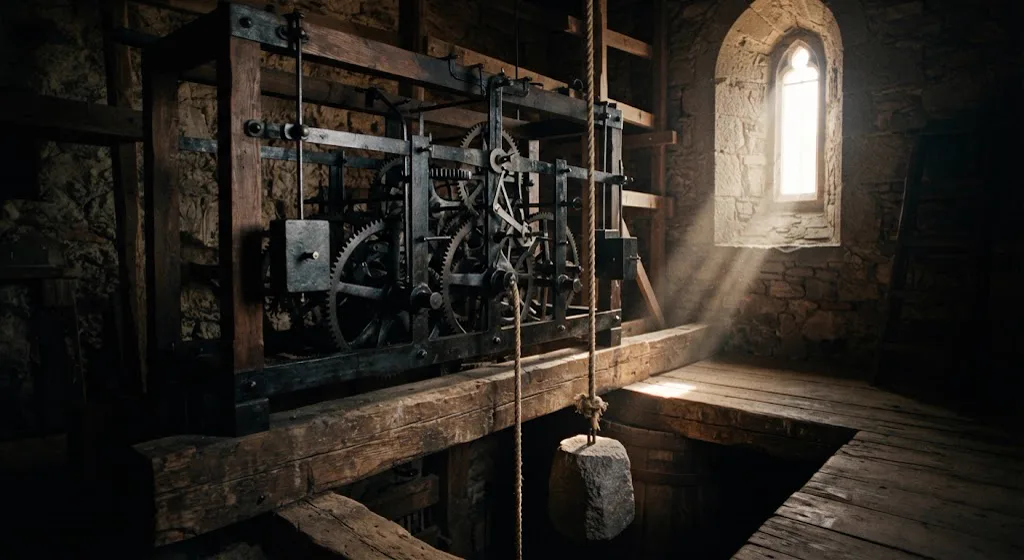
The verge-and-foliot escapement appears in Europe, releasing the energy of a falling weight one measured beat at a time. No one knows who built the first one. For the first time, a machine — not the sky — keeps the hour.
Open in interactive timeline →Key Numbers
- Verge Escapement Appears
- c. 1275 CE
- Earliest Large Clock Known
- Norwich, c. 1273
- First to Strike the Hour
- Milan, 1336
- Oldest Still Working
- Salisbury, c. 1386
Verified Facts
- The verge and foliot escapement appeared around 1275 CE and was the first true regulator in horology, letting a wheel advance one tooth at a time.
- No inventor is recorded. The mechanical clock appears in late-13th-century Europe with no name attached to it.
- The earliest large clock known is at Norwich Cathedral, around 1273, but it has not survived.
- The clock installed at Milan in 1336 is the first known to strike regularly on the hour.
- Salisbury Cathedral’s clock, from around 1386, is one of the oldest working clocks in the world.
- Wells Cathedral’s clock of 1392 is unique in retaining its original medieval face.
- Early mechanical clocks were regularly reset from a sundial — the sun stayed the authority.
Myth vs. Reality
Myth:
Reality: No inventor is known. Unlike the printing press, it has no Gutenberg — it emerges across European monasteries and cathedral towns in the late 13th century anonymously.
Myth:
Reality: They were not. They were regularly reset against a sundial. Their significance is not precision but the idea that a machine could divide time into countable, repeatable beats.
Myth:
Reality: Two still run. Salisbury Cathedral’s dates from around 1386 and Wells Cathedral’s from 1392, the latter keeping its original medieval face.
Frequently Asked Questions
Who invented the mechanical clock?
No one knows. There is no recorded inventor. The verge and foliot escapement appears in Europe around 1275 CE without a name attached, emerging from monastic and cathedral workshops rather than from a single identifiable maker.
What is an escapement and why does it matter?
An escapement is the regulator: a mechanism that releases the drive one measured step at a time, letting a wheel advance a single tooth per beat. It converts the steady pull of a falling weight into a countable rhythm, which is what makes a machine a clock rather than merely a moving object.
What is the oldest working clock in the world?
Salisbury Cathedral’s clock, dating from around 1386, is one of the oldest working clocks in the world. Wells Cathedral’s clock of 1392 is notable for still having its original medieval face.
Were medieval clocks accurate?
No. Early mechanical clocks were poor timekeepers and were regularly reset using a sundial. The sun remained the reference; the clock simply counted the intervals between checks.
Sources & Further Reading
Cite This Page
AskHistoryAI. “The Mechanical Clock.” AskHistoryAI — Interactive Timeline of Everything. Updated 2026-10-20. https://askhistoryai.com/event/sv-mechanical-clock/
Every fact on this page is checked against the published fact ledger and methodology; sources are listed above.
More from this project
- Is a Seiko 5 a good first automatic? — The Horologist — The escapement invented around 1275 is still the beating part of every mechanical watch sold today.
- How often should a watch be serviced? — The Horologist — A geartrain driven by a spring still needs the same care a cathedral clock did.
The Horologist is another reference site by the same author.