Genghis Khan & The Mongol Empire
The explosive, terrifying rise of the largest contiguous empire in history.
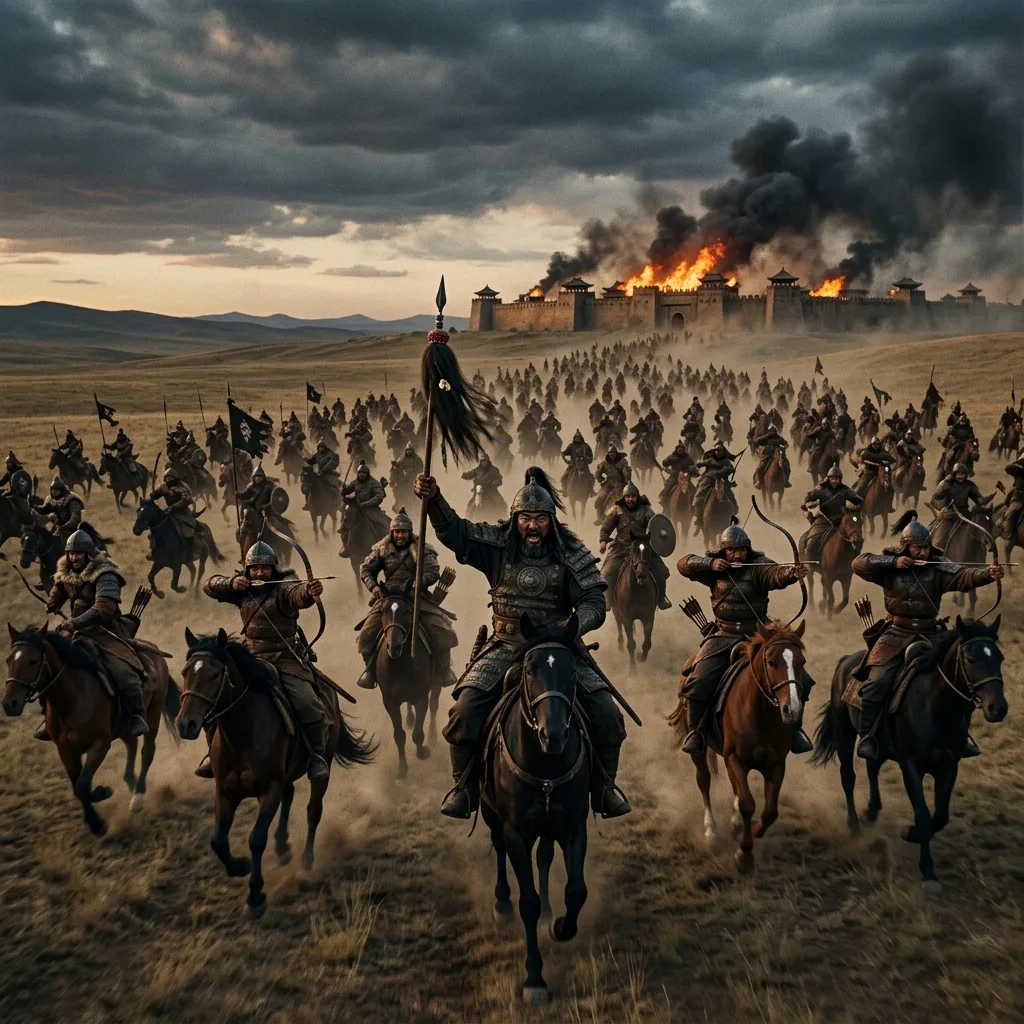
Temüjin unites the nomadic tribes of the Mongolian plateau, taking the title "Genghis Khan" (Universal Ruler). He launches a series of incredibly destructive but highly organized military campaigns that conquer vast swaths of Eurasia.
Open in interactive timeline →Key Numbers
- Peak empire size
- ~23M km² (9M sq mi)
- Estimated death toll
- ~40 million
- Reign as Great Khan
- 1206–1227
- Empire status
- Largest contiguous land empire in history
- Born / Died
- c.1162 – 18 Aug 1227
Verified Facts
- Genghis Khan was born Temüjin around 1162; he discarded his birth name only at the great kurultai of 1206, when an assembly of the Mongol tribes proclaimed him 'Chinggis Khan' (a title of uncertain meaning, often rendered 'Universal' or 'Oceanic' Ruler) after he unified the perpetually warring steppe tribes.
- At its death-of-Genghis extent in 1227 the empire spanned roughly 12 million km²; within a century of further conquest it reached about 23 million km² (9 million sq mi), making it the largest contiguous land empire in world history — second overall only to the British Empire.
- He restructured Mongol society on a strict decimal military model — units of 10 (arban), 100 (zuun), 1,000 (mingghan) and 10,000 (tumen) — which deliberately broke up old tribal loyalties and promoted commanders by merit rather than birth.
- His law code, the Yassa, enshrined religious tolerance, banned theft and the looting of civilian property under his protection, and elevated chosen generals; he also commissioned the first written Mongol script (adapted from the Uyghur alphabet) to record it.
- The invasion of the Khwarazmian Empire (1219–1221) was triggered by the 1218 Otrar incident: governor Inalchuq seized and executed a Mongol trade caravan of around 450 men as 'spies,' and Shah Muhammad II then beheaded Genghis Khan's envoy — provocations that unleashed one of history's bloodiest campaigns, with regional casualty estimates running as high as 10–15 million.
- Historians estimate the Mongol conquests killed on the order of 40 million people; demographic evidence is stark — northern China's Jin census recorded about 7.6 million households in the early 13th century, but the first Mongol census there in 1234 counted only roughly 1.7 million.
- The empire was knit together by the Yam, a relay-courier system of stations spaced roughly every 20–40 miles stocked with fresh horses and provisions; by the late 13th century it reportedly involved over 300,000 horses, enabling messengers to cover enormous distances and effectively functioning as a medieval pony express.
- Genghis Khan died on 18 August 1227 during a campaign against the Western Xia (Xi Xia); per legend he was buried in a secret, unmarked grave near the sacred Burkhan Khaldun mountain, with a 'Great Taboo' zone (Ikh Khorig) declared around it, and his tomb has never been located despite numerous searches.
- A 2003 study in the American Journal of Human Genetics found a Y-chromosome lineage (within the C3* cluster) carried by roughly 8% of men across the former Mongol empire — about 0.5% of the world's men, or ~16 million — and attributed it to Genghis Khan; later research has cast serious doubt on this, suggesting the widespread lineage predates and is distinct from the rare sub-branch tied to medieval Mongol rulers.
- After Möngke Khan died in 1259 without a clear successor, the Toluid Civil War split the realm into four khanates: the Yuan dynasty in China (Kublai Khan), the Ilkhanate in Persia (Hülegü), the Golden Horde in the Rus' steppe (Jochi's line), and the Chagatai Khanate in Central Asia.
The World at This Moment
When Temüjin was acclaimed Chinggis Qan in 1206, Eurasia was a mosaic of regional powers with no integrating center. North China was divided between the Jurchen Jin and Tangut Xia, while the Southern Song held the south; the Persianate east lay under the expansive but brittle Khwarazmian sultanate of ʿAlaʾ al-Din Muhammad. Baghdad's Abbasid caliphate, under al-Nasir (r. 1180–1225), retained spiritual prestige but limited reach. To the west, the Fourth Crusade had just sacked Constantinople (1204), fracturing Byzantium into Latin and Greek successor states. In England, the baronial crisis that produced Magna Carta (1215) was brewing; the Almohads still dominated the Maghreb and Iberia until Las Navas de Tolosa (1212). India saw the Delhi Sultanate consolidating under Iltutmish. None of these polities anticipated a steppe confederation; the contemporaneous worlds of Song commerce, Islamic scholarship, and Crusader politics operated largely in isolation. Within two generations the Mongols would forcibly stitch much of this fragmented landscape into a single, if violent, communications zone.
The Paradigm Shift
The Mongol unification redirected world history by collapsing the distance between previously sealed civilizational zones. By imposing a single overlordship from the Pacific to the Black Sea, the empire created what historians call the Pax Mongolica: the yam relay-courier system, merchant safe-conducts (the paiza), and protection of caravan routes lowered the cost and risk of trans-Eurasian exchange. This accelerated the movement of goods, technologies, and ideas—gunpowder, printing, and, by some accounts, the conceptual transmissions Joseph Needham and Thomas Allsen traced westward. Allsen's Culture and Conquest in Mongol Eurasia (2001) shows deliberate state-sponsored exchange of astronomers, physicians, and administrators between Iran and China. The same arteries, however, channeled the Black Death from Inner Asia into the Mediterranean by 1347. The conquests also reshaped political geography permanently: the destruction of the Abbasid caliphate (1258), the demographic ruin of Khurasan, and the founding of successor khanates that seeded Timurid, Mughal, and Russian state-building. Genghis Khan thus stands as a hinge between a regionally compartmentalized medieval world and an interconnected early-global one.
In Their Own Words
"O people, know that you have committed great sins, and that the great ones among you have committed these sins. If you ask me what proof I have for these words, I say it is because I am the punishment of God. If you had not committed great sins, God would not have sent a punishment like me upon you." — Words attributed to Genghis Khan addressing the people of Bukhara (1220), as recorded by ʿAlaʾ al-Din ʿAta-Malik Juvayni, *Tarikh-i Jahangushay* (History of the World Conqueror), tr. J. A. Boyle (1958). Note: Juvayni wrote c. 1252–60 under Mongol patronage; the speech is a chronicler's reconstruction, not a verbatim transcript.
At the time of his birth he was born clutching in his right hand a clot of blood the size of a knucklebone.
The Secret History of the Mongols, §59 (the principal Mongol-side source, anonymous, mid-13th c.), describing the birth of Temüjin/Chinggis Qan; English translation by Igor de Rachewiltz (Brill, 2004). This is the chronicle's own narration, not a quoted speaker. — source
O people, know that you have committed great sins, and that the great ones among you have committed these sins. If you ask me what proof I have for these words, I say it is because I am the punishment of God. If you had not committed great sins, God would not have sent a punishment like me upon you.
Words attributed to Genghis Khan addressing the people of Bukhara after its fall (1220), as REPORTED by the Persian historian ʿAla-al-Din ʿAta-Malik Juvayni in Tarikh-i Jahan-Gushay (History of the World Conqueror, c. 1252-60); English translation by John Andrew Boyle (1958). This is Juvayni reporting Genghis Khan, not the Khan's own surviving writing. — source
They came, they sapped, they burnt, they slew, they plundered and they departed.
A survivor of the sack of Bukhara (1220) describing the Mongol onslaught, as QUOTED by Juvayni in Tarikh-i Jahan-Gushay; trans. J. A. Boyle (1958). These are the words of an anonymous survivor recorded by Juvayni, representing the perspective of the conquered, not Juvayni's own first-person statement. — source
In Depth
The Steppe Strikes Back: How a Nomad Confederation Rewired Eurasia
In 1206, at a kuriltai on the banks of the Onon River, the assembled tribes of the Mongolian steppe proclaimed Temüjin as Genghis Khan — "universal ruler." Within a single lifetime, the empire he founded would become the largest contiguous land empire in human history, stretching from the Pacific to the gates of Europe. To understand why this happened in the thirteenth century, and not before, is to read the entire arc of human social organization backward.
The Deep Preconditions
The Mongol explosion was the final, most extreme expression of a tension that began with The Agricultural Revolution (sv-agriculture). Farming created surplus, cities, and writing — The Invention of Cuneiform (sv-cuneiform) — but it also created a permanent frontier between settled grain-growers and the mounted herders of the Eurasian steppe. For three thousand years this frontier had bled, ever since the chariot warfare immortalized at The Battle of Kadesh (sv-battle-kadesh) demonstrated what horse-borne mobility could do to infantry empires. The steppe had always threatened the sown; what Genghis added was unprecedented organization. He shattered tribal loyalties, reorganized his armies into decimal units, instituted a written legal code echoing the impulse of The Code of Hammurabi (sv-hammurabi), and welded a fractious confederation into a single disciplined instrument. The Mongols did not invent the cavalry advantage — they perfected its command structure.
Rewiring the World
The conquests were catastrophic; chroniclers describe cities depopulated and rivers running black with the ink of destroyed libraries. Yet what followed reshaped the planet. The Pax Mongolica placed the entire Silk Road under one authority, with protected merchants, way-stations (yam), and reduced tolls. For the first time, a person could travel from the Black Sea to Beijing under a single law. Goods, people, and crucially ideas flowed west: paper, the compass, and the gunpowder that would mature into The Invention of Firearms (sv-firearms) all migrated along Mongol arteries. Many historians credit this technology transfer with helping ignite The Italian Renaissance (sv-renaissance); cheap paper, in particular, made possible the explosion of literacy that The Gutenberg Press (sv-printing-press) would soon weaponize.
But the same arteries carried death. The trade network that bound Eurasia together became the superhighway for Yersinia pestis. The Black Death of 1346–1353, which killed perhaps a third of Europe, traveled the very roads the Mongols had pacified — a grim inversion of the ancient pattern where pandemics had punctuated crises like The Late Bronze Age Collapse (sv-bronze-collapse). Connection and contagion arrived together.
Threads Forward
The Mongol moment fractured by 1368, but its consequences compounded. The disruption of the overland routes, and Europe's hunger for the Asian goods the Mongols had once delivered, pushed seafaring powers to seek alternate paths — a hunger that ultimately drove European Arrival in the Americas (sv-new-world). The Mongols thus belong to the same lineage of world-shrinking events that runs through The Early Muslim Conquests (sv-rise-of-islam) and the Islamic Golden Age (sv-islamic-golden-age) they so violently interrupted at Baghdad in 1258.
In the grand sequence this site traces — from The Big Bang (sv-big-bang) through matter, life, and mind — the Mongol Empire marks a phase transition in human connectivity. It was the first time the Old World became, briefly, a single system: one network of roads, laws, plagues, and inventions. That integration, born of conquest, is the distant ancestor of the planetary information network that would one day become The World Wide Web (sv-www). Genghis Khan built, in horseflesh and terror, the first rough draft of a connected world.
Causes & Consequences
What led to it
- A tree-ring study published in PNAS in 2014 by Neil Pederson and Amy Hessl documented a 'Mongol Pluvial' of unusually warm, wet weather across central Mongolia from roughly 1211 to 1225, which boosted grassland productivity and supplied the horses and livestock that powered Mongol armies.
- Centuries of nomadic statecraft on the Eurasian steppe, embodied in earlier confederations such as the Xiongnu, Turkic Khaganates, and the Khitan Liao, established the political models of the khan and the kurultai that Temujin would later inherit and surpass.
- Between roughly 1179 and 1206 Temujin defeated or absorbed the rival Merkit, Tatar, Kereit, and Naiman tribes, ending generations of steppe blood-feuds and clearing the field for a single supreme ruler.
- Temujin dismantled traditional clan loyalties by reorganizing his followers into a decimal military system of units of tens, hundreds, and thousands (the arban, jaghun, and mingghan), redirecting allegiance away from tribal chiefs and toward himself.
- Temujin's promotion of commanders by merit and loyalty rather than birth, along with his practice of incorporating defeated warriors into his own ranks, built an army that grew stronger with each conquest.
- At a kurultai in 1206 the assembled Mongol chiefs proclaimed Temujin as Genghis Khan, formally uniting the previously fragmented steppe tribes under one political authority for the first time.
What it set in motion
- The conquest of the Khwarazmian Empire in 1219-1221, triggered after Shah Muhammad II executed Mongol envoys, opened Persia and Central Asia to Mongol rule and devastated cities such as Samarkand and Bukhara.
- By 1294 the empire had fractured into four functionally independent khanates: the Yuan dynasty in China, the Ilkhanate in Persia, the Chagatai Khanate in Central Asia, and the Golden Horde in the northwest, after succession disputes following Mongke Khan's death in 1259 sparked the Toluid Civil War.
- The Pax Mongolica secured the Silk Road across a single political space, allowing relatively safe long-distance travel and trade and enabling figures such as the Venetian merchant Marco Polo to reach Kublai Khan's court.
- Cross-Eurasian contact under Mongol rule helped move technologies westward, with scholars arguing that gunpowder, papermaking, and printing reached the Islamic world and Europe partly through stimulus diffusion enabled by Mongol-era exchange.
- The same connected trade routes and relay (yam) stations that carried goods are widely argued by historians to have helped the Black Death spread out of Central Asia in the 14th century, killing a large share of Europe's population.
- Kublai Khan's establishment of the Yuan dynasty in 1271 placed all of China under foreign rule for the first time and blended Mongol authority with Chinese imperial administration until the dynasty's fall in 1368.
The Live Academic Debate
A central debate pits "destruction" against "integration" readings of the Mongol legacy. The traditional view, voiced in classic scholarship and reflected in works like David Morgan's The Mongols (1986; rev. 2007), stresses catastrophic mortality—estimates of tens of millions dead and the permanent demographic wrecking of Khurasan and Central Asia (Merv, Nishapur). Against this, a revisionist current emphasizes connectivity, religious tolerance, meritocracy, and commercial florescence; Jack Weatherford's popular Genghis Khan and the Making of the Modern World (2004) is its most visible, if contested, expression, criticized by specialists as over-indulgent. Thomas Allsen and the late Igor de Rachewiltz (translator-commentator of the Secret History) occupy more rigorous middle ground, documenting exchange without minimizing violence. A second, demographic debate concerns the reliability of the chroniclers' casualty figures: scholars increasingly read Juvayni's and Rashid al-Din's enormous numbers as rhetorical topoi rather than censuses. A third strand, advanced by Monica Green, reframes the Mongols' role in the Black Death's genesis through aDNA evidence, recasting the empire's epidemiological significance.
How This Event Connects
The explosive expansion of the Mongol Empire in the 13th century fundamentally rewired the geopolitical and economic structure of Eurasia. Historiographically, modern scholarship has shifted from viewing the Mongols merely as an apocalyptic horde to recognizing them as unparalleled administrative geniuses who engineered the Pax Mongolica. This massive, integrated trans-continental network violently connected disparate civilizations, abruptly terminating the political primacy of Baghdad during the Islamic Golden Age while simultaneously facilitating an unprecedented flow of knowledge and technology.
By establishing secure trade routes across the Silk Road, the Mongol Empire inadvertently laid the economic foundations for the Italian Renaissance. The massive influx of Asian luxury goods, capital, and ideas into Italian city-states catalyzed a sudden explosion of cultural and intellectual flourishing in Western Europe, proving that the Renaissance was deeply dependent on the geopolitical stability enforced by the Mongol Khans.
Furthermore, the Mongol military apparatus served as the primary conduit for the transmission of revolutionary technologies. The brutal efficiency of their conquests facilitated the spread of Chinese gunpowder across Eurasia, directly leading to the Invention of Firearms. This technological transfer completely revolutionized global warfare, permanently altering the balance of power and hastening the demise of traditional aristocratic structures in both Europe and the Islamic world.
Destruction narrative vs. Pax Mongolica — the revisionist reckoning
Historian Daniel C. Waugh, in 'The owl of misfortune or the phoenix of prosperity? Re-thinking the impact of the Mongols' (Journal of Eurasian Studies 8.1, 2017), weighs the harrowing devastation recorded by Persian chroniclers like Juvayni — whose figures, e.g. a cleric's count of roughly 1.3 million dead at Nishapur, were often rhetorical or inflated — against archaeological evidence that many regions recovered and that long-distance trade and exchange flourished under Mongol rule. His conclusion is deliberately two-sided: 'we encounter here both the owl of misfortune and the phoenix of prosperity,' since 'far from everything in their path was destroyed' and some areas revived thanks to deliberate Mongol policy. This cautions against reading either the Persian devastation accounts or the celebratory 'Mongol peace' as the whole truth.
The Counterfactual
Had Temüjin failed to unify the steppe—or died young, as he nearly did in his fractious early career reconstructed in the Secret History—the steppe would likely have remained a patchwork of competing confederations (Naimans, Keraits, Tatars) periodically raiding sedentary neighbors but incapable of sustained conquest. The Jin and Khwarazmian states, absent the Mongol shock, might have persisted for decades; the Abbasid caliphate would not have fallen in 1258, plausibly altering the trajectory of Sunni political-religious authority. Crucially, the integrated Eurasian disease and trade corridor would not have formed as it did, and the mid-fourteenth-century plague pandemic might have followed different timing and routes—though William McNeill (Plagues and Peoples, 1976) and Monica Green's recent paleogenomic work caution that plague reservoirs predated the Mongols, so transmission was facilitated, not invented. Russia would have escaped the "Tatar yoke" that David Morgan and Charles Halperin argue shaped Muscovite autocracy. Counterfactuals here remain speculative: steppe history shows recurrent unifier-figures (Attila, later Timur), suggesting some eventual consolidation, but its specific scale and timing were contingent on one man's organizational genius.
Myth vs. Reality
Myth: "Genghis Khan" was the man's name.
Reality: He was born Temujin (meaning "of iron" or "blacksmith"). "Genghis Khan" - more accurately rendered Chinggis Khan - is a title meaning roughly "universal" or "oceanic" ruler, bestowed on him at the 1206 quriltai (assembly of chieftains) after he unified the Mongol tribes. "Khan" itself simply means leader or ruler. The familiar "Genghis" spelling reached the West through Arabic and Persian intermediaries.
Myth: Genghis Khan killed around 40 million people, a precise and settled historical fact.
Reality: Casualty figures for the Mongol conquests are speculative and vary enormously among historians, commonly cited anywhere from 10 to 40 million; the 40 million figure is an upper-bound estimate, not a consensus. Many of the most dramatic numbers trace back to medieval chroniclers, such as the Persian claim of 1,747,000 killed at Nishapur, who routinely inflated death tolls, sometimes as deliberate Mongol psychological warfare. The conquests were undeniably catastrophic, but the famous figures should be treated as rough and contested.
Myth: The Mongols were purely destructive barbarians with no civilization of their own.
Reality: Although Temujin was likely illiterate, he commissioned a writing system for Mongolian, promulgated a legal code (the Yassa), conducted censuses, organized a long-distance postal relay system (the yam), and built a largely meritocratic state that promoted by ability rather than birth. The resulting Pax Mongolica secured trade routes across Eurasia and accelerated exchange of goods, technology, and ideas between East and West. Historians like Jack Weatherford have argued the "savage" stereotype obscures these administrative and commercial achievements.
Myth: The Mongols practiced principled religious tolerance as a core founding value.
Reality: Scholars generally describe Mongol religious policy as pragmatic statecraft rather than ideological commitment. Tolerance, including tax exemptions for clergy and freedom of worship, developed and expanded as the empire conquered diverse populations, easing governance of subject peoples rather than antagonizing them. It also was not uniform across all faiths or all periods. Framing it as an enlightened modern-style principle from the outset overstates and oversimplifies the historical record.
Myth: DNA proves that 1 in 200 men alive today are direct descendants of Genghis Khan.
Reality: This stems from Zerjal et al. (2003), which found a Y-chromosome lineage in roughly 8% of men across a swath of Asia (about 0.5% worldwide) and inferred a link to Genghis Khan from its geographic spread and timing. It was an inference, not a match: no verified DNA from Genghis Khan exists, and his burial site is unknown. Later work, including ancient DNA from high-status 12th-13th century Mongolian graves showing a different haplogroup (R1b rather than C), and analyses suggesting the lineage predates him, has cast serious doubt on the attribution.
Frequently Asked Questions
Who was Genghis Khan?
Genghis Khan (c. 1162–1227) was the founder and first Great Khan of the Mongol Empire, born with the name Temüjin. After spending decades uniting the warring nomadic tribes of the Mongolian steppe, he was proclaimed leader at a kurultai (tribal assembly) in 1206 and given the title Genghis Khan, often interpreted as 'universal ruler.' From there he launched the conquests that would build the largest contiguous land empire in history.
When did the Mongol Empire begin, and how big did it become?
The empire was formally founded in 1206 when Temüjin was proclaimed Genghis Khan. By the late 13th century, after continued expansion under his successors, it stretched from the Pacific Ocean and Korea in the east to the Danube River and the Persian Gulf in the west, covering an estimated 11 to 12 million square miles. This makes it the largest contiguous land empire ever assembled, roughly the size of Africa.
How did Genghis Khan die?
Genghis Khan died in August 1227, in his mid-60s, during a military campaign against the Tangut kingdom of Western Xia (Xixia). The exact cause has never been confirmed: the 14th-century 'History of Yuan' records that he fell ill and died eight days later, and theories have ranged from illness (some recent researchers point to plague or typhoid) to injuries from a fall from his horse. Many of the more dramatic legends about his death were likely invented later, since his followers kept the death secret during a critical phase of the campaign.
Where is Genghis Khan buried?
The location of Genghis Khan's tomb is one of history's most famous unsolved mysteries. According to tradition he was buried in an unmarked grave, and the soldiers who carried out the burial are said to have killed anyone who witnessed it to keep the site secret. Legend places the grave somewhere in the Khentii Mountains of Mongolia, but despite decades of searching, no verified tomb or remains have ever been found.
Is it true that millions of people are descended from Genghis Khan?
A widely cited 2003 genetic study found a Y-chromosome lineage common to roughly 8% of men across a large region of Asia (an estimated 16 million men), and proposed it might trace back to Genghis Khan or his close male relatives. This link, however, was inferred from geography and timing rather than from his actual DNA, and it remains unproven. Because no confirmed remains of Genghis Khan have ever been recovered, scientists still cannot say with certainty which Y-chromosome branch was his.
What is Genghis Khan's lasting legacy beyond conquest?
While his conquests caused immense destruction, with death-toll estimates ranging widely into the tens of millions, Genghis Khan also built institutions that reshaped Eurasia. He instituted a degree of religious tolerance, exempting clergy of various faiths from taxation, promoted officials based on merit rather than birth, and created the Yam, a vast relay-station postal and courier network. The stability his empire later brought to trade routes, known as the Pax Mongolica, revitalized Silk Road commerce and east-west exchange across the 13th and 14th centuries.
Sources & Further Reading
- Genghis Khan — Wikipedia
- Igor de Rachewiltz (trans. and comm.), The Secret History of the Mongols: A Mongolian Epic Chronicle of the Thirteenth Century (Brill, 2004)
- Thomas T. Allsen, Culture and Conquest in Mongol Eurasia (Cambridge University Press, 2001)
- David Morgan, The Mongols (2nd ed., Blackwell, 2007)
- ʿAla al-Din ʿAta-Malik Juvayni, The History of the World-Conqueror, trans. J. A. Boyle (Manchester University Press, 1958)
- Monica H. Green, 'The Four Black Deaths,' American Historical Review 125.5 (2020)
- World History: Genghis Khan
Cite This Page
AskHistoryAI. “Genghis Khan & The Mongol Empire.” AskHistoryAI — Interactive Timeline of Everything. Updated 2026-09-11. https://askhistoryai.com/event/sv-genghis-khan/
Every fact on this page is checked against the published fact ledger and methodology; sources are listed above.