Michael Faraday & Electromagnetic Induction
The discovery that powers the modern world.
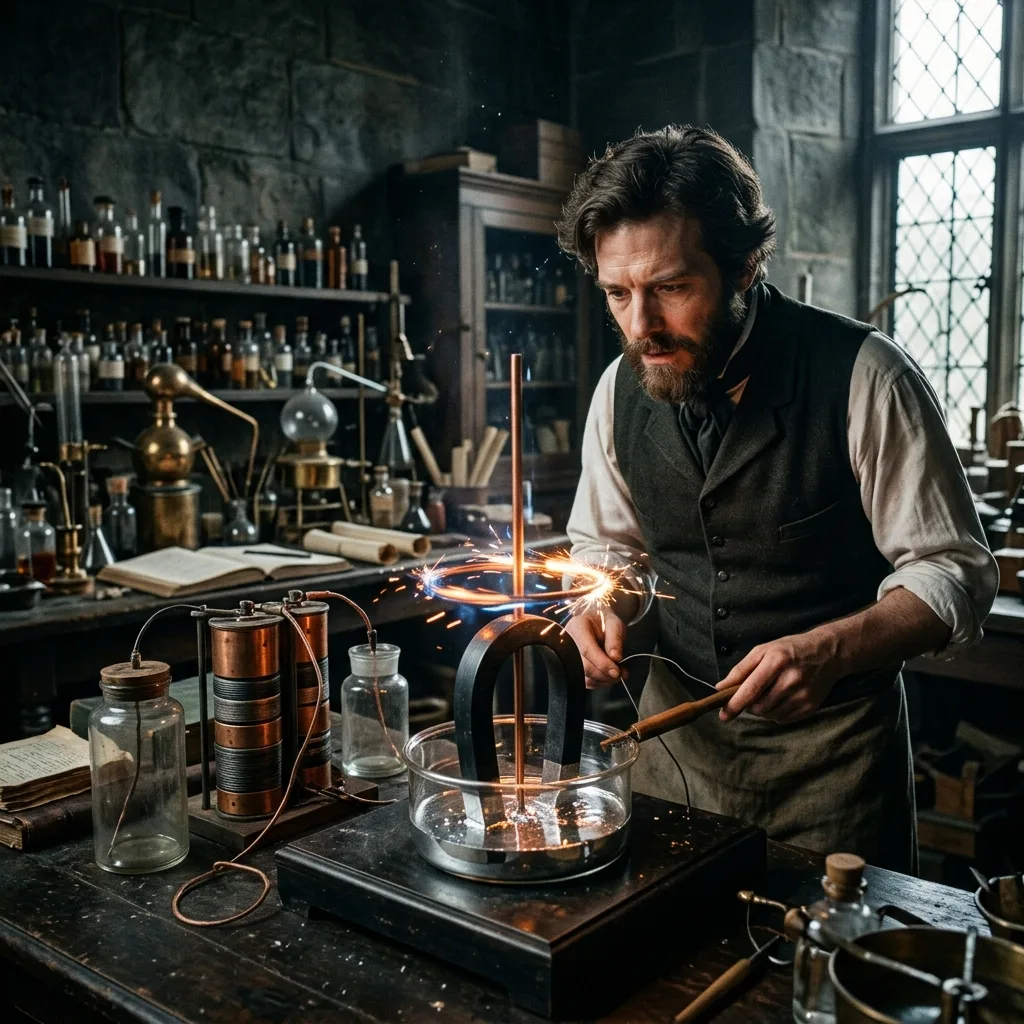
Self-taught English scientist Michael Faraday discovers electromagnetic induction, proving that a changing magnetic field can create an electrical current. This principle is the foundation of all modern electric motors and generators.
Open in interactive timeline →Key Numbers
- Discovery date
- Aug 29, 1831
- Experiments in 4 months
- ~135
- Formal schooling
- Almost none
- Bookbinder apprenticeship
- 7 years
- Faraday's disk
- First generator, 1831
Verified Facts
- On 29 August 1831 Faraday recorded in his laboratory notebook the first demonstration of electromagnetic induction: winding two insulated coils on opposite sides of a soft iron ring, he saw that switching the current in one coil produced a momentary deflection of a galvanometer needle connected to the other -- the world's first transformer.
- The key insight was that only a changing magnetic field induces a current; a steady current in the first coil produced nothing, and the galvanometer twitched only at the instants the circuit was made or broken.
- Across roughly August to November 1831 Faraday ran about 135 experiments probing the effect, work he reported to the Royal Society in his first 'Experimental Researches in Electricity' paper, read on 24 November 1831 and published in the Philosophical Transactions in 1832.
- On 28 October 1831 Faraday built the 'Faraday disk,' a copper disc (about 12 inches across) spun between the poles of a permanent magnet with sliding mercury contacts at the axle and rim -- the first electromagnetic generator, producing a continuous direct current from mechanical motion.
- Faraday had almost no formal education, growing up in a poor London family and attending only a basic Sunday school; he is one of history's great examples of a self-taught scientist.
- He was apprenticed in 1805 at age 14 to bookbinder George Riebau on Blandford Street, and during his seven-year apprenticeship he read the science books passing through the shop, including the Encyclopaedia Britannica's electricity article.
- His path into science came when a customer gave him tickets to Humphry Davy's lectures at the Royal Institution; Faraday took meticulous notes, bound them into a book, and sent them to Davy, who hired him as a laboratory assistant in 1813.
- Faraday knew very little advanced mathematics and reasoned in physical terms using his concept of 'lines of force'; it was James Clerk Maxwell who later translated these field ideas into rigorous equations, and Maxwell wrote that Faraday's methods showed him 'to have been in reality a mathematician of a very high order.'
- Faraday's induction work underpins the electric motor, dynamo, and transformer, making it the foundation of essentially all modern electric power generation and electrical engineering.
- Faraday declined the presidency of the Royal Society twice and repeatedly stated he wished to remain 'plain Mr. Faraday,' though historians note no clear evidence he was ever actually offered a knighthood despite the popular claim that he refused one.
The World at This Moment
Faraday's induction-ring experiment of 29 August 1831 occurred amid acute upheaval. Britain was convulsed by the Reform Bill crisis: the Lords' rejection in October 1831 sparked riots in Bristol and Nottingham before the Representation of the People Act passed in 1832. Simultaneously, the second cholera pandemic crossed Europe, reaching Sunderland in autumn 1831 and eventually killing roughly 52,000 in Britain. On the Continent, the London Conference recognized an independent, neutral Belgium (January 1831), Leopold I taking the throne that July; the November Uprising in Russian Poland was crushed by 1831. Charles Darwin departed on HMS Beagle in December 1831. In science, this was the threshold of the discipline's professionalization: the British Association for the Advancement of Science was founded in 1831, and William Whewell would soon coin "scientist." Faraday, a self-taught bookbinder's apprentice elevated through Humphry Davy's patronage at the Royal Institution, worked outside the mathematical traditions then dominant in France (Ampère, Poisson) and Germany, making his experimental, non-mathematical approach distinctive within this transforming intellectual landscape.
The Paradigm Shift
Faraday demonstrated that a changing magnetic flux induces an electromotive force in a nearby circuit—converting magnetism into electricity, the inverse of Oersted's 1820 result. Published in the first series of Experimental Researches in Electricity (Philosophical Transactions, 1832), this established the principle underlying the dynamo, transformer, and generator, making large-scale electrical power technologically conceivable and underwriting the later "second industrial revolution." Conceptually, the shift ran deeper. Lacking mathematical training, Faraday interpreted induction through "lines of force" filling space, displacing the prevailing action-at-a-distance Newtonian framework derived from Ampère and Coulomb. This proto-field ontology—that physical reality resides in the medium between bodies, not in instantaneous forces across a void—was the seed James Clerk Maxwell mathematized in "On Faraday's Lines of Force" (1856) and the Treatise on Electricity and Magnetism (1873). The field concept Faraday pioneered became foundational to all subsequent physics, from Maxwell's electromagnetic theory of light through Einstein's relativity and quantum field theory. Few experiments have so directly redirected both industrial civilization and the metaphysics of physical science.
In Their Own Words
"Have had an iron ring made (soft iron), iron round and 7/8 inches thick, and ring 6 inches in external diameter. Wound many coils of copper wire round one half, the coils being separated by twine and calico... will call this side of the ring A." — Michael Faraday, laboratory notebook ("Diary") entry, 29 August 1831, recording the induction-ring experiment (published in Faraday's Diary, ed. Thomas Martin, Royal Institution of Great Britain)
In Depth
The Field Beneath the Wire: How a Bookbinder's Apprentice Rewired the Future
On August 29, 1831, in the basement laboratory of London's Royal Institution, Michael Faraday wound two coils of insulated wire on opposite faces of a soft iron ring. When he closed the circuit on one coil, a galvanometer attached to the other twitched — and twitched again when he broke it. Nothing flowed while the current was steady; the needle moved only during change. In that flicker, Faraday had captured electromagnetic induction: a changing magnetic field births an electric current. It is no exaggeration to say that nearly every generator, transformer, and electric motor humming on the planet today is a descendant of that ring.
Deep Preconditions
Faraday's discovery was the harvest of a long convergence. Its philosophical taproot reached back to the first speculations that nature obeyed hidden, lawful forces — the tradition of Thales of Miletus (sv-thales), who reputedly noted the attractive power of rubbed amber, the Greek elektron that lent electricity its name. More immediately, it stood on the shoulders of Isaac Newton (sv-newton), whose Principia had made mathematical law the language of physical reality, and of Benjamin Franklin (sv-benjamin-franklin), whose kite experiments tamed electricity into a single fluid. The proximate spark was Hans Christian Ørsted's 1820 finding that a current deflects a compass — proof that electricity and magnetism were entangled. Faraday, a self-taught former bookbinder's apprentice with little mathematics, asked the symmetric question: if electricity makes magnetism, can magnetism make electricity? His answer required the workshop culture of the Industrial Revolution (sv-industrial-revolution), which had normalized precision instruments, reliable batteries, and the very idea that experiment could yield power.
How It Reshaped What Came After
Faraday gave the world two gifts. The first was practical: induction is the principle of the dynamo, and within fifty years it would electrify cities through the rival labors of Thomas Edison (sv-thomas-edison) and Nikola Tesla (sv-nikola-tesla), whose alternating-current systems are pure applied Faraday. The second gift was conceptual and arguably greater. Distrusting "action at a distance," Faraday imagined invisible lines of force threading space — the seed of the field concept. This intuition, sketched by a man who could barely write an equation, was translated into rigorous mathematics by James Clerk Maxwell (sv-james-maxwell), whose papers "On Faraday's Lines of Force" and "On Physical Lines of Force" became the four equations unifying electricity, magnetism, and light. From Maxwell's fields flowed Einstein (sv-einstein), who has said relativity grew directly from contemplating Faraday and Maxwell's electromagnetism, and ultimately the quantum field theories that describe matter itself.
Threads Forward
The deepest ripple is informational. Induction made possible the generators and signaling that became telephony and radio, and the electrified logic that became computing. Every transistor switched, every byte moved across the World Wide Web (sv-www), rides on currents Faraday taught us to summon and control. The training of the neural networks behind AlexNet (sv-alexnet-convnets) and the Transformer (sv-transformer-paper) consumes terawatt-hours generated by spinning Faraday's ring at planetary scale. In Ray Kurzweil's framing of the Law of Accelerating Returns (sv-kurzweil-law), electrification is the substrate on which exponential computation is built — the bridge between the steam age and the age of mind. When speculative timelines imagine the Dawn of AGI (sv-ai-dawn), they imagine machines whose very thoughts are patterns of induced current. A galvanometer twitching in a London cellar was, in the truest sense, the universe beginning to wire itself for thought.
Sources: EDN: Faraday Discovers Electromagnetic Induction; Royal Institution: Faraday's ring-coil apparatus; In Compliance: Faraday's Lines of Force and Maxwell's Theory.
Causes & Consequences
What led to it
- Hans Christian Ørsted's July 1820 demonstration that an electric current deflects a nearby compass needle proved for the first time that electricity produces magnetism, establishing the physical link that Faraday would later invert into induction.
- André-Marie Ampère's electrodynamics of the early 1820s, formalizing the forces between current-carrying wires, built a quantitative framework for current-magnetism interactions that Faraday studied directly before his own experiments.
- Humphry Davy's 1813 appointment of Faraday as chemical assistant at the Royal Institution, after Faraday attended Davy's lectures and sent him bound notes, gave the self-taught bookbinder the laboratory access and scientific apprenticeship he otherwise could never have obtained.
- Faraday's own 1821 discovery of electromagnetic rotation, in which a current-carrying wire continuously revolved around a magnet in a mercury bath, produced the first electric motor and convinced him that magnetism and current could be made to act on each other mechanically.
- The well-equipped basement laboratory of the Royal Institution in London, with its batteries, coils, and instruments, provided Faraday the sustained experimental setting in which he could iterate on the ring-coil apparatus across August 1831.
- Improvements in voltaic batteries and insulated wire coils in the early nineteenth century supplied the strong, steady currents and tightly wound multi-turn coils that made the small, transient induced currents detectable with a galvanometer.
What it set in motion
- Faraday's induction principle led directly to the electric generator and dynamo, machines that convert mechanical motion into electrical current and remain the basis of nearly all electricity generation worldwide today.
- The discovery underpinned the electrical transformer, since mutual induction between coils on a shared iron core allows voltages to be stepped up and down, which became essential to long-distance power transmission.
- James Clerk Maxwell rendered Faraday's law of induction into mathematics in the 1860s as the Maxwell-Faraday equation, one of the four Maxwell equations that unified electricity, magnetism, and light into a single field theory.
- Maxwell's theory, grounded in Faraday's induction, predicted self-propagating electromagnetic waves traveling at the speed of light, which Heinrich Hertz experimentally generated and detected in 1887-1888, opening the path to radio, radar, and wireless communication.
- Induction-based generators and motors powered the second industrial revolution and the electrification of factories, homes, and transit, making large-scale electric power grids practical from the late nineteenth century onward.
- Faraday's concept of lines of force and fields, developed alongside his induction work, reshaped physics away from action-at-a-distance and toward the field-based thinking that later informed Einstein's relativity and modern electromagnetic theory.
The Live Academic Debate
A live historiographical dispute concerns when Faraday actually "had" his field concept. L. Pearce Williams (Michael Faraday, 1965) reads the field as central to Faraday's thought relatively early, rooting it partly in Boscovichean point-atomism, though he is imprecise about timing. Joseph Agassi (Faraday as a Natural Philosopher, 1971) and especially Gerald Berkson (Fields of Force, 1974) argue Faraday possessed a worked-out field conception already at the 1831 discovery. Against them, David Gooding (in studies from the late 1970s–1981, including his work on Faraday's experimental practice) contends the field notion emerged only in Faraday's later research, particularly on magnetic induction and diamagnetism in the 1840s–50s, developing gradually through experiment rather than springing fully formed. As Gooding notes, much of the disagreement reflects an unexamined assumption about what "having" a concept means—arguably a matter of degree. A parallel debate, advanced by historians like Daniel Siegel and Jed Buchwald, concerns how faithfully Maxwell's mathematical field translated, versus transformed, Faraday's original physical intuition.
How This Event Connects
Michael Faraday's revolutionary discoveries in electromagnetic induction stand as a critical bridge between early empirical science and modern theoretical physics. His trajectory is intrinsically linked to the pioneering work of Benjamin Franklin. Franklin's earlier demystification of electricity and his invention of the lightning rod transformed a terrifying natural phenomenon into an object of empirical study. Where Franklin established the initial conceptual vocabulary of positive and negative charges, Faraday deepened this understanding into a profound physical reality. He moved beyond the mere collection of static charges to demonstrate how changing magnetic forces could induce electrical currents, effectively creating the first electric motor and generator, and thereby laying the foundation for the entire electrified modern world.
Crucially, Faraday's highly visual, tactile approach to physics required translation to achieve full scientific hegemony, a task accomplished by James Clerk Maxwell. Faraday, lacking formal mathematical training, conceptualized magnetic forces through physical imagery, famously inventing the concept of "lines of force." He rejected the Newtonian paradigm of "action at a distance" in favor of an interconnected, space-filling medium. Maxwell undertook the monumental task of translating Faraday’s spatial intuitions into rigorous differential equations. This dialectic between Faraday's experimental, visual model-building and Maxwell's theoretical, mathematical formalization created classical electromagnetism, proving that deep physical insight can precede and guide complex mathematical abstraction.
Faraday's discoveries ultimately catalyzed the technological wars of the late 19th century, dominated by figures like Thomas Edison and Nikola Tesla. Faraday provided the fundamental principles of induction, but it was Edison and Tesla who engineered these principles into massive, commercial power grids. The "War of the Currents"—Edison's direct current (DC) versus Tesla's alternating current (AC)—was essentially a battle over how best to deploy and monetize the physical phenomena that Faraday had discovered decades earlier. While Faraday was motivated by a Sandemanian desire to understand the divine unity of nature, his work was ultimately subsumed into the hyper-capitalist drive for industrial electrification spearheaded by Edison and Tesla.
The Counterfactual
Had Faraday not performed the 1831 experiment, induction would not have gone undiscovered—Joseph Henry independently observed self- and mutual induction in Albany around 1830–32, and Francesco Zantedeschi reportedly anticipated related effects. The phenomenon's discovery was thus overdetermined; electrical technology would still have emerged, perhaps delayed by years. What is genuinely contingent is the conceptual route. Henry was a more conventional experimentalist; the Continental tradition (Ampère, Weber, Neumann) formulated induction within action-at-a-distance mathematics. Without Faraday's specific, mathematically untutored insistence on lines of force pervading space, the field concept might have arrived later or in attenuated form. Historians such as L. Pearce Williams argue Faraday's idiosyncratic ontology was essential scaffolding for Maxwell; absent it, Maxwell lacked the "On Faraday's Lines of Force" starting point, and the unification of electricity, magnetism, and light could have been substantially deferred. The practical dynamo seems near-inevitable by mid-century; the field-theoretic worldview that reshaped twentieth-century physics was the more fragile, path-dependent legacy.
Myth vs. Reality
Myth: Faraday discovered electricity.
Reality: Faraday discovered electromagnetic induction in 1831, not electricity itself, which had been studied for centuries before him (from static electricity through Volta's battery of 1800). What Faraday demonstrated was that a changing magnetic field induces an electric current in a nearby conductor, the principle underlying generators, transformers, and the electric motor. His induction-ring and rotating-disc experiments established how to generate electricity from magnetism, a distinct and arguably more consequential achievement than 'discovering' the phenomenon.
Myth: Faraday alone discovered electromagnetic induction, with no competitors.
Reality: The American physicist Joseph Henry independently observed induction effects in 1831, around the same time as Faraday, but teaching duties and delays kept him from publishing first. Faraday reported his results to the Royal Society in late 1831, with publication in the Philosophical Transactions in 1832, so he is credited with mutual induction. Henry published his work on self-induction in Silliman's American Journal of Science in July 1832 and is credited with that discovery. The unit of inductance, the henry, honors him.
Myth: Because Faraday knew almost no mathematics, his work was less rigorous and Maxwell deserves the real credit for field theory.
Reality: It is true that Faraday had little formal schooling and almost no mathematical training, but historians regard his conceptual 'lines of force' and field ideas (developed in papers such as his 1852 work on lines of magnetic force) as a genuine theoretical breakthrough, not merely raw data. James Clerk Maxwell explicitly credited Faraday, saying he set out to translate Faraday's ideas into mathematical form. Maxwell's equations gave the field concept its mathematical language, but the physical insight originated with Faraday.
Myth: When asked what use his discovery was, Faraday told Prime Minister Gladstone 'one day you will be able to tax it' (or replied 'What use is a newborn baby?').
Reality: Both anecdotes are popular but historically unverified. There is no contemporaneous record of Faraday saying either line; the stories appear only in later nineteenth- and twentieth-century writings in multiple inconsistent versions. The 'newborn baby' retort is often traced back to Benjamin Franklin and only later attached to Faraday. A 1946 note in Nature on the authenticity of scientific anecdotes already flagged these as the kind of too-good-to-check quotations that lack documentary support.
Myth: Faraday invented the practical electric generator (dynamo) that powers the modern grid.
Reality: Faraday built the first device to convert mechanical motion into a steady electric current, the 1831 copper-disc 'Faraday disc,' but it was a homopolar machine producing very low voltage at high current and was not commercially practical. It also lacked a commutator. Later inventors built the usable dynamo: Hippolyte Pixii constructed a magneto based on Faraday's principle in 1832, and figures like Zenobe Gramme developed the commercially successful generators of the 1870s. Faraday supplied the founding principle, not the working power-station machine.
Frequently Asked Questions
When did Michael Faraday discover electromagnetic induction?
Faraday discovered electromagnetic induction on 29 August 1831, when he wound two insulated coils of wire around opposite sides of an iron ring and found that switching the current in one coil on or off induced a momentary current in the other. He presented his findings to the Royal Society of London later that year, on 24 November 1831, in a paper on the 'Induction of electric currents.' His broader results appeared in the first series of his 'Experimental Researches in Electricity' in 1832.
What is Faraday's law of induction?
Faraday's law states that the electromotive force (EMF) induced around a closed circuit equals the negative rate of change of the magnetic flux through that circuit, written as EMF = -dΦ/dt (or -N·dΦ/dt for a coil of N turns). In plain terms, a changing magnetic field produces an electric current; the faster the flux changes, the larger the induced EMF. The minus sign reflects Lenz's law, meaning the induced current opposes the change that created it. James Clerk Maxwell later expressed this relationship mathematically, and it became one of the four Maxwell equations.
How did Michael Faraday become a scientist despite his poor background?
Faraday was the son of a blacksmith and had only a basic education at Sunday school, making him largely self-taught. From 1805 to 1812 he was apprenticed to the London bookbinder George Riebau, where he read the books he was binding and developed a passion for science. In 1812 a customer gave him tickets to hear the chemist Sir Humphry Davy lecture at the Royal Institution; Faraday took careful notes, bound them, and sent them to Davy with a request for work, eventually becoming Davy's laboratory assistant.
Did Faraday really say a discovery would 'soon be taxed,' or call it a 'newborn baby'?
These famous quips, in which Faraday supposedly answers a skeptical politician's 'What use is it?' with 'What use is a newborn baby?' or 'You will soon be able to tax it,' are almost certainly apocryphal. They appear in no letters, newspapers, or biographies from Faraday or his contemporaries and surfaced only after his death. The politician is often named as William Gladstone, but Gladstone did not become prime minister until 1868, the year after Faraday died in 1867, making that version impossible.
Why is electromagnetic induction so important today?
Electromagnetic induction is the fundamental operating principle behind electric generators, transformers, inductors, and many electric motors and solenoids. Virtually all of the electricity that powers homes and industry is produced by generators that rely on Faraday's principle of moving magnets and conductors relative to one another. The discovery effectively bridged the gap between scientific curiosity and the electrified modern world, underpinning technologies from power grids to inductive charging.
Did Faraday invent the electric motor and the electric generator?
Faraday demonstrated electromagnetic rotation in 1821, building a device in which a wire carrying current rotated continuously around a magnet, which is regarded as a forerunner of the electric motor. After discovering induction in 1831, he built the 'Faraday disk' around 1831 to 1832, a copper disk rotated through a magnetic field that produced a continuous current, making it one of the first electric generators (a homopolar dynamo). These devices were experimental proofs of principle rather than practical machines, but they established the basis for later motors and generators.
Sources & Further Reading
- Electromagnetic induction — Wikipedia
- L. Pearce Williams, Michael Faraday: A Biography (New York: Basic Books, 1965)
- David Gooding, Experiment and the Making of Meaning: Human Agency in Scientific Observation and Experiment (Dordrecht: Kluwer, 1990)
- Michael Faraday, Experimental Researches in Electricity, First Series, Philosophical Transactions of the Royal Society (1832)
- Brian Bowers and Frank A. J. L. James, 'The birth of the electric machines: a commentary on Faraday (1832)', Philosophical Transactions of the Royal Society A 373 (2015), 20140208
- Joseph Agassi, Faraday as a Natural Philosopher (Chicago: University of Chicago Press, 1971)
- Wikipedia: Michael Faraday
- Royal Institution: Faraday's Discoveries
Cite This Page
AskHistoryAI. “Michael Faraday & Electromagnetic Induction.” AskHistoryAI — Interactive Timeline of Everything. Updated 2026-09-11. https://askhistoryai.com/event/sv-michael-faraday/
Every fact on this page is checked against the published fact ledger and methodology; sources are listed above.