Karl Marx & The Communist Manifesto
The specter of communism haunts the industrialized world.
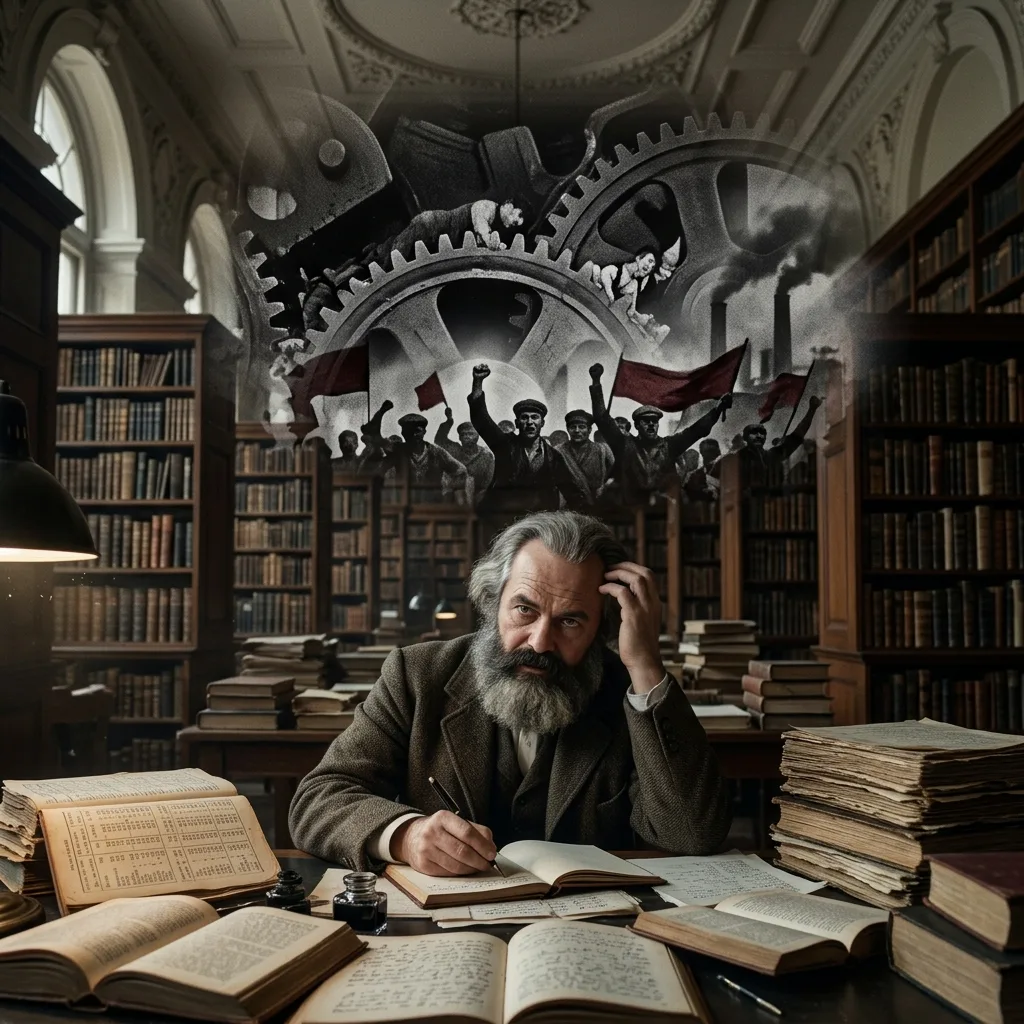
Karl Marx and Friedrich Engels publish "The Communist Manifesto," arguing that all of human history is driven by class struggle, and that the working class (proletariat) must inevitably overthrow the capitalist owners (bourgeoisie).
Open in interactive timeline →Key Numbers
- Published
- Feb 21, 1848, London
- Authors' ages
- Marx 29, Engels 27
- Original language
- German
- Action program
- 10 demands
- First English ed.
- 1850
Verified Facts
- The pamphlet was published in London around February 21, 1848, in German as 'Manifest der Kommunistischen Partei,' printed by the office of J.E. Burghard, just days before the February Revolution erupted in Paris on February 24.
- It was commissioned as the official platform of the Communist League, a small international workers' association; Marx and Engels were tasked at the League's late-1847 congresses with summarizing its doctrines.
- Engels drafted a catechism-style precursor, 'The Principles of Communism' (1847), with 25 questions and answers; in a November 1847 letter to Marx he urged abandoning the catechism format in favor of a manifesto, but the bulk of the final text was written by Marx alone in January 1848.
- Marx was 29 and Engels 27 when it appeared; Marx, who had renounced his Prussian citizenship and was living in Brussels, was expelled from Belgium by the authorities in early March 1848 amid the revolutionary panic, just after the text was finished.
- The work famously opens, 'A spectre is haunting Europe — the spectre of communism,' and closes with the rallying cry rendered in the standard 1888 English edition as 'Working men of all countries, unite!'
- Chapter II lays out a concrete ten-point program for proletarian revolution, including abolition of property in land, a heavy progressive or graduated income tax, abolition of all right of inheritance, centralization of credit in a state bank, and free public education for all children.
- The first English translation appeared in 1850 by Scottish Chartist and feminist Helen Macfarlane, serialized in George Julian Harney's journal 'The Red Republican' in four parts that November; she rendered the opening as 'A frightful hobgoblin stalks throughout Europe.'
- The now-standard English text is Samuel Moore's 1888 translation, made with Friedrich Engels's direct assistance and editing, which superseded Macfarlane's version.
- The 1872 German preface, written jointly by Marx and Engels after the 1871 Paris Commune, conceded that the program had in some details become 'antiquated,' notably that the working class 'cannot simply lay hold of the ready-made state machinery and wield it for its own purposes.'
- One of its most-quoted lines declares that 'the executive of the modern state is but a committee for managing the common affairs of the whole bourgeoisie,' encapsulating the materialist theory of class conflict driving history.
The World at This Moment
The Manifesto appeared in a hinge year. Its pamphlet rolled off J. E. Burghard's London press in late February 1848, days before barricades rose in Paris on 22-24 February, toppling Louis-Philippe and igniting the "Springtime of Nations" that swept Vienna, Berlin, Milan, Budapest and Rome. Simultaneously, on 2 February 1848 the Treaty of Guadalupe Hidalgo ended the Mexican-American War, transferring roughly half of Mexico's territory to the United States; gold had just been struck at Sutter's Mill (24 January), seeding the California Rush. In China, social strain was building toward the Taiping Rebellion (1850). Britain, post-Reform Act and amid Chartism's final great petition (April 1848), was the industrial workshop whose factory conditions Engels had already anatomized in The Condition of the Working Class in England (1845). Liberalism, romantic nationalism, and emergent socialism contended everywhere. The document was thus a small, German-language intervention into a vast, polyglot upheaval whose immediate outcome would be the revolutions' defeat by 1849.
The Paradigm Shift
The Manifesto recast politics as a science of class struggle. Declaring that "the history of all hitherto existing society is the history of class struggles," Marx and Engels fused German idealist dialectics, French revolutionary politics, and British political economy into historical materialism: the claim that modes of production, not ideas or great men, drive history. It offered both a startlingly prescient analysis of capitalism's globalizing, dissolving dynamism ("All that is solid melts into air") and a prophecy of its proletarian overthrow. Though its 1848 print run vanished with the revolutions' collapse, the text was resurrected after the 1871 Paris Commune and the rise of mass socialist parties; Engels's authorized 1888 English edition canonized it. By the twentieth century it had become the foundational charter for movements that governed roughly a third of humanity. It also reframed the human story itself as one of material progress culminating in emancipation—a secular eschatology that would shape revolutions, welfare states, anticolonial struggle, and the entire vocabulary of left-right politics.
In Their Own Words
"A spectre is haunting Europe — the spectre of Communism. ... The proletarians have nothing to lose but their chains. They have a world to win. Working Men of All Countries, Unite!" — Karl Marx and Friedrich Engels, Manifesto of the Communist Party (1848); opening sentence and closing exhortation, as rendered in Engels's authorized 1888 English translation by Samuel Moore
A spectre is haunting Europe — the spectre of communism.
Karl Marx and Friedrich Engels, opening line of the Manifesto of the Communist Party (1848); quoted from the authorized 1888 English translation by Samuel Moore, edited by Engels. — source
The history of all hitherto existing society is the history of class struggles.
Karl Marx and Friedrich Engels, opening sentence of Section I (Bourgeois and Proletarians), Manifesto of the Communist Party (1848), authorized 1888 Samuel Moore translation. In the 1888 edition Engels appended a footnote clarifying this refers to all written history. — source
The proletarians have nothing to lose but their chains. They have a world to win. Working men of all countries, unite!
Karl Marx and Friedrich Engels, closing lines of the Manifesto of the Communist Party (1848), authorized 1888 Samuel Moore translation. The German original of the final line is "Proletarier aller Länder, vereinigt euch!" — source
In Depth
The Specter Born of the Engine: Marx and the Manifesto
In late February 1848, a twenty-three-page German pamphlet rolled off a London press, written anonymously by Karl Marx and Friedrich Engels at the commission of the Communist League. Its opening line — "A spectre is haunting Europe" — would prove one of the most consequential sentences ever printed since the Gutenberg Press (sv-printing-press) first made cheap text a political force. The Communist Manifesto did not invent socialism, but it welded class conflict to a theory of history so totalizing that it reframed how millions understood their own lives.
Deep Preconditions
The Manifesto is unthinkable without the smokestacks that preceded it. The Industrial Revolution (sv-industrial-revolution) had, within two generations, torn peasants from the land and packed them into Manchester mills, manufacturing the very proletariat Marx claimed would become capitalism's gravedigger. Marx watched the factory system that men like Michael Faraday (sv-michael-faraday) were electrifying and saw not progress alone but a new and sharpened antagonism between those who owned the machines and those who fed them.
Intellectually, Marx inherited a longer lineage. He took the dialectic of G.W.F. Hegel — history advancing through the clash of thesis and antithesis — and, in his own image, turned it "right side up," grounding it in material conditions rather than the movement of ideas. This materialism reaches back through the Enlightenment confidence of René Descartes (sv-descartes) and Isaac Newton (sv-newton), who had taught Europe to read the world as a system governed by discoverable laws. Marx aimed to do for society what they had done for nature: expose the iron machinery beneath the surface of events.
The Ripples Forward
No nineteenth-century text reshaped the twentieth more violently. Marx's claim that class struggle drives history became the founding myth of revolutions from Petersburg to Beijing, and the Cold War that followed Hiroshima and Nagasaki (sv-hiroshima-nagasaki) was, in large part, a planetary argument over whether Marx was right. The Manifesto also belongs to a remarkable cluster of mid-century works that each dissolved a comforting certainty. Just eleven years later, Charles Darwin & the Origin of Species (sv-charles-darwin) removed divine design from biology; Friedrich Nietzsche (sv-nietzsche) would soon pronounce the death of God; together they form a great unmasking, the moment Europe's thinkers turned their tools against their own civilization's foundations.
There is a deep irony binding Marx to his ideological opposite. The framers of the Federalist Papers (sv-federalist-papers) had also studied history to engineer a society, but they built institutions to channel faction; Marx insisted faction — class — could only be abolished by transcending the system entirely. Both were heirs of the same Enlightenment faith that society obeys analyzable laws and can therefore be rebuilt.
The Longest Thread
What makes Marx strangely contemporary is his vision of history as an accelerating sequence of modes of production, each generating the technology that destroys it. That structure prefigures, in a secular key, the techno-prophecy of Ray Kurzweil's Law of Accelerating Returns (sv-kurzweil-law). Marx believed the productive forces would eventually outgrow every social arrangement built to contain them; today's debates over automation, the World Wide Web (sv-www), and whether artificial intelligence will shatter the wage relation are arguments his categories still frame. The Manifesto's haunting question — who owns the machines, and what happens to those who do not — only grows louder as the machines begin to think.
That a slim pamphlet, printed anonymously amid the failing revolutions of 1848, still sets the terms of that question is the surest measure of its place in history's long arc.
Causes & Consequences
What led to it
- The Industrial Revolution created a large urban industrial working class concentrated in factory cities like Manchester, whose poverty, high mortality, and squalid living conditions Engels documented firsthand in 'The Condition of the Working Class in England' (written 1844-45).
- G.W.F. Hegel's dialectical philosophy of history gave Marx a framework of development through contradiction, which Marx famously inverted into a materialist dialectic, claiming Hegel's dialectic stood on its head and needed to be set back on its feet.
- Ludwig Feuerbach's materialist critique of Hegelian idealism, defending perception and empirical reality against the primacy of thought, pushed Marx toward a materialist conception of human society and religion.
- The British classical political economy of Adam Smith and David Ricardo supplied Marx with the labour theory of value and an analytical vocabulary of capital, wages, and class that he reworked critically.
- French utopian and revolutionary socialism, including the ideas of Saint-Simon, Charles Fourier, and Pierre-Joseph Proudhon, furnished the socialist tradition and class-struggle politics that Marx both drew on and sought to supersede with 'scientific' socialism.
- The Communist League, a German-born revolutionary workers' association, commissioned Marx and Engels at its November 1847 London congress to draft a party programme, with Engels' earlier catechism-style 'Principles of Communism' serving as the working model for the text Marx wrote in January 1848.
What it set in motion
- The Manifesto's call 'Working Men of All Countries, Unite!' helped inspire organized international labour, feeding into the First International (founded 1864) under Marx's leadership and the mass Social Democratic parties that adopted it as a cornerstone text from the 1870s onward.
- Vladimir Lenin and the Bolsheviks worked from the Manifesto's blueprint in the 1917 Russian Revolution, which transformed the pamphlet's scale and established the Soviet Union as the first Marxist-governed state.
- Marxism-Leninism, the Bolshevik-modified reading of Marx, became the official state ideology of the Soviet Union, the Eastern Bloc, and many Third World states, defining one side of the twentieth-century Cold War.
- The document achieved its widest circulation in the twentieth century and gained 'hallowed status' as one of the world's most influential political texts, mass-distributed by communist states as essential reading.
- Marx's critique of capitalism and class pressured Western governments and reformist movements toward labour rights and social reforms, contributing to the rise of reformist social democracy and welfare-state politics that competed with revolutionary communism.
- Even after the 1991 collapse of the Soviet Union, the Manifesto endures as a touchstone critique of inequality, globalization, and economic crisis, cited by contemporary activists and scholars addressing labour, climate, and social-justice movements.
The Live Academic Debate
A live historiographical debate concerns the gap between the Manifesto's negligible 1848 impact and its colossal afterlife—what one might call Hobsbawm's puzzle. Eric Hobsbawm (introductions, 1998 and 2012) stressed the text's almost "biblical force" and its uncanny anticipation of globalization, arguing its analysis of capitalism reads truer in our era than in its own. Gareth Stedman Jones, in his long introduction to the Penguin edition (2002) and in Karl Marx: Greatness and Illusion (2016), instead historicizes it, deflating the prophetic myth: the Manifesto misjudged 1848, overestimated the industrial proletariat, neglected the peasantry, and was a contingent product of 1840s émigré politics rather than timeless prophecy. A further axis runs between those (e.g., A. J. P. Taylor) who treat it as a literary-rhetorical monument and political theorists who read it as rigorous social science. Contributors to the 2022 collection The Communist Manifesto in the Revolutionary Politics of 1848 likewise reassess how programmatically the document actually functioned during the revolutions.
How This Event Connects
Karl Marx’s philosophical and economic project was fundamentally an autopsy of the Industrial Revolution. While classical economists viewed the rapid industrialization of the 19th century as a triumph of progress and efficiency, Marx exposed the brutal underbelly of this transformation. He argued that the massive accumulation of wealth during the Industrial Revolution was predicated entirely on the expropriation of surplus value from the proletariat. The factory system did not liberate humanity; rather, it subjected the working class to unprecedented levels of alienation and physical degradation. Marx’s analysis of "Fossil Capitalism" highlighted how the very technology of industrialization—such as coal-fired steam engines—was weaponized to break labor power and enforce urban factory discipline.
Marx’s materialist conception of history also engages in a complex dialogue with the biological materialism of Charles Darwin. When Darwin published The Origin of Species, Marx initially welcomed it as a "basis in natural science for the class struggle in history," seeing natural selection as the biological equivalent to his own rejection of divine teleology. However, Marx and Engels later grew highly critical of Darwin’s reliance on Malthusian economics. They argued that Darwin had mistakenly projected the vicious, hyper-competitive dynamics of bourgeois capitalism onto the natural world. For Marx, the "struggle for existence" was not a universal biological law, but a specific, historical condition created by capitalist scarcity—a condition that communism would ultimately transcend.
Later in the 19th century, Marx’s sweeping, systemic critique of society found a dark, psychological parallel in the philosophy of Friedrich Nietzsche. While Marx located the crisis of modernity in structural economic exploitation, Nietzsche located it in cultural and spiritual decadence. Both thinkers were radical diagnosticians of a decaying bourgeois order, fiercely attacking the hypocrisy of Christian morality and the shallow optimism of Enlightenment liberalism. Yet, their solutions were entirely antithetical: Marx sought the emancipation of the collective masses through proletarian revolution, while Nietzsche despised the "herd" and sought the elevation of the individual, aristocratic Übermensch. Together, they represent the dual, structural-and-psychological assault on 19th-century European civilization.
Critique — the theory-to-regime gap (Leszek Kolakowski)
The Polish philosopher Leszek Kolakowski, in his three-volume Main Currents of Marxism (1976–78), mounted the most influential scholarly critique of the gap between Marx's emancipatory theory and the regimes built in his name. Against defenders who called Stalinism a betrayal of authentic Marxism, Kolakowski argued that Leninist and Stalinist communism were not distortions but among the doctrine's possible interpretations, with theoretical roots in Marx himself. He concluded that Marxism was 'the greatest fantasy of our century' — a dream of perfect unity that became the foundation for 'a monstrous edifice of lies, exploitation and oppression.'
The Counterfactual
Counterfactually, the Manifesto's 1848 absence would have changed little in that year: its imprint on the revolutions was, as Eric Hobsbawm and Gareth Stedman Jones note, nearly invisible—the first edition sold poorly and dropped from sight by 1849. The decisive question is downstream. Without Marx and Engels distilling socialist currents (Saint-Simon, Fourier, Blanqui, the League of the Just) into one compact, quotable text, post-1871 socialism might have crystallized around rival traditions—Lassallean state-socialism, Proudhonian mutualism, or Bakuninist anarchism—yielding a more federalist, less determinist left. The German SPD and, crucially, Lenin's Bolshevism drew authority from the Manifesto's teleology; a different canonical text could have produced a different 1917. Yet because the Manifesto synthesized rather than invented its ideas, some comparable codification was arguably overdetermined by industrialization itself. The plausible counterfactual is therefore not "no Marxism" but a more plural, less doctrinally unified socialist movement.
Myth vs. Reality
Myth: Karl Marx wrote the Communist Manifesto alone.
Reality: The Manifesto was commissioned by the Communist League at its London congress in late 1847 as the organization's official program, not a solo treatise. Marx wrote the final text, but it grew directly out of Friedrich Engels' earlier draft, 'Principles of Communism' (1847), and Engels later affirmed it was 'our joint production.' In his 1888 preface Engels wrote that 'the fundamental proposition which forms the nucleus belongs to Marx,' explicitly crediting Marx with the core idea while underscoring that the pamphlet itself was a collaborative party document.
Myth: The Communist Manifesto was immediately influential and helped drive the revolutions of 1848.
Reality: The pamphlet appeared in London in February 1848, too late and too obscurely to shape the 1848 revolutions, and after the Communist League dissolved it nearly faded into oblivion. It gained wide attention only in the 1870s, when the Paris Commune of 1871 raised Marx's profile and prompted a wave of new editions in multiple languages. Its status as a foundational text came still later, with the growth of organized socialist labor movements and, ultimately, the 1917 Bolshevik Revolution.
Myth: Marx wanted to abolish all private property, including ordinary people's homes and personal possessions.
Reality: In Chapter 2 the Manifesto states that 'the distinguishing feature of Communism is not the abolition of property generally, but the abolition of bourgeois property' — meaning capital and the means of production (factories, large productive assets), not personal belongings like clothes, furniture, or a family home. Marx and Engels even noted that the small property of artisans and peasants was already being destroyed by industrial capitalism itself. The modern distinction often drawn between 'personal property' and 'private property' (productive, capital-generating assets) reflects this passage in the text.
Myth: Marx predicted that communist revolution would break out in poor, agrarian countries like Russia.
Reality: Marx's theory held the opposite: he expected proletarian revolution to emerge first in the most advanced industrial capitalist societies, where a large, organized working class had developed. The actual communist revolutions of the twentieth century — Russia in 1917, then China and Cuba — occurred in predominantly agrarian, less-developed economies, contradicting his expectation. Scholars note this gap is one reason Lenin had to substantially revise Marx, including the idea of a vanguard party leading the revolution.
Myth: The Soviet Union under Lenin and Stalin was the blueprint Marx laid out for a communist state.
Reality: Classical Marxism deliberately offered little detail on how a future socialist government would be organized; Marx provided no operating manual for a communist state. 'Marxism-Leninism' as a formal doctrine was codified only after Lenin's death, during Stalin's consolidation of power, and incorporated features — a vanguard party, state-led collectivization and forced industrialization — that depart significantly from Marx's own writings. Treating the USSR as the straightforward realization of Marx's plan conflates Marx's nineteenth-century critique of capitalism with a twentieth-century state ideology built largely by Lenin and Stalin.
Frequently Asked Questions
When was the Communist Manifesto published?
The Communist Manifesto was first published in London in late February 1848, originally in German as Manifest der Kommunistischen Partei. It was commissioned by the Communist League at its second congress in London (held in early December 1847) and written by Karl Marx, drawing on a draft by Friedrich Engels, between late 1847 and January 1848. It was printed anonymously, just weeks before the wave of revolutions that swept Europe in 1848.
Who wrote the Communist Manifesto, Marx or Engels?
Both are credited as authors, but the final text was written primarily by Karl Marx, working from earlier drafts by Friedrich Engels, most notably Engels's 1847 "Principles of Communism." Engels later acknowledged that the central guiding idea belonged to Marx. The two were lifelong collaborators after meeting in Paris in 1844, and their partnership produced both the Manifesto and the foundations of what became Marxism.
What is the main idea of the Communist Manifesto?
Its central thesis is that "the history of all hitherto existing society is the history of class struggles." Marx and Engels argued that industrial capitalism had split society into two opposed classes, the bourgeoisie (owners of capital) and the proletariat (wage laborers), and that capitalism's internal contradictions would lead the proletariat to overthrow it. The Manifesto calls for the abolition of private property and lays out a program of demands, ending with the rallying cry for workers of all countries to unite.
What is the famous opening line of the Communist Manifesto?
The Manifesto opens, "A spectre is haunting Europe — the spectre of communism." The line dramatizes how Europe's established powers feared and denounced communism even before it was a coherent movement, treating it as a looming threat to the existing order. It is one of the most recognized opening lines in political literature, paired with the equally famous closing call, "Working men of all countries, unite!"
Who was Karl Marx?
Karl Marx (born May 5, 1818, in Trier, Prussia; died March 14, 1883, in London) was a German philosopher, economist, historian, and revolutionary socialist. After studying at the universities of Bonn and Berlin, where he absorbed Hegelian philosophy, he worked as a radical journalist and was expelled from several countries before settling in London in 1849. Besides co-authoring the Communist Manifesto, he wrote Das Kapital, his major critique of political economy, and is buried in London's Highgate Cemetery.
How did the Communist Manifesto influence history?
Though it had limited immediate impact in 1848, the Manifesto became one of the most influential political texts ever written, shaping socialist and labor movements worldwide. Its ideas underpinned 20th-century revolutions and states, and by the mid-20th century a large share of the world's population lived under governments that claimed Marxist foundations. It remains widely read and debated, both as a foundational work of communist theory and as a critique of capitalism's social effects.
Sources & Further Reading
- The Communist Manifesto — Wikipedia
- Karl Marx and Friedrich Engels, Manifesto of the Communist Party (1848; Engels-authorized English edition, 1888)
- Eric Hobsbawm, Introduction to The Communist Manifesto: A Modern Edition (Verso, 1998; reissued 2012)
- Gareth Stedman Jones, Karl Marx: Greatness and Illusion (Allen Lane/Harvard University Press, 2016)
- Gareth Stedman Jones, Introduction to Marx and Engels, The Communist Manifesto (Penguin Classics, 2002)
- Terrell Carver and James Farr (eds.), The Communist Manifesto in the Revolutionary Politics of 1848: A Critical Evaluation (Palgrave Macmillan, 2022)
- Wikipedia: Karl Marx
Cite This Page
AskHistoryAI. “Karl Marx & The Communist Manifesto.” AskHistoryAI — Interactive Timeline of Everything. Updated 2026-09-11. https://askhistoryai.com/event/sv-marx/
Every fact on this page is checked against the published fact ledger and methodology; sources are listed above.