The Early Muslim Conquests
The explosive expansion of Islam out of the Arabian Peninsula.
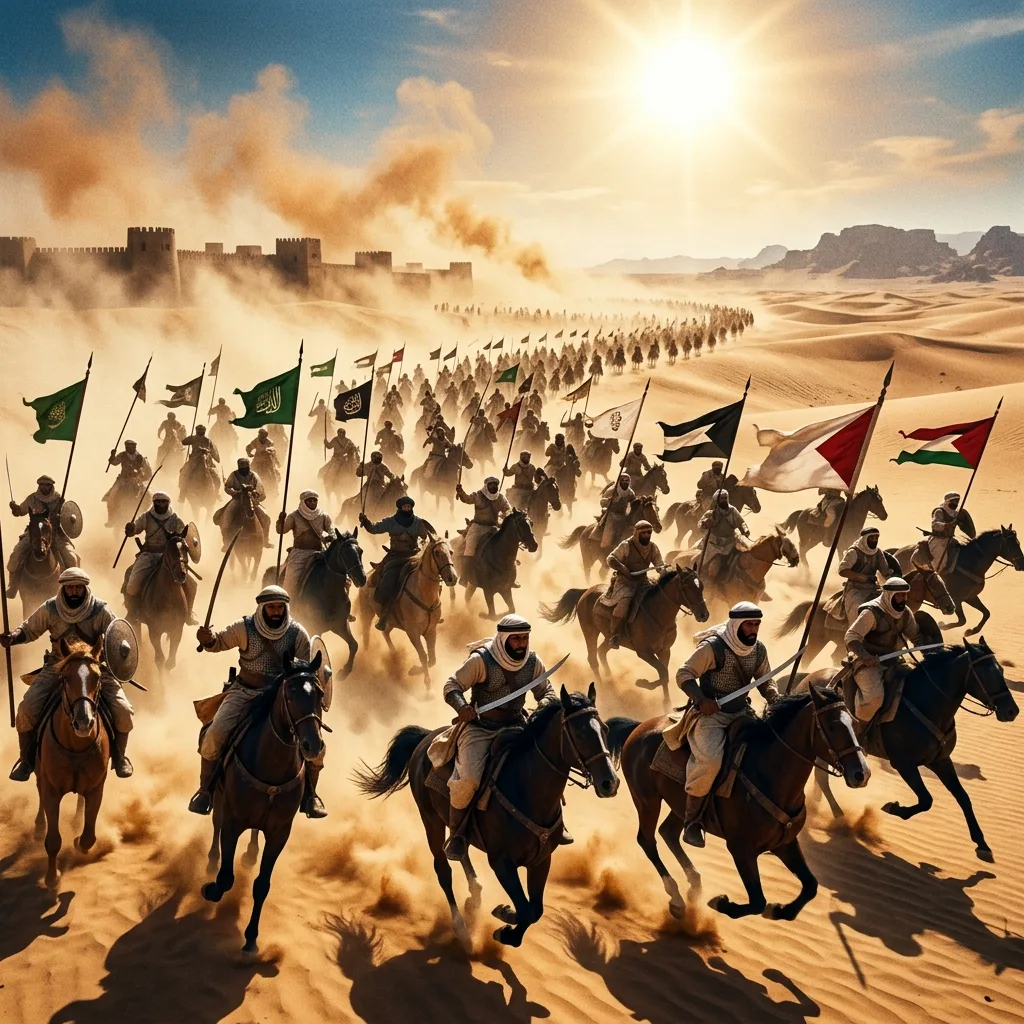
Following the death of the Prophet Muhammad, the Rashidun and Umayyad Caliphates launch an unprecedented military expansion, completely toppling the ancient Sassanid Persian Empire and permanently stripping the Byzantine Empire of its southern territories.
Open in interactive timeline →Key Numbers
- Duration
- ~632-661 CE (Rashidun era)
- Reach achieved
- Arabia to Persia, Egypt & N. Africa
- East-west span
- Greater than Roman Empire, in ~half the time
- Yarmouk
- Byzantine Syria lost in 6 days (636)
- Empires broken
- Sasanian Persia destroyed; Byzantium gutted
Verified Facts
- After Muhammad's death in 632, Caliph Abu Bakr first had to reconquer Arabia itself in the Ridda (apostasy) Wars, which ended around March 633 with the entire peninsula reunited under Medina's authority before any outward expansion began.
- At the Battle of Yarmouk (15-20 August 636), a Rashidun army of roughly 24,000-40,000 under Khalid ibn al-Walid decisively defeated a much larger Byzantine force commanded by Vahan, permanently ending Byzantine rule in Syria and the Levant in just six days of fighting.
- At al-Qadisiyyah in November 636, Sa'd ibn Abi Waqqas defeated the Sasanian army under the general Rostam Farrokhzad, stripping Persia of Mesopotamia and everything west of the Iranian plateau and opening the road to the capital, Ctesiphon.
- In 637 or 638 Caliph Umar traveled to Jerusalem in person to accept its surrender from Patriarch Sophronius; his guarantee of safety (al-Uhda al-Umariyya) protected Christians' lives, property, churches, and crosses, and he famously declined to pray inside the Church of the Holy Sepulchre so as not to endanger its Christian status.
- The Battle of Nahavand in 642, called by Muslims the 'Victory of Victories,' shattered the last great Sasanian field army and ended organized Persian resistance; Arab sources give wildly varying numbers, with a Muslim force of roughly 30,000 facing a Persian host reported anywhere from 50,000 to 150,000.
- The Muslim conquest of Egypt under Amr ibn al-As broke Byzantine power at the Battle of Heliopolis in 640; the great Babylon Fortress on the Nile fell on 9 April 641 after a long siege, and Alexandria's governor agreed to surrender by treaty in November 641.
- The last Sasanian emperor, Yazdegerd III, fled eastward across his collapsing realm and was killed near Merv around 651, reportedly murdered by a local miller for his jewels, an inglorious end to a dynasty that had ruled for roughly four centuries.
- Caliph Umar, architect of much of the expansion, was assassinated in 644 by Abu Lulu, a captured Persian slave; his successor Uthman ibn Affan oversaw the standardization of the Quran through a committee headed by Muhammad's former scribe Zayd ibn Thabit.
- The murder of Uthman in 656 triggered the First Fitna (656-661), the first Muslim civil war, in which Caliph Ali ibn Abi Talib won the Battle of the Camel (December 656) but then fought the inconclusive Battle of Siffin (657) against Muawiya, halting the outward conquests and setting the stage for the Umayyad Caliphate.
- As historian Hugh Kennedy stresses in 'The Great Arab Conquests,' within roughly a century of Muhammad's death the Arabs had subdued a territory of greater east-west extent than the Roman Empire and did so in about half the time Rome took to reach its peak, conquering the thousand-year-old Persian Empire outright and reducing Byzantium toward a rump state around Constantinople.
The World at This Moment
The conquests erupted into a world freshly exhausted by the climactic Byzantine–Sasanian war of 602–628, which Heraclius won only after Khusrau II had briefly held Jerusalem, Egypt, and Anatolia. Both empires were militarily depleted and fiscally drained, and recurrences of the Justinianic plague (first struck 541) had thinned populations and revenues across the Mediterranean. In the Levant, Monophysite and Jewish communities were alienated by Constantinople's coercive religious policy. Far to the east, Tang China under Emperor Taizong (r. 626–649) was entering a golden age, breaking the Eastern Türk khaganate in 630 and reaching toward the Tarim oases. In western Europe the Merovingian Franks and Visigothic Spain were fragmenting Christendom's old Roman core; Northumbria's conversion was underway. Within a generation the Arab armies, riding from Yarmuk (636) and al-Qadisiyya (636/637), would erase one empire entirely and amputate the richest half of the other, redrawing the map from the Atlas to the Oxus.
The Paradigm Shift
The conquests dissolved the late-antique geopolitical order overnight. The Sasanian empire, four centuries old, was annihilated; the Byzantine empire lost Syria, Palestine, Egypt, and eventually North Africa, shrinking to an Anatolian–Balkan rump and ceding its grain and tax base. A single new polity, the caliphate, now bridged the Mediterranean and the Iranian plateau, ending the millennium-old Rome–Persia bipolarity and uniting trade routes from Iberia to Central Asia. Religiously, the conquests created the geographic frame within which a distinct Islam crystallized over the following century, while Christianity's demographic center began its long shift northward into Europe. The newly governed populations of Greek, Aramaic, Coptic, and Pahlavi speakers were progressively Arabized and, more slowly, Islamized. Crucially, the absorption of Greek philosophical and scientific texts into Arabic translation under the later Abbasids—the Greco-Arabic translation movement—preserved and extended Hellenistic learning, seeding the medieval intellectual flowering that would eventually feed back into Latin Europe.
In Their Own Words
"On Friday, 4 February, [634 CE] at the ninth hour, there was a battle between the Romans and the Arabs of Muhammad [Syriac: tayyaye d-Mhmt] in Palestine twelve miles east of Gaza. The Romans fled... and the Arabs ravaged the whole region." — Thomas the Presbyter, Syriac Chronicle (the "Chronicle of 640"), the earliest dated non-Muslim reference to Muhammad; trans. Andrew Palmer and Robert Hoyland, Seeing Islam as Others Saw It (1997)
Fight those who do not believe in Allah or in the Last Day and who do not consider unlawful what Allah and His Messenger have made unlawful and who do not adopt the religion of truth from those who were given the Scripture - [fight] until they give the jizyah willingly while they are humbled.
The Qur'an 9:29 (Surah At-Tawbah), Sahih International English translation. A scriptural verse cited by later Muslim jurists in connection with the imposition of jizya (tribute) on conquered 'People of the Book'; not itself a narrative of the conquests. — source
Unwillingly, indeed, contrary to our wishes, we are required to stay at home, not bound closely by bodily bonds, but bound by fear of the Saracens.
Sophronius, Patriarch of Jerusalem, Christmas Sermon of 634 (lamenting that the 'godless Saracens' had captured Bethlehem and barred the road from Jerusalem). English translation by Robert G. Hoyland, 'Seeing Islam as Others Saw It' (1997), p. 70 (Christmas Sermon §506). A contemporary Byzantine Christian eyewitness perspective. — source
Now, however, you are the sons of Abraham, and God shall fulfill the promise made to Abraham and his son on you.
Words attributed to Muhammad addressing the Arabs/Ishmaelites, as REPORTED by the 7th-century Armenian chronicler Sebeos, 'History', ch. 30. English translation by R. W. Thomson, 'The Armenian History Attributed to Sebeos' (Liverpool, 1999). A near-contemporary non-Muslim (Armenian Christian) account framing the conquest as an Abrahamic land-claim. — source
In Depth
The Conquests That Redrew the Map of Late Antiquity
In the span of a single generation after the death of Muhammad in 632, armies riding out of the Arabian Peninsula overturned the geopolitical order that had governed the Near East for a thousand years. By the time the dust settled around 650, the Sasanian Persian Empire had ceased to exist and the Eastern Roman Empire had lost Syria, Palestine, and Egypt. Few events in human history rearranged so much, so quickly, with such durable consequences.
Deep Preconditions: An Exhausted World
The conquests did not erupt into a vacuum; they exploited a world worn thin. The two superpowers of late antiquity—the Roman Empire that Augustus had forged (sv-augustus) and the Persian realm heir to the Seleucids (sv-seleucid)—had just concluded a catastrophic war (602–628) that bled both white. Plague had hollowed their populations and treasuries. In the Levant, decades of religious coercion—Theodosius having outlawed paganism (sv-theodosius) and successive emperors having persecuted non-Chalcedonian Christians—left many provincials indifferent to Constantinople's fate. When the unified Arab armies struck, they often met populations weary of imperial rule rather than rallied against the newcomers.
The decisive blows came fast. At the Battle of Yarmuk in August 636, Khalid ibn al-Walid shattered the Byzantine field army in Syria; the next year, the victory at al-Qadisiyyah opened Mesopotamia, and Ctesiphon, the Sasanian capital, fell in March 637. Caliph Umar accepted the surrender of Jerusalem in 638—the city whose Second Temple Rome had destroyed six centuries earlier (sv-second-temple).
A New Civilization From Old Materials
What makes the conquests pivotal is less the territory seized than the synthesis they enabled. The new rulers inherited the bureaucracies, coinage, and learning of the lands they absorbed. Within decades the Umayyads proclaimed their faith in stone with the Dome of the Rock (sv-dome-of-rock), and within a century that inheritance flowered into the Islamic Golden Age (sv-islamic-golden-age)—the era when Arabic-speaking scholars preserved and extended the geometry of Euclid (sv-euclid), the philosophy of Aristotle (sv-aristotle), and the medicine and astronomy of the ancient world. The Great Library of Alexandria (sv-library-alexandria) had vanished, but the intellectual tradition it embodied found a second home in Baghdad and Córdoba. Much of what Europe later rediscovered in the Renaissance (sv-renaissance) arrived through translations made in this Arabic-Islamic crucible.
The conquests also permanently reshaped the religious geography seeded long before. The monotheism that had grown from Second Temple Judaism and spread through the Roman world after Constantine and Nicaea (sv-constantine-legal) now had a third great branch. The Christian Mediterranean that thinkers like Augustine of Hippo (sv-augustine) had defined was cut roughly in half, with its southern and eastern shores entering the Islamic world for good.
Ripples Across the Millennium
The fault lines drawn in the 630s never fully closed. The contraction of Byzantine Christendom contributed to the estrangement between the Greek East and Latin West that culminated in the Great Schism of 1054 (sv-great-schism). The frontier between Islam and Christendom would later be probed by the Mongol storm of Genghis Khan (sv-genghis-khan), which sacked Baghdad in 1258 and ended the classical caliphate.
Yet the deepest legacy is intellectual. By transmitting and transforming Greek science, the conquering civilization became an indispensable relay in the long chain that runs from Thales (sv-thales) and Pythagoras (sv-pythagoras) toward the Scientific Revolution and, ultimately, the information age. The Early Muslim Conquests are thus not merely a chapter of war but a hinge of cultural transmission—proof that empires fall and rise, but the accumulated knowledge of humanity, once carried into new hands, tends to compound rather than vanish.
Causes & Consequences
What led to it
- The Byzantine-Sasanian War of 602-628 left both empires militarily and financially exhausted, with the long war and Heraclius's costly victory hollowing out the very frontier regions in Syria, Iraq, and Egypt that the Arabs would soon overrun.
- Recurring outbreaks of bubonic plague, beginning with the Plague of Justinian in 541 and returning in waves through the early 7th century, devastated the densely populated cities of the Byzantine and Sasanian empires and crippled their ability to conscript and pay new troops, while sparsely settled nomadic Arab populations were far less affected.
- Muhammad's preaching from 610 onward and his move to Medina in 622 forged a new religious and political community that unified most of the feuding tribes of the Arabian Peninsula under a single faith and authority within a single decade.
- After Muhammad's death in 632, Abu Bakr's victory in the Ridda Wars (the Wars of Apostasy, 632-633) crushed breakaway tribes and pretender prophets, welding Arabia into a single disciplined state with battle-hardened armies that could be turned outward.
- The Sasanian Empire fell into political chaos after the deposition of Khosrow II in 628, cycling through numerous short-lived rulers in a few years, which left it without stable leadership to resist invasion at the moment the Arab armies struck.
- Long-standing Arab military familiarity with the imperial frontiers, including service as foederati and the alienation of border populations such as Monophysite Christians taxed and persecuted by Constantinople, meant the conquerors faced provinces with weak loyalty to their distant rulers.
What it set in motion
- The twin decisive victories of 636, the Battle of Yarmouk against the Byzantines and the Battle of al-Qadisiyyah against the Sasanians, permanently stripped Byzantium of Syria and the Levant and led to the total collapse and annexation of the Sasanian Empire by around 651.
- Within roughly a century the conquests had built one of history's largest contiguous empires, with Islamic rule stretching from the Iberian Peninsula in the west across North Africa and the Near East to Central Asia and the fringes of South Asia.
- Arabic gradually displaced Coptic, Aramaic, Greek, Latin, and Berber as the dominant language across the conquered lands, a process accelerated when the Umayyad caliph Abd al-Malik (r. 685-705) made Arabic the language of administration around 696.
- The unified, trade-connected Islamic realm fostered the Islamic Golden Age, exemplified by the Abbasid House of Wisdom in Baghdad and its translation movement, which preserved and built upon Greek, Persian, and Indian learning in mathematics, astronomy, and medicine.
- Disputes over the rightful succession to leadership of the new community, rooted in the era of the first caliphs and the civil wars that followed, hardened into the enduring Sunni-Shia division within Islam.
- The conquests turned Islam from a regional Arabian faith into a world religion whose adherents now number well over a billion, reshaping the religious, legal, and cultural identity of vast regions of Asia, Africa, and Europe for over a thousand years.
The Live Academic Debate
A live debate concerns whether these were "Islamic" or merely "Arab" conquests, and what motivated them. The traditional account, drawn from ninth-century Arabic sources (al-Tabari, al-Baladhuri), depicts a religiously galvanized movement; Fred Donner (Muhammad and the Believers, 2010) refines this into an ecumenical, apocalyptically charged "Believers' movement" whose hard Islamic identity crystallized only under the Marwanids. Robert Hoyland (In God's Path, 2014) deliberately prefers "Arab conquests," arguing Islam was still inchoate and emphasizing non-Muslim contemporary sources. The revisionists Patricia Crone and Michael Cook (Hagarism, 1977) once read the movement as Judaic-messianic, recoverable only from external evidence—a position Crone later softened. Stephen Shoemaker presses the apocalyptic-imminent-eschatology reading further. Skeptics doubt the late Arabic narratives' reliability altogether, while Donner and Kennedy defend a critical-but-usable core. The dispute turns on source reliability: how much weight to give Syriac, Greek, and Armenian witnesses versus the canonical Islamic tradition.
How This Event Connects
The historiography of the Early Muslim Conquests fundamentally recontextualizes the emergence of Islam not as an isolated rupture, but as a deeply integrated Late Antique phenomenon. Emerging from the geopolitical devastation of the Byzantine-Sassanian Wars, the early "Believers Movement" capitalized on the exhaustion of existing superpowers. In doing so, it aggressively inherited and adapted the sophisticated administrative and fiscal infrastructures originally established by empires like that of Constantine & Nicaea, ensuring the survival of Christian bureaucracy within a new Islamic framework.
As this ecumenical, apocalyptic movement crystallized into a distinct imperial identity, its ideological triumph was permanently monumentalized in the Construction of the Dome of the Rock. This architectural masterpiece served as a profound theological polemic against Byzantine Trinitarianism, visually and geographically asserting the finality and superiority of Islam over both Judaism and Christianity in the highly contested sacred landscape of Jerusalem.
The vast geopolitical unity achieved by these early conquests laid the foundational socioeconomic network that would eventually blossom into the Islamic Golden Age. By synthesizing Hellenistic philosophy, Persian statecraft, and Indian mathematics across a contiguous trans-regional empire, the early conquests created the necessary conditions for a massive, multi-generational flourishing of science and culture.
The two exhausted empires (Byzantine and Sasanian view)
Modern historians emphasize that the Arabs did not strike strong, stable states but two superpowers wrecked by their own preceding conflict. The Byzantine-Sasanian War of 602-628 was, in J. Howard-Johnston's words, 'the last great war of antiquity,' leaving both East Rome and Sasanian Persia financially drained, plague-stricken, and politically unstable just before the conquests. Howard-Johnston likens the ensuing Arab expansion to 'a human tsunami,' and near-contemporary non-Muslim sources such as the Armenian chronicler Sebeos record the speed of the collapse from the conquered peoples' own vantage point.
The Counterfactual
Had the conquests stalled—plausible given how contingent the decisive battles were—late antiquity's bipolar Rome–Persia world might have persisted. Walter Kaegi stresses that Byzantine defeat was not foreordained: Heraclius's reconquered Syria was lost through tactical failures at Yarmuk rather than structural inevitability. Without the Arab breakthrough, a recovering Byzantium might have re-entrenched in Syria and Egypt, keeping the Mediterranean a Christian Roman lake and possibly reabsorbing or partitioning a chastened Sasanian Iran. Zoroastrianism would likely have remained Iran's dominant faith rather than dwindling to a minority. The Greco-Arabic translation movement that transmitted Aristotle, Galen, and Ptolemy would not have occurred in that form, altering the trajectory of medieval philosophy and science in both the Islamic world and Latin Europe. Hugh Kennedy and Robert Hoyland both caution, however, that the underlying drivers—imperial exhaustion, plague, and Arab mobilization—made some expansion probable; the radical counterfactual is the scale and permanence, not the existence, of an Arab military surge.
Myth vs. Reality
Myth: Islam was spread across the conquered lands by the sword: populations were forced to convert at the point of a weapon as the armies advanced.
Reality: The conquests created an empire ruled by a Muslim elite, but conversion of the population was slow and largely voluntary, lagging the military victories by centuries. Richard Bulliet's quantitative study of Muslim names found that regions like Iran did not reach a Muslim majority until roughly the mid-to-late ninth and tenth centuries, long after their seventh-century conquest. Non-Muslims (Christians, Jews, Zoroastrians) remained the demographic majority within the empire for well over two centuries, and surrender treaties such as the early pact for Jerusalem guaranteed protection of life, property and religious practice rather than mandating conversion.
Myth: The conquerors imposed the jizya poll tax specifically as a coercive tool to push subject peoples to convert to Islam.
Reality: The jizya was primarily a fiscal and political arrangement: in exchange for the tax, non-Muslim 'dhimmi' communities received protection and the right to keep practicing their faith. In several early provinces the financial logic actually ran the other way. Because non-Muslims were the tax base, mass conversion threatened state revenue, so authorities at times had little incentive to encourage it. The tax functioned more as a stable revenue source on a protected non-Muslim majority than as a deliberate conversion engine, which is part of why conversion stayed slow.
Myth: The rapid Arab victories prove the conquests were driven mainly by overwhelming religious zeal sweeping aside intact, powerful empires.
Reality: Historians such as Hugh Kennedy stress that the two great powers the Arabs faced were severely weakened on the eve of the conquests. The Byzantine and Sasanian empires had just fought a ruinous war (602-628) that drained both, while plague and internal religious divisions among Eastern Christians further sapped Byzantine territory. These material and structural weaknesses, alongside Arab military skill and mobility, are central to explaining the speed of expansion. Some revisionist scholars (e.g. Fred Donner, Robert Hoyland) even prefer the term 'Arab conquests,' arguing a distinct Islamic identity was still crystallizing during this period.
Myth: The Arab conquerors burned the great Library of Alexandria, dealing a final blow to classical learning.
Reality: Modern historians overwhelmingly reject this story. The famous account, in which Caliph Umar supposedly ordered the books burned to heat the city's bathhouses, first appears in sources from around the thirteenth century, roughly 500 years after the 642 conquest, and is absent from the detailed earlier histories of Alexandria's fall. The legend is also logistically absurd, and the great library had already declined or been destroyed centuries before Islam arose. Scholars across confessional backgrounds treat the tale as a later polemical fabrication.
Myth: Charles Martel's victory at the Battle of Tours (732) was the decisive moment that single-handedly saved Christian Europe from Islamic conquest.
Reality: The dramatic 'Tours saved the West' framing owes much to Edward Gibbon's eighteenth-century rhetoric. Many modern historians argue the engagement was closer to a large raid than a campaign of outright conquest, and that its world-historical importance has been inflated. Tellingly, Muslim forces held Narbonne and parts of southern Gaul (Septimania) for decades afterward, into the 750s. The battle mattered more for consolidating Charles Martel's power and launching the Carolingian dynasty than as a civilizational turning point, though its broader symbolic impact in Western memory is real.
Frequently Asked Questions
What were the Early Muslim Conquests and when did they happen?
The Early Muslim Conquests were the rapid military expansion of the Arab-Muslim state in the decades after the Prophet Muhammad's death in 632 CE, carried out mainly under the first four Rashidun caliphs (Abu Bakr, Umar, Uthman, and Ali, 632-661 CE). Within roughly thirty years, Arab armies conquered the entire Sasanian Persian Empire and stripped the Byzantine Empire of Syria, Palestine, and Egypt. By the mid-650s the new caliphate stretched from parts of North Africa to the edge of modern Pakistan, making it one of the largest empires assembled in such a short span in history.
Why were the early Arab Muslim armies so successful so quickly?
Most historians point to a combination of factors rather than a single cause. The Byzantine and Sasanian empires had just fought a devastating war (602-628 CE) and were militarily and financially exhausted, while the Sasanians were further weakened by a civil war and recurring outbreaks of plague. At the same time, Arabia had been newly unified under Islam, giving the Arab forces ideological cohesion, motivation, and mobility that scholars such as Fred Donner emphasize as decisive. The Arab armies were often outnumbered but were fast, well-coordinated, and highly motivated, whereas their opponents frequently relied on mercenaries with less commitment to the cause.
What were the most important battles of the conquests?
Two battles in 636 CE were turning points. At the Battle of Yarmouk (August 636) near the Yarmouk River, the Rashidun army won a decisive victory that effectively ended Byzantine rule in Syria, with Jerusalem surrendering the following year. At the Battle of al-Qadisiyyah (November 636) in Iraq, the Arabs crushed the main Sasanian army, opening Mesopotamia and the Iranian plateau to conquest. Because the Sasanian state was already near collapse, Qadisiyyah ultimately doomed the Persian Empire entirely, whereas Yarmouk shrank rather than destroyed Byzantium.
Were conquered peoples forced to convert to Islam?
The historical consensus is no, mass forced conversion was not the rule. Conquered non-Muslims, especially Christians and Jews, were typically granted dhimmi status, allowing them to keep their churches, synagogues, and religious organizations in exchange for paying a tax called the jizya. In fact, many Muslim rulers preferred ruling over non-Muslims because the jizya was a key source of revenue. Demographic studies by scholars such as Richard Bulliet show conversion was gradual: in many conquered regions Islam did not become the majority religion until roughly 850-1050 CE, well over a century after the conquests.
Which empires fell or were diminished by the conquests?
The Sasanian (Persian) Empire was destroyed outright. After the defeat at al-Qadisiyyah and the later Battle of Nahavand, the Sasanian state collapsed, and the last emperor, Yazdegird III, fled eastward and was assassinated around 651 CE. The Byzantine (Eastern Roman) Empire survived but was severely diminished, permanently losing its wealthy provinces of Syria, Palestine, and Egypt; Amr ibn al-As completed the conquest of Egypt between 639 and 642 CE. Byzantium endured for centuries more from its core in Anatolia and the Balkans, repelling later Arab sieges of Constantinople.
What ended the period of the early conquests?
The first great wave of expansion stalled with internal conflict. The murder of Caliph Uthman in 656 CE triggered the First Fitna (656-661 CE), a civil war over leadership of the Muslim community. Uthman's successor, Ali ibn Abi Talib, spent his entire reign struggling to hold the realm together rather than expanding it. The strife ended with Ali's assassination in 661 and the rise of the Umayyad dynasty, which later resumed expansion but under a new political order.
Sources & Further Reading
- Early Muslim conquests — Wikipedia
- Fred M. Donner, Muhammad and the Believers: At the Origins of Islam (Harvard University Press, 2010)
- Robert G. Hoyland, In God's Path: The Arab Conquests and the Creation of an Islamic Empire (Oxford University Press, 2014)
- Walter E. Kaegi, Byzantium and the Early Islamic Conquests (Cambridge University Press, 1992)
- Hugh Kennedy, The Great Arab Conquests: How the Spread of Islam Changed the World We Live In (Da Capo Press, 2007)
- Patricia Crone and Michael Cook, Hagarism: The Making of the Islamic World (Cambridge University Press, 1977)
- World History: Early Muslim Conquests
Cite This Page
AskHistoryAI. “The Early Muslim Conquests.” AskHistoryAI — Interactive Timeline of Everything. Updated 2026-09-11. https://askhistoryai.com/event/sv-rise-of-islam/
Every fact on this page is checked against the published fact ledger and methodology; sources are listed above.