Seneca the Younger
The hypocritical genius of Roman Stoicism.
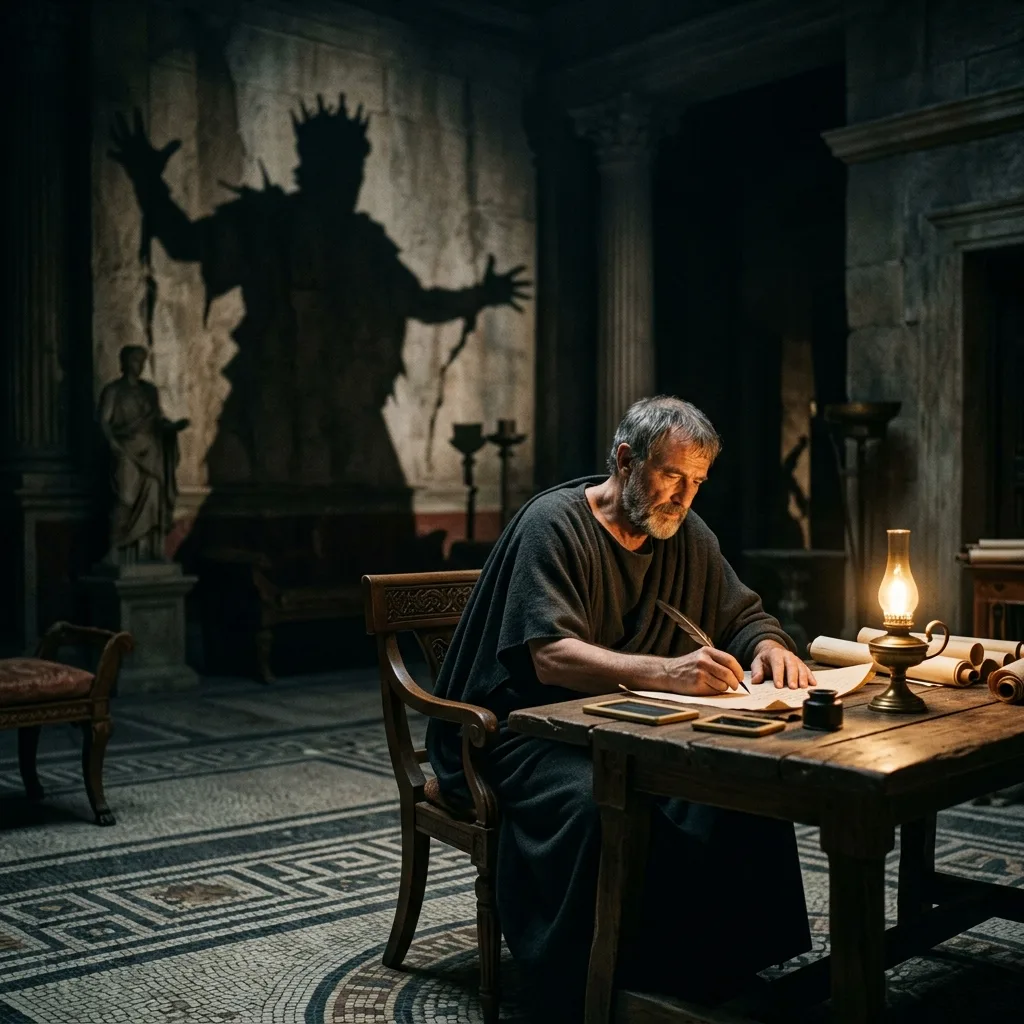
A Roman philosopher, statesman, and dramatist who became one of the leading intellectual figures of Stoicism. He served as the primary tutor and advisor to the tyrannical Emperor Nero, a position that ultimately cost him his life.
Open in interactive timeline →Key Numbers
- Lifespan
- c. 4 BCE - 65 CE (~68 yrs)
- Moral Epistles
- 124 letters to Lucilius
- Private fortune
- ~300 million sesterces
- Exile on Corsica
- 8 years (41-49 CE)
- Extant tragedies
- 8 (7 complete + Phoenissae)
Verified Facts
- Lucius Annaeus Seneca was born around 4 BCE in Corduba (modern Cordoba), in Roman Hispania, to Seneca the Elder, a noted teacher of rhetoric; he was raised and educated in Rome in rhetoric and Stoic philosophy.
- In 41 CE the emperor Claudius, reportedly at the urging of his wife Messalina, exiled Seneca to Corsica on a likely-trumped-up charge of adultery with Julia Livilla, Caligula's sister; he spent roughly eight years there before being recalled in 49 CE.
- Claudius's new wife Agrippina the Younger secured Seneca's recall in 49 CE specifically to serve as tutor to her son Domitius Ahenobarbus, the boy who would become the emperor Nero.
- When Nero took the throne at age 17 in 54 CE, Seneca and the Praetorian prefect Sextus Afranius Burrus effectively guided the government during the relatively moderate early years later remembered as the 'quinquennium Neronis,' and Seneca held a suffect consulship around 55-56 CE.
- Around 55-56 CE Seneca addressed the treatise De Clementia ('On Mercy') to the young Nero, urging clemency as the supreme virtue of a ruler, and he authored the satirical Apocolocyntosis mocking the deification of the late emperor Claudius.
- Despite preaching Stoic moderation, Seneca amassed a fortune reported at about 300 million sesterces, and Cassius Dio blamed his sudden recall of a 40-million-sesterce loan to Britons as a contributing spark of Boudica's revolt; the senator Suillius Rufus publicly attacked him for this hypocrisy (Tacitus, Annals 13.42).
- Near the end of his life, largely withdrawn from court, Seneca composed his most influential prose work, the Epistulae Morales ad Lucilium, a collection of 124 surviving moral letters addressed to his friend Lucilius Junior, then procurator of Sicily.
- In 65 CE, after the Pisonian conspiracy to assassinate Nero (led by Gaius Calpurnius Piso and involving more than forty accused) was exposed, Nero ordered Seneca to take his own life, though the philosopher was probably innocent of direct involvement.
- According to Tacitus (Annals 15.60-64), Seneca opened the veins of his arms and legs, but his aged, frugal body bled too slowly; hemlock poison (echoing Socrates) also failed to work quickly, and he finally entered a warm bath to hasten death, sprinkling water as a libation to 'Jupiter the Liberator.'
- His wife Pompeia Paulina opened her own veins to die alongside him, but Nero ordered that she be kept alive; soldiers bound her wounds and she survived several more years, reportedly with a paleness that testified to her loss of blood.
- Seneca's surviving dramatic corpus comprises eight tragedies (seven complete plus the fragmentary Phoenissae), including Thyestes, Medea, Phaedra, Oedipus, Agamemnon, Troades, and Hercules Furens, whose bloody, rhetorical style profoundly shaped Renaissance and Elizabethan drama.
The World at This Moment
Seneca's career (c. 4 BCE–65 CE) spans the consolidation of the Julio-Claudian principate—from Augustus's late reign through Tiberius, Caligula, Claudius, and Nero. Born in Corduba (Roman Hispania) to a wealthy equestrian family, he matured amid an empire stretching from Britain (invaded under Claudius, 43 CE) to Syria. While Seneca tutored Nero in Rome, the Parthian Empire contested Armenia under Corbulo's campaigns; Judaea simmered toward the revolt of 66 CE; and the apostle Paul was reportedly active in the eastern provinces and Rome (an apocryphal correspondence between Paul and Seneca later circulated). In China, the Eastern Han dynasty flourished under Emperor Ming, who according to tradition welcomed Buddhism. The Great Fire of Rome (64 CE) and Nero's subsequent persecutions form the immediate backdrop to Seneca's forced suicide in 65 CE. Intellectually, this was the height of imperial Latin literature: Seneca's nephew Lucan wrote the Pharsalia, and Stoicism, transplanted from Hellenistic Greece, had become the dominant philosophy of the Roman governing elite.
The Paradigm Shift
Seneca recast Greek Stoicism into Latin as a practical, therapeutic discipline aimed not at the unattainable sage but at the proficiens—the imperfect person striving toward virtue. Writing in Latin rather than translating Greek, he forged a vocabulary (notably voluntas, will) and a confessional, aphoristic prose style that made philosophy a regimen of daily self-examination and consolation. The Epistulae Morales, De Brevitate Vitae, De Ira, and De Clementia transmitted Stoic ethics to the medieval and Renaissance West more powerfully than any Greek source, shaping figures from Augustine and Boethius to Petrarch, Montaigne, Lipsius's Neostoicism, and Calvin. His verse tragedies—*Thyestes*, Medea, Phaedra—virtually defined the model of high tragedy for Elizabethan and Jacobean drama, influencing Kyd, Marlowe, and Shakespeare. Politically, De Clementia inaugurated the "mirror for princes" tradition, theorizing mercy as a specifically royal virtue. Seneca thus became the conduit through which classical moral philosophy and rhetorical introspection entered the Christian and humanist traditions.
In Their Own Words
"Non est ad astra mollis e terris via. ("There is no easy way from the earth to the stars.")" — Seneca the Younger, *Hercules Furens*, line 437
In Depth
The Philosopher in the Palace: Seneca and the Conscience of Empire
Lucius Annaeus Seneca (c. 4 BC–AD 65) stands at one of history's most uncomfortable intersections: the point where the life of the mind collided with absolute power, and lost. Born in Córdoba in Roman Spain and dying by his own opened veins on the order of his former pupil, Seneca embodies a problem as old as civilization itself — what happens when the counsel of wisdom is invited into the throne room of a tyrant.
The Preconditions of a Roman Stoic
Seneca did not invent his ideas; he inherited and Latinized them. His Stoicism descends through a long Greek lineage. The doctrine of the logos — the rational fire ordering the cosmos — reaches back to Heraclitus of Ephesus (sv-heraclitus), whose vision of a world governed by an underlying logos the Stoics adopted and systematized. Behind that lay the broader ferment of the Pre-Socratic Philosophers (sv-presocratics), the first humans to seek natural rather than mythic explanations. The intellectual world Seneca worked within was made portable by Alexander the Great (sv-alexander), whose conquests spread Greek thought across the Mediterranean, and was archived in institutions like the Great Library of Alexandria (sv-library-alexandria). Seneca's achievement was to take this Hellenistic inheritance and render it in muscular, aphoristic Latin — turning philosophy from a Greek academic pursuit into a Roman art of living.
Wisdom and the Sword
The political stage Seneca walked onto was itself a recent construction. The fragile compromise of Augustus & the Roman Empire (sv-augustus) had replaced the Roman Republic (sv-roman-republic), concentrating power in a single household. As tutor and then advisor to the emperor Nero, Seneca tried, with the praetorian prefect Burrus, to channel that concentrated power toward decent ends. For roughly the first five years of Nero's reign — the so-called quinquennium Neronis — it partly worked. But the experiment collapsed. After the Great Fire of Rome (sv-great-fire) in AD 64 and the souring of the regime, Seneca was implicated in the Pisonian conspiracy and ordered to die in AD 65. His composed, Socratic suicide became, for the Roman historian Tacitus (sv-tacitus), an emblem of dignity under despotism.
The Long Afterlife
Seneca's letters and essays outlived the politics that killed him. His 124 Moral Letters to Lucilius, written in retirement, treat philosophy as daily spiritual exercise — a discipline of attention, an analysis of emotions as judgments, a cultivation of inner freedom that no emperor could confiscate. This same vein of practical Stoicism would later produce its imperial counterpart in Marcus Aurelius & the Meditations (sv-marcus-aurelius), the rare case of the philosopher-king Seneca could only hope to shape.
His deepest ripple, though, ran into a tradition not his own. Seneca was the near-contemporary of Philo of Alexandria (sv-philo), who fused Greek logos with Hebrew scripture, and his moralism so resembled emerging Christian ethics that medieval forgers invented a correspondence between Seneca and Saint Paul — fabricated, yet revealing how readily Christendom claimed him. Through figures like Augustine of Hippo (sv-augustine), Stoic moral psychology seeped into the Western conscience. When the Italian Renaissance (sv-renaissance) recovered the classics, Seneca's prose became a model for essayists from Montaigne onward.
Seneca's enduring question — can reason govern power, or only console those crushed by it? — is no antique relic. It echoes in every modern debate about whether wisdom can steer the machines and institutions humanity is now building. The philosopher in the palace failed to tame his emperor, but he left behind a more durable sovereignty: the rule of the examined life over the only kingdom anyone truly owns.
Causes & Consequences
What led to it
- Zeno of Citium founded the Stoic school in Athens around 300 BCE, teaching in the Stoa Poikile (Painted Colonnade) from which the philosophy took its name, establishing the doctrines of reason, virtue, and self-control that Seneca would later inherit.
- Stoicism was carried to Rome when Diogenes of Babylon, a head of the Stoic school, came to the city as part of an Athenian embassy in 155 BCE, beginning the philosophy's transformation into a distinctly Roman intellectual tradition.
- Seneca was born around 4 BCE in Corduba in Roman Hispania to Seneca the Elder, a wealthy and noted rhetorician and author, whose status and literary milieu gave the younger Seneca access to elite education and a path into Roman public life.
- Seneca's exile to the island of Corsica from 41 CE, after Empress Messalina engineered an adultery charge under Claudius, gave him eight years of forced leisure during which he composed major works such as the Consolation to Helvia.
- Agrippina the Younger, mother of the future emperor Nero, secured Seneca's recall from exile in 49 CE and appointed him tutor to her son, placing him at the center of imperial power.
- Nero's accession as emperor in 54 CE elevated Seneca, alongside the praetorian prefect Sextus Afranius Burrus, into the role of chief advisor, giving his Stoic ideas of restrained, virtuous rulership a real platform of state influence.
What it set in motion
- Seneca produced a large body of Stoic prose, most influentially the 124 Epistulae Morales (Moral Letters to Lucilius), which became the most accessible and widely read survival of Roman Stoic ethics.
- His prose treatises on practical ethics, including De Ira, De Brevitate Vitae, and the Consolations, shaped a tradition of philosophy as a guide to coping with grief, anger, and the shortness of life.
- Seneca was forced by Nero to commit suicide in 65 CE after being implicated in the Pisonian conspiracy, and his composed Stoic death, recounted by Tacitus, became a model of philosophical fortitude in the face of tyranny.
- His blood-soaked tragedies such as Thyestes furnished the form and themes of the revenge tragedy that profoundly shaped Elizabethan and Jacobean drama, supplying the ghost, soliloquy, and corpse-strewn climax echoed in works like Kyd's Spanish Tragedy and Shakespeare's Hamlet and Titus Andronicus.
- An apocryphal fourth-century correspondence of fourteen letters between Seneca and the Apostle Paul circulated widely, leading Jerome to list Seneca among the Christian 'famous men' and helping cast him as a near-Christian sage admired by Tertullian, Lactantius, and Augustine.
- In the late sixteenth century Justus Lipsius founded Neostoicism by fusing Senecan Stoicism with Christianity in works like De Constantia, influencing thinkers such as Montaigne, Du Vair, and later European writers, and his short ethical writings remain central to the twenty-first-century Stoic revival driven by authors like Ryan Holiday.
The Live Academic Debate
The oldest debate, traceable to Dio Cassius and revived by modern critics, concerns Seneca's alleged hypocrisy: how a Stoic preaching contempt for wealth amassed an enormous fortune and served a tyrant. Miriam Griffin's landmark Seneca: A Philosopher in Politics (1976) treats the tension soberly, while Mary Beard ("How Stoical Was Seneca?", 2014) and Emily Wilson (The Greatest Empire, 2014) probe the gap between persona and practice, with Wilson reading him as a self-conscious literary self-fashioner. A second debate concerns his philosophical originality: Brad Inwood argues Seneca preserves orthodox Stoic psychological monism, deploying vivid metaphor rather than revising doctrine, whereas Richard Sorabji detects Aristotelian elements (notably akrasia) in De Ira. A third contests whether the tragedies cohere with the prose—Fantham and others doubted a Stoic could author such works, while Wray and Schiesaro read them as complementary explorations of passion's destructiveness. Tacitus's staging of his death (Annals 15.60–64) likewise fuels debate over ambitiosa mors—a sincerely Stoic exit or a theatrically engineered one.
How This Event Connects
Lucius Annaeus Seneca (c. 4 BCE – 65 CE) stands as one of the most compelling and contradictory figures of the Roman Empire. As a statesman, dramatist, and leading philosopher of the late Stoic school, Seneca adapted the rigid, theoretical Stoicism of the Greeks into a pragmatic, psychological toolkit for navigating the extreme volatility of Roman imperial politics.
Serving as the tutor and later prime minister to the tyrannical Emperor Nero, Seneca's life poses a profound historiographical problem: the tension between philosophical ideals and the corrupting nature of absolute power. Despite his immense wealth and complicity in Nero's brutal regime, his writings—particularly his Letters to Lucilius and essays on anger and the shortness of life—offer profound insights into human resilience, emotional regulation, and cosmopolitanism. His accessible formulation of Stoicism deeply influenced later thinkers, from Marcus Aurelius to early Christian fathers and Renaissance humanists.
The Counterfactual
Had Seneca not survived his exile on Corsica (41–49 CE) and returned to tutor Nero, the early "quinquennium Neronis"—the relatively well-governed first five years that Trajan reportedly praised—might have lacked its restraining hand, accelerating Nero's descent. More consequentially for intellectual history, the bulk of his prose was composed during his political retirement and the period of his fall; without that late, prolific phase, the Latin Stoic corpus that dominated Western moral thought for a millennium would be drastically thinner. Boethius, the medieval florilegia, and Renaissance Neostoicism (Lipsius) all leaned heavily on Seneca; their character would shift markedly absent him. His tragedies, the only complete Latin examples to survive, were the formal template for Renaissance tragedy—without them, the five-act, sententious, blood-soaked model that shaped Elizabethan drama would have rested on far weaker foundations. As Mary Beard and others stress, however, the precise contours of his influence depend on textual survival as much as biography, so any counterfactual remains conjectural rather than determinate.
Myth vs. Reality
Myth: Seneca was a calm, ascetic Stoic sage who lived simply and practiced exactly what he preached.
Reality: Seneca was one of the richest men in Rome, with ancient sources estimating his fortune at roughly 300 million sesterces, and he held a powerful, compromised position at Nero's court. He himself acknowledged the tension between his philosophical ideals and his life, arguing in works like De Vita Beata that a philosopher may possess wealth so long as he is not enslaved by it. Scholars such as Emily Wilson stress that the interesting question is not why Seneca failed to live up to his ideals but why he preached them so adamantly given the life he actually led; he presented himself as a striving student of philosophy, not a perfected sage.
Myth: Seneca founded Stoicism, or was its central figure.
Reality: Stoicism was founded in Athens around 300 BCE by Zeno of Citium, roughly three centuries before Seneca. Seneca (c. 4 BCE-65 CE) belongs to the later Roman or 'Imperial' phase of the school, alongside figures like Musonius Rufus, Epictetus, and Marcus Aurelius. His importance lies in adapting and popularizing earlier Stoic ethics in Latin, focusing on moral psychology and philosophy as daily practice rather than originating the system's logic and physics.
Myth: As Nero's tutor, Seneca controlled the emperor and is therefore to blame for Nero's tyranny.
Reality: Seneca became Nero's tutor in 49 CE and, with the praetorian prefect Burrus, helped guide policy during the relatively moderate first years of the reign (the so-called quinquennium Neronis). But his influence waned sharply after about 62 CE, following Burrus's death, and he withdrew from court. Historians generally hold that Seneca's restraining power over Nero was real but limited and temporary, not the total control later legend implies.
Myth: Seneca was a guilty ringleader of the plot to kill Nero, which is why he was executed.
Reality: Seneca was ordered to take his own life in 65 CE after the Pisonian conspiracy was exposed, but ancient and modern assessments alike treat his guilt as doubtful. Tacitus, our main source (Annals XV), presents little concrete evidence tying him to the plot, and Suetonius suggests Nero feared Seneca as an intellectual rival. Most scholars conclude the forced suicide rested on suspicion and political calculation rather than proven involvement.
Myth: Seneca corresponded with the Apostle Paul and was sympathetic to, or secretly a, Christian.
Reality: The surviving Correspondence of Paul and Seneca, a set of fourteen letters, is a forgery, written in the fourth century CE (roughly 320-380) rather than by the two men in the 50s-60s. It was widely accepted as genuine through the Middle Ages and helped Christianize Seneca's reputation, but Renaissance humanists began exposing it in the fifteenth century, and it is now universally regarded as apocryphal. There is no historical evidence Seneca knew Paul or had any contact with Christianity.
Frequently Asked Questions
Who was Seneca the Younger?
Lucius Annaeus Seneca, called Seneca the Younger, was a Roman Stoic philosopher, statesman, and dramatist born around 4 BCE in Corduba (modern Córdoba, Spain) and who died in 65 CE in Rome. He became one of the leading intellectual figures of the mid-first century CE and served as tutor and later chief political adviser to the emperor Nero. He is remembered both for his Stoic moral writings and for the tension between his philosophy of simple living and his life at the heart of imperial power.
How did Seneca die?
In 65 CE, Nero ordered Seneca to take his own life after Seneca was implicated in the Pisonian conspiracy, a failed plot to assassinate the emperor. According to the historian Tacitus, Seneca opened his veins, but because his aged body and spare diet made him bleed slowly, he also took poison and finally died in a warm bath. Most modern historians believe Seneca was probably innocent of any real role in the conspiracy and that Nero used it as a pretext to remove him.
What did Seneca write?
Seneca produced philosophical essays (dialogues) such as On the Shortness of Life, On Anger, On Mercy, On Benefits, and On the Happy Life, along with three consolations and the satire known as the Apocolocyntosis (the "Pumpkinification" of the dead emperor Claudius). His most famous work is the Epistulae Morales ad Lucilium, a collection of 124 moral letters written near the end of his life. He also wrote tragedies, including Medea, Phaedra, Oedipus, and Thyestes, which were likely intended for recitation rather than the stage.
Was Seneca a hypocrite?
Seneca preached detachment from wealth yet amassed one of the largest private fortunes in Rome, reportedly around 300 million sesterces, and ancient sources record that he lent money at high interest. This contradiction drew criticism in his own time and ever since, with the critic Robert Hughes calling him "a hypocrite almost without equal in the ancient world." Seneca defended himself in On the Happy Life by arguing that a philosopher may possess wealth as long as he is not enslaved by it, and modern scholars remain divided on how harshly to judge him.
Why was Seneca exiled to Corsica?
In 41 CE, shortly after Claudius became emperor, Seneca was accused of adultery with Julia Livilla, a sister of the late emperor Caligula. The Senate condemned him to death, but Claudius commuted the sentence to exile on the island of Corsica, where Seneca spent about eight years and wrote works including the Consolation to Helvia. Many historians regard the adultery charge as a political pretext driven by court rivalries rather than a genuine offense.
What was Seneca's relationship with Nero?
In 49 CE, Claudius's wife Agrippina secured Seneca's recall from exile and appointed him tutor to her young son, the future emperor Nero. After Nero took the throne in 54 CE, Seneca, together with the praetorian prefect Burrus, effectively guided the government during the early, relatively well-run years of the reign. As Nero grew more autocratic and Seneca's influence waned, the philosopher withdrew from public life around 62 CE, and Nero ultimately forced him to commit suicide in 65 CE.
Sources & Further Reading
- Seneca the Younger — Wikipedia
- Miriam T. Griffin, Seneca: A Philosopher in Politics (Oxford University Press, 1976)
- Emily Wilson, The Greatest Empire: A Life of Seneca (Oxford University Press, 2014)
- Brad Inwood, Reading Seneca: Stoic Philosophy at Rome (Oxford University Press, 2005)
- Katharina Volk and Gareth D. Williams (eds.), Seeing Seneca Whole: Perspectives on Philosophy, Poetry and Politics (Brill, 2006)
- Tacitus, Annals 15.60–64 (account of Seneca's death)
- Internet Encyclopedia of Philosophy: Seneca
Cite This Page
AskHistoryAI. “Seneca the Younger.” AskHistoryAI — Interactive Timeline of Everything. Updated 2026-09-11. https://askhistoryai.com/event/sv-seneca/
Every fact on this page is checked against the published fact ledger and methodology; sources are listed above.