Plutarch & The Parallel Lives
The ancient master of comparative biography.
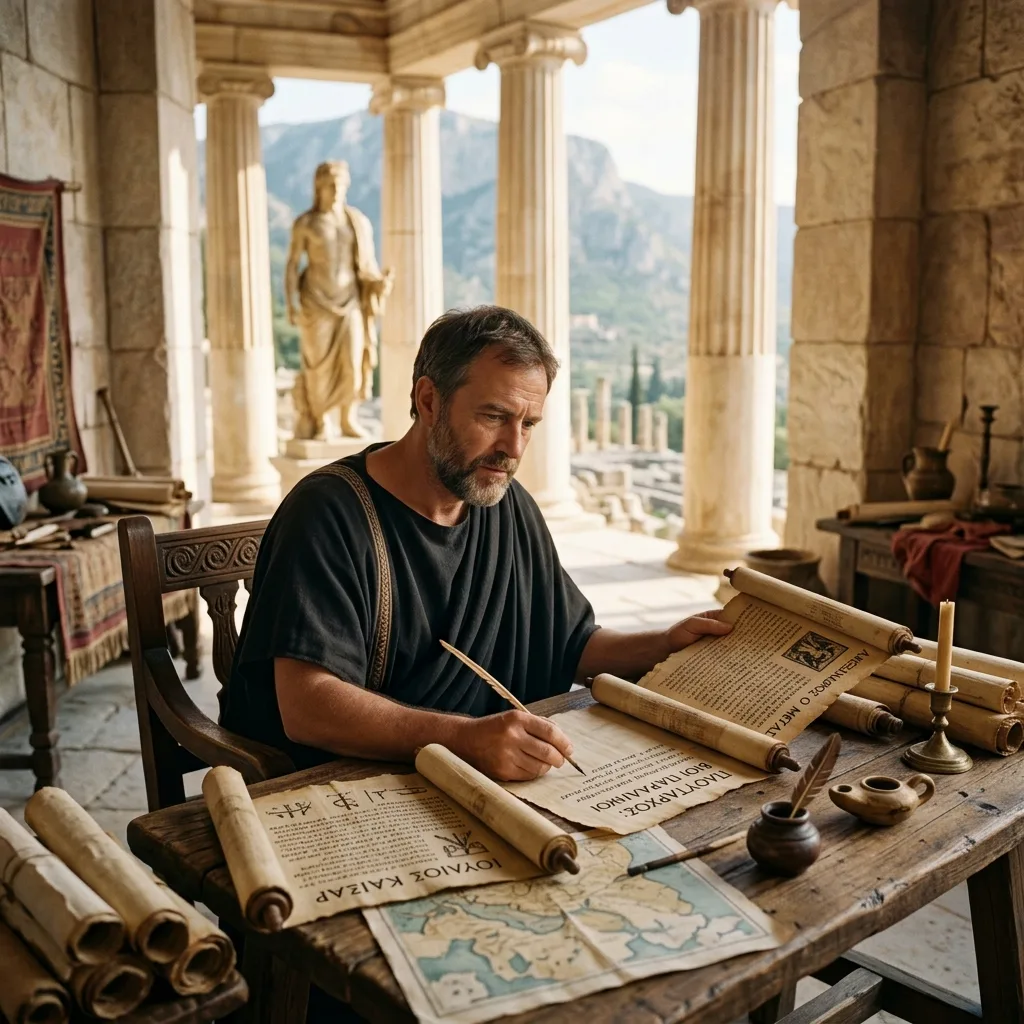
A Greek Middle Platonist philosopher, historian, and priest at the Temple of Apollo in Delphi. He is most famous for his "Parallel Lives" (a series of biographies pairing famous Greeks with famous Romans) and the "Moralia" (a collection of essays on philosophy, religion, and ethics).
Open in interactive timeline →Key Numbers
- Surviving Lives
- 48 biographies
- Paired Greek-Roman books
- 23 pairs
- Plutarch's lifespan
- c. AD 46-120
- Years as priest at Delphi
- ~30 (from c. AD 95)
- Surviving Moralia works
- 78 essays/treatises
Verified Facts
- The 'Parallel Lives' survive as 23 paired books, each yoking one Greek and one Roman statesman or general (e.g., Alexander with Caesar, Demosthenes with Cicero), plus four unpaired single lives, for a total of 48 surviving biographies.
- Plutarch was born around AD 46-47 in Chaeronea, a small town in Boeotia in central Greece, and remained so attached to it that he wrote he stayed there lest the already-declining town grow even smaller.
- From roughly AD 95 until his death, Plutarch served for life as one of the two priests of Apollo at the Oracle of Delphi, responsible for interpreting the utterances of the Pythia.
- In the famous opening of the 'Life of Alexander,' Plutarch declares his method: 'For it is not Histories that I am writing, but Lives,' arguing that a phrase or a jest often reveals character more than battles where thousands fall.
- Each pair was designed around an explicit moral aim and most pairs close with a formal comparison, the 'synkrisis,' weighing the two men's virtues and failings side by side; the synkrisis is missing from four of the pairs.
- The famous pairing of the Theban general Epaminondas with Scipio Africanus of Rome, both celebrated for defeating supposedly invincible foes (Sparta and Hannibal respectively), was lost in transmission and survives only in fragments.
- Beyond the Lives, Plutarch produced a vast body of work known as the 'Moralia,' of which 78 essays and treatises on ethical, religious, political, and literary subjects survive, cast mainly as dialogues or diatribes.
- Plutarch's Greek text reached English through a chain of translations: Jacques Amyot rendered it into French in 1559, and Sir Thomas North translated Amyot's French into English in 1579, not from the original Greek.
- Shakespeare drew his Roman plays, including 'Julius Caesar,' 'Antony and Cleopatra,' and 'Coriolanus,' directly from North's translation, at times versifying North's prose almost word-for-word, as in Enobarbus's description of Cleopatra's barge.
- According to the later Byzantine chronicler George Syncellus, Emperor Hadrian late in Plutarch's life appointed him nominal procurator of Achaea, an honor entitling him to the vestments and ornaments of a Roman consul; he had earlier received Roman citizenship through his friend L. Mestrius Florus, taking the name Lucius Mestrius Plutarchus.
The World at This Moment
Plutarch (c. 45–c. 120 CE) wrote the Parallel Lives largely under Trajan (r. 98–117) and into Hadrian's reign, the height of Roman imperial power and the so-called Pax Romana. He was a Boeotian Greek priest at Delphi (from c. 95 CE), holding Roman citizenship (L. Mestrius Plutarchus) and, reportedly, honorary consular rank. His project belongs to the cultural revival historians call the Second Sophistic, in which Greek elites under Rome asserted Hellenic identity through literature and rhetoric. Contemporaries include the Stoic Epictetus, the orator Dio Chrysostom, the satirist Lucian (slightly later), and on the Latin side Tacitus and the younger Pliny, who were composing their own histories and letters. Eastward, the Kushan empire flourished and Han China under Emperor He maintained the Silk Road exchanges. Plutarch wrote as a provincial intellectual reconciling Greek heritage with Roman governance, treating Greek and Roman statesmen as morally commensurable—a project intelligible only within a unified Mediterranean imperial order.
The Paradigm Shift
The Parallel Lives helped consolidate biography as a distinct mode of writing, separate from but adjacent to history, organized around the disclosure of character (ēthos) rather than the chronicle of public events. Plutarch's programmatic insistence that a jest or gesture can reveal a soul more than a battle reoriented the genre toward ethical interiority and exemplarity. By pairing a Greek with a Roman (Alexander–Caesar, Demosthenes–Cicero) and appending a comparison (synkrisis), he proposed that virtue and vice are cross-cultural and that Greek and Roman pasts form one moral inheritance—an idea foundational to later humanism. Transmitted through Jacques Amyot's French (1559) and Thomas North's English (1579), the Lives shaped Shakespeare's Roman plays (Julius Caesar, Antony and Cleopatra, Coriolanus, often near-verbatim from North), Montaigne's essays, and the political imagination of the Enlightenment and the American and French revolutions, where Plutarchan heroes served as models of republican character. Few ancient works so durably defined how the West reads exemplary lives.
In Their Own Words
"For it is not Histories that I am writing, but Lives; and in the most illustrious deeds there is not always a manifestation of virtue or vice, nay, a slight thing like a phrase or a jest often makes a greater revelation of character than battles where thousands fall, or the greatest armaments, or sieges of cities." — Plutarch, Life of Alexander 1.2 (trans. Bernadotte Perrin, Loeb Classical Library)
In Depth
The Mirror Between Two Worlds
Around 100 CE, a Greek priest at Delphi who never severed his ties to his small home town of Chaeronea sat down to do something quietly revolutionary: he paired the great men of vanished Greece with the masters of the empire that had conquered it. Plutarch (c. 46–after 119 CE) wrote the Parallel Lives to hold a Greek and a Roman up to the same light — Alexander beside Caesar, Demosthenes beside Cicero — and ask, in each pair, what made a soul noble or corrupt. His stated method, declared in the Life of Alexander, was that he was "writing not histories but lives," and that a jest or an offhand phrase could reveal a character more truly than the bloodiest siege.
The conditions that produced him. Plutarch is a creature of a fused world. That fusion began when Alexander (sv-alexander) carried Greek language and learning east, and it hardened when Rome absorbed the Hellenistic kingdoms — the Ptolemies (sv-ptolemaic) and Seleucids (sv-seleucid) — into a single Mediterranean order under Augustus (sv-augustus). By Plutarch's lifetime a cultured Greek could be a Roman citizen, hold local magistracies, and still feel himself heir to Athens. His project only makes sense inside that doubleness. He drank from an old well: the moral biography descends from the heroic exemplars of Homer (sv-homer), and his Middle Platonist convictions — a transcendent, ordering god — root him in the school Plato (sv-plato) founded, by way of Aristotle's (sv-aristotle) interest in character and ethics. He is also, like Herodotus (sv-herodotus) and his near-contemporary Tacitus (sv-tacitus), part of the long classical effort to ask what the past means, not merely what happened.
What he reshaped. Plutarch effectively invented comparative biography as a moral instrument. Eighteen of the paired lives close with a formal synkrisis, a head-to-head verdict — a structure that treats history as a gymnasium for the soul rather than a chronicle. This had consequences far out of proportion to its modest origins. When Thomas North rendered the Lives into English in 1579 (through Jacques Amyot's French), he handed Shakespeare the raw material and often the very cadences of Julius Caesar, Antony and Cleopatra, and Coriolanus — so the Rome of Caesar at the Rubicon (sv-julius-caesar) reaches modern audiences largely through Plutarch's framing. The Renaissance (sv-renaissance) seized on him as the supreme teacher of statecraft and virtue; through the printing press (sv-printing-press) his cheap, portable wisdom spread across Europe, shaping the essay (Montaigne adored him), the biography, and the political imagination of men who would make the American Revolution (sv-american-revolution). The founders read Plutarch's republicans as living models.
The threads outward. What Plutarch did to character, others did to information: he stands within a Greco-Roman knowledge economy whose monument is the Library of Alexandria (sv-library-alexandria) and whose method of measured judgment runs alongside Josephus's (sv-josephus) effort to make a conquered people's past legible to its conquerors. His religious world — a pagan priest serving Delphi for decades while the Second Temple fell (sv-second-temple) and a new faith stirred — would, within three centuries, be outlawed when Theodosius (sv-theodosius) closed the oracles. Yet Plutarch outlived the gods he served. Christian humanists kept copying him precisely because his ethics felt portable across creeds.
That portability is his deepest legacy. Plutarch grasped that history's true subject is the human interior, and that the way to study it is by comparison — placing two lives side by side until each illuminates the other. It is a method we never abandoned. Every modern dual biography, every "compare and contrast" essay assigned in school, is a faint echo of a Boeotian priest deciding that the measure of a life is best taken against another.
Causes & Consequences
What led to it
- The Pax Romana, the long period of relative stability under the early Roman Empire, gave a provincial Greek like Plutarch the security, mobility, and leisure to travel to Rome, lecture, and devote decades to literary composition.
- The Second Sophistic, a revival of Greek rhetorical and literary culture in the late first and second centuries CE, created elite demand for works asserting Hellenic cultural prestige within a Roman political order.
- Plutarch's philosophical education in Athens under the Platonist Ammonius, and his lifelong immersion in Plato, gave him the ethical framework he used to judge character as the central engine of his biographies.
- Plutarch's acquisition of Roman citizenship (as Lucius Mestrius Plutarchus) and his friendships with influential Romans gave him access to Roman historical material and a personal stake in reconciling Greek and Roman elites.
- His lifelong priesthood at Delphi from about 95 CE rooted him in a revered center of Greek tradition and reinforced the moralizing, exemplary cast of his writing.
- An existing tradition of Greek and Roman biography and historiography, including writers such as Cornelius Nepos who had earlier paired or collected lives of notable men, supplied models and source material Plutarch could adapt into his paired structure.
What it set in motion
- Plutarch popularized the paired-comparison biography focused on moral character rather than comprehensive history, shaping the Western genre of the exemplary 'life' for centuries.
- Thomas North's 1579 English translation (made from Jacques Amyot's French version) became an Elizabethan classic and the direct source for Shakespeare's Roman plays, including Julius Caesar, Antony and Cleopatra, and Coriolanus, with Shakespeare borrowing whole passages.
- Plutarch's essays and Lives deeply influenced Montaigne, whose Essais drew repeatedly on him, helping seed the modern personal-essay tradition.
- John Dryden lent his name to a new English translation of the Lives published in 1683-86, keeping Plutarch a staple of educated reading through the 17th and 18th centuries.
- Plutarch became required reading for the American founders and European revolutionaries, supplying republican heroes and models of civic virtue; figures like George Washington consciously emulated his subjects and Napoleon treated the Lives as a manual of rule.
- His emphasis on individual heroes as the drivers of events fed the 19th-century 'great man theory' of history, influential through writers like Emerson and Carlyle and prevalent in antebellum thought.
The Live Academic Debate
The central modern debate concerns the nature of Plutarch's moralism. An older view read the Lives as straightforwardly didactic—offering heroes as patterns to imitate or shun (protreptic, expository moralism). Against this, Christopher Pelling argued that much of Plutarch's moralism is "descriptive" and "exploratory," prompting readers to reflect on human behavior rather than issue verdicts. Timothy Duff, in Plutarch's Lives: Exploring Virtue and Vice (1999), developed this further, contending that Plutarch's moralism is "exploratory and challenging, rather than affirmative," with many pairs deliberately resisting easy judgment; Duff's book became the starting point for subsequent discussion. Others, such as Philip Stadter and (more pragmatically) Frances Titchener, stress concrete political and ethical instruction for statesmen, partly reasserting a didactic reading. A related dispute concerns the synkriseis—whether the formal comparisons are integral and authentic or perfunctory appendages—and how seriously to take Plutarch's claimed distinction between "lives" and "history" as a genuine methodological commitment versus a rhetorical topos.
How This Event Connects
Plutarch’s monumental Parallel Lives is far more than a collection of biographies; it is a profound exercise in moral philosophy and cultural negotiation. Historiographically, his work is deeply anchored in the intellectual lineage of Plato & The Academy. Modern scholarship recognizes Plutarch not merely as a biographer, but as a rigorous Middle Platonist who utilized historical narrative as a pedagogical tool. His biographies are functional applications of Platonic ethics, demonstrating how the rational soul, governed by proper paideia (education), must master the irrational passions. The Lives are essentially applied Platonism, serving to guide the reader toward philosophical virtue.
Methodologically, Plutarch’s reliance on synkrisis—the structured comparison between Greek and Roman figures—is perfectly exemplified in his treatment of world-shaping autocrats, notably his juxtaposition involving Julius Caesar Crosses the Rubicon. By placing Greek heroes on an equal moral and philosophical footing with the conquerors of Rome, Plutarch subtly asserted the supremacy of Greek cultural identity in a world dominated by Roman military might. His analysis of Caesar’s ambition and fall serves as a quintessential moral paradeigma (pattern) of how untamed passion and hubris lead to tragic consequences, shaping the Western perception of Caesar for millennia.
Furthermore, Plutarch’s role as an intellectual navigating the realities of the Roman Empire parallels the complex inner life of Marcus Aurelius & The Meditations. While Plutarch championed Middle Platonism and Marcus adhered to Stoicism, both authors exemplify the second-century synthesis of philosophy and statecraft. Both used literature—whether it be the biographical exempla of the Lives or the private spiritual exercises of the Meditations—as psychological and moral bastions against the corrupting pressures of imperial power, reflecting a shared elite obsession with maintaining an \"inner citadel\" of virtue amidst the sprawling machinery of Rome.
The Counterfactual
Had Plutarch never composed the Lives, the ancient lives of Alexander, Caesar, Brutus, Antony, Pericles, and many others would survive only in fragments and inferior sources; for figures such as Coriolanus or Aratus, Plutarch is a principal witness. The damage would be less to the bare record than to the European tradition of moral biography. Without the Amyot–North transmission, Shakespeare would have lacked his chief source for the Roman plays—Antony and Cleopatra and Coriolanus are built so closely on North that their absence is hard to imagine in present form. Montaigne, who quotes Plutarch constantly, and the revolutionary cult of antique virtue (Rousseau, the Jacobins, the American founders' fondness for Plutarchan exemplars) would have drawn on thinner materials. A plausible alternative is that Suetonius's gossipy imperial Lives and Nepos's brief sketches would have dominated the biographical model, yielding a tradition more anecdotal and less ethically searching. The genre's distinctive marriage of comparative ethics and narrative would likely have been weaker or arrived later.
Myth vs. Reality
Myth: Plutarch was a historian, and the Parallel Lives are meant to be accurate history.
Reality: Plutarch explicitly disclaimed this. In the Life of Alexander he writes that he is composing not Histories but Lives, and that a small thing like a phrase or a jest often reveals character more than battles where thousands die. His aim was moral and biographical, not chronological or evidentiary. Eighteenth-century critics who attacked the Lives for inaccuracies and exaggerations were faulting Plutarch for failing at a task he never set himself; modern scholarship reads the Lives as ethical biography, not annals.
Myth: Plutarch lived around the same time as the Greeks and Romans he wrote about, so his accounts are eyewitness or near-contemporary.
Reality: Plutarch was born around 46 CE and died after about 119 CE, writing the Lives in the early second century CE. He lived more than four centuries after Alexander the Great and roughly a century and a half after Julius Caesar. He worked from earlier sources, many now lost (for Alexander he drew on writers like Aristobulus, Onesicritus, Ptolemy and the so-called Royal Diary), so the Lives are compilations from prior texts, not firsthand testimony.
Myth: The Parallel Lives were written to prove Greeks were superior to Romans.
Reality: Plutarch, a Greek who held Roman citizenship and esteemed Greek culture, nonetheless paired a Greek and a Roman precisely to encourage mutual respect and to blunt the stereotypes of practical Rome versus aesthetic Greece. The work was dedicated to Sosius Senecio, a friend of the emperor Trajan. While Plutarch leaned toward the Greeks, scholars note he gave the Romans their due and aimed at a near balance of virtues and vices rather than ethnic triumphalism.
Myth: Plutarch was essentially just a biographer; the Lives are his main body of work.
Reality: Plutarch was a Middle Platonist philosopher and served for decades as a priest at the Temple of Apollo at Delphi. Alongside the Lives he produced the Moralia, a large collection of more than 70 surviving essays and dialogues on ethics, religion, natural philosophy and more, with a roughly contemporary catalogue listing about 100 further works now lost. Biography was one strand of a wide literary and philosophical output, not the whole.
Myth: Shakespeare read Plutarch in the original Greek when writing his Roman plays.
Reality: Shakespeare's source for Julius Caesar, Antony and Cleopatra and Coriolanus was Sir Thomas North's English Lives of the Noble Grecians and Romanes (1579). North did not translate from Plutarch's Greek either: he worked from Jacques Amyot's French version. So the Plutarch that shaped Shakespeare reached him through a French intermediary and an English translation, not the Greek text.
Frequently Asked Questions
Who was Plutarch and when did he live?
Plutarch was a Greek philosopher, biographer, and essayist born around 46 CE in Chaeronea, a small town in Boeotia, central Greece, and he died sometime after 119 CE (often given as around 120 CE). He spent most of his life in his hometown, where he held municipal offices and ran a school centered on ethics, and he served for many years as one of the priests of Apollo at the oracle of Delphi. He is best known today for his 'Parallel Lives' and for a large collection of essays known as the 'Moralia.'
What is Plutarch's 'Parallel Lives' about?
The 'Parallel Lives' is a series of biographies pairing a famous Greek figure with a comparable Roman one, with each pair usually followed by a short formal comparison (a 'synkrisis'). Plutarch chose his subjects for similarities of character or career, aiming to draw out moral lessons and to encourage mutual respect between Greeks and Romans. Twenty-two paired biographies survive along with four single Lives. Famous pairings include Alexander the Great with Julius Caesar and the Greek orator Demosthenes with the Roman orator Cicero.
When did Plutarch write the Parallel Lives?
Scholars generally date the composition of the 'Parallel Lives' to roughly 105-115 CE, during the later years of Plutarch's life under the Roman emperors Trajan and Hadrian. Internal references within the text point to these final decades, and Plutarch appears to have published the biographies in successive books of paired Lives over a span of years rather than all at once.
Did Plutarch consider himself a historian?
No. In the preface to his Life of Alexander, Plutarch explicitly distinguishes his project from history, writing that he is composing 'not Histories but Lives.' He argued that 'a slight thing like a phrase or a jest often makes a greater revelation of character than battles where thousands fall,' meaning his goal was to illuminate the moral character of his subjects rather than to give a complete account of their deeds. He compared his task to that of a portrait painter who concentrates on the face and the expression of the eyes to reveal the soul.
How did Plutarch influence Shakespeare?
Shakespeare drew heavily on the 'Parallel Lives' through Sir Thomas North's 1579 English translation, which North made from Jacques Amyot's 1559 French version rather than from the original Greek. Plutarch's Lives were the principal source for Shakespeare's Roman plays, chiefly 'Julius Caesar,' 'Antony and Cleopatra,' and 'Coriolanus.' In some passages Shakespeare followed North's prose so closely that he turned it almost directly into blank verse, most famously in Enobarbus's description of Cleopatra on her barge in 'Antony and Cleopatra.'
How were the Parallel Lives structured and what was their purpose?
Each unit typically presented a Greek life and a Roman life as a matched pair, followed by a brief comparison weighing the two figures against each other. Plutarch's method was to recount a subject's birth, upbringing, achievements, and death, using telling anecdotes and small details to reveal character rather than to catalog every event. His broader purpose was moral and educational: to offer model patterns of virtue and vice for readers to imitate or avoid, and to foster understanding between the Greek and Roman worlds of his day.
Why are some of the Parallel Lives missing today?
Plutarch is believed to have written more pairs than survive; the work has come down to us incomplete after centuries of manuscript transmission. Today twenty-two paired biographies and four standalone Lives survive, but at least a few pairs known to have existed, such as a Lives of Epaminondas and Scipio referred to in antiquity, have been lost. Some of the surviving pairs are also missing their concluding formal comparison, suggesting those sections did not survive or were never completed.
Sources & Further Reading
- Parallel Lives — Wikipedia
- Timothy E. Duff, Plutarch's Lives: Exploring Virtue and Vice (Oxford, 1999)
- Christopher Pelling, Plutarch and History: Eighteen Studies (Swansea/London, 2002)
- Philip A. Stadter, Plutarch and his Roman Readers (Oxford, 2015)
- Bernadotte Perrin (trans.), Plutarch's Lives, Loeb Classical Library (Harvard, 1914–26)
- Christopher Pelling, 'Plutarch's Method of Work in the Roman Lives', Journal of Hellenic Studies 99 (1979)
- Wikipedia: Plutarch
- Read: Parallel Lives (MIT Classics)
Cite This Page
AskHistoryAI. “Plutarch & The Parallel Lives.” AskHistoryAI — Interactive Timeline of Everything. Updated 2026-09-11. https://askhistoryai.com/event/sv-plutarch/
Every fact on this page is checked against the published fact ledger and methodology; sources are listed above.