The Singularity Is Near
The codification of the Law of Accelerating Returns.
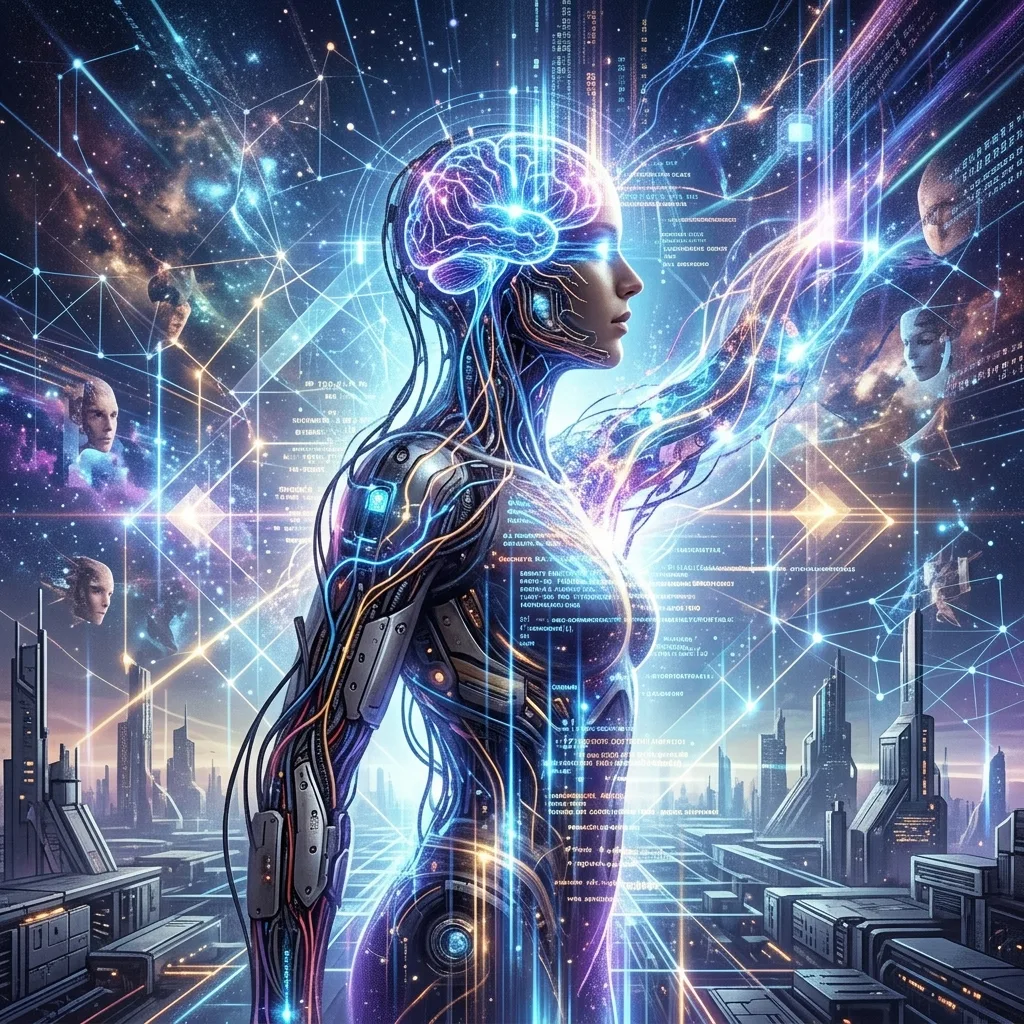
Inventor and futurist Ray Kurzweil publishes "The Singularity Is Near", a massively influential book predicting that exponential technological growth will inevitably lead to artificial superintelligence and the merger of humans and machines by 2045.
Open in interactive timeline →Key Numbers
- Published
- Sept 2005, Viking (652 pp.)
- Human-level AI (predicted)
- 2029
- The Singularity (predicted)
- 2045
- Self-claimed forecast accuracy
- ~86% (disputed)
- Status
- Documented prediction, not fact
Verified Facts
- Ray Kurzweil's 'The Singularity Is Near: When Humans Transcend Biology' was published in September 2005 by Viking; it became a New York Times bestseller and was named one of Amazon.com's Best Science Books of 2005, with reviewer Janet Maslin calling it 'startling in scope and bravado.'
- The book's two headline predictions are documented projections, not established facts: Kurzweil forecasts that AI will reach human-level intelligence (passing a valid Turing test) by around 2029, and that 'the Singularity' the moment humans merge with their machine intelligence and amplify their effective intelligence will arrive around 2045.
- Kurzweil defines the Singularity in his own words as the point 'when we will multiply our effective intelligence a billion fold by merging with the intelligence we have created,' envisioning nonbiological intelligence in the 2030s connecting human brains to the cloud.
- The book's central thesis is the 'Law of Accelerating Returns' a generalization of Moore's Law arguing that not just transistor density but all information technologies (computing, genome-sequencing cost, brain-scanning resolution, bandwidth, storage) improve exponentially, so technological change itself accelerates over time.
- Kurzweil predicted that around 2020 a $1,000 computer would match the raw processing power of a single human brain, and that by the early 2030s $1,000 of computation would buy roughly 10^17 operations per second, eventually rivaling the combined intelligence of all living humans (estimated at ~10^26 computations per second) each year.
- Chapter 1, 'The Six Epochs,' frames the Singularity within a cosmic-evolutionary scheme of six stages from physics and chemistry, to biology and DNA, to brains, to technology, to the merger of human technology with human intelligence, culminating in a final epoch in which intelligence saturates and 'wakes up' the universe.
- The path to the Singularity runs through what Kurzweil abbreviates as GNR three overlapping revolutions in Genetics (reprogramming biology to reverse aging and disease), Nanotechnology (molecular robots repairing cells and manufacturing atom-by-atom), and Robotics/AI (machine intelligence equaling and then surpassing human intelligence).
- Kurzweil's forecasting reputation rests on a contested self-assessment: reviewing the 147 predictions in his 1999 book 'The Age of Spiritual Machines,' he counted 115 as 'entirely correct,' 12 'essentially correct,' and 17 'partially correct' for a claimed ~86% accuracy a figure critics such as Forbes's Alex Knapp dispute, arguing many predictions were vague or wrong and that true accuracy was closer to half.
- In December 2012 Kurzweil joined Google as a Director of Engineering working on machine learning and natural-language understanding, giving the futurist a direct hand in the AI field whose trajectory he had been forecasting.
- Kurzweil reaffirmed both signature dates in his 2024 sequel 'The Singularity Is Nearer: When We Merge with AI' (released June 25, 2024), holding to 2029 for human-level AI and 2045 for the Singularity, and noting 'I said 2029 in 1999... I see no reason to increase my estimate,' while conceding that recent AI progress makes 2029 look, if anything, conservative.
The World at This Moment
Kurzweil's 652-page book appeared from Viking in September 2005, a moment when "deep learning" did not yet exist as a working paradigm. The dominant AI approaches were still statistical and symbolic; the convolutional-net breakthrough (AlexNet, 2012) and the Transformer (2017) lay years ahead. Yet the technological substrate Kurzweil invoked was visibly accelerating: Moore's Law still held, Google had IPO'd in 2004, the Human Genome Project had finished in 2003, and broadband and mobile computing were diffusing globally. The book built on his earlier The Age of Spiritual Machines (1999) and Vernor Vinge's 1993 essay coining the technological "Singularity." It arrived amid a wider transhumanist ferment—Nick Bostrom and the World Transhumanist Association, Aubrey de Grey's anti-aging program, Eric Drexler's molecular-nanotechnology vision. Contemporaneously, the Iraq War, post-9/11 securitization, and early climate-policy debates dominated headlines, while popular futurism was largely dismissive of strong AI. Kurzweil deliberately positioned his optimism against that prevailing skepticism.
The Paradigm Shift
The book's chief effect was rhetorical and cultural rather than scientific: it crystallized "the Singularity" as a mainstream concept and gave exponential-growth futurism a popular vocabulary. Kurzweil's "Law of Accelerating Returns"—the claim that information-technology capability per unit cost grows exponentially, even double-exponentially—framed AI progress as predictable extrapolation rather than open-ended uncertainty. His headline forecasts (human-level AI passing the Turing test by 2029; a merger of human and machine intelligence around 2045) became reference points debated for two decades. The book helped seed Singularity University (2008, co-founded with Peter Diamandis) and shaped Silicon Valley's self-understanding; Kurzweil himself joined Google in 2012. It also sharpened the existential-risk conversation that Bostrom would systematize in Superintelligence (2014). Crucially, Kurzweil shifted the question from "whether" machine superintelligence is possible to "when," normalizing aggressive timelines. Whether that reframing clarified or distorted subsequent AI discourse remains contested—but its agenda-setting power is hard to deny.
In Their Own Words
"We won't experience 100 years of progress in the 21st century—it will be more like 20,000 years of progress (at today's rate)." — Ray Kurzweil, The Singularity Is Near: When Humans Transcend Biology (Viking, 2005), prologue ("The Power of Ideas")
In Depth
The Map of Acceleration: How One Book Turned Cosmic History Into a Countdown
When Ray Kurzweil published The Singularity Is Near: When Humans Transcend Biology in 2005, he was not making a prediction so much as drawing a map. The book's audacity was to plot every milestone on this timeline — from The Big Bang (sv-big-bang) to the dawn of computers — on a single logarithmic curve, and to claim that the curve bent the same way throughout. That claim, formalized as the Law of Accelerating Returns (sv-kurzweil-law), is the deep idea around which everything else in the book orbits.
Deep Preconditions
The Singularity thesis could only be written after a particular chain of intellectual events made it thinkable. It required a universe whose history could be read as a sequence of information-processing revolutions — the emergence of self-replicating chemistry at The Origin of Life (sv-origin-of-life), the encoding of heredity in DNA, the runaway growth of nervous tissue after The Cambrian Explosion (sv-cambrian-explosion), and finally the symbolic externalization of memory that began with The Invention of Cuneiform (sv-cuneiform) and accelerated with The Gutenberg Press (sv-printing-press). Kurzweil's six epochs — physics and chemistry, biology, brains, technology, the human-machine merger, and a cosmos that "wakes up" — are essentially this entire timeline recast as one accelerating process, culminating in Epoch 6: The Universe Wakes Up (sv-kurzweil-epoch6).
The more immediate precondition was empirical. By 2005, the exponential trend lines were impossible to ignore: Moore's Law had held for forty years, and Deep Blue Defeats Kasparov (sv-deep-blue) had shown that brute computation could topple a domain once thought to require human genius. Kurzweil generalized Moore's narrow observation about transistors into a universal pattern, arguing that the twenty-first century would see not a hundred but the equivalent of twenty thousand years of progress at today's rate.
Ripple Effects
The book's real influence was cultural rather than technical. It gave the diffuse intuitions of Silicon Valley a vocabulary and a date — 2045 — and reframed the future as a countdown rather than an open horizon. It seeded the longevity movement and the transhumanist program, splitting Kurzweil's own forecast into the now-familiar sub-predictions tracked here: AGI by 2029 (sv-kurzweil-agi-2029), Longevity Escape Velocity (sv-kurzweil-lev), and the millionfold intelligence explosion (sv-kurzweil-singularity). When the deep-learning breakthroughs arrived — AlexNet (sv-alexnet-convnets) in 2012, AlphaGo Defeats Lee Sedol (sv-alphago) in 2016 — believers read them as the curve coming due, vindication of a schedule set a decade earlier.
Threads and Counter-Threads
Kurzweil's vision belongs to an ancient lineage. His epochs echo the cosmic genealogies of Hesiod & the Theogony (sv-hesiod), and his confidence that reality is fundamentally computational descends from Democritus & the Atom (sv-democritus) and Pythagoras (sv-pythagoras), for whom number was the substrate of the world. Critics seized on exactly this. Jaron Lanier warned that "the distance between recognizing a great metaphor and treating it as the only metaphor is the same as the distance between humble science and dogmatic religion." Others objected that hardware was racing while software lagged, that the brain might not be reducible to silicon, and that no empirical evidence for machine consciousness existed — echoes of the same doubts that have shadowed every claim about minds since Plato & the Academy (sv-plato).
This timeline must therefore hold The Singularity Is Near honestly: not as fact but as the most documented and influential projection of its age. It is the hinge where a history written backward from the present pivots to become a forecast — the moment the long arc of accelerating information first dared to name the year it expected to converge.
Causes & Consequences
What led to it
- John von Neumann, as recalled secondhand by Stanislaw Ulam in 1958, spoke of an 'ever accelerating progress of technology' and an approaching essential singularity beyond which human affairs as we know them could not continue, planting the conceptual seed Kurzweil later expanded.
- I.J. Good's 1965 paper 'Speculations Concerning the First Ultraintelligent Machine' introduced the 'intelligence explosion' argument that a machine able to design better machines would recursively self-improve, supplying the core mechanism Kurzweil invokes for runaway superintelligence.
- Gordon Moore's 1965 observation that transistor counts on integrated circuits were doubling roughly every one to two years gave Kurzweil the empirical exponential curve he generalized into his broader 'Law of Accelerating Returns.'
- Vernor Vinge's 1993 essay 'The Coming Technological Singularity' fixed the term 'singularity' in popular and academic discourse and framed the post-human-intelligence transition Kurzweil built his book around.
- Kurzweil's own earlier books, 'The Age of Intelligent Machines' (1990) and 'The Age of Spiritual Machines' (1999), developed his views on pattern recognition, machine intelligence, and exponential technology trends that 'The Singularity Is Near' synthesized and extended.
- Decades of documented exponential improvement across computing cost-performance, genome sequencing, and brain-scanning resolution gave Kurzweil the multi-domain data sets he plotted to argue that accelerating returns extend far beyond microchips.
What it set in motion
- The book inspired Peter Diamandis, who together with Kurzweil co-founded Singularity University at NASA's Moffett Field in 2008 to train leaders in exponential technologies, an institution that has since reached audiences in over 100 countries.
- Kurzweil's high-profile advocacy helped popularize 2045 as a widely cited target date for the Singularity, anchoring the futurist '2045 Initiative' and countless subsequent debates over AGI timelines.
- In 2012 Larry Page hired Kurzweil as a Director of Engineering at Google to work on machine learning and natural language understanding, embedding his vision inside one of the world's leading AI research organizations.
- The book intensified mainstream debate over AI existential risk and alignment, a discourse later formalized by Nick Bostrom's 'Superintelligence' (2014) and institutionalized in the founding missions of organizations like OpenAI and DeepMind.
- It became a defining text of the modern transhumanist and radical-life-extension movements, amplifying interest in human-machine merger, mind uploading, and longevity research that Kurzweil personally championed.
- Its sequel 'The Singularity Is Nearer' (2024) revisited and largely reaffirmed the 2005 predictions in light of the deep-learning and large-language-model boom, presenting the original book's framework as a lens for interpreting contemporary AI progress.
The Live Academic Debate
The central, still-live dispute is whether Kurzweil's exponential extrapolation is genuine science or pattern-mongering. Critics argue his curves are cherry-picked and that real systems follow logistic (S-shaped) growth that saturates. Physicist Theodore Modis contended Kurzweil mistook the rising arm of a sigmoid for unbounded acceleration; neuroscientist David Linden argued data collection grows exponentially while genuine insight grows only linearly. Douglas Hofstadter dismissed the work in The New Yorker as "a very bizarre mixture of ideas that are solid and good with ideas that are crazy," likening it to good food blended into mush. Paul Davies, reviewing in Nature, praised its "breathtaking" sweep but urged "a huge dose of salt," and philosopher John Gray read the Singularity as a secularized apocalyptic myth. Defenders—including allies at Singularity University and Kurzweil himself, who claims a high hit-rate for his predictions—counter that critics underestimate compounding and that 2029-era LLM progress vindicates his timeline. The debate now centers on whether recent AI advances confirm Kurzweil or merely resemble one stretch of an S-curve.
How This Event Connects
This event covers a contemporary or forecast topic. The analysis below interprets a fast-moving subject; treat forward-looking claims as forecast, not settled history.
Ray Kurzweil's The Singularity Is Near codified the ideological framework of Transhumanism, fundamentally altering the teleology of technological progress. Kurzweil's thesis posits that the exponential growth curve initiated during the Industrial Revolution is not merely a localized historical trend, but a universal evolutionary law. By extrapolating Moore's Law into biological and cognitive domains, Kurzweil argues that humanity is rapidly approaching a point where technological intelligence will exponentially outstrip human cognition.
This deterministic vision is a radical reinterpretation of the evolutionary paradigms established by Charles Darwin. In the Transhumanist framework, Darwinian biological evolution is deemed too slow; humanity must proactively seize control of its own evolutionary trajectory through cybernetics and genetic engineering. This ideological stance draws profound, albeit highly contested, parallels to the philosophy of Friedrich Nietzsche. Silicon Valley frequently co-opts Nietzsche’s concept of the Übermensch to justify the Singularity, framing machine superintelligence as the literal, triumphant self-overcoming of the human species, despite posthumanist critiques that such a future obliterates Nietzschean spiritual affirmation in favor of algorithmic efficiency.
The urgency of Kurzweil's theoretical eschatology has been sharply contextualized by the recent events surrounding The Dawn of AGI. As theoretical models of the Singularity collide with the actual emergence of highly capable artificial general intelligence, Kurzweil's predictions are no longer abstract philosophy. The historiographical focus has violently shifted from whether the Singularity will occur, to the catastrophic existential risks of the "Alignment Problem," proving that the unchecked acceleration of the Industrial Revolution has brought humanity to the precipice of its own obsolescence.
The Counterfactual
Had Kurzweil never published, the technological achievements—deep learning's resurgence after 2012, large language models after 2018—would almost certainly have arrived on the same schedule, since they flowed from hardware (GPUs), data, and algorithmic work largely independent of his forecasts. What would differ is the interpretive frame. Without The Singularity Is Near, "the Singularity" might have remained a niche term from Vinge and the cypherpunk fringe rather than a boardroom and op-ed staple. The transhumanist movement would have continued through Bostrom, de Grey, and More, but lacked Kurzweil's mass-market megaphone and his specific, falsifiable dates that disciplined subsequent debate. Institutions like Singularity University presuppose his platform. Counterfactually, the AI-safety and longtermist conversation might have crystallized later or with different emphases, perhaps anchored more soberly in Bostrom's risk framing than Kurzweil's techno-optimist teleology. The deeper point, stressed by critics like Theodore Modis, is that the underlying curves—logistic, not endlessly exponential—do not depend on any book; only the public mythology around them does.
Myth vs. Reality
Myth: Kurzweil predicted the Singularity itself for 2029.
Reality: In 'The Singularity Is Near' (2005), Kurzweil tied two distinct dates to two distinct events. He projected that AI would reach human-level intelligence and pass a valid Turing Test around 2029, but he placed the Singularity proper, the point at which non-biological intelligence vastly exceeds the sum of human intelligence and humans merge with it, at 2045. The 2029 date is a milestone on the way, not the Singularity. His later 2024 book 'The Singularity Is Nearer' kept 2029 for human-level AGI and 2045 for the merger.
Myth: The book is fundamentally about a hostile AI that takes over or enslaves humanity, the Skynet scenario.
Reality: Kurzweil's thesis is not a machines-versus-humans takeover. His subtitle is 'When Humans Transcend Biology,' and his vision is a merger: brain-computer interfaces, nanobots in the bloodstream, and digital extensions blurring the line between human and machine. Kurzweil has explicitly called the science-fiction depiction of AI enslaving humanity unrealistic, framing the Singularity instead as a human enhancement and life-extension event. The book does discuss existential risks of GNR technologies, but the central narrative is augmentation, not subjugation.
Myth: Kurzweil's case rests on Moore's Law, so when transistor scaling stalls his whole prediction collapses.
Reality: Kurzweil's underlying claim is his broader 'Law of Accelerating Returns,' set out in a 2001 essay and central to the book, which holds that technological progress is exponential across many measures, not just transistor density. He explicitly models computing as a cascade of overlapping S-curves where one paradigm (such as integrated circuits) gives way to the next, so Moore's Law ending is, in his framework, just one S-curve handing off to another rather than the end of the trend.
Myth: It's a pure-AI / software prediction.
Reality: Kurzweil frames the Singularity as driven by three overlapping revolutions he abbreviates GNR: Genetics (reprogramming biology to reverse disease and aging), Nanotechnology (molecular-scale machines that repair cells and manufacture matter), and Robotics (which for Kurzweil includes strong AI). Radical life extension and 'nanobots in the bloodstream' are as central to his argument as machine intelligence, which is why critics have engaged with his biology and nanotech timelines, not only his AI claims.
Myth: The predictions are precise, testable forecasts that experts broadly endorse.
Reality: Kurzweil's forecasts have drawn substantive criticism from named experts. Microsoft co-founder Paul Allen argued in 2011 (MIT Technology Review) for a 'complexity brake,' contending that understanding cognition gets harder, not exponentially easier, as we probe deeper. Former Scientific American editor-in-chief John Rennie argued in IEEE Spectrum (2010) that many of Kurzweil's predictions carry so many loopholes they border on the unfalsifiable, while his clearest hits often lack originality. Biologist PZ Myers separately attacked Kurzweil's brain-reverse-engineering timeline as lacking a measurable baseline. These are forecasts and projections of a contested future, not established fact.
Frequently Asked Questions
What is The Singularity Is Near about?
The Singularity Is Near: When Humans Transcend Biology is a 2005 book by inventor and futurist Ray Kurzweil. It argues that technological progress, especially in computing, genetics, nanotechnology, and robotics, advances exponentially rather than linearly, leading toward a 'technological singularity'—a point at which machine intelligence vastly surpasses human intelligence and human life is irreversibly transformed. Kurzweil frames this not as science fiction but as an extrapolation of measurable historical trends, and predicts humans will ultimately merge with the AI they create.
When did Ray Kurzweil predict the singularity would happen?
Kurzweil predicted the singularity would arrive around 2045, the year he expects machine intelligence to vastly exceed the combined intelligence of all humans. As a key milestone along the way, he predicted that AI would reach human-level intelligence and pass the Turing test by 2029. In interviews around the 2024 publication of his follow-up book, The Singularity Is Nearer, he reaffirmed that he was sticking with the 2045 date.
What is the 'law of accelerating returns'?
The law of accelerating returns is Kurzweil's central thesis: the rate of technological progress is itself exponential, not constant, because each generation of tools makes the next generation faster and cheaper to develop. He argues this creates feedback loops that compound over time, so progress that looks gradual in the short term accelerates dramatically over decades. Kurzweil uses this principle to project trends like computing price-performance forward to the singularity, treating the pattern as predictable across many technologies.
Did Kurzweil invent the idea of the technological singularity?
No. The concept predates Kurzweil's book. Mathematician I. J. Good described an 'intelligence explosion' in 1965, arguing that a machine able to slightly surpass human intellect could recursively improve itself into a far greater intelligence. Science-fiction author and computer scientist Vernor Vinge popularized the term 'singularity' in his 1993 essay 'The Coming Technological Singularity.' Kurzweil built on and popularized these ideas, packaging them with his exponential-growth data and a specific timeline.
How has The Singularity Is Near been criticized?
Critics have challenged Kurzweil's assumption that progress in AI and science accelerates smoothly and exponentially. In a 2011 MIT Technology Review essay titled 'The Singularity Isn't Near,' Microsoft co-founder Paul Allen argued that scientific understanding does not advance exponentially and that the complexity of replicating human cognition would slow progress—what he called the 'complexity brake.' Lotus founder Mitch Kapor dismissed the singularity as 'intelligent design for the IQ 140 people.' Skeptics generally argue that exponential curves in narrow metrics like transistor counts do not reliably translate into human-level general intelligence on schedule.
Did Kurzweil make a bet about his AI predictions?
Yes. In 2002 Kurzweil and Mitch Kapor registered a public $20,000 wager through the Long Now Foundation's Long Bets project. Kurzweil bet that a computer would pass a properly administered Turing test by the end of 2029; Kapor bet that none would. If Kurzweil wins, the stake goes to a foundation of his choice; if Kapor wins, it goes to the Electronic Frontier Foundation. The bet remains unresolved as of 2026, with its 2029 deadline still pending.
Sources & Further Reading
- The Singularity Is Near — Wikipedia
- Ray Kurzweil, The Singularity Is Near: When Humans Transcend Biology (Viking, 2005)
- Theodore Modis, 'The Singularity Myth,' Technological Forecasting and Social Change 73, no. 2 (2006)
- Paul Davies, review of The Singularity Is Near, Nature 438 (2005)
- Nick Bostrom, Superintelligence: Paths, Dangers, Strategies (Oxford University Press, 2014)
- John Gray, 'Better Than Human?' (review/essay on technological apocalypticism, drawing on Black Mass, 2007)
- Kurzweil: The Law of Accelerating Returns
Cite This Page
AskHistoryAI. “The Singularity Is Near.” AskHistoryAI — Interactive Timeline of Everything. Updated 2026-09-11. https://askhistoryai.com/event/sv-singularity-near/
Every fact on this page is checked against the published fact ledger and methodology; sources are listed above.