Archimedes of Syracuse
The greatest mathematician and engineer of the ancient world.
A Greek mathematician, physicist, engineer, and inventor from the colony of Syracuse in Sicily. Archimedes is widely considered the greatest scientist of classical antiquity, making breakthroughs in mathematics, physics, and engineering that were centuries ahead of their time.
Open in interactive timeline →Key Numbers
- Lifespan
- c. 287 – c. 212 BC (Syracuse, Sicily)
- Pi bounded
- 223/71 < π < 22/7
- Polygon sides used
- 96 (doubling from a hexagon)
- Grains of sand to fill the cosmos
- 8 × 10⁶³
- Lost works recovered
- 1906 palimpsest, re-imaged 1998–2008
Verified Facts
- Archimedes was born around 287 BC in the Greek city-state of Syracuse, Sicily, and is generally regarded as the greatest mathematician of antiquity; he anticipated integral calculus by roughly 1,800 years using the 'method of exhaustion' to rigorously prove formulas for the area of a circle, the area under a parabola, and the surface area and volume of a sphere.
- In his treatise 'Measurement of a Circle,' he proved that π lies between 223/71 and 22/7 (roughly 3.1408 and 3.1429) by inscribing and circumscribing regular polygons in a circle and successively doubling their sides up to a 96-sided polygon — an approximation accurate to about one part in 2,484.
- He regarded his proof that a sphere has exactly two-thirds the volume and surface area of its circumscribing cylinder as his greatest achievement, and asked that a sphere-and-cylinder figure be carved on his tomb to commemorate it.
- In 75 BC, roughly 137 years after Archimedes' death, the Roman orator Cicero — then serving as quaestor in Sicily — located the long-forgotten, overgrown tomb by recognizing the sphere-and-cylinder carving the locals had denied existed, an episode he recounts in his 'Tusculan Disputations.'
- In 'The Sand Reckoner,' Archimedes devised a system of large numbers to express an upper bound on the grains of sand that could fill the universe, arriving at 8 × 10⁶³; to do so he cited the heliocentric model of Aristarchus of Samos, making his work one of the few surviving ancient references to that Sun-centered theory.
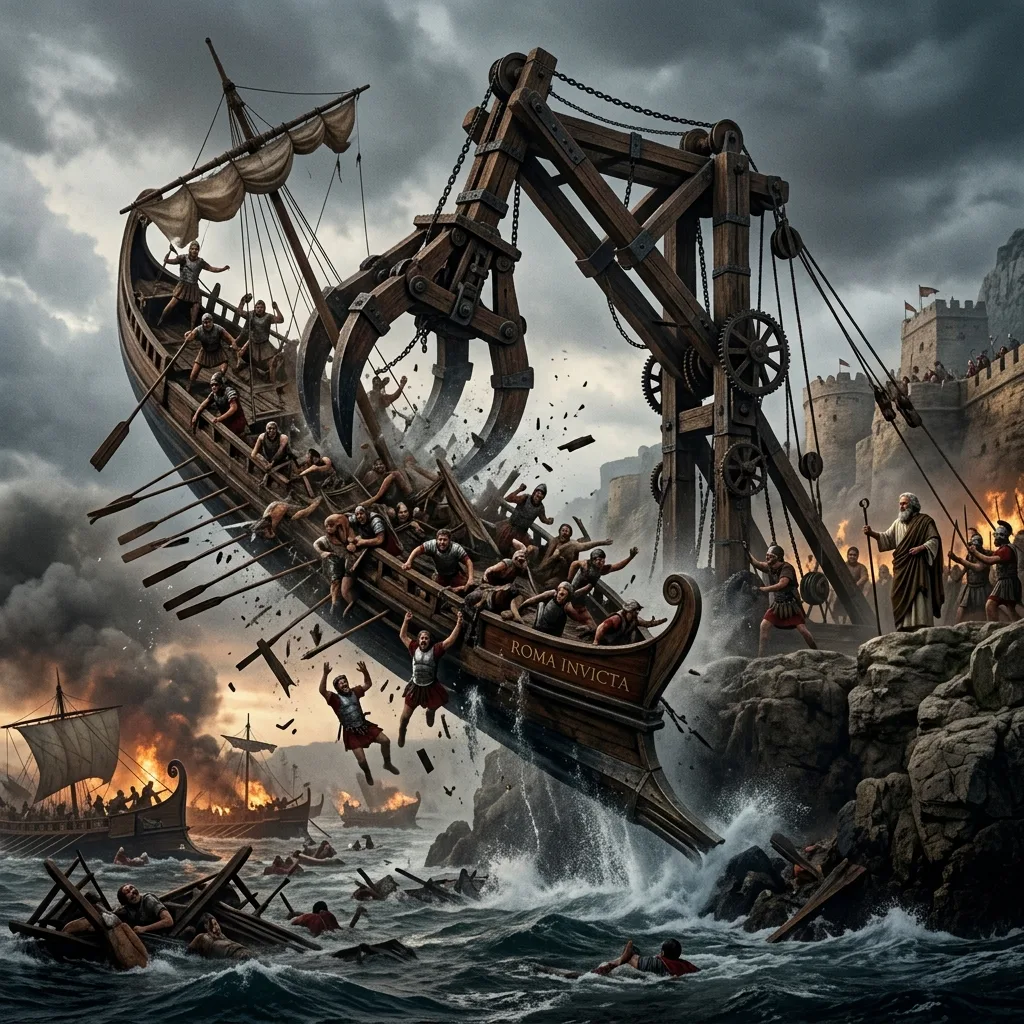
- During the Roman siege of Syracuse (c. 213–212 BC) in the Second Punic War, Archimedes engineered defensive war machines — including the ship-capsizing 'Claw of Archimedes' described by Polybius, Plutarch, and Livy — that helped the city hold out against the forces of the general Marcus Claudius Marcellus for about two years.
- According to Plutarch, Archimedes was killed by a Roman soldier around 212 BC while absorbed in a geometric diagram, despite Marcellus having ordered that he be spared; the famous defiant line 'Do not disturb my circles' (Noli turbare circulos meos) is a later Latin tradition not found in the earliest Greek accounts.
- The celebrated 'Eureka!' bath story — testing a crown's gold purity via water displacement — comes only from the Roman architect Vitruvius writing some 200 years later, and modern scholars consider it likely apocryphal, since the displacement method described would have been too imprecise to detect the alloy; his actual hydrostatic principle is laid out in 'On Floating Bodies.'
- In his treatise 'The Method of Mechanical Theorems,' written as a letter to Eratosthenes, Archimedes revealed how he intuited results by imagining shapes sliced into infinitely thin sections and balanced on a lever — Stanford historian Reviel Netz has argued this shows Archimedes treating infinity almost as a number, a striking conceptual leap.
- Several of these works survive only because of the Archimedes Palimpsest: a 10th-century Greek copy overwritten as a 13th-century prayer book, identified by Danish philologist Johan Ludvig Heiberg in 1906 and made far more legible through ultraviolet, infrared, and X-ray imaging conducted between 1998 and 2008.
The World at This Moment
Archimedes' death in 212 BC fell during the Second Punic War, when Rome under Marcus Claudius Marcellus stormed Syracuse, the wealthy Greek city-state in Sicily that had allied with Carthage after Hieron II's death. Hannibal was still ravaging Italy following Cannae (216), and Rome's eastward and westward expansion was reshaping the Hellenistic Mediterranean. Archimedes' lifetime coincided with the high Hellenistic flowering of Alexandrian science: he corresponded with Eratosthenes of Cyrene and Conon of Samos, and worked in the intellectual orbit of Euclid's successors at the Museum. Far to the east, the same decade saw upheaval in China: Qin Shi Huang's regime carried out the notorious "burning of books and burying of scholars" (traditionally dated 213–212 BC), and the Qin dynasty would collapse within years, yielding to Liu Bang's Han by 202 BC. Thus a singular moment links the violent Roman absorption of Greek Sicily with the consolidation and crisis of China's first empire.
The Paradigm Shift
Archimedes redirected the trajectory of mathematics and physics by fusing rigorous Greek geometry with quantitative physical reasoning. In On the Sphere and Cylinder, Measurement of a Circle, and On the Equilibrium of Planes he pioneered the "method of exhaustion" to bound areas, volumes, and π between converging inequalities—an anticipation of integral calculus realized only with Newton and Leibniz nearly two millennia later. His On Floating Bodies founded hydrostatics, and his work on the lever and centers of gravity formalized statics. Crucially, the rediscovered Method of Mechanical Theorems reveals that he used a heuristic of "weighing" geometric figures—treating areas and volumes as composed of indivisible lines or slices—to discover results he then proved deductively, separating discovery from demonstration in a strikingly modern way. Reviel Netz argues this involved a genuine, if controlled, deployment of actual infinity. Translated through Arabic and Latin transmission, Archimedes' corpus shaped Galileo, Stevin, and Kepler, becoming foundational to the Scientific Revolution's mathematization of nature.
In Their Own Words
"Certain things first became clear to me by a mechanical method, although they had to be demonstrated by geometry afterwards because their investigation by the said method did not furnish an actual demonstration. But it is of course easier, when we have previously acquired, by the method, some knowledge of the questions, to supply the proof than it is to find it without any previous knowledge." — Archimedes, preface to The Method of Mechanical Theorems (addressed to Eratosthenes), translated by T. L. Heath, The Works of Archimedes (Supplement, 1912)
In Depth
The Geometer Who Touched Infinity
Archimedes of Syracuse (c. 287–c. 212 BC) is the moment in the human story where mathematics stops being a tool for counting harvests and surveying fields and becomes a method for interrogating the infinite. He stands at the far end of a chain of abstraction that begins in the mud of Sumer and runs, eventually, to the calculus that powers modern physics and machine learning.
Deep Preconditions
Archimedes did not appear from nowhere. His work rests on a millennium of accumulating intellectual infrastructure. The capacity to record and transmit ideas across generations begins with the first writing systems (sv-cuneiform), without which no cumulative science is possible. The Greek habit of demanding reasons rather than myths for natural phenomena was inaugurated by the Pre-Socratic philosophers (sv-presocratics) and Thales (sv-thales), who first proposed that the world was intelligible. Pythagoras (sv-pythagoras) had already married number to cosmos, and the atomism of Democritus (sv-democritus)—the intuition that continuous quantities might be summed from infinitely many tiny parts—prefigures the very reasoning Archimedes would weaponize. Most directly, Archimedes built on the axiomatic edifice of Euclid (sv-euclid), whose Elements gave him the rigorous deductive language in which his own proofs are cast. He reportedly studied at Alexandria, the intellectual capital created when Alexander the Great (sv-alexander) shattered the old order and the Ptolemaic Kingdom (sv-ptolemaic) funded the Great Library (sv-library-alexandria), corresponding afterward with the scholars there.
What He Actually Did
Working for King Hiero II, Archimedes calculated the relationship between a sphere's surface and volume, approximated pi with stunning accuracy using the "method of exhaustion," formulated the principle of buoyancy, and built the water-raising screw and mechanical planetaria. But his deepest move was philosophical. The method of exhaustion—inscribing ever-more polygons inside a curve until their summed area converges on the truth—is a geometric form of the limit process. In The Method of Mechanical Theorems, recovered only in 1906 by Johan Ludvig Heiberg from a reused Byzantine prayer book (the Archimedes Palimpsest), he confessed how he discovered his results before proving them: by weighing infinitesimal slices against one another on an imagined balance. One passage even deploys actual infinity, a use unique in all of ancient mathematics.
The Ripple Forward
Archimedes was killed during the Roman siege of Syracuse in 212 BC, cut down by a soldier while absorbed in a diagram—a small atrocity that the Roman Republic (sv-roman-republic) absorbed without noticing it had murdered the most advanced mind of the age. His texts survived precariously, and the formal codification of his infinitesimal intuitions had to wait nearly two thousand years. When it came, it came through him: Isaac Newton's Principia (sv-newton) is written in geometric arguments Archimedes would have recognized at sight, and both Newton's fluxions and Leibniz's differentials are descendants of the reasoning Archimedes thought too informal to publish as proof.
That delayed inheritance is the throughline. The Islamic Golden Age (sv-islamic-golden-age) preserved and extended his works; the Italian Renaissance (sv-renaissance) translated and printed them; and the Scientific Revolution finally finished the calculus he had begun. From Newton flows the entire apparatus of modern physics, including Einstein (sv-einstein), and the differential equations and gradient-based optimization at the heart of the deep learning revolution (sv-alexnet-convnets). Every neural network trained by descending a loss surface is, in a distant sense, summing infinitesimals on Archimedes' imagined balance. He is the bridge between the ancient dream of an intelligible cosmos and the machinery now being built to think about it.
Causes & Consequences
What led to it
- Eudoxus of Cnidus (c. 408-355 BC) developed the method of exhaustion and a rigorous theory of proportion, which Archimedes himself credited and used as the foundational tool for computing areas and volumes bounded by curves.
- Euclid's Elements, especially the use of exhaustion in Book XII to prove the areas of circles and the volumes of cones and pyramids, supplied the rigid axiomatic-geometric framework within which Archimedes cast his own proofs.
- The cultural and intellectual flourishing of Hellenistic Syracuse and its alliance with Greek learning gave Archimedes a wealthy patron state (under King Hiero II) that supported his mathematical and engineering work.
- The founding of the Library and Museum of Alexandria created a network of correspondent scholars, including Eratosthenes and Conon of Samos, with whom Archimedes exchanged problems and to whom he addressed treatises such as The Method.
- Earlier Greek mechanics and the practical traditions of the lever, pulley, and screw gave Archimedes the physical principles he formalized in works like On the Equilibrium of Planes and applied in his 'mechanical method' of discovery.
- The accumulated Greek geometric study of conic sections and curves (parabolas, spirals) provided the specific figures whose areas and volumes Archimedes set out to determine exactly.
What it set in motion
- In On the Sphere and Cylinder, Archimedes established the first exact expressions for the volume and surface area of a sphere and proved the sphere-to-cylinder ratio of 2:3, a result he prized so highly that a sphere and cylinder were carved on his tomb, later found by Cicero.
- In Measurement of a Circle he bounded pi between 3 10/71 and 3 1/7 (approximately 22/7) using inscribed and circumscribed polygons, giving antiquity its standard approximation of pi.
- His sophisticated use of the method of exhaustion and informal summing of infinitesimal 'slices' anticipated integral calculus by roughly nineteen centuries and remained unsurpassed until the 17th century.
- When Newton and Leibniz developed calculus in the late 1600s they built on foundations Archimedes laid, with his kinematic and infinitesimal methods regarded as forerunners of Newton's fluxions and Leibniz's differentials respectively.
- His war machines defending Syracuse during the Roman siege of 213-212 BC, and his account of dying at a Roman soldier's hand, made him an enduring symbol of the scientist-engineer in Western culture.
- The 1906 rediscovery by Johan Ludvig Heiberg of the Archimedes Palimpsest revealed the lost text of The Method of Mechanical Theorems, exposing his hidden heuristic use of indivisibles and reshaping modern understanding of how close ancient mathematics came to the calculus.
- His practical inventions, including the water-lifting screw that bears his name and refined compound-pulley and block-and-tackle systems, entered lasting engineering use for irrigation and lifting heavy loads.
The Live Academic Debate
A central modern debate concerns the Method and infinity. Reviel Netz (Stanford), in The Archimedes Codex and subsequent papers, contends that Archimedes' Method—especially Proposition 14 of the Stomachion-adjacent material and the heuristic balancing of figures—involved manipulating actually infinite collections and even rudimentary combinatorics, pushing his sophistication far beyond what was credited before the palimpsest's 1998–2008 reimaging. Critics urge caution: many historians, following the rigorist reading associated with the Heath/Dijksterhuis tradition, stress that Archimedes deliberately confined infinity to a non-demonstrative, heuristic role and always retranslated discoveries into finite exhaustion proofs, so attributing a "concept of actual infinity" risks anachronism. A related dispute concerns the historicity of the wartime engines—the burning mirrors and the "claw of Archimedes." Polybius, Livy, and Plutarch attest formidable defensive machines, but the parabolic heat-ray story is widely regarded by historians as a late, embellished tradition (traceable to Anthemius and Tzetzes) rather than reliable fact.
How This Event Connects
The mathematical and engineering achievements of Archimedes of Syracuse represent a profound inflection point in classical antiquity, bridging the axiomatic rigor established by Euclid with unprecedented applications in physical mechanics and combinatorics. While Euclid’s Elements codified the static, deductive framework of Greek geometry, Archimedes dynamically extended these principles to the physical world, manipulating concepts of center of gravity and infinitesimals to calculate volumes and areas. The discovery of the Archimedes Palimpsest decisively demonstrated that his "Method of Mechanical Theorems" transcended pure classical geometry, providing a heuristic framework that effectively anticipated the integral calculus synthesized millennia later by figures like Isaac Newton. Thus, Archimedes fundamentally shifts the historiographical perception of ancient mathematics from a purely theoretical pursuit into an arena of radical computational abstraction.
Archimedes also stands in sharp contrast to the earlier numerological and mystical traditions associated with Pythagoras. Where Pythagorean thought often imbued numbers with intrinsic religious or philosophical essence, Archimedes applied rigorous, secular logic to solve concrete, infinitely complex problems, such as the combinatorial puzzle of the Stomachion and the astronomical calculations in The Sand Reckoner. His ability to conceptualize numerical values capable of filling the cosmos stripped mathematics of its early mystical constraints, establishing it as an empirical tool for both cosmic quantification and advanced engineering.
Historically, the violent termination of Archimedes's life during the Siege of Syracuse perfectly encapsulates the aggressive geopolitical reality of the Middle Roman Republic. His creation of devastating siege engines to fend off the Roman legions highlights the tension between Hellenistic intellectual supremacy and Roman martial dominance. The apocryphal narrative of his death at the hands of a Roman soldier while contemplating geometric figures serves as a powerful historiographical metaphor for the Republic's brutal assimilation of the Hellenistic East—a paradigm where sophisticated scientific inquiry was ultimately subordinated to the ruthless efficiency of Roman imperialism.
The Counterfactual
Had Archimedes not lived—or had his texts perished entirely—the mathematization of physics plausibly suffers a long delay. His survival was precarious: the Method was effectively lost until Heiberg identified it in a Constantinople palimpsest in 1906, showing how nearly his most advanced thinking vanished. Counterfactually, without the Archimedean corpus transmitted via Eutocius, Arabic scholars (Thābit ibn Qurra), and the Latin Moerbeke translation (1269), Renaissance mathematicians would have lacked rigorous models of exhaustion and hydrostatics. Galileo explicitly venerated Archimedes; historians such as Marshall Clagett documented how deeply medieval mechanics drew on him. A counterfactual is necessarily speculative, but the calculus and quantitative statics might have emerged later or along different lines. Conversely, had Marcellus's soldier spared him (Plutarch reports Marcellus had ordered his protection), little additional output is certain—Archimedes was already roughly seventy-five. The deeper contingency lies less in his death than in the fragile manuscript survival of his ideas across the centuries.
Myth vs. Reality
Myth: Archimedes shouted "Eureka!" and ran naked through the streets after discovering buoyancy in his bath to test a golden crown.
Reality: This famous tale comes only from the Roman architect Vitruvius, writing roughly 200 years after Archimedes' death, and appears nowhere in Archimedes' own surviving writings. Modern scholars treat it as likely apocryphal, and many doubt the simple water-displacement method Vitruvius describes would even be practical to detect the small density difference in a crown. Galileo and others argued Archimedes more plausibly used a hydrostatic balance, weighing the crown in air and submerged in water, an approach far more consistent with the physics in his genuine treatise On Floating Bodies.
Myth: Archimedes' last words were "Do not disturb my circles," spoken defiantly to a Roman soldier.
Reality: This exact phrase is not in Plutarch's account, our most detailed ancient source, and there is no reliable evidence Archimedes said it. The closest early version, from Valerius Maximus in the 1st century AD, has him merely protecting his diagram in the dust and pleading "I beg you, do not disturb this." Ancient sources even disagree on how he died, with some implying he was killed in the general chaos of the city's sack rather than at his diagram, so the dramatic deathbed quip is a later literary embellishment.
Myth: Archimedes built a "death ray" of mirrors that set the Roman fleet ablaze during the siege of Syracuse.
Reality: No contemporary source mentions any such weapon, and it does not appear in Archimedes' own works. The earliest surviving claims come centuries later from Lucian (2nd century AD) and Galen, who wrote more than 350 years after the siege. Modern reconstructions, including a 2005 MIT experiment and the MythBusters tests, found that igniting a ship with arrayed mirrors is possible only under unrealistic conditions, a stationary target, cloudless skies, and many minutes of exposure, leading experimenters to judge the legend possible but militarily impractical.
Myth: Archimedes invented the water-raising screw that bears his name.
Reality: The attribution is contested. Archimedes never claimed the device, which was first credited to him by Diodorus Siculus about two centuries later. Assyrian King Sennacherib's inscriptions (704 to 681 BC) describe bronze screw-like water-lifting devices predating Archimedes, and some scholars connect such technology to Mesopotamian irrigation. Archaeologist John Peter Oleson has cautioned that no firm evidence places the screw with Archimedes specifically; his likely contribution was describing or analyzing the device mathematically rather than originating it.
Myth: Archimedes thought of himself primarily as an inventor and engineer of war machines.
Reality: According to Plutarch, Archimedes prized pure mathematics far above his mechanical inventions, regarding engineering as "ignoble and sordid" and undertaking war machines only at King Hieron II's request. He reportedly asked that his tomb depict a sphere inscribed in a cylinder, commemorating his proof that a sphere's volume is two-thirds that of its circumscribing cylinder, which he considered his finest achievement. Some scholars note Plutarch may have exaggerated this disdain to glorify theory, but his self-image as a mathematician, not a tinkerer, is well attested.
Frequently Asked Questions
Who was Archimedes of Syracuse?
Archimedes (c. 287 - c. 212 BC) was a Greek mathematician, physicist, engineer, and inventor from Syracuse, a Greek city-state on the island of Sicily. He is widely regarded as one of the greatest mathematicians of antiquity and worked for King Hiero II of Syracuse as an engineer and problem-solver. He is credited with foundational work on buoyancy, levers, the measurement of the circle, and the geometry of the sphere and cylinder, alongside numerous mechanical inventions. He lived in Syracuse his whole life apart from a period of study connected to Alexandria, Egypt.
How did Archimedes die?
Archimedes was killed around 212 BC when Roman forces under the general Marcus Claudius Marcellus captured Syracuse during the Second Punic War, after a long siege his war machines had helped delay. According to later tradition, he was slain by a Roman soldier, with one popular story claiming he was absorbed in a mathematical diagram at the time. Ancient sources report that Marcellus had wished to spare him and was angered by his death because he admired Archimedes' ingenuity. The exact circumstances are uncertain, as the surviving accounts were written long after the event.
Did Archimedes really say 'Do not disturb my circles'?
This famous last line is probably legendary rather than historical. It does not appear in Plutarch's well-known account of Archimedes' death, and there is no reliable contemporary evidence that he spoke these exact words. The closest ancient source is the Roman writer Valerius Maximus, who recorded a Latin phrase to the effect of 'do not disturb that (figure in the sand).' The Greek and Latin slogans now widely quoted are later embellishments of that tradition.
What is Archimedes' principle and the 'Eureka' story?
Archimedes' principle states that the upward buoyant force on a body immersed in a fluid equals the weight of the fluid the body displaces; he was the first to set out the laws of buoyancy, in his work On Floating Bodies. The famous tale that he leapt from his bath shouting 'Eureka!' ('I have found it!') after noticing his body displaced water comes from the Roman architect Vitruvius, writing roughly two centuries later, and is generally considered an embellished anecdote rather than documented fact. The underlying physics, however, is genuinely his.
What did Archimedes invent and discover?
In mathematics he calculated that pi lies between 3 10/71 and 3 1/7 (about 3.1408 to 3.1429) using inscribed and circumscribed polygons, proved that a parabolic segment has 4/3 the area of an inscribed triangle, and pioneered the 'method of exhaustion' that anticipated integral calculus. He also formulated the law of the lever and principles of pulleys. He is associated with practical devices including the water-raising Archimedes' screw (still used today) and compound pulley systems, though the precise attribution of some inventions is debated.
Did Archimedes' 'death ray' of mirrors really burn Roman ships?
The story that Archimedes set Roman ships ablaze with focused mirrors comes from late sources such as Lucian and Galen, written centuries after the siege, and is not mentioned by earlier historians, so most scholars treat it as legend. Modern tests have been inconclusive: a 2005 MIT experiment ignited a stationary mock ship only after about ten minutes under ideal cloudless conditions, and the television show MythBusters rated the claim 'busted' as impractical for real combat. The consensus is that while focusing sunlight can char wood under perfect conditions, a battlefield heat ray was almost certainly impractical.
What did Archimedes consider his greatest achievement, and what happened to his tomb?
Archimedes regarded his proof that a sphere has two-thirds the volume and surface area of the cylinder that encloses it as his finest result, and he reportedly asked for a sphere-in-cylinder figure to mark his tomb. The Roman statesman Cicero wrote that, while serving as quaestor in Sicily around 75 BC, he rediscovered the neglected, overgrown tomb by spotting a column topped with that very sphere-and-cylinder emblem. Whether Cicero's account is literally accurate is debated, but it remains the most famous story about the monument's fate.
Sources & Further Reading
- Archimedes — Wikipedia
- Reviel Netz and William Noel, The Archimedes Codex: How a Medieval Prayer Book Is Revealing the True Genius of Antiquity's Greatest Scientist (2007)
- T. L. Heath, The Works of Archimedes, with the Method of Archimedes (Cambridge, 1897; Supplement 1912)
- E. J. Dijksterhuis, Archimedes (trans. C. Dikshoorn, Princeton, 1987)
- Marshall Clagett, Archimedes in the Middle Ages, 5 vols. (1964–1984)
- Plutarch, Life of Marcellus, chs. 14–19 (Loeb Classical Library)
- Wikipedia: Archimedes Palimpsest
- Stanford Encyclopedia: Archimedes
Cite This Page
AskHistoryAI. “Archimedes of Syracuse.” AskHistoryAI — Interactive Timeline of Everything. Updated 2026-09-11. https://askhistoryai.com/event/sv-archimedes/
Every fact on this page is checked against the published fact ledger and methodology; sources are listed above.