The Great Library of Alexandria
The ancient world's most ambitious attempt to collect all human knowledge.
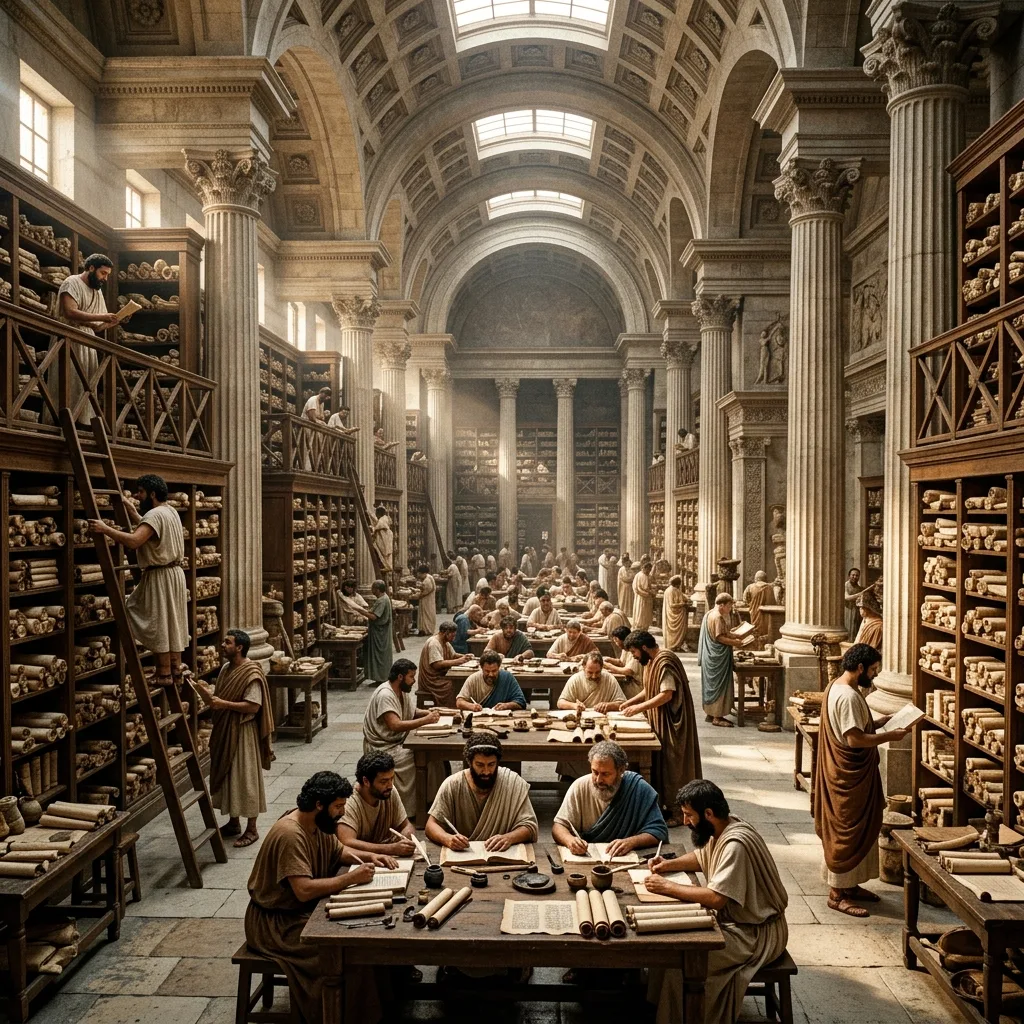
Proposed by Demetrius of Phalerum to Ptolemy I and fully realized under Ptolemy II, the Great Library of Alexandria was an unprecedented research institution aimed at gathering every text in the known world.
Open in interactive timeline →Key Numbers
- Founded
- Early 3rd c. BC (under Ptolemy I/II)
- Scroll collection
- ~400,000 (some ancient claims up to 700,000)
- Ptolemy III's loan bond
- 15 talents of silver, forfeited
- Caesar's fire
- 48 BC; one source claims 40,000 scrolls lost
- Serapeum razed
- AD 391, by order of Patriarch Theophilus
Verified Facts
- The Library was conceived under Ptolemy I Soter, likely on the advice of the exiled Athenian statesman Demetrius of Phalerum, but was probably not built until the reign of his son Ptolemy II Philadelphus in the early 3rd century BC; its ambition was unprecedented: to gather a copy of every book in the known world.
- It was not a standalone building but the research arm of the Mouseion (literally 'shrine of the Muses,' the root of the word 'museum'), where, according to the geographer Strabo, resident scholars received a salary, free food and lodging, a shared dining hall, and exemption from taxes.
- To stock the shelves, Ptolemaic officials seized scrolls from every ship docking at Alexandria, copied them, kept the originals, and returned the copies to the owners; these confiscated texts were catalogued as 'books from the ships.'
- Ptolemy III posted a colossal bond of 15 talents of silver to borrow Athens' official state manuscripts of Aeschylus, Sophocles, and Euripides for copying, then kept the originals, returned the copies, and simply forfeited the deposit.
- The poet-scholar Callimachus of Cyrene compiled the Pinakes, a 120-book catalogue of authors and their works often described as the world's first library catalogue, even though he himself never served as head librarian.
- Eratosthenes of Cyrene, chief librarian from around 245 BC, used shadow-angle measurements between Alexandria and Syene to calculate the Earth's circumference with remarkable accuracy, and is credited with founding the discipline of geography.
- Among scholars connected to Alexandria, Euclid compiled the 'Elements,' which served as the core geometry textbook for roughly 2,000 years, and Aristarchus of Samos proposed a Sun-centered cosmos some 1,800 years before Copernicus.
- A pivotal blow came not from fire but from politics: around 145 BC, Ptolemy VIII Physcon purged Alexandria's intellectuals, including head librarian Aristarchus of Samothrace, scattering scholars to Athens, Rhodes, and elsewhere.
- In 48 BC, Julius Caesar set fire to ships in Alexandria's harbor during a siege and the flames spread to dockside areas; the Roman writer Seneca, citing a now-lost source, reported 40,000 scrolls were lost, though scholars debate how much of the main Library was actually affected.
- Most historians now reject the myth of a single apocalyptic burning, favoring a centuries-long decline through lost royal patronage, neglect, and episodic damage, with the daughter-library in the Serapeum temple destroyed in AD 391 on the orders of the Christian patriarch Theophilus.
The World at This Moment
The Library arose in the turbulent decades after Alexander's death in 323 BCE, as his generals (the Diadochi) carved his empire into rival kingdoms. Ptolemy I Soter, securing Egypt, made Alexandria his capital around the time the Seleucids dominated the Near East and Antigonids held Macedon. The foundation, c. 295–283 BCE, drew on the advice of Demetrius of Phalerum, an exiled Athenian Peripatetic schooled in Aristotle's Lyceum. Contemporaneously, Rome was consolidating control of central Italy in the Samnite Wars, soon to clash with Pyrrhus; the Maurya Empire under Ashoka would shortly spread Buddhism across South Asia; and Warring States China was nearing Qin unification (221 BCE). The Hellenistic world fostered cosmopolitan exchange of Greek, Egyptian, Babylonian, and Jewish learning—the milieu that produced the Septuagint translation, mathematized astronomy, and Euclidean geometry. The Mouseion, a royally funded research cult of the Muses, embodied this moment when monarchic patronage replaced the polis as the engine of intellectual life.
The Paradigm Shift
The Library institutionalized knowledge on an unprecedented scale, transforming scholarship from individual inquiry into a state-funded, collaborative enterprise. By attempting, per the Letter of Aristeas, to collect "all the books in the world," the Ptolemies created the first systematic universal library and, with Callimachus's Pinakes (120 scrolls), the foundations of bibliography and library cataloguing by author and subject. The associated Mouseion incubated foundational results: Euclid's Elements codified deductive geometry; Eratosthenes measured Earth's circumference; Aristarchus of Samos proposed heliocentrism; and Aristarchus of Samothrace and Zenodotus pioneered textual criticism, producing critical editions of Homer with diacritical sigla still echoed in modern philology. This fusion of comprehensive collection, professional scholarship, and royal stipend established the template for the research institute and the university. The Library made the preservation, comparison, and emendation of texts a discipline, shaping how the Western and Islamic worlds would later organize, transmit, and authenticate written knowledge.
In Their Own Words
"Demetrius of Phalerum, the president of the king's library, received vast sums of money, for the purpose of collecting together, as far as he possibly could, all the books in the world." — Letter of Aristeas to Philocrates, §9 (Hellenistic Jewish text, c. 2nd century BCE), trans. R. H. Charles
In Depth
The Universal Library: When a Civilization Tried to Hold All Knowledge
The Great Library of Alexandria was the first institution in history to attempt the impossible: to gather, in one place, every book ever written. That ambition did not appear from nowhere. It was the late fruit of a long acceleration in how humans stored thought outside their own skulls — a chain that runs from the first marks pressed into clay with The Invention of Cuneiform (sv-cuneiform) through the oral epic machinery of Homer & the Epic Tradition (sv-homer) to the alphabetic Greek prose of Herodotus, the Father of History (sv-herodotus). For three thousand years, knowledge had been bounded by what a scribe could copy or a bard could remember. Alexandria proposed to gather it all under one roof.
The Preconditions: Conquest, Cash, and a Dynasty That Bought Books
The Library was a political project before it was a scholarly one. It became possible only because Alexander the Great (sv-alexander) carved a Greek-speaking world from the Adriatic to the Indus, and because his general Ptolemy seized Egypt to found The Ptolemaic Kingdom (sv-ptolemaic). Egypt's grain wealth gave the Ptolemies something rare: the surplus to fund pure inquiry with no immediate payoff. Around 295 BCE the exiled Athenian Demetrius of Phalerum, a student of the Peripatetic tradition descending from Aristotle & the Lyceum (sv-aristotle), proposed the Mouseion — a "shrine of the Muses" — and its attached collection. The intellectual DNA was Athenian; the model was the research community pioneered by Plato & the Academy (sv-plato) and Aristotle's Lyceum, now scaled up with royal money and a state mandate to acquire scrolls by any means, including confiscating books from ships docking in the harbor.
What the Library Made
Concentration of texts and scholars produced a burst of discovery that still structures modern thought. Euclid & the Elements (sv-euclid) systematized geometry into the most durable textbook ever written. Eratosthenes, who served as chief librarian, used the collection's resources to measure the Earth's circumference with startling accuracy. The poet Callimachus compiled the Pinakes — a 120-book survey of authors and their works — effectively inventing the library catalog and, with it, the very idea of bibliography: knowledge about knowledge. This was something new. For the first time, a culture could see the shape of its own learning laid out as a navigable map. The Hellenistic scholarship Alexandria perfected — critical editing, cataloging, cross-referencing — became the template every later knowledge institution would imitate.
The Long Threads Forward
The Library's story is also a parable of fragility. Its decline was not a single fire but a centuries-long erosion. The harbor blaze during Julius Caesar Crosses the Rubicon (sv-julius-caesar) era civil war (48 BCE) did real damage; later purges under Roman and Christian rule finished the slow work. The lesson — that centralized knowledge can vanish — haunts intellectual history. Yet the impulse never died. It re-emerged in the translation houses of The Islamic Golden Age (sv-islamic-golden-age), which preserved and extended Greek learning while Europe slept, and again with The Gutenberg Press (sv-printing-press), which finally solved Alexandria's deepest flaw: a hand-copied scroll is a single point of failure, but a printed edition lives in a thousand copies at once.
Seen from the far end of history, Alexandria is the ancestor of every effort to make knowledge total and searchable — a line that runs through The World Wide Web (sv-www) to the language models trained on humanity's collected text. The dream of one place holding all books was never abandoned; it was only waiting for a medium that could not burn. The Great Library asked the question the entire information age would spend two millennia answering: what would it mean to gather everything humans know, and never lose it again?
Causes & Consequences
What led to it
- Alexander the Great's conquest of Egypt and his founding of Alexandria around 331 BCE created a deliberately planned, cosmopolitan Greek city on the Mediterranean intended as a cultural and commercial hub for his new empire.
- After Alexander's death, his general Ptolemy I Soter seized control of Egypt and established the Ptolemaic dynasty, whose wealth and royal ambition to assemble a repository of all human knowledge funded and directed the Library's creation around the early 3rd century BCE.
- Egypt's near-monopoly on the papyrus plant gave the Ptolemies abundant, cheap writing material and a dominant position in the ancient book trade, making large-scale copying and collection of texts economically feasible.
- Aristotle's Lyceum in Athens, with its methodically organized personal library inherited by Theophrastus, provided the institutional model of a research school combining teaching, collection, and classification that the Mouseion and Library consciously imitated.
- The exiled Athenian statesman and Peripatetic scholar Demetrius of Phalerum took refuge at Ptolemy I's court and is credited in ancient sources with proposing and helping organize the Library and Mouseion on the Aristotelian model.
- The spread of Koine Greek as a common language across Alexander's former empire created a unified scholarly and literary culture, giving the Library a shared language in which to gather, translate, and study texts from across the known world.
What it set in motion
- Eratosthenes, while serving as chief librarian, used astronomical and geographical records held at the Library to calculate the Earth's circumference with remarkable accuracy, a feat that depended on the institution's accumulated data.
- Callimachus compiled the Pinakes, a roughly 120-volume catalogue listing the Library's authors with biographies and bibliographies, which is widely regarded as the first systematic library catalogue and bibliography in the Western tradition.
- Scholars such as Zenodotus and Aristarchus of Samothrace developed the practice of textual criticism by comparing multiple manuscript copies of the Homeric epics to reconstruct authoritative texts, founding methods that classical philologists still use today.
- The Library's environment fostered landmark scientific and mathematical work associated with Alexandria, including Euclid's Elements and Aristarchus of Samos's early heliocentric proposal, advancing geometry and astronomy for centuries.
- According to the tradition preserved in the Letter of Aristeas, the Hebrew Torah was translated into Greek as the Septuagint under Ptolemy II, producing the first translation of Hebrew scripture into another language and a text the early Christian Church later adopted as authoritative.
- The Library's prestige spurred rival institutions such as the Library of Pergamon, and the resulting competition (including the Ptolemaic restriction on papyrus exports) is linked in ancient accounts to the expanded development of parchment as a writing material.
- As a celebrated symbol of gathered knowledge whose loss became emblematic of cultural catastrophe, the Library of Alexandria established a lasting model of the universal research library that influenced later libraries and continues to shape ideals of knowledge preservation.
The Live Academic Debate
The fiercest debate concerns the Library's destruction and its true scale. Popular tradition blames a single cataclysm, but scholars identify at least four candidate events—Caesar's fire (48 BCE), Aurelian's sack (c. 273 CE), Theophilus and the Serapeum (391 CE), and the Arab conquest (642 CE)—and increasingly reject the last as a tenth-century legend transmitted by Bar Hebraeus. Mostafa El-Abbadi (1990) and Roy MacLeod's contributors (2000/2004) reconstruct an institutional history while largely crediting ancient testimony. Against this, Roger Bagnall's "Alexandria: Library of Dreams" (2002) argues the inflated scroll counts (200,000–700,000) "do not deserve any credence," being corrupt or rhetorical, and that the Library more plausibly suffered slow decline through lost patronage—especially after Ptolemy VIII expelled foreign scholars in 145 BCE—than a dramatic burning. The competing positions thus pit a maximalist, catastrophe-centered narrative against a minimalist, decline-by-neglect reading. Diana Delia's work on the Caesarian fire similarly stresses the contradictions and biases of Plutarch, Seneca, and Dio.
How This Event Connects
The Great Library of Alexandria, established under the early Ptolemaic kings in the 3rd century BCE, represents the ancient world's most ambitious attempt to construct a universal repository of human knowledge. As part of the larger Mouseion research institute, the Library transitioned the Mediterranean world from localized, fragmented knowledge to centralized, state-funded systematic research.
Historiographically, the Library was crucial for the standardization of texts. Its scholars, such as Callimachus and Zenodotus, developed the first systems of cataloging (the Pinakes) and the discipline of textual criticism, striving to compile authoritative editions of Homer and other classical works. The concentration of texts and brilliant minds from across the Hellenistic world catalyzed unprecedented advancements in mathematics, astronomy, and medicine. The eventual decline and destruction of the Library—a process occurring over centuries rather than a single dramatic fire—has become a powerful cultural symbol for the fragility of accumulated knowledge and the catastrophic cost of societal collapse.
The Counterfactual
Had no Ptolemaic library coalesced, much classical Greek literature would likely have reached posterity in poorer condition, if at all. The Alexandrian scholars' editorial labor—Zenodotus and Aristarchus standardizing Homer, the establishment of canonical author lists—shaped which texts survived and in what form; without it, the textual baseline for later Byzantine and Renaissance transmission would differ markedly. Yet one must avoid overstatement. Roger Bagnall (2002) cautions that the Library's scale and singular importance are partly modern romance; rival centers, notably Pergamon's library (and the parchment industry it spurred), and later Roman collections, provided redundancy. Hellenistic science—Euclid, Archimedes (Syracuse), Apollonius—was not wholly dependent on Alexandria's walls. Still, the concentrated patronage that drew Eratosthenes, Callimachus, and Apollonius of Rhodes into one place catalyzed cumulative work hard to replicate piecemeal. The likeliest counterfactual is slower, more fragmentary progress in philology, geography, and astronomy, and the loss of the cataloguing paradigm that organized knowledge for centuries.
Myth vs. Reality
Myth: The Library was destroyed in a single catastrophic fire that erased it from history in one night.
Reality: There was no single destruction event. Modern historians describe a gradual decline across centuries driven by neglect, political instability, and loss of royal patronage rather than one apocalyptic blaze. The institution suffered multiple setbacks (Caesar's 48 BCE fire, the Serapeum's demolition in 391 CE, and slow administrative decay) and continued to function for generations after the most famous supposed 'destruction.' As the World History Encyclopedia and National Geographic summarize, the Library faded out over time rather than being snuffed out at once.
Myth: Julius Caesar burned the Great Library to the ground in 48 BCE.
Reality: During Caesar's occupation of Alexandria he set fire to enemy ships in the harbor, and the blaze spread to dockside warehouses, likely destroying stored scrolls. But ancient sources disagree wildly on the damage (Seneca cites a lost account claiming 40,000 scrolls; Plutarch implies the library itself burned), and the Library demonstrably persisted afterward, with scholars working there for centuries. Roger Bagnall and others note the fire most plausibly hit off-site book depots near the shore, not the main Mouseion collection.
Myth: The Library held hundreds of thousands of scrolls containing lost super-knowledge, and its loss set human science back a thousand years.
Reality: Roger Bagnall's 2002 study 'Alexandria: Library of Dreams' argues the famous figures of 400,000 to 700,000 rolls are 'outlandish' and 'do not deserve any credence,' since they would require far more ancient texts than we have any evidence ever existed. Important works typically circulated in many copies across the Mediterranean, so little of unique consequence was permanently lost in any one event. The notion of suppressed advanced science vanishing with the Library is, as scholars put it, a modern fantasy projected onto antiquity.
Myth: A Christian mob destroyed the Library when they murdered the philosopher Hypatia.
Reality: These are two separate events conflated by popular culture (notably the film Agora). The Serapeum, which housed a 'daughter' branch of the collection, was demolished in 391 CE after pagan-Christian rioting, but contemporary Christian and pagan accounts mention no destruction of a great book collection there. Hypatia was murdered in 415 CE, roughly 24 years later, and her death stemmed from a political feud between the prefect Orestes and Bishop Cyril, not from the burning of any library. The main Library was already long gone by her lifetime.
Myth: The 7th-century Arab/Muslim conquest burned the Library on the orders of Caliph Umar.
Reality: This story comes from a single source written roughly six centuries after the fact (the 13th-century writer Ibn al-Qifti, with the tale that the scrolls fueled the city's bathhouses for months). Modern historians regard it as a later legend with no contemporary support; the Great Library had effectively ceased to exist centuries before the Arab conquest of 642 CE. The anecdote is widely treated by scholars as apocryphal rather than history.
Frequently Asked Questions
Who founded the Library of Alexandria and when?
The Library was established in Alexandria, Egypt, under the early Ptolemaic dynasty in the first half of the 3rd century BCE. Most scholars credit Ptolemy I Soter (who took power after Alexander the Great's death) with conceiving it, often working with his adviser Demetrius of Phalerum, while Ptolemy II Philadelphus is generally thought to have brought it to fruition around the 280s BCE. It formed part of a larger research institution, the Mouseion ("shrine of the Muses"), the source of our word "museum."
How many scrolls did the Library of Alexandria contain?
No one knows the exact number, and ancient figures are unreliable. Estimates cited in ancient and modern sources range enormously, from roughly 40,000 up to 400,000 or even 700,000 scrolls at its peak. Because a single ancient "book" often spanned multiple scrolls, some modern scholars argue the count of distinct works was far lower, and any specific number should be treated as an educated guess rather than fact.
Did Julius Caesar burn down the Library of Alexandria?
This is the most famous claim, but it is overstated. In 48 BCE, during a civil war in Alexandria, Caesar's forces set fire to enemy ships in the harbor and the blaze spread to dockside structures, likely destroying stored scrolls or a warehouse. However, ancient writers describe scholars still working at the institution decades afterward, and most historians now agree the library survived this event and that its decline was gradual rather than the result of one fire.
What actually happened to the Library of Alexandria?
Scholars today generally reject the idea of a single dramatic destruction in favor of a slow decline over centuries. Major setbacks included Ptolemy VIII expelling many scholars around 145 BCE, the harbor fire during Caesar's campaign in 48 BCE, and later instability under Roman rule. Various sources blame the emperor Aurelian's war (270s CE), Christian conflict in the late 4th and early 5th centuries, and the Arab conquest of the 7th century, but the evidence is fragmentary and contradictory, so no single culprit or date can be confirmed.
Which famous scholars worked at the Library of Alexandria?
The Mouseion attracted leading minds of the ancient world. Euclid produced his foundational geometry text, the Elements, in Alexandria around 300 BCE. Eratosthenes, who served as chief librarian, famously estimated the Earth's circumference, and Aristarchus of Samos proposed a heliocentric model with Earth orbiting the Sun. Aristarchus of Samothrace, another head librarian, produced influential editions of Homer. The Ptolemies supported such scholars with stipends, lodging, and tax exemptions.
How did the Library of Alexandria acquire its books?
The Ptolemies pursued an aggressive collection policy aimed at gathering a copy of every known work. Agents bought manuscripts abroad, and according to ancient accounts, ships docking at Alexandria were searched so officials could seize books, copy them, keep the originals, and return the copies to owners (catalogued as books "from the ships"). In one famous story, Ptolemy III borrowed the official Athenian texts of the great tragedians Aeschylus, Sophocles, and Euripides, then kept the originals and forfeited his large deposit.
Sources & Further Reading
- Library of Alexandria — Wikipedia
- Roger S. Bagnall, "Alexandria: Library of Dreams," Proceedings of the American Philosophical Society 146.4 (2002), 348–362
- Mostafa El-Abbadi, The Life and Fate of the Ancient Library of Alexandria (UNESCO, 1990)
- Roy MacLeod, ed., The Library of Alexandria: Centre of Learning in the Ancient World (I.B. Tauris, 2000)
- Diana Delia, "From Romance to Rhetoric: The Alexandrian Library in Classical and Islamic Traditions," American Historical Review 97.5 (1992), 1449–1467
- Letter of Aristeas to Philocrates, trans. R. H. Charles, in The Apocrypha and Pseudepigrapha of the Old Testament (1913)
- World History: Library of Alexandria
- Wikipedia: Eratosthenes (Head Librarian)
- Wikipedia: Septuagint
- Time: The Truth About the Library's Destruction
Cite This Page
AskHistoryAI. “The Great Library of Alexandria.” AskHistoryAI — Interactive Timeline of Everything. Updated 2026-09-11. https://askhistoryai.com/event/sv-library-alexandria/
Every fact on this page is checked against the published fact ledger and methodology; sources are listed above.