The Roman Republic
The unstoppable war machine that conquered the entire Mediterranean.
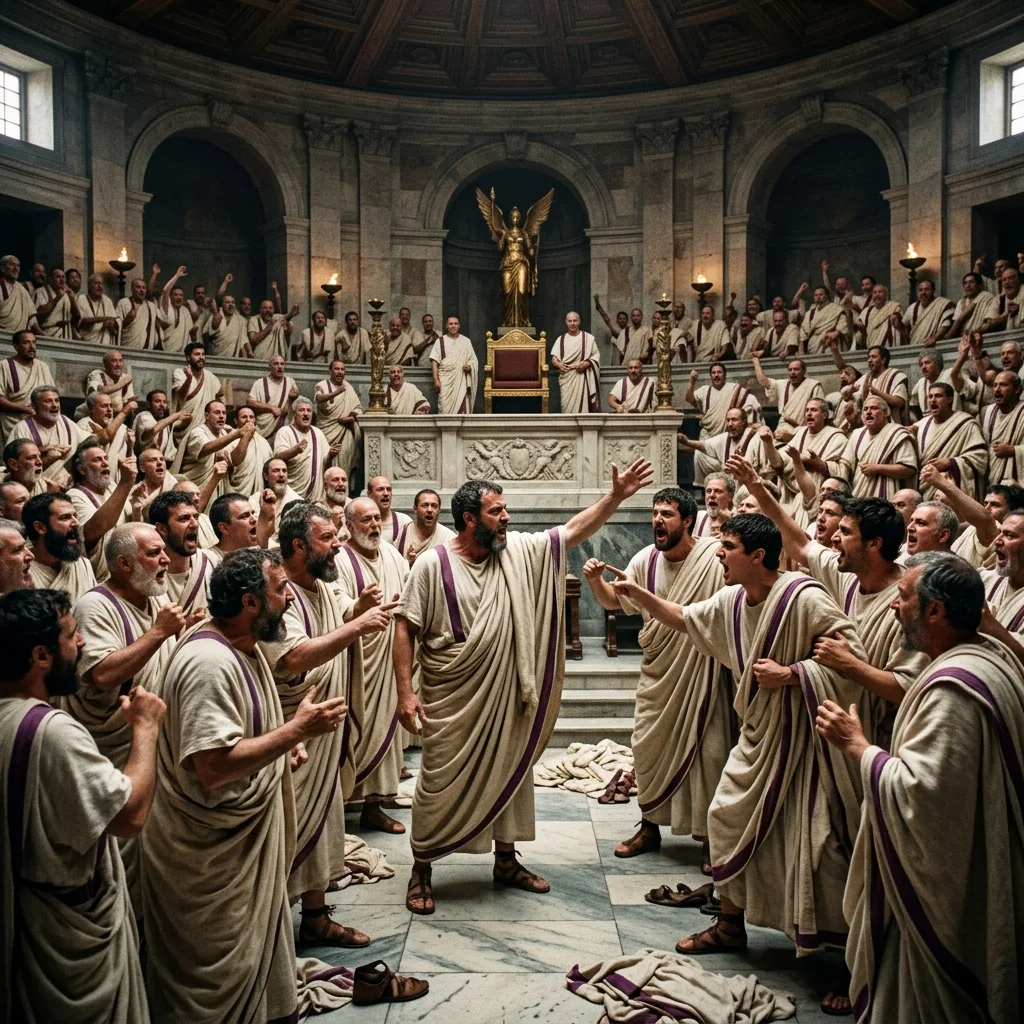
Originally a small city-state founded in 509 BCE, Rome methodically conquered the entire Italian peninsula. But it was the three devastating Punic Wars against the Carthaginian Empire that transformed Rome from a regional power into the undisputed master of the entire Mediterranean world.
Open in interactive timeline →Key Numbers
- Duration
- ~482 years (509-27 BC)
- Founding
- 509 BC (traditional)
- Supreme office
- 2 consuls, 1-year term
- Cannae dead
- ~50,000-70,000 Romans
- End
- 27 BC, Augustus
Verified Facts
- By tradition the Republic was founded in 509 BC when Roman aristocrats led by Lucius Junius Brutus expelled the last king, Lucius Tarquinius Superbus, after the rape of Lucretia by the king's son Sextus; most modern scholars treat the detailed narrative as semi-legendary, but it became Rome's foundational charter against monarchy.
- Executive power was deliberately split: two consuls were elected annually, each able to veto the other, and they retained imperium (military command). This collegiality and one-year limit were designed to prevent any one man from becoming a king again.
- Polybius, a Greek historian writing in the 2nd century BC, analyzed Rome as a 'mixed constitution' balancing monarchic (the consuls), aristocratic (the Senate of roughly 300 members), and democratic (the popular assemblies and tribunes) elements; Cicero later embraced the same model, though the constitution was unwritten.
- The 'Conflict of the Orders' (traditionally 494-287 BC) was a long struggle by plebeians for rights against the patrician elite; in 494 BC the plebs seceded from the city and forced the creation of the Tribunes of the Plebs, officials who were sacrosanct and held the power of veto ('I forbid').
- Around 451-450 BC Roman law was first written down as the Twelve Tables and publicly displayed in the Forum, ending the patrician monopoly on interpreting unwritten law administered by priests.
- The three Punic Wars against Carthage (264-146 BC) made Rome the dominant power of the western Mediterranean; in the Second Punic War, Hannibal's double-envelopment at Cannae in 216 BC annihilated a Roman army, with losses Livy put at about 55,000 and Polybius at about 70,000.
- Scipio Africanus defeated Hannibal at Zama in 202 BC, ending the Second Punic War; the Third Punic War ended in 146 BC with the total destruction of Carthage and the enslavement of its surviving population.
- The tribunates of Tiberius Gracchus (133 BC) and his brother Gaius (123-121 BC) over land reform ended in both brothers' violent deaths; the murder of Tiberius in 133 BC is traditionally marked as the start of the Republic's century of internal decline.
- In 88 BC Lucius Cornelius Sulla became the first Roman general to march his legions on Rome itself; after winning the civil war of 83-82 BC he was made dictator without the traditional six-month limit and posted proscription lists in the Forum condemning hundreds of enemies to death and confiscation.
- Julius Caesar crossed the Rubicon in January 49 BC in defiance of the Senate, won the ensuing civil war, and was made dictator perpetuo ('dictator for life') in early 44 BC; he was stabbed to death by roughly 60 senators led by Brutus and Cassius on the Ides of March (15 March) 44 BC.
- Caesar's assassination accelerated rather than saved the Republic: after Octavian's naval victory over Antony and Cleopatra at Actium on 2 September 31 BC, the Senate granted Octavian the title 'Augustus' in 27 BC, an event historians conventionally take as the end of the Republic and the start of the Roman Empire.
The World at This Moment
The Republic's traditional founding (509 BCE) clusters with a remarkable global moment of political and intellectual innovation. Almost simultaneously, Cleisthenes' reforms (508/7 BCE) reorganized Athens into ten tribes and a Council of 500, inaugurating what Greeks later called dēmokratia—a striking coincidence of two Mediterranean experiments in non-monarchic rule. Eastward, the Achaemenid Empire under Darius I (r. 522–486 BCE) was the largest state yet seen, stretching from the Aegean to the Indus and administered through satrapies and the royal road. In China, Confucius (Kong Qiu, c. 551–479 BCE) taught during the late Spring and Autumn period as Zhou authority fragmented; in northern India, the Buddha and Mahavira preached amid the mahajanapadas. Carthage was consolidating its western-Mediterranean commercial empire, soon Rome's chief rival. Crucially, the 509 date is itself a later Roman construction: archaeology (Forsythe, Cornell) shows sixth-century Rome as a substantial Etruscan-influenced city, and the clean monarchy-to-republic rupture is partly retrojected tradition rather than securely documented event.
The Paradigm Shift
The Republic institutionalized an alternative to personal monarchy that proved extraordinarily durable and expansionist. By distributing supreme power between annually elected, collegial magistrates (consuls), a deliberative Senate, and popular assemblies, Rome generated a system Polybius (Histories 6) famously analyzed as a "mixed constitution" balancing monarchic, aristocratic, and democratic elements—an idea that, transmitted through Cicero, the Renaissance, Montesquieu, and the American framers, shaped modern theories of separation of powers and checks and balances. Equally consequential was the legal-institutional apparatus the Republic built: the Twelve Tables (c. 451–450 BCE), the gradual extension of citizenship, and a magistracy-and-imperium framework that scaled from a central-Italian city-state into a Mediterranean hegemon by 200 BCE. The Republic's machinery of conquest, provincial administration, and law became the institutional substrate of the later Empire and, through Roman law's medieval reception, of much subsequent European legal thought. Its eventual collapse into one-man rule under Augustus also furnished the West's archetypal cautionary narrative about civic decay and the fragility of liberty.
In Their Own Words
"Libertatem et consulatum L. Brutus instituit. (Liberty and the consulship Lucius Brutus established.)" — Tacitus, Annals 1.1, opening Rome's history with the founding of the Republic by Lucius Junius Brutus
In Depth
The Republic Without a King: How a Single City's Refusal of Monarchy Wired the Modern State
Traditionally dated to 509 BC, the founding of the Roman Republic begins not with a constitution but with an expulsion. When Rome's last king, Tarquin the Proud, was driven out, the Romans replaced one lifelong ruler with two consuls elected for a single year. The deep significance of that swap is easy to miss across the long arc that runs from The Big Bang (sv-big-bang) to the present: Rome did not invent civilization, but it invented a durable machine for distributing power so that no one person could hold it all.
Preconditions: A Civilizational Inheritance
The Republic stood on inherited scaffolding. The shift to settled cities began with The Agricultural Revolution (sv-agriculture), and the very idea of written, public law that the Romans would later carve into their Twelve Tables descends from the Mesopotamian tradition of The Code of Hammurabi (sv-hammurabi) and the script first born with The Invention of Cuneiform (sv-cuneiform). Money, too, was a precondition: the monetized economy a republic needs to pay armies and tax citizens grew out of The Invention of Coinage (sv-coins) in nearby Lydia and Ionia.
Most decisive was the Greek intellectual world to Rome's east. The Romans were not the first to imagine self-rule; that experiment ran a century earlier with The Birth of Democracy in Athens (sv-athenian-democracy). Roman tradition even held that envoys studied Greek law before drafting the Twelve Tables. And the conceptual frame through which the Republic would understand itself came from Greek philosophy, the lineage of Aristotle & the Lyceum (sv-aristotle), whose analysis of constitutions shaped how later thinkers theorized Rome's balance of one, few, and many.
What Rome Built
Rome's genius was the mixed constitution: consuls (a monarchic element), the Senate (aristocratic), and popular assemblies (democratic), braided together with veto powers and annual terms so each checked the others. The Greek historian Polybius, writing inside Rome in the second century BC, argued that exactly this balance explained Rome's astonishing stability and reach. That diagnosis — that liberty survives by dividing power against itself — is one of the most consequential ideas in political history.
The Ripple Forward
The Republic's tragedy is woven into the arc as tightly as its triumph. The same system that conquered the Mediterranean could not absorb the strains of empire, and it tore itself apart in a century of civil war that runs straight through Sulla Marches on Rome (sv-sulla) and Julius Caesar Crosses the Rubicon (sv-julius-caesar), ending when Augustus & the Roman Empire (sv-augustus) replaced the Republic with monarchy in all but name around 27 BC. The Republic thus became history's enduring cautionary tale about how free states die — not by foreign conquest but by ambition exploiting their own institutions.
Yet the idea outlived the state. When the architects of The American Revolution (sv-american-revolution) sought a model, they reached past the Empire to the Republic. Madison, Hamilton, and Jay published The Federalist Papers (sv-federalist-papers) under the pen name "Publius," after the republican founder Publius Valerius Publicola, and built a system of separated powers and checks descended directly from Polybius's reading of Rome. The Senate, the veto, the very word "republic," and the anxious awareness that liberty is fragile all trace back to one city's decision to live without a king.
The Long Thread
Seen from the scale of cosmic time, the Roman Republic is a brief flicker. But it is the hinge on which a particular human idea turns: that legitimate power is power that can be limited, divided, and recalled. That conviction, born in 509 BC, still structures the constitutional order under which most of humanity lives today — a quietly radical inheritance from a small republic on the Tiber.
Causes & Consequences
What led to it
- The Roman Kingdom established the city's earliest political institutions, including the Senate as an advisory council of elders and the popular assemblies, which the Republic inherited and repurposed once kings were abolished.
- The traditional overthrow of the last king, Lucius Tarquinius Superbus, in c.509 BC after the rape of Lucretia by his son Sextus drove the Roman aristocracy, led by Lucius Junius Brutus, to expel the monarchy and replace it with elected magistrates.
- Deep aristocratic resentment of one-man rule produced the founding principle that supreme authority must be split: two annually elected consuls replaced the lifelong king, so that each could check the other and no individual could again monopolize power.
- Etruscan civilization, which had dominated and culturally shaped early Rome, supplied institutions, religious practices, and urban organization that the new Republic adapted even as it threw off Etruscan kingship.
- Greek political experience and theory, including ideas about citizen self-government and constitutional forms, circulated in the Italian world and gave later thinkers a framework for understanding Rome's emerging mixed system.
- Rome's small but cohesive citizen-soldier base and its emphasis on collective civic duty made it possible to sustain a state governed by shared offices and assemblies rather than by a single hereditary ruler.
What it set in motion
- The Conflict of the Orders forced concessions to the plebeians, including the plebeian secession of 494 BC that created the Tribunes of the Plebs with their veto power, expanding political participation beyond the patrician elite.
- The demand for written, publicly known law produced the Twelve Tables around 450 BC, which displayed Roman law in the Forum and made it apply to citizens equally, foundational to the later Western legal tradition.
- Polybius analyzed Rome's government as a mixed constitution balancing monarchic consuls, aristocratic Senate, and democratic assemblies, theorizing checks and balances in a way that shaped centuries of later political thought.
- Republican Rome's expansion through the Punic Wars (264-146 BC) destroyed Carthage and made Rome the dominant Mediterranean power, but the strains of governing a vast territory helped destabilize republican institutions.
- Decades of civil war culminating in Caesar's assassination and the defeat of Antony and Cleopatra at Actium in 31 BC ended the Republic, leading to Octavian's settlement of 27 BC, the title Augustus, and the Principate that began the Roman Empire.
- The Roman Republic became a direct model for the American Founders, who drew vocabulary and institutions such as 'senate,' 'veto,' and 'republic' itself, and read Polybius and Cicero while designing their own system of separated powers.
The Live Academic Debate
A central modern debate concerns how "democratic" the Republic actually was. Fergus Millar (The Crowd in Rome in the Late Republic, 1998; The Roman Republic in Political Thought, 2002) provocatively argued that sovereignty lay with the popular assemblies and that Rome should be counted among the ancient direct democracies, challenging the older Syme/Münzer "oligarchic" orthodoxy of senatorial faction and patronage. Critics, notably Henrik Mouritsen (Plebs and Politics, 2001; Politics in the Roman Republic, 2017), counter that assembly attendance was small, structurally skewed toward the elite, and ritually choreographed, leaving real power with the aristocracy. John North reframed the question around "political culture" rather than a democracy/oligarchy binary. A separate, older controversy concerns Polybius' mixed-constitution model itself—whether it accurately describes Roman practice or imposes Greek theoretical schemata (a point pressed in Walbank's tradition). Underlying all this is the source-critical problem foregrounded by Cornell and Forsythe: how much of the early-Republican narrative in Livy and Dionysius is reliable versus annalistic reconstruction.
How This Event Connects
The Roman Republic stands alongside Athenian Democracy as one of classical antiquity’s most vital experiments in collective governance, yet it fundamentally diverged in its structural ideology. While Athens developed a radical, direct democracy that actively empowered the citizenry, the Roman Republic functioned as a complex, unwritten constitution heavily weighted toward an oligarchic elite. Historiographical debates regarding the true nature of Roman power—whether it resided in the formal magistrates, the patron-client networks of the aristocratic Senate, or the populist power of the contiones—highlight the precarious balance of the Republican system. Ultimately, the Republic’s spectacular territorial expansion brought massive influxes of wealth and slaves, creating socio-economic pressures that the rigid, traditional institutions were entirely unequipped to manage.
This structural inadequacy culminated in catastrophic institutional failure, most starkly realized when Sulla Marches on Rome. Sulla’s ruthless weaponization of a private, loyal citizen-army against the state shattered the psychological taboo of the Republic. Although Sulla positioned himself as a reactionary Optimate attempting to restore traditional senatorial authority through brutal proscriptions and constitutional reform, his methodology proved fatal. By demonstrating that supreme political power could be seized and rewritten through naked military force, Sulla established the deadly precedent that transformed Roman politics from constitutional debate into a sequence of catastrophic civil wars driven by autonomous warlords.
The terminal consequence of Sulla's precedent was actualized when Julius Caesar Crosses the Rubicon, an act that decisively annihilated the Republican framework. Caesar's subsequent assumption of the title dictator perpetuo represented an irreconcilable break with the Republican ethos of shared, temporary power, triggering his assassination and a final, apocalyptic round of civil conflict. The ashes of this system were masterfully manipulated by Augustus, who engineered the "First Settlement." By retaining absolute military control while cloaking his autocracy in the traditional semantic architecture of the Republic, Augustus effectively solved the crisis of the warlords by becoming the permanent, sole warlord, thereby ending the Roman Republic and initiating the imperial Principate.
The Counterfactual
Had no enduring republican order emerged from the expulsion of the Tarquins—had Rome remained a monarchy or, like many central-Italian polities, persisted as a modest city-state—the trajectory of Mediterranean and Western history would differ profoundly. Scholars such as T.J. Cornell stress that the specific institutional features of the Republic (collegiality, annual office, the patrician-plebeian "Struggle of the Orders" that progressively widened participation) were tightly bound up with Rome's capacity to mobilize manpower and absorb defeated peoples as citizens or allies—the engine of its expansion. Absent that integrative citizenship model, the unification of Italy and the defeat of Carthage become far less likely; the political vocabulary of "republic," "senate," "consul," "veto," and the mixed-constitution tradition that fed early-modern constitutionalism would lack their formative exemplar. One must, however, resist crude determinism: the 509 founding is semi-legendary (Forsythe), so the genuine counterfactual concerns the slow consolidation of republican institutions across the fifth and fourth centuries, not a single dramatic year.
Myth vs. Reality
Myth: Julius Caesar was the first Roman emperor, and his rise marks the start of the Roman Empire.
Reality: Caesar never held the office of emperor. He was named dictator (the last person to hold that traditional Roman office) and bore the title imperator in its older sense of victorious commander, but he never took the titles Augustus or princeps that defined the imperial office. The first emperor was his adopted heir Octavian, who took the name Augustus and consolidated power after 27 BCE. Caesar's assassination in 44 BCE accelerated the Republic's collapse, but the imperial system was Augustus's creation, not Caesar's.
Myth: The Roman Republic was a democracy much like a modern representative one.
Reality: Roman citizens voted, but the structure was not representative and was heavily skewed toward the wealthy. In the Centuriate Assembly, citizens were sorted into property classes that gave the richest a disproportionate share of the vote, and voting required physically being in Rome on election day. For most of the 20th century scholars treated the Republic as a closed hereditary oligarchy (the so-called 'frozen waste' theory); recent scholarship, notably Fergus Millar, argues popular assemblies had real power, but the consensus is that it was a hybrid in which elite influence remained dominant, not a democracy in the modern sense.
Myth: The Republic had a written constitution that defined and limited the powers of its offices.
Reality: Rome had no single codified constitution. Its political order rested on the mos maiorum ('the way of the ancestors'), an evolving body of unwritten custom, supplemented by individual statutes, senatorial decrees, and magisterial edicts. Because these norms were customary rather than entrenched in law, they could be eroded: once strictures like the non-reelection of tribunes and the separation of military command from city politics were violated in the late Republic, the transgressions quickly became routine and helped open the path to dictatorship.
Myth: Patricians were simply the rich and plebeians were the poor.
Reality: The patrician-plebeian divide was about hereditary status and access to political and religious office, not wealth. Plebeians ranged from the destitute to the extremely rich, and after the Conflict of the Orders (resolved by the early 3rd century BCE) wealthy plebeians could hold the highest magistracies and entered the governing elite. A new ruling class, the nobiles, came to include both patrician and plebeian families, so by the middle and late Republic the old distinction carried far less practical weight than money, office-holding, and patronage.
Myth: The Roman Senate was the Republic's law-making legislature, like a modern parliament.
Reality: The Senate was formally an advisory council, not a legislature, and its members were appointed (originally by consuls, later by censors) rather than elected. Laws were enacted by the popular assemblies, the comitia, on proposals brought by magistrates such as consuls and tribunes; the Senate issued senatus consulta, which were technically 'advice' to magistrates. In practice the Senate wielded enormous influence by controlling finances, foreign policy, and military commands, but its formal legislative authority was limited, which is why the motto SPQR pairs the Senate with the People of Rome.
Frequently Asked Questions
When did the Roman Republic begin and end?
The Roman Republic is traditionally dated from 509 BCE, when Romans overthrew their last king, Tarquin the Proud, and replaced the monarchy with annually elected magistrates. It lasted until 27 BCE, when Octavian was granted the name Augustus and made princeps, marking the conventional start of the Roman Empire. That span of roughly 482 years saw Rome grow from a regional Italian power into the dominant force across the Mediterranean world.
How was the Roman Republic governed?
The Republic mixed monarchic, aristocratic, and democratic elements so that no single person or faction could hold absolute power. Executive authority rested with two consuls elected annually, each able to veto the other, while the Senate, composed of life-serving wealthy citizens, guided finance, foreign policy, and legislation. Popular assemblies elected officials and passed laws, and tribunes of the plebs could veto acts they saw as harmful to ordinary citizens. This web of checks and balances later influenced the design of modern republics, including the United States.
What was the Conflict of the Orders?
The Conflict (or Struggle) of the Orders was a prolonged political contest, roughly 494 to 287 BCE, between the aristocratic patricians and the common plebeians over civil and political equality. Plebeians, burdened by debt and excluded from office while law remained unwritten and interpreted by patrician priests, pressed their demands partly through mass withdrawals from the city. Major outcomes included the written Twelve Tables (around 451-450 BCE), the right to intermarry with patricians via the Lex Canuleia (445 BCE), and the Lex Hortensia (287 BCE), which made resolutions of the plebeian assembly binding on all Romans.
What were the Punic Wars and why did they matter?
The Punic Wars were three conflicts between Rome and Carthage fought between 264 and 146 BCE. The First War (264-241 BCE) won Rome control of Sicily, its first overseas province; the Second (218-201 BCE) featured Hannibal's crossing of the Alps and his crushing victory at Cannae in 216 BCE before Rome ultimately prevailed; and the Third (149-146 BCE) ended with the total destruction of Carthage. Victory left Rome the dominant power of the western Mediterranean, but the flood of wealth and enslaved captives also strained Roman society and helped sow the seeds of the Republic's later crises.
Why did the Roman Republic fall?
Historians point to no single cause but a combination of pressures that built over the Republic's final century (roughly 133-27 BCE). Vast wealth and enslaved labor from conquest concentrated land in elite hands and displaced small farmers, while ambitious generals commanded armies loyal to them personally rather than to the state. Political violence, corruption, and the breakdown of norms designed to prevent any one man's dominance led to repeated civil wars. The system's inability to reform itself under these strains paved the way for one-man rule.
How did Julius Caesar contribute to the end of the Republic?
In 49 BCE Caesar defied the Senate by crossing the Rubicon River with his army, an act of insurrection that ignited civil war against Pompey and the senatorial faction. After winning, he accumulated unprecedented power and was eventually named dictator for life, alarming those who feared he aimed at kingship. He was assassinated on the Ides of March (March 15) in 44 BCE by senators hoping to restore the Republic, but his death instead triggered further civil war. The conflict ended with his heir Octavian becoming Augustus, the first emperor, in 27 BCE.
Sources & Further Reading
- Roman Republic — Wikipedia
- T.J. Cornell, The Beginnings of Rome: Italy and Rome from the Bronze Age to the Punic Wars (c. 1000–264 BC) (Routledge, 1995)
- Gary Forsythe, A Critical History of Early Rome: From Prehistory to the First Punic War (University of California Press, 2005)
- Fergus Millar, The Roman Republic in Political Thought (Brandeis/University Press of New England, 2002)
- Henrik Mouritsen, Politics in the Roman Republic (Cambridge University Press, 2017)
- F.W. Walbank, A Historical Commentary on Polybius, Vol. I (Oxford, 1957), on Histories Book 6
- Wikipedia: Punic Wars
Cite This Page
AskHistoryAI. “The Roman Republic.” AskHistoryAI — Interactive Timeline of Everything. Updated 2026-09-11. https://askhistoryai.com/event/sv-roman-republic/
Every fact on this page is checked against the published fact ledger and methodology; sources are listed above.