The Bronze Age Collapse
The sudden, mysterious collapse of a highly interconnected global economy.
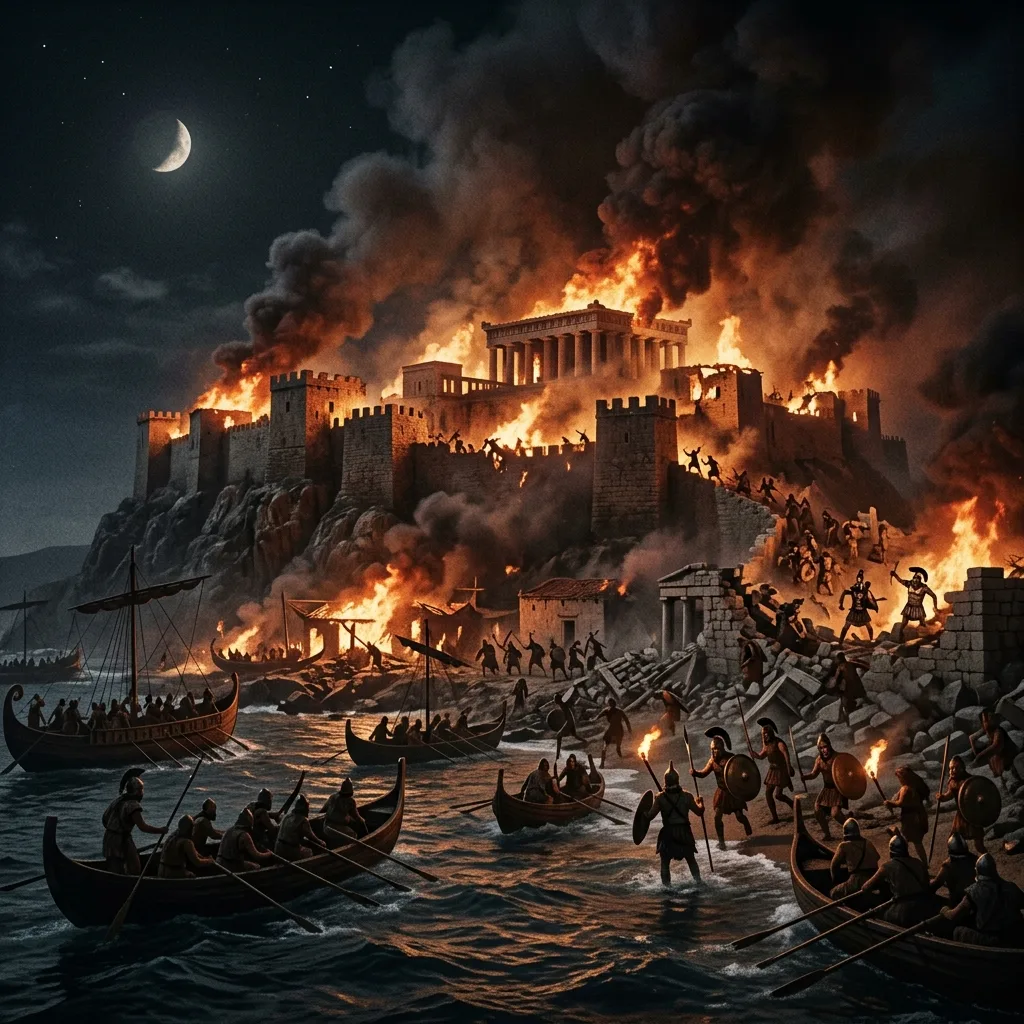
Within a span of 50 years, the major empires of the Mediterranean and Near East—Mycenaean, Hittite, Egyptian—either fell entirely or were severely crippled. Trade routes vanished, writing systems were forgotten, and cities burned.
Open in interactive timeline →Key Numbers
- Symbolic collapse year
- c. 1177 BC
- Civilizations toppled
- ~8 (Mycenaean, Minoan, Hittite, Trojan, Babylonian, Ugaritic, Cypriot, Egyptian decline)
- Megadrought duration
- ~300 years (c. 1200-900 BC)
- Greek literacy lost
- ~400 years (Linear B vanished)
- Ugarit's distress fleet
- 7 enemy ships
Verified Facts
- Archaeologist Eric H. Cline anchored the collapse to 1177 BC in his 2014 book '1177 B.C.: The Year Civilization Collapsed,' choosing the date of Pharaoh Ramesses III's Year-8 battle against the Sea Peoples as a symbolic marker for a breakdown that actually unfolded over several decades, roughly 1200-1150 BC.
- The mortuary temple of Ramesses III at Medinet Habu records that the invaders cut down empires 'at one time,' naming Hatti (the Hittites), Qode/Kode, Carchemish, Arzawa, and Alashiya (Cyprus): 'No land could stand before their arms.' Their named confederation included the Peleset, Tjekker, Shekelesh, Denyen (Danuna), and Weshesh.
- Ammurapi, the last king of Ugarit (a wealthy Syrian port), left a desperate clay letter reporting that 'the enemy's ships came here; my cities were burned' and that 'the seven ships of the enemy that came here have done very great damage.' His army and chariots were stranded in Hatti and his fleet in the land of Lukka, leaving the city defenseless; Ugarit was burned and never reoccupied around 1185-1180 BC.
- Hattusa, the mountain capital of the Hittite Empire, was abandoned and sacked around 1180 BC; its cuneiform royal archives fall silent at that date, and one of the empire's final letters is a plea for grain shipments, evidence of acute famine before the end.
- Across mainland Greece the great Mycenaean palace centers, including Mycenae, Tiryns, Pylos, and Thebes, were destroyed or abandoned around 1200 BC; some show burn layers and last-minute defensive fortifications, signs of a society bracing for attack.
- The collapse was so total in Greece that the Linear B script, used almost exclusively for palace accounting, disappeared entirely, plunging the Aegean into a roughly four-century 'Greek Dark Age' with no writing until the Phoenician-derived alphabet appeared around 800 BC.
- Paleoclimate studies led by David Kaniewski and Elise Van Campo, using pollen cores from Cyprus (Larnaca/Hala Sultan Tekke) and the Dead Sea, identify the onset of a roughly 300-year megadrought beginning around 1200 BC, with the driest interval c. 1250-1100 BC marked by a sharp decline in Mediterranean tree pollen.
- Rather than a single cause, scholars now favor a 'systems collapse' or 'perfect storm' model in which drought, famine, earthquakes (a so-called earthquake storm), internal revolt, the rupture of long-distance trade in tin and bronze, and Sea Peoples migrations compounded one another, so that interdependent kingdoms fell like dominoes once their fragile trade networks failed.
- Egypt under Ramesses III repelled the Sea Peoples around 1177 BC, but the New Kingdom emerged so weakened that it never regained its former imperial reach and slid into the decline of the Third Intermediate Period, illustrating how even the era's 'victor' was hollowed out by the wider crisis.
- The breakdown severed an interconnected Late Bronze Age world that had stretched from Mycenaean Greece across the Hittite realm, Cyprus, the Levant, Mesopotamia, and Egypt, ending centuries of palace economies, international diplomacy (the Amarna-style correspondence between Great Kings), and monumental building in a collapse with no recovery for generations.
The World at This Moment
Around 1200 BC the eastern Mediterranean hosted a tightly networked world-system: New Kingdom Egypt under Ramesses III, the Hittite empire ruled from Hattusa, the Mycenaean palace kingdoms of Greece, Kassite Babylon, Middle Assyria, Cyprus (Alashiya), and the Syrian entrepot of Ugarit, all bound by diplomatic correspondence, dynastic marriage, and trade in tin, copper, and luxury goods (vividly attested by the Uluburun shipwreck, c. 1320 BC). Beyond this core, the wider world moved on separate clocks: Shang-to-Western-Zhou transition in China (the Zhou conquest is traditionally dated 1046 BC), the Olmec preclassic emerging in Mesoamerica, and Vedic culture taking shape in northern India. The collapse was thus a regional, not global, event, but it struck the most densely interconnected polities of the age. The Sea Peoples raids recorded at Medinet Habu, the destruction of Ugarit and Hattusa, and Mycenaean palatial abandonment all cluster within roughly a half-century, making c. 1177 BC a convenient symbolic marker rather than a single datable catastrophe.
The Paradigm Shift
The collapse terminated the Bronze Age palace economy and inaugurated history's first true "dark age." Centralized redistributive palaces with their Linear B and cuneiform bureaucracies vanished; in Greece literacy disappeared for roughly four centuries until the alphabet arrived. Yet the rupture cleared ground for transformation. The disruption of long-distance tin networks is widely linked to the spread of iron metallurgy, which uses locally available ore, helping inaugurate the Iron Age. Out of the ashes came smaller, less hierarchical polities and new peoples in the historical record, including the Israelites in the highland Levant and the Philistines (the Peleset of Egyptian texts) on the coast. The Phoenician city-states, surviving the storm, propagated their consonantal alphabet across the Mediterranean, the ancestor of Greek and Latin script. Eric Cline's central thesis, that globalized interdependence itself magnified fragility, reframed the episode as a cautionary study in systemic vulnerability, making 1177 BC a touchstone in modern discussions of complexity, resilience, and the fragility of interconnected civilizations.
In Their Own Words
"My father, behold, the enemy's ships came (here); my cities(?) were burned, and they did evil things in my country. Does not my father know that all my troops and chariots(?) are in the Land of Hatti, and all my ships are in the Land of Lukka?... Thus, the country is abandoned to itself. May my father know it: the seven ships of the enemy that came here inflicted much damage upon us." — Ammurapi, last king of Ugarit, in a letter to the king of Alashiya (Cyprus); clay tablet RS 18.147, found in the destruction layer of Ugarit, early 12th century BC (translation as transmitted via Jean Nougayrol, Ugaritica V, and widely cited by Eric Cline).
My father, behold, the enemy's ships came here; my cities were burned, and they did evil things in my country. The seven ships of the enemy that came here inflicted much damage upon us.
King Ammurapi of Ugarit, in a letter to the king of Alashiya (Cyprus), clay tablet RS 18.147, c. 1190 BCE — among the last words from the city before its destruction — source
The foreign countries made a conspiracy in their islands. All at once the lands were removed and scattered in the fray. No land could stand before their arms, from Hatti, Kode, Carchemish, Arzawa, and Alashiya on.
Pharaoh Ramesses III, mortuary-temple inscription at Medinet Habu, c. 1177 BCE, describing the Sea Peoples (Wilson translation, ANET) — source
In Depth
When the Network Failed: The First Globalized World and Its Undoing
The Late Bronze Age Collapse is the moment history first demonstrated that complexity is not the same as resilience. Around 1200–1150 BC, within roughly two generations, an interlocking system of palace civilizations across the eastern Mediterranean fell almost in unison: the Mycenaean palaces of mainland Greece (Pylos, Tiryns, Mycenae) burned, the Hittite capital Hattusa was abandoned, the wealthy Syrian port of Ugarit was destroyed and never reoccupied, and Egypt — though it survived — was so weakened that its imperial reach in the Levant withered. The archaeologist Eric Cline, in 1177 B.C.: The Year Civilization Collapsed, uses that date (when Ramesses III repelled the "Sea Peoples" at the Nile Delta) as a symbolic anchor for a process that was anything but a single event.
The Deep Preconditions
The collapse was the dark shadow of an extraordinary achievement. The Bronze Age Near East was the most interconnected world humanity had yet built — a true international system of diplomacy, dynastic marriage, and long-distance trade running on writing born from Cuneiform (sv-cuneiform). That very system depended on bronze, an alloy requiring tin and copper mined hundreds of miles apart, so that a Greek sword might contain metal from Afghanistan. This interdependence had grown across centuries: the same great powers that fought the chariot battle at The Battle of Kadesh (sv-battle-kadesh) in 1274 BC — and then signed history's first surviving peace treaty — were precisely the states that fell. Their sophistication was their fragility. Palace economies centralized grain, metal, and literacy in a way that left no redundancy when the network frayed.
The Cascade
Modern scholarship has largely abandoned the search for a single villain in favor of a "systems collapse" model: a perfect storm of cascading stresses. Climate science — pollen cores, lake sediments, and cave stalagmites — points to a severe, prolonged megadrought gripping the Mediterranean around 1200 BC. Drought meant famine; famine meant migration and the displaced raiders Egypt called the Sea Peoples; broken trade meant no tin, and no tin meant no bronze. Earthquakes, internal revolt, and severed routes compounded each other until interdependence became the very mechanism of ruin. The Ugarit tablets preserve the last desperate letters of a king begging for help that never came.
What It Reshaped
The aftermath was a genuine dark age. On the Greek mainland, literacy itself vanished — the Linear B script of the palaces was simply forgotten, and Greece would not write again for some four centuries. From that silence two things eventually grew. First, the memory of the lost Mycenaean world hardened into legend, supplying the raw material that Homer & the Epic Tradition (sv-homer) and Hesiod & the Theogony (sv-hesiod) would shape centuries later into the Iliad and the Greek myth of a vanished Age of Heroes. Second, into the vacuum stepped survivors and adapters: the Phoenicians of the Levantine coast weathered the storm and carried a streamlined alphabet that the Greeks would borrow and complete with vowels — a humbler, more democratic technology than scribal cuneiform.
The collapse also accelerated the shift from bronze to iron, a metal whose ore was common everywhere and which therefore needed no fragile global supply chain. The world that re-emerged was less centralized, more literate from the bottom up, and ultimately more creative — the soil from which The Pre-Socratic Philosophers (sv-presocratics) and The Birth of Democracy in Athens (sv-athenian-democracy) would much later spring. The Late Bronze Age Collapse thus stands as history's first cautionary tale about hyper-connected civilizations — a 3,200-year-old warning that the systems we build for prosperity can become the channels through which catastrophe propagates.
Causes & Consequences
What led to it
- The Late Bronze Age had woven Egypt, the Hittite Empire, Mycenaean Greece, Assyria, Babylonia, Cyprus, and the Canaanite city-states into the first genuinely international system, bound together by trade, diplomacy, and intermarriage and thus exposed to shared shocks.
- Bronze metallurgy required both copper and tin, metals rarely found together, forcing rulers to depend on long-distance supply lines (Cypriot copper, tin reaching the Mediterranean from as far as Central Asia) that could be severed.
- The Amarna Letters of the 14th century BC document a palace-centered diplomatic culture of royal gift exchange, marriage alliances, and balance-of-power negotiation, showing how tightly the great kingdoms had become interdependent.
- The Mycenaean and Near Eastern states ran centralized, redistributive palace economies (recorded on Linear B tablets at Pylos and Knossos) that concentrated surplus and lacked resilience once their administrative centers were disrupted.
- Paleoclimate proxies including tree rings, lake sediments, and pollen cores record the onset of the 3.2 ka BP megadrought, a prolonged arid episode that cut crop yields across rain-fed Anatolia, Greece, and the Levant.
- A roughly fifty-year sequence of major earthquakes between about 1225 and 1175 BC, the so-called earthquake storm mapped by Amos Nur and Robert Drews, struck a corridor of cities running from Mycenae and Tiryns through Troy to Ugarit.
What it set in motion
- The Hittite Empire ceased to exist and its capital Hattusa was destroyed, ending Hittite as a written and spoken language and removing one of the era's dominant powers from the map.
- Mycenaean palatial civilization fell, the Linear B accounting script was abandoned because the redistributive economy it served had vanished, and Greece entered a centuries-long Dark Age of depopulation and lost literacy (c. 1100-800 BC).
- The Phoenicians, among the survivors who adapted best, standardized and carried the alphabet across the Mediterranean to Greece and Italy, seeding the Greek and Latin alphabets still in use today.
- The collapse of Egyptian and Hittite imperial control over the Levant opened space for new peoples and polities to emerge, including the Israelites, Arameans, Philistines, and Neo-Hittite city-states.
- Iron metallurgy spread as a practical replacement for bronze when tin supply lines failed, with Cyprus producing early bi-metallic tools and weapons, accelerating the transition into the Iron Age.
- Large centralized empires gave way to smaller, more localized city-states and kingdoms, reshaping the political landscape of the eastern Mediterranean for the early first millennium BC.
The Live Academic Debate
The core debate concerns causation: monocausal versus systemic explanations. Older accounts foregrounded the Sea Peoples as invaders, drawn directly from Ramesses III's Medinet Habu reliefs; most current scholars reject migration-as-prime-mover, treating the Sea Peoples as symptom as much as cause. The leading climate hypothesis, advanced by David Kaniewski and colleagues from Levantine and Cypriot pollen and isotope records, posits a prolonged drought (the so-called 3.2 ka event) triggering crop failure, famine, and migration. This is contested: A. Bernard Knapp and Sturt Manning argue the paleoclimate data are too coarse and unsynchronized to demonstrate a single region-wide megadrought, cautioning against environmental determinism. Eric Cline synthesizes these into a "perfect storm" of earthquakes, drought, internal rebellion, severed trade, and invasion, arguing systemic interdependence amplified each shock. Others, including scholars working on "complexity collapse" frameworks influenced by Joseph Tainter, emphasize internal socioeconomic fragility and declining marginal returns on complexity. The field has largely moved from asking "who" to asking "how systems fail."
How This Event Connects
The Late Bronze Age Collapse serves as a catastrophic lesson in the fragility of hyper-connected civilizations, echoing the profound environmental vulnerabilities first witnessed during The Last Ice Age & The Megafauna Extinction. Just as the abrupt cooling of the Younger Dryas decimated the Pleistocene megafauna and forced early humans to radically adapt, the 300-year megadrought of the 12th century BCE shattered the agricultural foundations of the Eastern Mediterranean. In both epochs, humanity's complex societal structures were violently dismantled by climatic shifts, proving that even the most advanced palace economies were ultimately subservient to the brutal dictates of paleoclimatology.
The collapse utterly destroyed the delicate geopolitical equilibrium established centuries prior at The Battle of Kadesh. The "Silver Tablet" treaty had forged a highly globalized network of trade and diplomacy between the Hittites, Egyptians, and Mycenaeans. However, this very interdependence became their undoing. When famine caused by the megadrought sent desperate "Sea Peoples" migrating across the Mediterranean, the rigid, centralized states could not adapt. The systemic collapse model proves that the international supply chains—reliant on the safe transport of tin and copper—cascaded into failure, bringing down the entire Bronze Age world in a localized apocalypse.
One of the most devastating casualties of this systemic failure was the obliteration of highly specialized literacy, linking the collapse back to the origins of The Invention of Cuneiform. As the palace bureaucracies that managed the grain surpluses vanished, so too did the necessity for their complex writing systems. Scripts like Mycenaean Linear B completely disappeared from the historical record. The Dark Age that followed was characterized by a profound loss of accumulated data, highlighting that writing is not an irreversible evolutionary step, but a fragile technology deeply dependent on the survival of the bureaucratic state.
Collapse as system failure, not a single villain
For a century scholars blamed the mysterious "Sea Peoples," but modern research has shifted toward a systems-collapse model. In 1177 B.C.: The Year Civilization Collapsed, archaeologist Eric H. Cline argues that no single cause toppled the interconnected Bronze Age world; instead a "perfect storm" of drought and famine, earthquakes, internal rebellion, and severed trade routes struck a tightly interdependent network, so that each society's fall became a new stressor on its neighbors. In this reading the Sea Peoples were as much a symptom — displaced refugees and raiders — as a cause.
The Counterfactual
Had the palatial system absorbed its shocks, as it had weathered earlier crises, the trajectory of the Mediterranean might have looked very different. Continuity of Mycenaean and Hittite bureaucracies would likely have preserved syllabic literacy, possibly forestalling the Greek alphabet's adoption and the cultural watershed it enabled, including the eventual fixing of Homeric epic. A surviving Hittite empire would have remained a counterweight to a rising Assyria, plausibly altering the later geopolitics that produced the Neo-Assyrian and Persian empires. The highland conditions that fostered emergent Israel and the coastal Philistine settlement were partly products of the collapse; without it, the political stage on which the Hebrew Bible's national narratives unfold might not have existed in recognizable form. This reasoning must remain probabilistic: scholars such as Cline stress multicausality, so no single removed factor guarantees survival. The deeper counterfactual lesson, emphasized in resilience-focused work, is that the very interconnection that made these societies prosperous also propagated failure, suggesting collapse was a systemic risk rather than mere bad luck.
Myth vs. Reality
Myth: The Sea Peoples invaded and destroyed Bronze Age civilization.
Reality: Modern scholarship treats the Sea Peoples as more a symptom than the prime cause. Eric Cline and others argue the collapse was a 'perfect storm' of interacting stresses (climate change, drought, earthquakes, internal rebellion, and the breakdown of interdependent trade systems) rather than a single invading horde. Tellingly, inland powers like Assyria, Babylonia, and Elam declined despite never being touched by the Sea Peoples, and many scholars now view the Sea Peoples as displaced migrants set in motion by crises already underway.
Myth: The collapse happened suddenly, essentially in the year 1177 BC.
Reality: The collapse unfolded over roughly a century, not a single year. The destructions, abandonments, and declines run from about 1220 to 1170 BC with a long tail of decline continuing afterward. Eric Cline has stated plainly that the '1177 BC' in his book title is a deliberate convention; the date marks Ramesses III's recorded eighth-year battle against the Sea Peoples, while the broader civilizational unraveling 'took not a year, but more like a century.'
Myth: Civilization everywhere was wiped out and the region went totally dark.
Reality: The collapse was severe but uneven and incomplete. Egypt survived in weakened form and Assyria contracted but endured; some highland and smaller settlements continued, and many cities that escaped destruction simply shrank or grew poorer over decades. Scholars increasingly describe the episode as a reorientation toward different social and economic models as much as a simple collapse, with the palace-centered systems failing while populations and cultures persisted into the Iron Age.
Myth: The Sea Peoples were a single unified nation or ethnic group.
Reality: Egyptian records name several distinct groups (such as the Peleset, Shekelesh, and Tjeker), and scholarship indicates they came from a wide area rather than one homeland. Archaeological evidence at Philistine sites shows a blend of Aegean and local Canaanite traditions in pottery and architecture, suggesting the Peleset had Aegean roots, while other groups have been linked to Anatolia and the central Mediterranean. They are best understood as a heterogeneous wave of migrants and raiders, not a coordinated empire.
Myth: Climate change is just a modern guess with no hard evidence behind it.
Reality: There is now substantial paleoclimate data for a prolonged drought around this period. High-resolution pollen analysis from a Sea of Galilee core (Langgut, Finkelstein, and Litt 2013) identifies the driest interval of the Bronze and Iron Ages at roughly 1250 to 1100 BC, and sediment and radiocarbon data from Tell Tweini in Syria and sites in Cyprus (Kaniewski et al.) support a multi-century dry phase often termed the 3.2 ka BP megadrought. This is one well-documented stressor among several, not the sole cause.
Frequently Asked Questions
What caused the Late Bronze Age Collapse?
There was no single cause. The leading scholarly view, popularized by Eric Cline in his book 1177 B.C.: The Year Civilization Collapsed, is that a "perfect storm" of interconnected stressors brought down the system: prolonged drought and famine, earthquakes, internal rebellion, the disruption of international trade routes, and the migrations and raids of the so-called Sea Peoples. Because the Bronze Age palace economies of the eastern Mediterranean were deeply interdependent, the failure of one part cascaded through the whole network, turning regional crises into a systemic collapse.
Who were the Sea Peoples?
The Sea Peoples were a loose coalition of seafaring and migrating groups who appeared in the eastern Mediterranean toward the end of the 13th and into the early 12th century BC. Egyptian records, especially the inscriptions of Ramesses III at Medinet Habu, name groups such as the Peleset, Tjeker, Shekelesh, Denyen, Weshesh, and Sherden. Their precise origins remain debated, but many scholars connect them to Aegean and western Anatolian populations displaced by the wider upheaval; the Peleset are generally identified with the later Philistines of the southern Levant. Most historians now see them as a symptom of the collapse as much as a cause.
Which civilizations and cities fell during the collapse?
Several major powers declined or fell within roughly a century around 1200-1150 BC. The Hittite Empire disintegrated and its capital Hattusa was destroyed and abandoned; the Mycenaean palace centers of Greece, including Pylos, were burned and their system collapsed; and the wealthy Syrian port of Ugarit was destroyed and never reoccupied. Egypt survived but was severely weakened and entered a long decline. Cyprus and many Levantine trading cities were also disrupted, ending the cosmopolitan, interconnected world of the Late Bronze Age.
Why is the date 1177 BC used for the collapse?
1177 BC is a symbolic marker rather than the date of a single decisive event. It refers to the eighth regnal year of the Egyptian pharaoh Ramesses III, when, according to his inscriptions at Medinet Habu, Egypt fought off a major invasion of the Sea Peoples in land and naval battles. Eric Cline chose it as a memorable anchor point, the way 476 AD is used for the fall of Rome, even though the collapse actually unfolded gradually over several decades across many regions.
Did climate change and drought really contribute to the collapse?
Yes, there is substantial paleoclimatic evidence for a severe, prolonged drought in the eastern Mediterranean and Near East around 1200 BC, often linked to the so-called 3.2 kiloyear event. Tree rings, pollen cores, and lake and sea sediments point to drier, cooler conditions that would have caused crop failures and famine in rain-fed agricultural regions like Anatolia, Greece, and the Levant. A 2023 study even found evidence of severe consecutive drought years coinciding with the fall of the Hittite Empire around 1198-1196 BC. Most scholars treat drought as a major amplifying factor working alongside the other stressors rather than the sole cause.
What happened after the Late Bronze Age Collapse?
The collapse ushered in a centuries-long "dark age" across much of the region. In Greece, the Mycenaean palace system disappeared, populations declined, long-distance trade contracted, and the Linear B writing system was lost, leaving the Greek Dark Age (roughly 1200-800 BC) with almost no written records. Literacy eventually returned to the Aegean only with the adoption of the Phoenician alphabet around the 8th century BC. Out of this disruption new cultures and political forms gradually emerged, including the Iron Age kingdoms of the Levant and, in time, Archaic Greece.
Sources & Further Reading
- Late Bronze Age collapse — Wikipedia
- Eric H. Cline, 1177 B.C.: The Year Civilization Collapsed, Revised and Updated (Princeton University Press, 2021)
- David Kaniewski et al., 'Environmental Roots of the Late Bronze Age Crisis,' PLOS ONE (2013) and related drought studies
- A. Bernard Knapp and Sturt W. Manning, 'Crisis in Context: The End of the Late Bronze Age in the Eastern Mediterranean,' American Journal of Archaeology 120 (2016)
- Donald B. Redford, The Medinet Habu Records of the Foreign Wars of Ramesses III (Brill, 2018)
- Robert Drews, The End of the Bronze Age: Changes in Warfare and the Catastrophe ca. 1200 B.C. (Princeton University Press, 1993)
- Lecture: Eric Cline on the Collapse
- National Geographic: Megadroughts
- ResearchGate: Pollen and Climate Data
Cite This Page
AskHistoryAI. “The Bronze Age Collapse.” AskHistoryAI — Interactive Timeline of Everything. Updated 2026-09-11. https://askhistoryai.com/event/sv-bronze-collapse/
Every fact on this page is checked against the published fact ledger and methodology; sources are listed above.