The Ediacaran Biota
The first large, visible creatures—and they looked absolutely alien.
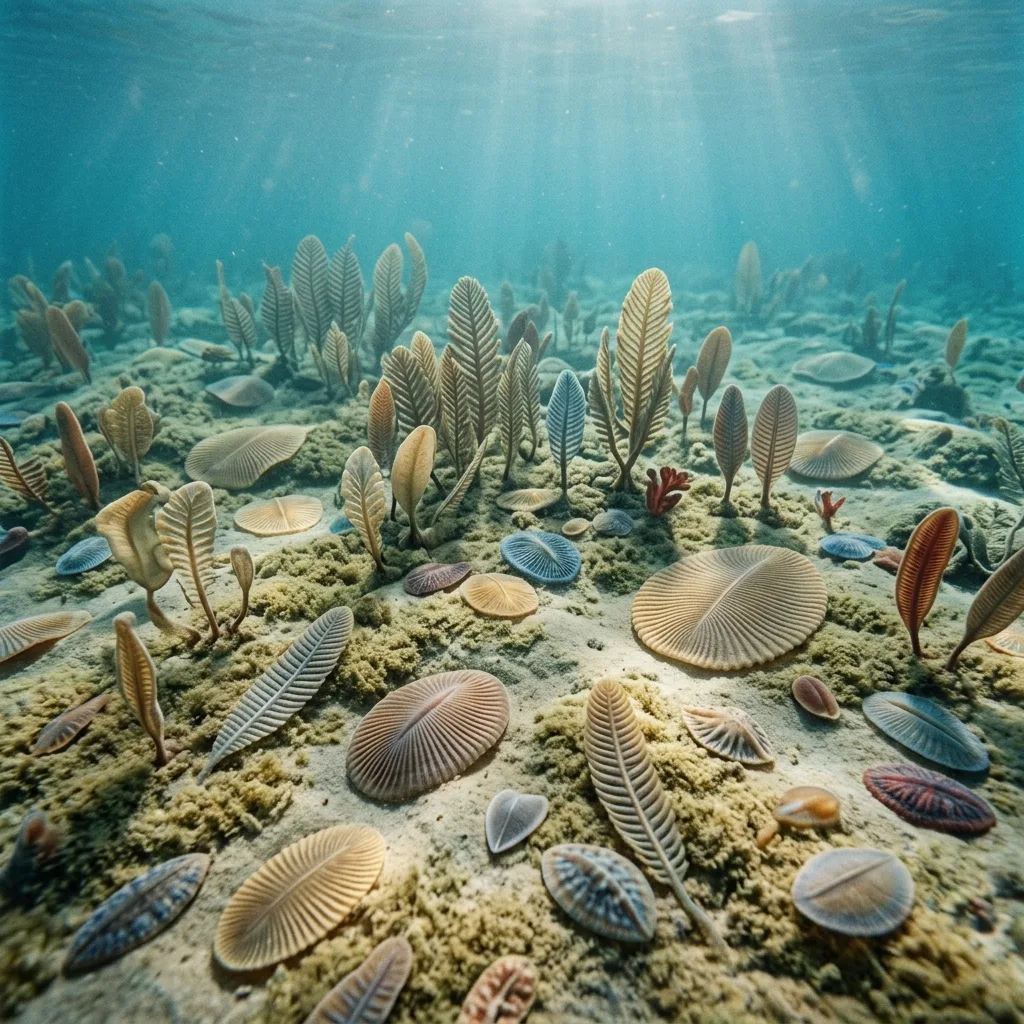
After Snowball Earth thaws, the very first large, multicellular organisms appear in the fossil record. These bizarre, soft-bodied creatures look like nothing alive today—flat, quilted, fractal-shaped things lying on the ocean floor.
Open in interactive timeline →Key Numbers
- Age range
- ~571–539 million years ago
- Predates Cambrian explosion by
- ~30+ million years
- Mistaken Point fossils
- 10,000+ specimens
- Largest frond (Charnia wardi)
- Up to ~2 metres long
- Ediacaran Period span
- 635–539 Ma (~96 Myr)
Verified Facts
- The Ediacaran biota represents Earth's earliest known communities of large, complex, soft-bodied multicellular organisms, appearing roughly 571 million years ago after nearly three billion years of life dominated by microbes — a watershed that predates the Cambrian explosion by tens of millions of years.
- The first Precambrian fossil scientifically recognized as such was Charnia, found in 1957 in Charnwood Forest, England, by schoolboy Roger Mason; because England's geology was so well-mapped, it was certain the leaf-like frond came from below the Cambrian, overturning the long-held belief that no complex life existed before the Cambrian explosion.
- A 15-year-old schoolgirl, Tina Negus, had actually spotted the same Charnwood frond a year earlier in 1956, but her geography teacher dismissed the idea of Precambrian fossils; her priority was only formally acknowledged decades later, at the discovery's 50th-anniversary celebrations.
- Reg Sprigg had reported 'jellyfish-like' impressions from the Ediacara Hills of South Australia's Flinders Ranges in 1946, but the rocks were wrongly assumed to be Early Cambrian, so the find drew little serious attention internationally until around 1961 — which is why the 1957 Charnwood discovery is usually credited as 'first.'
- Paleontologists recognize three successive Ediacaran assemblages: the deep-water Avalon (~575–560 Ma, dominated by fractal rangeomorphs like Charnia), the shallow-marine White Sea (~560–550 Ma, the peak of diversity, including Dickinsonia and Kimberella), and the low-diversity Nama (~550–538 Ma) that persisted up to the Cambrian transition.
- A 2018 study by Ilya Bobrovskiy and colleagues, published in Science, extracted fossil cholesterol-class steroids (C27 cholesteroids making up roughly 85–93% of the organic material) from a Dickinsonia specimen — a hallmark of animal cells — providing strong chemical evidence that this enigmatic creature was one of the earliest animals.
- Kimberella, found in the White Sea region of northwest Russia in beds radiometrically dated to about 558–555 million years ago, is associated with radula-like scratch marks, suggesting it was a mollusc-like grazer that scraped microbial mats — making it one of the strongest candidate bilaterian animals of the Ediacaran.
- Mistaken Point in Newfoundland, Canada — a UNESCO World Heritage Site since 2016 — preserves over 10,000 fossils on a ~565-million-year-old seafloor, frozen in place 'Pompeii-style' when soft-bodied organisms were buried under repeated influxes of volcanic ash whose zircon crystals allow precise uranium-lead dating.
- The Ediacaran Period was ratified by the International Union of Geological Sciences in 2004 — the first new geological period formally declared in some 120 years — with its base defined by a 'golden spike' (GSSP) at the Nuccaleena Formation cap carbonate at Enorama Creek in the Flinders Ranges, South Australia.
- The largest Ediacaran organisms, the frondose rangeomorphs, reached striking sizes early: Charnia wardi consists of slender fronds nearly 2 metres long, making it the longest Ediacaran fossil yet described, even though these creatures had no mouths, guts, or limbs and likely absorbed nutrients directly from seawater.
The World at This Moment
The Ediacaran biota appeared in the aftermath of the Cryogenian "Snowball Earth" glaciations (Sturtian and Marinoan, ending ~635 Ma), as the planet thawed and ocean chemistry shifted toward greater oxygenation. The Ediacaran Period itself (635–~539 Ma) was formally ratified by the International Commission on Stratigraphy in 2004—the first new geological period defined in over a century, its base anchored by the cap carbonate above the Marinoan glacials in the Flinders Ranges. The macroscopic Ediacaran organisms radiated in three successive assemblages: the deep-water Avalon (~575–560 Ma, Mistaken Point, Newfoundland and Charnwood Forest, England), the shallower White Sea (~560–550 Ma, Russia and South Australia), and the terminal Nama (~550–539 Ma, Namibia), where the first biomineralized skeletons (Cloudina) appear. This was a world without land plants, without predators of consequence, and without animals as we know them on the seafloor, dominated instead by microbial mats. These organisms vanished at or near the Ediacaran–Cambrian boundary, immediately before the Cambrian explosion of bilaterian body plans.
The Paradigm Shift
The Ediacaran biota dismantled the long-standing assumption, traceable to Darwin's own "dilemma," that complex life began abruptly in the Cambrian with no Precambrian antecedents. R.C. Sprigg's 1946 discoveries in South Australia's Ediacara Hills, and the independent 1957 find of Charnia masoni in England's Charnwood Forest, demonstrated unambiguously that large, structured, multicellular organisms existed tens of millions of years before the Cambrian. This pushed the documented history of complex macroscopic life back by roughly 30–40 million years and reframed the Cambrian explosion not as life's origin but as a later acceleration. The biota forced paleontologists to grapple with body plans—the fractal "quilting" of rangeomorphs—that fit no living phylum, expanding the conceptual space of how multicellularity and large body size can be achieved. It established the principle that Earth's deep biosphere included evolutionary experiments later extinguished, and it made the Precambrian fossil record a central, rather than peripheral, arena for understanding the assembly of animal life.
In Their Own Words
"Until recently the fossils of organisms that lived earlier than the Cambrian period of 500 to 600 million years ago were rare. Now a wealth of such fossils has been found in South Australia." — Martin F. Glaessner, opening of "Pre-Cambrian Animals," Scientific American, vol. 204, no. 3 (March 1961)
In Depth
The Garden Before the Storm
For roughly three billion years after life began, the Earth's biosphere was, to the naked eye, invisible: a world of microbes, slime, and microscopic cells. The Ediacaran biota — the strange, soft-bodied, often meter-scale organisms that flourished from about 575 to 541 million years ago — were the first time the planet grew large, complex bodies you could have seen and touched. They are the hinge between a microbial Earth and an animal Earth, and almost everything alive today descends from the experiment they began.
Deep preconditions: oxygen, cold, and complexity
The Ediacarans could not have existed earlier. Building a large body is metabolically expensive, and that requires oxygen. The first crucial down payment came with the Great Oxygenation Event (sv-great-oxygenation) roughly two billion years prior, but the air and oceans only became rich enough for macroscopic life after a second, late-Neoproterozoic oxygen rise. That rise was bound up with the planet-scale glaciations of Snowball Earth (sv-snowball-earth); as the ice retreated, fluctuating climates and surging nutrient fluxes coincided with a step-change in marine oxygen. Equally essential were the deeper biological inventions that preceded them: the first complex cells (sv-first-complex-cells), whose mitochondria made energetic multicellularity possible, and the invention of sexual reproduction (sv-invention-of-sex), which accelerated the genetic shuffling that body-plan evolution demands. The Ediacaran biota is what the long chain reaching back to the origin of life (sv-origin-of-life) finally built once the chemistry allowed.
What they were — and the puzzle they pose
These organisms are genuinely alien. The rangeomorph Charnia, described by Trevor Ford in 1958, grew in fractal, frond-like branches with no mouth, gut, or limbs — recent work resolves it as a stem-eumetazoan with a body plan that no longer exists. Dickinsonia, a quilted oval up to a meter across, was long a mystery until 2018, when Bobrovskiy and colleagues recovered fossil cholesteroid molecules from it, arguing it was one of the earliest animals. Most revealing is Kimberella: associated radiating scratch-marks suggest an active, mobile grazer rasping at microbial mats — strong evidence for a true bilaterian, an animal with a front, a back, and directional purpose. Many Ediacarans, though, may belong to extinct clades all their own, a failed first draft of large life.
How it reshaped what came after
The Ediacaran world ended in turmoil. Around 541 million years ago a large fraction of these forms vanished — possibly Earth's first mass extinction, linked to oxygen crashes and the very ecological engineering of the new animals. What followed was the Cambrian explosion (sv-cambrian-explosion), the rapid appearance of shells, eyes, guts, and predators. Whether the Cambrian erased the Ediacarans or grew from their "deep root" is still debated, but the continuity matters: the bilaterian body plan glimpsed in Kimberella is the architecture later inherited by sharks (sv-first-sharks), by Tiktaalik and the move onto land (sv-tiktaalik), by the first mammals (sv-first-mammals), and ultimately by primates (sv-first-primates) and ourselves. Every animal that ever crawled, swam, or thought is built on the front-back, left-right symmetry the Ediacaran experiment first made flesh.
Seen from the long arc — from the Big Bang (sv-big-bang) forging hydrogen, to Earth's formation (sv-earth-formation) supplying a stage — the Ediacaran biota marks the moment the universe's slow accumulation of complexity finally produced organisms large enough to leave fossils a person could recognize. They were a quiet garden of soft, strange forms holding the planet's surface for thirty million years before the storm of the Cambrian rewrote everything. They failed, mostly. But they proved it could be done.
Causes & Consequences
What led to it
- The end of the Cryogenian Snowball Earth glaciations around 635 million years ago thawed a globally frozen planet and reset surface conditions, opening the Ediacaran Period in which large-bodied organisms could appear.
- Deglaciation of the Sturtian and Marinoan snowball ice sheets flushed clay-derived phosphate into the oceans, increasing seawater phosphate bioavailability by more than twentyfold and fueling a surge in marine primary productivity.
- The Neoproterozoic Oxygenation Event raised atmospheric and oceanic oxygen levels and oxygenated the seas to greater depths, creating the aerobic habitats that energetically demanding, morphologically complex multicellular life required.
- The prior evolution of eukaryotic cells, multicellularity, and (in the metazoan lineage) the genetic toolkit for complex bodies had already taken place during the Cryogenian or Tonian, so the biological raw material for large organisms existed before the Ediacaran began.
- The Gaskiers glaciation, a comparatively brief regional ice age dated to roughly 580 million years ago in Newfoundland, immediately preceded the first appearance of Ediacaran macrofossils, with the oldest Avalon-type fossils appearing less than about 9.5 million years afterward.
- Exceptional preservation conditions in deep-marine settings such as Mistaken Point, where volcanic ash (tuff) beds rapidly buried and cast soft-bodied organisms, made the fossilization of these otherwise unmineralized forms possible in the first place.
What it set in motion
- The Ediacaran biota produced the first macroscopic, architecturally complex multicellular organisms in the geological record, beginning with the rangeomorph-dominated communities of the Avalon explosion around 575 million years ago.
- It included the oldest confirmed macroscopic animals, such as Dickinsonia, whose preserved cholesteroid lipid biomarkers identify it as a basal animal living about 558 million years ago, roughly 16 million years before the Cambrian explosion.
- Mobile grazers and probable bilaterians like Kimberella left feeding trails showing animals were actively consuming microbial mats, foreshadowing the disruption of the Precambrian mat-dominated seafloor.
- Late Ediacaran organisms such as Cloudina developed the earliest animal biomineralized skeletons, calcareous tubes appearing between roughly 549 and 541 million years ago that mark the origin of skeletons and shelled reef-building.
- Increasingly complex burrowing and sediment exploration toward the Ediacaran-Cambrian boundary initiated the 'agronomic' or substrate revolution, in which infaunal animals churned the seabed and ended the stable microbial-mat substrates of earlier times.
- The biota's late-Ediacaran decline and disappearance at the Cambrian boundary near 539 million years ago, plausibly driven by ecosystem-engineering metazoans and the advent of predation, helped clear ecological space for and set the stage for the Cambrian explosion of modern animal body plans.
The Live Academic Debate
The central, still-unresolved debate concerns the biological affinity of these organisms. Adolf Seilacher argued (1989, 1992) that most are not animals at all but members of an extinct kingdom, the "Vendobionta"—giant, quilted, multinucleate constructions with no close relation to modern phyla; Mark McMenamin and others extended non-metazoan readings toward lichens, fungi, or giant protists. Against this, Martin Glaessner had long maintained the biota included true metazoans, and Mikhail Fedonkin and Ben Waggoner's reinterpretation of Kimberella (1997) as a mollusc-grade bilaterian grazer—supported by associated radula-like scratch traces (Kimberichnus)—argues for genuine animals. Ilya Bobrovskiy et al. (Science, 2018) reported that 558-million-year-old Dickinsonia preserve abundant cholesteroids, a hallmark of animals, bolstering the metazoan camp. Yet the rangeomorphs (Charnia, Rangea) remain genuinely problematic: most workers, including Guy Narbonne and Alex Liu, treat them as a possibly extinct stem-group experiment rather than crown-group animals. The field has moved toward a pluralistic view—a mixed assemblage of early animals, stem lineages, and enigmatic dead ends.
How This Event Connects
The sudden appearance of the Ediacaran Biota following the Avalon Explosion represents a pivotal inflection point in the history of life, serving as the critical bridge between the microbial past and the complex faunal dynamics of the Phanerozoic. This enigmatic assembly of macroscopic organisms is inextricably linked to the extreme climatic perturbations of Snowball Earth, the morphological innovations culminating in Tiktaalik & The Move to Land, and the macro-evolutionary paradigms of faunal replacement seen in the K-Pg Extinction Event.
The emergence of Ediacaran life is directly predicated upon the biogeochemical consequences of the Snowball Earth. The extreme glaciation of the Cryogenian, and its violent termination, resulted in the deposition of cap carbonates and a massive influx of limiting nutrients into the oceans. This drove the Neoproterozoic Oxygenation Event, which fundamentally altered the redox state of the global oceans. The Ediacarans, many of which relied on osmotrophy—absorbing dissolved organic carbon directly across their expansive, quilted surfaces—were entirely dependent on this post-glacial nutrient regime. Thus, the Ediacaran morphological experiment was a direct biochemical response to the planetary-scale terraforming initiated by the preceding glacial epoch.
In a broader evolutionary trajectory, the Ediacarans establish the foundational paradigm of morphological problem-solving that eventually leads to the adaptations seen in Tiktaalik & The Move to Land. Just as the Ediacarans represent the first major biological attempt to maximize surface area and structural integrity in a marine environment, Tiktaalik represents an analogous biomechanical breakthrough in adapting to terrestrial and shallow-water challenges. Both epochs represent critical thresholds where biological architecture was radically re-engineered to exploit novel, previously inaccessible ecological niches.
Finally, the mysterious demise of the Ediacaran Biota perfectly mirrors the catastrophic turnovers characterized by the K-Pg Extinction Event. Historiographically, both events represent "biotic replacements" where incumbent dominant ecosystems are entirely supplanted by novel body plans and ecological strategies. Whether the Ediacarans were driven to extinction by shifting anoxic conditions (a mass extinction analog) or outcompeted and consumed by the newly evolving, burrowing bilaterians of the Cambrian (the Agronomic Revolution), their fate underscores a universal evolutionary principle: prolonged periods of morphological stasis are inevitably shattered by abrupt environmental or biological disruptions, clearing the slate for successive evolutionary dynasties.
The Counterfactual
Had the Ediacaran biota left no recognizable fossil record—being soft-bodied, its preservation depended on unusual taphonomic windows such as "death masks" of pyrite and rapid burial under volcanic ash at Mistaken Point—the Cambrian explosion would likely still appear, as it did to nineteenth-century geologists, as life's sudden and inexplicable beginning. Without these fossils, Darwin's worry that the absence of Precambrian forerunners "may be truly urged as a valid argument against" his theory would have remained acute well into the molecular era. The eventual reconciliation came partly through these fossils and partly through molecular-clock estimates and trace fossils; absent the body fossils, the debate would lean far more heavily on inferred phylogenies. More consequentially, science would lack direct evidence that large multicellular life arose, diversified, and largely went extinct before animals proper—the very pattern that reveals macroscopic complexity as repeatedly evolvable and contingent rather than a single inevitable threshold crossed once in the Cambrian.
Myth vs. Reality
Myth: The Ediacaran biota were all a single, bizarre 'failed experiment' that went wholly extinct and left no descendants.
Reality: This stems from Adolf Seilacher's influential 'Vendobionta' hypothesis, which cast the Ediacarans as an extinct kingdom built on a unique quilted body plan with no link to later life. Modern work treats the Ediacara biota not as one clade but as a mix of lineages, varying widely in shape, symmetry, growth, and modularity. Many researchers now interpret some forms as stem-group members of known animal clades, so the assemblage included genuine evolutionary dead ends alongside organisms plausibly related to later metazoans, rather than one doomed kingdom.
Myth: None of the Ediacaran organisms were animals; they were all algae, lichens, or giant protists unrelated to us.
Reality: Earlier interpretations did propose that forms like Dickinsonia were giant single-celled organisms, lichens, or fungi. In 2018, Ilya Bobrovskiy and colleagues recovered cholesteroid steroid biomarkers (about 93 percent C27 sterols) from a well-preserved White Sea Dickinsonia fossil; because abundant cholesterol is a signature of animals, this is widely cited as strong evidence Dickinsonia was an animal. Some researchers remain cautious about long-term biomarker preservation, but the find shifted mainstream opinion toward an animal affinity for at least some Ediacarans.
Myth: Every Ediacaran organism was soft-bodied, with no shells or skeletons until the Cambrian.
Reality: Most Ediacarans are indeed preserved as soft-bodied impressions, but the late Ediacaran already had biomineralizing animals. Cloudina and Namacalathus built calcium-carbonate skeletons, and Cloudina occurs in some of Earth's earliest animal reef structures; some Cloudina shells bear bored holes interpreted as evidence of predation. So biomineralization and the ecological pressures often associated with the Cambrian had begun before the period boundary, not after it.
Myth: All Ediacaran life was rooted in place, immobile, and incapable of behavior.
Reality: Many iconic Ediacarans such as the frond Charnia were sessile, anchored by holdfasts, which feeds the image of a motionless world. But trace and body fossils show otherwise: Kimberella is associated with fanned bifid scratch marks (Kimberichnus) interpreted as grazing across microbial mats, and evidence for movement in Kimberella and Dickinsonia was reported as early as 2005. Mobile, behaving animals were therefore part of Ediacaran ecosystems millions of years before the Cambrian.
Myth: The Ediacaran biota are simply the direct, recognizable ancestors of Cambrian animals, smoothly transitioning into them.
Reality: The relationship is genuinely debated, not settled as simple ancestry. Researchers describe distinct successive assemblages (Avalon, White Sea, Nama) and weigh at least three models for their disappearance: outright mass extinction, biotic replacement by Cambrian organisms, and the 'Cheshire Cat' idea that the forms faded from the record as the microbial-mat conditions that preserved them vanished. Many classic Ediacarans lack clear morphological links even to Cambrian groups, so framing them as straightforward Cambrian ancestors overstates the evidence.
Frequently Asked Questions
What is the Ediacaran biota?
The Ediacaran biota is an assemblage of enigmatic, mostly soft-bodied, tubular and frond-shaped organisms that represent the earliest known communities of large, complex multicellular life on Earth. They lived during the Ediacaran Period (roughly 635 to 538.8 million years ago) and were globally abundant from about 571 to 539 million years ago, predating the Cambrian Explosion by tens of millions of years. Their fossils have been found on nearly every continent, recording an early experiment in macroscopic life before the appearance of most modern animal body plans.
How old is the Ediacaran biota, and when did it live?
The biota flourished during the Ediacaran Period, which spanned approximately 635 to 538.8 million years ago. The most famous frond and disc-shaped macrofossils, however, appear later in the period, with the richest assemblages dating from roughly 571 to 539 million years ago. This places them well before the Cambrian Explosion (which began around 539 million years ago), making them the oldest widely accepted record of large, complex organisms in the fossil record.
Who discovered the Ediacaran fossils?
Geologist Reg Sprigg found fossils in the Ediacara Hills of South Australia in 1946 while inspecting old mines, but his interpretation that they were ancient was initially met with skepticism and his work struggled for acceptance. The decisive discovery came in England's Charnwood Forest in the 1950s, where schoolchildren Tina Negus and Roger Mason independently spotted a fronded fossil; in 1958 University of Leicester geologist Trevor Ford described it as Charnia masoni. Because the Charnwood rocks were unambiguously Precambrian, Ford's work was the first to prove these soft-bodied organisms genuinely predated the Cambrian. The Ediacaran Period was later named after the Australian hills where Sprigg made his find.
Were the Ediacaran organisms animals?
Some of them were, but the question remains genuinely debated, and the biota is not thought to be a single related group. In 2018, researchers led by Ilya Bobrovskiy and Jochen Brocks at the Australian National University extracted cholesterol-derived biomarkers (cholesteroids) from an exceptionally preserved Dickinsonia fossil, providing strong chemical evidence that it was an animal, since cholesterol is a hallmark of animal life. However, other Ediacaran forms have been interpreted variously as protists, algae, fungi, lichens, or members of an extinct group, so most scientists treat the biota as a mixture that likely includes some of the earliest animals alongside organisms whose affinities are still unresolved.
What were Dickinsonia, Charnia, and Spriggina?
These are three of the most iconic Ediacaran genera. Dickinsonia was a flat, oval, ribbed organism that grew up to roughly a meter long and is now widely regarded, on biomarker evidence, as one of the earliest animals. Charnia was a frond-shaped, sessile organism anchored to the seafloor and was the first Ediacaran fossil proven to be Precambrian. Spriggina was a small, segmented, bilaterally symmetrical, worm-like form that some researchers have tentatively linked to early arthropods or annelids, though its exact relationships remain uncertain.
Why did the Ediacaran biota go extinct?
The classic soft-bodied Ediacaran forms largely vanish near the Ediacaran–Cambrian boundary around 539 million years ago, in what is sometimes called Earth's earliest mass extinction of complex life, though the cause is still unresolved. The leading hypotheses include the 'biotic replacement' model, in which newly evolving, mobile, burrowing and predatory animals reengineered marine environments and outcompeted the Ediacarans; a 'catastrophe' model invoking abiotic environmental change such as ocean oxygen loss; and a taphonomic 'Cheshire Cat' model arguing the organisms persisted but stopped being preserved, an idea later challenged by evidence that Ediacaran-style microbial mats continued into the Cambrian. Their decline set the stage for the Cambrian Explosion of modern animal body plans.
Sources & Further Reading
- Ediacaran biota — Wikipedia
- Adolf Seilacher, 'Vendobionta and Psammocorallia: lost constructions of Precambrian evolution,' Journal of the Geological Society 149 (1992): 607–613
- Martin F. Glaessner, The Dawn of Animal Life: A Biohistorical Study (Cambridge University Press, 1984)
- Guy M. Narbonne, 'The Ediacara Biota: Neoproterozoic Origin of Animals and Their Ecosystems,' Annual Review of Earth and Planetary Sciences 33 (2005): 421–442
- Ilya Bobrovskiy et al., 'Ancient steroids establish the Ediacaran fossil Dickinsonia as one of the earliest animals,' Science 361 (2018): 1246–1249
- Mikhail A. Fedonkin and Benjamin M. Waggoner, 'The late Precambrian fossil Kimberella is a mollusc-like bilaterian organism,' Nature 388 (1997): 868–871
- Wikipedia: Dickinsonia
Cite This Page
AskHistoryAI. “The Ediacaran Biota.” AskHistoryAI — Interactive Timeline of Everything. Updated 2026-09-11. https://askhistoryai.com/event/sv-ediacaran-biota/
Every fact on this page is checked against the published fact ledger and methodology; sources are listed above.