Charles Darwin & The Origin of Species
The biological paradigm shift that upended humanity's place in nature.
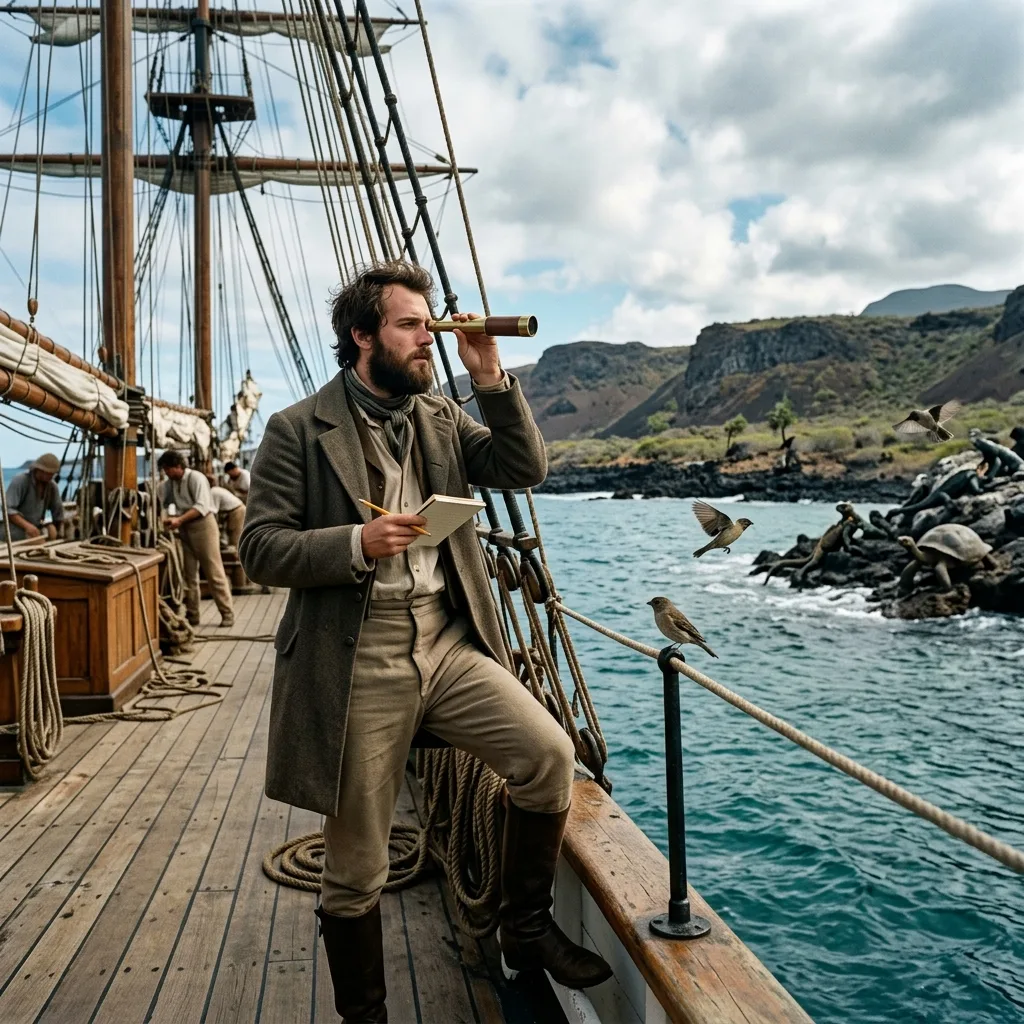
Following his 5-year expedition on the HMS Beagle, English naturalist Charles Darwin publishes "On the Origin of Species", introducing the scientific theory of evolution by natural selection.
Open in interactive timeline →Key Numbers
- Published
- Nov 24, 1859
- First-edition print run
- 1,250 copies (sold out day one)
- Beagle voyage
- ~5 years (1831-1836)
- Years Darwin sat on the theory
- ~20 (Malthus insight 1838 to 1859)
- Editions in Darwin's lifetime
- 6 (1859-1872)
Verified Facts
- The book's full original title was "On the Origin of Species by Means of Natural Selection, or the Preservation of Favoured Races in the Struggle for Life"; Darwin's preferred title used "natural selection," but publisher John Murray feared the public would not understand the term and pushed for the explanatory subtitle.
- Of the 1,250-copy first edition published on 24 November 1859, 58 copies went to reviewers and presentation; Darwin reported the entire remaining stock was taken up by booksellers on the first day of sale, making it an instant publishing event.
- Darwin had developed the core idea by 1838 after reading Thomas Malthus's "An Essay on the Principle of Population" "for amusement," which gave him the mechanism: organisms over-reproduce, and favorable variations are preserved in the resulting struggle for existence.
- Darwin only rushed the book into print after Alfred Russel Wallace, feverish with malaria in the Malay Archipelago, independently conceived natural selection and mailed Darwin an essay in 1858 outlining nearly the same theory.
- The theory was first made public not in the book but in a joint Darwin-Wallace paper, "On the Tendency of Species to form Varieties," read at the Linnean Society of London on 1 July 1858; neither author attended, as Darwin was at home in the wake of his infant son's death and Wallace was still abroad.
- The 1858 Linnean presentation was arranged and read on the two men's behalf by their colleagues Charles Lyell and Joseph Dalton Hooker, who paired Wallace's essay with Darwin's earlier 1844 sketch and an 1857 letter to Asa Gray to establish Darwin's priority.
- The word "evolution" does not appear in the first edition; the book's very last word is "evolved," in the famous closing line: "...from so simple a beginning endless forms most beautiful and most wonderful have been, and are being, evolved."
- The phrase "survival of the fittest" was coined not by Darwin but by philosopher Herbert Spencer in his 1864 "Principles of Biology"; Darwin adopted it as a synonym for natural selection only from the fifth edition (1869) onward, at Wallace's urging.
- Darwin set sail on HMS Beagle on 27 December 1831 at age 22 as the ship's gentleman naturalist and returned on 2 October 1836, with the Galapagos Islands' mockingbirds and finches among the observations that later fed his theory.
- Darwin died on 19 April 1882 at age 73 at Down House in Kent and, despite his unorthodox views, was honored with burial in Westminster Abbey on 26 April 1882, in the north aisle of the nave near Sir Isaac Newton and his hero John Herschel.
The World at This Moment
When John Murray issued On the Origin of Species on 24 November 1859 (1,250 copies, taken up by the trade that day), the wider world was convulsing. Britain stood at the zenith of industrial and imperial power, two years after the 1857 Indian Rebellion and the Crown's assumption of direct rule over India. In the United States, the Dred Scott decision (1857) and John Brown's raid on Harpers Ferry (October 1859) were dragging the republic toward civil war. Italy was mid-unification after the 1859 Franco-Austrian War; in China the Second Opium War was grinding on. Intellectually, the moment was charged: Karl Marx was drafting toward Das Kapital, Herbert Spencer was already preaching progressive development, and geology (Lyell's uniformitarianism) and the new "deep time" had loosened biblical chronology. Darwin had spent two decades hesitating, finally pressed into print by Alfred Russel Wallace's 1858 letter from the Malay Archipelago, which prompted the joint Darwin–Wallace reading at the Linnean Society on 1 July 1858.
The Paradigm Shift
Darwin supplied what natural theology lacked: a naturalistic mechanism—natural selection acting on heritable variation—capable of producing adaptation and the branching diversity of life without recourse to design. The Origin reframed species as mutable populations related by common descent rather than fixed types, replacing the static Great Chain of Being with a single, irregularly branching "tree of life," the book's only diagram. This dethroned humanity from a privileged ontological position (a corollary Darwin only made explicit in The Descent of Man, 1871) and recast biology as a historical, statistical science of variation and inheritance rather than ideal forms. Beyond biology, it furnished a template—change through accumulated small differences under competitive constraint—that radiated into anthropology, psychology, economics, and, more troublingly, the "social Darwinism" and eugenics later built (often against Darwin's own emphases) on his name. It also forced a renegotiation of science and religion. The Origin did not settle the mechanism of heredity—that awaited the Mendelian synthesis of the 1930s—but it permanently established evolution by descent with modification as the organizing framework of the life sciences.
In Their Own Words
"There is grandeur in this view of life, with its several powers, having been originally breathed into a few forms or into one; and that, whilst this planet has gone cycling on according to the fixed law of gravity, from so simple a beginning endless forms most beautiful and most wonderful have been, and are being, evolved." — Charles Darwin, closing sentence of On the Origin of Species by Means of Natural Selection, 1st edition (John Murray, 1859)
There is grandeur in this view of life, with its several powers, having been originally breathed into a few forms or into one; and that, whilst this planet has gone cycling on according to the fixed law of gravity, from so simple a beginning endless forms most beautiful and most wonderful have been, and are being, evolved.
Charles Darwin, the closing sentence of On the Origin of Species, 1st edition (1859), Chapter XIV 'Recapitulation and Conclusion'. Note: this is the original 1859 wording; from the 2nd edition (1860) onward Darwin inserted 'by the Creator' after 'breathed into a few forms or into one'. — source
It seems to me absurd to doubt that a man may be an ardent Theist & an evolutionist.
Charles Darwin, letter to John Fordyce, 7 May 1879 (Darwin Correspondence Project, DCP-LETT-12041). In the same letter Darwin adds, 'I have never been an atheist in the sense of denying the existence of a God' and that 'an agnostic would be the most correct description of my state of mind.' These are Darwin's own words as transcribed by the Cambridge Darwin Correspondence Project. — source
This survival of the fittest, which I have here sought to express in mechanical terms, is that which Mr. Darwin has called 'natural selection', or the preservation of favoured races in the struggle for life.
Herbert Spencer, The Principles of Biology, vol. 1 (1864), §165. This documents that the phrase 'survival of the fittest' was COINED BY SPENCER, not Darwin; Darwin only later adopted it (from the 5th edition of Origin, 1869) as a synonym for natural selection. It is the seed of what was later called 'Social Darwinism.' — source
In Depth
The Branching Tree: How One Book Rewrote the Story of Everything
When Charles Darwin published On the Origin of Species on 1 October 1859, he did not invent the idea that life changes over time. What he supplied was the mechanism — natural selection — and in doing so he handed history a single explanatory thread long enough to stitch together nearly four billion years of biology. The book's deepest precondition was conceptual: the discovery of deep time. Darwin built directly on Charles Lyell's Principles of Geology, which taught him that the Earth was unimaginably old and shaped by slow, ordinary forces still operating today. That vastness — first set in motion at the Formation of the Solar System & Earth (sv-earth-formation) some 4.5 billion years ago — was the canvas natural selection required. Without eons, gradual descent with modification is impossible.
Standing on Borrowed Ground
Darwin's other crucial debt was to political economy. Reading Thomas Malthus's 1798 essay on population, he grasped that organisms always overbreed their resources, and that this struggle does the work of selection. It is a striking irony that the same Malthusian engine of scarcity would, in Darwin's own century, animate the radically different vision of Karl Marx & the Communist Manifesto (sv-marx). And the theory did not arrive alone. In 1858 Alfred Russel Wallace, feverish in the Malay Archipelago, independently conceived natural selection, forcing the famously cautious Darwin to present a joint paper at the Linnean Society before publishing his "abstract" the next year — a reminder that ideas ripen when their preconditions are met.
The Long Arc Made Legible
What Darwin's tree of life retroactively explained is staggering in scope. Natural selection became the through-line connecting the Origin of Life (sv-origin-of-life) to the present: the deep innovations of the First Complex Cells (Eukaryotes) (sv-first-complex-cells) and the Invention of Sexual Reproduction (sv-invention-of-sex) — which supplied the very variation selection acts upon — now read as chapters in one continuous narrative. The sudden diversity of the Cambrian Explosion (sv-cambrian-explosion) and the dramatic clearing of ecological space at the K-Pg Extinction Event (sv-dinosaur-extinction), which opened the world to mammals, became episodes in a comprehensible process rather than isolated marvels. Most provocatively, Darwin's logic implied that humanity itself was no exception — a claim he developed in 1871's Descent of Man and which the later genetic confirmation of the Human-Chimpanzee Split (sv-human-chimp-split) would vindicate with molecular precision.
Ripples Forward
The downstream effects ran in every direction. Darwin's work fused with later breakthroughs to form the modern synthesis, and it set the intellectual stage for treating Albert Einstein & the Theory of Relativity (sv-einstein)-era science as something that could overturn ancient certainties without apology. Philosophically, the removal of design from biology helped license Friedrich Nietzsche (sv-nietzsche)'s declaration that the old metaphysical guarantees were gone. The theory also seeded its own dark misreadings — social Darwinism and eugenics — distortions of a biological claim into a social prescription Darwin never made.
There is a further resonance worth naming. Natural selection is, at bottom, an algorithm: variation, selection, replication, iterated over time, producing apparent design without a designer. That insight — that blind, cumulative optimization can generate intelligence — runs straight to the present, where AlphaGo Defeats Lee Sedol (sv-alphago) and the broader deep-learning era deploy evolutionary and gradient-based search to climb fitness landscapes of their own. Ray Kurzweil's claim that Biology Becomes Information Technology (sv-kurzweil-genome) is, in one sense, simply Darwin read forward: if life is information shaped by selection, then engineering it directly is the next chapter. Darwin gave us the first rigorous account of how complexity bootstraps itself from simplicity — the question that still defines the road toward The Dawn of AGI (sv-ai-dawn).
Causes & Consequences
What led to it
- Darwin's five-year voyage aboard HMS Beagle in the 1830s gave him firsthand exposure to the flora, fauna, and geology of places like the Galapagos Islands and South America, supplying the observational evidence on which his theory rested.
- Charles Lyell's 'Principles of Geology', which Darwin carried on the Beagle, taught him that the Earth was shaped gradually over immense spans of time by slow natural processes, providing the deep timescale that gradual evolution by natural selection required.
- Thomas Malthus's 'Essay on the Principle of Population', which Darwin read in 1838, supplied the key mechanism: because organisms produce more offspring than can survive, a perpetual struggle for existence favors the survival of the better-adapted.
- Earlier transmutationist thinkers, including Darwin's own grandfather Erasmus Darwin (Zoonomia, 1794) and Jean-Baptiste Lamarck, had already proposed that species change over time, establishing evolution as a debated idea that Darwin could refine with a credible mechanism.
- Alfred Russel Wallace independently arrived at the principle of natural selection and sent Darwin his manuscript in 1858, prompting their joint presentation to the Linnean Society of London that July and pushing Darwin to finally publish.
- Decades of Darwin's own careful work after the voyage, including his studies of barnacles, pigeon breeding, and correspondence with naturalists and animal breeders, gave him the detailed evidence of variation and artificial selection needed to build his argument.
What it set in motion
- The book established evolution by natural selection as the unifying framework of modern biology, reframing all living things as related through common descent on a single branching tree of life.
- The early-20th-century rediscovery of Gregor Mendel's laws of heredity combined with Darwinian selection to produce the 'Modern Synthesis' of the 1930s and 1940s, developed by figures such as R.A. Fisher, J.B.S. Haldane, Sewall Wright, Theodosius Dobzhansky, and Ernst Mayr.
- Watson and Crick's 1953 discovery of the structure of DNA gave evolution a molecular foundation, explaining how heritable variation arises and is passed on and enabling modern population genetics and phylogenetics.
- Darwin's ideas were misappropriated into 'Social Darwinism' and the eugenics movement promoted by his cousin Francis Galton, which used distorted appeals to natural selection to justify coercive social and racial policies.
- The theory provoked an enduring confrontation between evolutionary science and religious accounts of creation, shaping debates over the teaching of evolution that continue today.
- The principles of variation and selection now underpin fields far beyond biology, informing medicine and antibiotic-resistance research, evolutionary computing and genetic algorithms, and our broader understanding of humanity's place in nature.
The Live Academic Debate
A live historiographical dispute concerns whether there was a coherent "Darwinian Revolution" at all. Michael Ruse (The Darwinian Revolution, 1979) defends a genuine, relatively rapid conceptual rupture rooted in British political economy—Malthus, Adam Smith—making Darwin "quintessentially English." Peter J. Bowler (The Non-Darwinian Revolution, 1988) counters that contemporaries accepted common descent while largely rejecting natural selection, so the nineteenth-century revolution was about evolution, not Darwin's distinctive mechanism, which only triumphed with the 1930s–40s Modern Synthesis. Robert J. Richards (with Ruse, Debating Darwin, 2016) pushes back, stressing Continental and Romantic (Haeckelian) currents and a more developmental Darwin. A second strand debates the "eclipse of Darwinism," a phrase popularized by Julian Huxley: recent work (e.g., in the British Journal for the History of Science) questions whether the "eclipse" was as total as the neo-Darwinian narrative claimed. A third asks how decisively Malthus furnished the mechanism versus merely crystallizing ideas Darwin already held—revisited in recent Isis scholarship rereading the Malthus connection.
How This Event Connects
Charles Darwin's theory of evolution by natural selection is arguably the most consequential paradigm shift in the history of science, yet it is inextricably bound to the socioeconomic conditions of the Industrial Revolution. Modern historiography, particularly the "Social Construction" paradigm, emphasizes that Darwin did not formulate his theory in an isolated vacuum. His core mechanism—the violent "struggle for existence" where only the fittest survive—was directly extrapolated from the grim, laissez-faire economic theories of Thomas Malthus. Darwin effectively naturalized the brutal, hyper-competitive realities of Victorian industrial capitalism, projecting the ruthlessness of the unregulated market onto the biological world. Thus, the Industrial Revolution provided both the cultural lexicon and the conceptual framework that made natural selection legible.
This deep entanglement with capitalist ideology sparked a complex reception from Karl Marx. Initially, Marx celebrated The Origin of Species for destroying divine teleology and providing a materialist basis for natural history, which mirrored his own materialist conception of human history. However, Marx rapidly grew critical of Darwin's Malthusian underpinnings. Marx argued that Darwin had committed a profound ideological error by taking the specific, artificial scarcity created by bourgeois capitalism and elevating it to an eternal, universal law of nature. The debate between Darwinian biology and Marxist sociology remains a central tension in understanding whether human competition is a biological imperative or a historical construct.
Furthermore, Darwin's radical decentering of humanity from a divine pedestal paved the way for the profound psychological and cultural crises articulated by Friedrich Nietzsche. Darwin proved that humans were not specially created in the image of God, but were merely highly evolved animals. This biological demystification directly contributed to Nietzsche's famous declaration of the "Death of God." Stripped of divine origin and objective moral grounding, the post-Darwinian world was one of terrifying freedom and nihilism. Nietzsche's philosophy, emphasizing the raw "Will to Power" and the necessity of creating one's own values, was a direct, traumatic response to the existential void opened up by Darwin's ruthless, mechanized view of nature.
'Social Darwinism' as a distortion Darwin did not author
Historians stress that the harsh social and racial doctrines branded 'Social Darwinism' grew chiefly from Herbert Spencer's pre-Darwinian, Lamarckian sociology and his phrase 'survival of the fittest' (1864), not from Darwin's biology. Historian Richard Hofstadter, in 'Social Darwinism in American Thought' (1944), traced how Gilded-Age thinkers like Spencer and William Graham Sumner repurposed evolutionary language to justify laissez-faire capitalism and inequality, and later scholars (e.g. the Smithsonian's coverage of Spencer) note the term itself was popularized largely by critics. Darwin's Origin is about natural populations, and he privately rejected applying 'struggle for existence' as a moral prescription for human society.
The Counterfactual
Had Darwin died before publishing—he genuinely feared being "forestalled"—the theory would still have arrived, but differently. Wallace's 1858 essay independently articulated natural selection, so the core idea was not Darwin's alone; a Wallace-led evolutionism would likely have foregrounded biogeography and, given Wallace's later spiritualism and conviction that human intellect exceeded selection's reach, might have left a conspicuous teleological exception around humanity. What Darwin uniquely contributed was the overwhelming evidentiary architecture—domestic breeding, embryology, geographical distribution, the fossil record—marshaled in one "long argument," which made the case persuasive rather than merely speculative, as the unread evolutionary speculations of his grandfather Erasmus Darwin and the anonymous Vestiges (1844) had remained. Historian Peter J. Bowler's counterfactual study Darwin Deceived (2013) argues evolution would still have triumphed, though more haltingly and with selection a weaker, later-recognized force. Absent Darwin's relentless empirical synthesis, the "eclipse of Darwinism" might have begun earlier and lasted longer, delaying the convergence on selection until twentieth-century genetics compelled it.
Myth vs. Reality
Myth: Darwin coined the phrase "survival of the fittest" to describe his theory.
Reality: The phrase was coined by the philosopher Herbert Spencer in his 1864 "Principles of Biology," after reading the Origin. Darwin only adopted it from the fifth edition of On the Origin of Species (1869) at the urging of Alfred Russel Wallace, who had written to him in 1866 arguing that "natural selection" was being misread. Darwin explicitly credited Spencer and never abandoned "natural selection" as his primary term, treating Spencer's phrase only as a clarifying synonym.
Myth: Darwin discovered or invented the theory of evolution.
Reality: The idea that species change over time predated Darwin by decades. His own grandfather, Erasmus Darwin, had speculated that warm-blooded animals shared a common ancestor, and Jean-Baptiste Lamarck published a developed transmutation theory in 1809. In the historical sketch added to the third edition of the Origin, Darwin himself acknowledged these predecessors. His original contribution was the mechanism, natural selection, an adaptive process driven by variation and differential reproduction, not the bare idea of evolution.
Myth: On the Origin of Species (1859) argued that humans descended from monkeys.
Reality: The Origin says almost nothing about human evolution; Darwin deliberately avoided the topic, famously writing only that "light will be thrown on the origin of man." He addressed human ancestry directly twelve years later in The Descent of Man (1871), and even there argued for shared descent with other primates from a common ancestor, not descent "from monkeys." The monkey framing is a later popular simplification, not Darwin's claim.
Myth: Darwin had a eureka moment studying the Galápagos finches, which inspired his theory on the spot.
Reality: Darwin did not recognize the finches' significance during the voyage; he failed to label many specimens by island and was more focused on the mockingbirds. It was the ornithologist John Gould who, examining the specimens back in London in 1837, recognized them as a cluster of closely related endemic species. Darwin developed natural selection gradually over years afterward, and the finches are not even mentioned in the Origin.
Myth: Darwin recanted his theory and converted to Christianity on his deathbed.
Reality: This is the "Lady Hope" story, first told publicly by the evangelist Elizabeth Hope around 1915, more than thirty years after Darwin died in 1882. Darwin's daughter Henrietta Litchfield, who was present at his death, refuted it in The Christian (23 February 1922), writing that Lady Hope was not present during his last illness and that "he never recanted any of his scientific views, either then or earlier." Historians regard the account as fabricated.
Frequently Asked Questions
When was On the Origin of Species published, and how many copies were printed?
Charles Darwin's On the Origin of Species was published in London by John Murray on 24 November 1859. About 1,250 copies were printed for the first edition, and the entire print run was effectively spoken for on the first day, largely because much of it went to booksellers and circulating libraries in advance. The book has since become one of the most influential scientific works ever written.
What is the theory of natural selection that Darwin proposed?
Darwin argued that all living things have descended over time from common ancestors, producing a branching 'tree of life,' and that this pattern resulted from a process he called natural selection. Because organisms vary and more are born than can survive, individuals with traits better suited to their environment tend to survive and reproduce, passing those traits on. Over many generations this gradual process can produce new species without any guiding designer.
Did Darwin invent the phrase 'survival of the fittest'?
No. The phrase was coined by the philosopher Herbert Spencer in his Principles of Biology (1864) after he read Origin of Species, and it does not appear in the book's first edition. At Alfred Russel Wallace's urging, Darwin later adopted it as a synonym for natural selection, adding it to the fifth edition of Origin in 1869. The term is often misattributed to Darwin and is frequently misunderstood, since 'fittest' means best-suited to local conditions, not strongest.
How is Alfred Russel Wallace connected to Darwin's theory?
Wallace independently arrived at the idea of evolution by natural selection while working in the Malay Archipelago, and in 1858 he mailed Darwin an essay outlining a theory strikingly similar to Darwin's own unpublished work. To give both men credit, their friends Charles Lyell and Joseph Hooker arranged a joint presentation of Darwin's and Wallace's writings at the Linnean Society of London on 1 July 1858. This prompted Darwin, who had delayed publishing for some twenty years, to finally write up Origin of Species the following year.
How did Darwin develop his ideas during the voyage of the Beagle?
Darwin served as naturalist aboard HMS Beagle during its surveying voyage from 1831 to 1836, observing geology, fossils, and living species across South America and islands such as the Galapagos. These observations of variation and distribution planted seeds that he developed after returning home, formulating the core of natural selection by 1838. He then spent roughly two more decades gathering evidence before publishing in 1859.
How did the public and the church react to On the Origin of Species?
Reactions were intense and divided: the book provoked strong objections from parts of the religious and scientific establishment, while many liberal thinkers, including some Anglicans, embraced it. A famous flashpoint was the 1860 Oxford meeting of the British Association, where biologist Thomas Henry Huxley and Bishop Samuel Wilberforce reportedly clashed over human descent from apes, though no verbatim record of the exchange survives. Notably, Origin itself said almost nothing about human evolution; Darwin addressed that directly only later, in The Descent of Man (1871).
Sources & Further Reading
- On the Origin of Species — Wikipedia
- Charles Darwin, On the Origin of Species by Means of Natural Selection (John Murray, 1859; van Wyhe ed., Darwin Online)
- Janet Browne, Charles Darwin: The Power of Place (Knopf, 2002)
- Michael Ruse, The Darwinian Revolution: Science Red in Tooth and Claw (University of Chicago Press, 1979)
- Peter J. Bowler, The Non-Darwinian Revolution: Reinterpreting a Historical Myth (Johns Hopkins University Press, 1988)
- Robert J. Richards and Michael Ruse, Debating Darwin (University of Chicago Press, 2016)
- Wikipedia: Charles Darwin
Cite This Page
AskHistoryAI. “Charles Darwin & The Origin of Species.” AskHistoryAI — Interactive Timeline of Everything. Updated 2026-09-11. https://askhistoryai.com/event/sv-charles-darwin/
Every fact on this page is checked against the published fact ledger and methodology; sources are listed above.