Snowball Earth
The entire planet froze solid—twice.
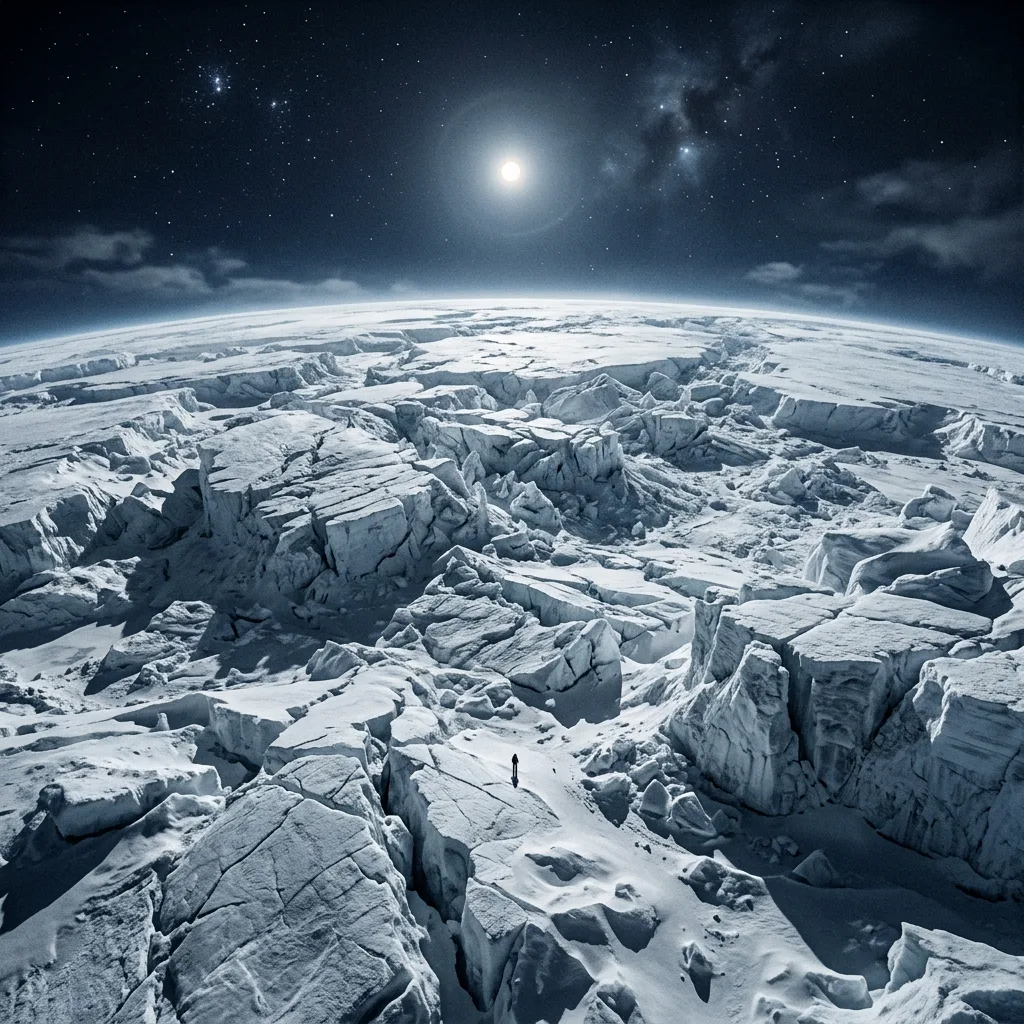
In one of the most extreme climate events in Earth's history, the entire planet—including the equator—freezes over under ice potentially a mile thick. This happened at least twice during the Cryogenian period.
Open in interactive timeline →Key Numbers
- When
- ~717-635 million years ago (Cryogenian)
- Sturtian glaciation
- ~56-60 million years long
- Deglaciation CO2
- ~350x modern atmospheric level
- Ice reach
- To the tropics / equator
- Post-thaw heat
- Mean global temp up to ~40 degrees C
Verified Facts
- The term 'Snowball Earth' was coined by Caltech geobiologist Joseph Kirschvink in a 1992 paper, where he proposed both a mechanism for runaway global glaciation (the ice-albedo feedback) and an escape route (volcanic CO2 buildup), and tied it to the reappearance of banded iron formations.
- The hypothesis was dramatically expanded and popularized by Paul Hoffman, Alan Kaufman, Galen Halverson, and Daniel Schrag in their landmark 1998 Science paper 'A Neoproterozoic Snowball Earth' (Science vol. 281, pp. 1342-1346), based on fieldwork in Namibia.
- The Cryogenian Period (~717-635 million years ago) hosted at least two distinct global glaciations: the older, longer Sturtian (roughly 717-660 Ma) and the younger Marinoan (roughly 650-635 Ma).
- The Sturtian glaciation lasted on the order of 56-60 million years, making it one of the longest-lived ice ages in Earth's history, with glacial deposits documented across some 39 sites on 6 continents.
- Recent high-precision radioisotopic dating constrains the Marinoan glaciation to roughly 4 million years (a 2022 PNAS study by the Macdonald/Hoffman group), far shorter than the Sturtian.
- Hoffman and colleagues argued that, lacking the silicate-weathering CO2 sink under a global ice sheet, volcanic outgassing drove atmospheric CO2 to about 350 times the present level before the greenhouse finally overwhelmed the ice albedo and triggered deglaciation.
- The post-glacial 'super-greenhouse' is thought to have spiked mean global temperature toward ~40 degrees C, ending the snowball state abruptly (on the order of years to millennia) and driving intense chemical weathering.
- A diagnostic geological fingerprint is the 'cap carbonate' (cap dolostone): thick carbonate layers deposited directly atop glacial debris, recording the rapid warming and alkaline-ocean chemistry of the meltback, exactly as found bracketing the Namibian glacial beds.
- Negative carbon-isotope anomalies in carbonates bracketing the glacial deposits indicate biological productivity in the surface ocean collapsed for millions of years, consistent with oceans largely sealed off from the atmosphere by ice.
- The reappearance of banded iron formations after a billion-year absence is cited as key evidence: under near-global ice cover the oceans became anoxic, allowing dissolved ferrous iron to accumulate and then precipitate as iron oxide once circulation and oxygenation resumed during deglaciation.
The World at This Moment
The Cryogenian glaciations unfolded in a world utterly unlike today's. The supercontinent Rodinia was fragmenting from roughly 825 Ma onward, and the resulting tropical continental margins—exposed to intense silicate weathering—are widely implicated in the CO2 drawdown that triggered runaway ice-albedo cooling. The atmosphere held only a fraction of modern oxygen; the deep oceans were largely anoxic and ferruginous, a chemistry recorded by the return of banded iron formations after a ~1-billion-year hiatus. Life was overwhelmingly microbial: cyanobacteria, protists, and early eukaryotes, with multicellular algae and the first sponges only beginning to diversify. No animals with skeletons, no plants, no land life of any complexity existed. The two great freezes—the Sturtian (~717–660 Ma) and the shorter Marinoan (~650–635 Ma)—bracketed the Cryogenian Period and immediately preceded the Ediacaran, the interval in which the first large, soft-bodied multicellular organisms appear. This was, in short, the threshold between a microbial Earth and a biosphere of visible complex life.
The Paradigm Shift
Snowball Earth overturned the assumption that Earth's climate is self-stabilizing and habitably buffered. Joseph Kirschvink (1992) coined the term and argued that low-latitude continents could trigger a runaway ice-albedo catastrophe freezing the entire planet, with volcanic CO2 slowly accumulating until a hyper-greenhouse thaw—a feedback making global glaciation not only possible but self-terminating. Hoffman, Kaufman, Halverson, and Schrag (1998) gave the idea empirical force using Namibian carbon-isotope and cap-carbonate data, transforming a fringe conjecture into a central organizing framework for Neoproterozoic Earth history. The hypothesis reframed glacial deposits found at paleo-equatorial latitudes, the puzzling "cap carbonates" capping glacial tills, and the resurgence of banded iron formations as a single coupled system. Crucially, it linked deep-time climate to biological evolution: the environmental upheaval and post-glacial oxygenation are now routinely invoked as context (if not cause) for the rise of complex multicellular life in the ensuing Ediacaran and Cambrian radiations, knitting climatology, geochemistry, and evolutionary biology into one narrative.
In Their Own Words
"This collapse can be explained by a global glaciation (that is, a snowball Earth), which ended abruptly when subaerial volcanic outgassing raised atmospheric carbon dioxide to about 350 times the modern level. The rapid termination would have resulted in a warming of the snowball Earth to extreme greenhouse conditions." — Paul F. Hoffman, Alan J. Kaufman, Galen P. Halverson, and Daniel P. Schrag, "A Neoproterozoic Snowball Earth," Science 281, no. 5381 (28 August 1998): 1342–1346.
In Depth
The Frozen Crucible: How a Planet of Ice Forged the Animal World
For most of its long middle age, Earth was a quiet world of microbes in warm seas. Then, between roughly 717 and 635 million years ago, it very nearly died of cold. Glaciers ground their way to the tropics, sea ice may have sealed the oceans from pole to pole, and the planet hung in space as a gleaming white ball. The Cryogenian Period contains two of these catastrophes — the Sturtian (~717–660 Ma) and the Marinoan (~650–635 Ma) glaciations — and out of their thaw came the explosion of complex life. Snowball Earth is the bottleneck through which our entire lineage had to squeeze.
The Deep Preconditions
The freeze was not random; it was the bill come due for life's own success. The faint sun was still weaker than today, and a near-equatorial supercontinent (Rodinia) left vast tropical coastlines exposed to chemical weathering, which drew carbon dioxide out of the air. Recent geochronology ties the onset of the Sturtian event to the eruption of the Franklin large igneous province, whose fresh basalts weathered furiously and stripped the greenhouse gas from the atmosphere. Once enough ice formed, its bright surface reflected sunlight back to space, and the cooling ran away with itself. In a real sense Snowball Earth was a delayed echo of an earlier crisis — the Great Oxygenation Event (sv-great-oxygenation), when photosynthesis first poisoned the air with oxygen and destroyed the methane greenhouse, plunging the world into the earlier Huronian glaciation. The recipe was old; the Cryogenian simply repeated it at a deeper extreme.
The Thaw and Its Inheritance
Volcanoes did not stop erupting under the ice. Carbon dioxide accumulated over millions of years until a super-greenhouse shattered the freeze in geological moments, leaving the strange "cap carbonate" rocks that drape glacial debris worldwide. The aftermath, not the freeze itself, is what changed history. Rapid melting flushed continents of nutrients — phosphorus above all — into the seas, fueling a bloom of photosynthetic life and a sustained rise in atmospheric oxygen. That oxygen was the budget that large, energy-hungry bodies had always lacked. The lineage of complex cells (sv-first-complex-cells) and the genetic shuffling unlocked by sexual reproduction (sv-invention-of-sex) had existed for ages, but only now could they build animals. Within a few tens of millions of years came the soft, quilted forms of the Ediacaran biota (sv-ediacaran-biota), and then the riot of body plans we call the Cambrian explosion (sv-cambrian-explosion), where predation, eyes, and shells appeared almost at once.
Threads Across the Arc
Everything downstream depends on surviving that ice. Without the post-glacial oxygen surge there are no early fish, no jawed hunters like the first sharks (sv-first-sharks), no fins repurposed into limbs when creatures like Tiktaalik (sv-tiktaalik) hauled onto land. The whole vertebrate road that eventually produced the first true mammals (sv-first-mammals) and, far later, ourselves, begins at the cap carbonate boundary. Snowball Earth also rhymes with later climate convulsions — the recurring glacial pulses that culminated in the last Ice Age (sv-last-ice-age), whose retreat opened the door to agriculture (sv-agriculture) and civilization. The pattern is consistent across four billion years: planetary catastrophe and biological flowering are not opposites but partners. Earth's most creative epochs followed its most lethal ones.
In the grand sweep from the Big Bang (sv-big-bang) to thinking machines, Snowball Earth marks the moment when a chemical planet became a biological one capable of complexity. It is a humbling reminder that intelligence rests on a foundation of frozen oceans, drowned continents, and the sheer luck of a thaw — that we are, quite literally, the children of an ice age the world barely survived.
Causes & Consequences
What led to it
- The breakup of the supercontinent Rodinia, beginning around 750 million years ago, left an unusual preponderance of land masses concentrated in tropical and mid-latitudes, raising planetary albedo and setting the geographic boundary conditions Joseph Kirschvink invoked when he coined the term 'Snowball Earth' in 1992.
- The emplacement of large igneous provinces of continental flood basalt during Rodinia's rifting, notably the Franklin large igneous province roughly 717-723 million years ago, exposed vast areas of fresh, easily weathered basalt at low latitudes shortly before the Sturtian glaciation began.
- Intense tropical silicate weathering of this exposed basalt consumed atmospheric carbon dioxide and buried organic carbon, drawing down the greenhouse gas concentrations that had kept Earth warm and nudging the climate toward a cooling threshold.
- An exceptionally low rate of mid-ocean ridge volcanic outgassing during the Cryogenian reduced the resupply of carbon dioxide to the atmosphere, helping push the planet past the tipping point and contributing to the multimillion-year duration of the Sturtian event.
- The runaway ice-albedo feedback, in which advancing ice and snow reflected progressively more sunlight and caused further cooling, amplified the initial CO2-driven temperature drop into a self-reinforcing global freeze once ice sheets advanced toward the equator.
- Earlier in Earth's history, the Great Oxidation Event around 2.4 billion years ago had already demonstrated this kind of climate vulnerability, when rising oxygen from cyanobacterial photosynthesis destroyed a methane greenhouse and helped trigger the Paleoproterozoic Huronian glaciation, establishing the precedent for global icehouse catastrophes.
What it set in motion
- Volcanic carbon dioxide accumulated in the atmosphere over millions of years because weathering largely stopped beneath the ice, eventually reaching the extremely high levels (pCO2 above roughly 0.2 bar) needed to overcome the ice albedo and force a rapid, runaway deglaciation into an ultra-greenhouse climate.
- The post-glacial greenhouse warmth and elevated seawater alkalinity drove the rapid precipitation of distinctive cap carbonate rock layers that drape glacial deposits worldwide, leaving a globally correlatable signature that became key evidence for the Snowball Earth hypothesis itself.
- Iron that had accumulated in solution within the anoxic, ice-covered oceans precipitated upon deglaciation as banded iron formations, a return of a rock type that had largely vanished after the Great Oxidation Event and which the snowball model successfully predicted.
- A surge of glaciogenic nutrients, especially phosphorus, flushed into the oceans during the melt, stimulating a bloom of photosynthetic primary productivity and contributing to a significant rise in marine and atmospheric oxygenation after the Marinoan deglaciation around 635 million years ago.
- This nutrient pulse and oxygenation favored the rise of eukaryotic algae as dominant marine primary producers and the persistent expansion of more complex algal ecosystems, transforming the base of the marine food web in the early Ediacaran.
- The higher oxygen levels and ecological upheaval following the Cryogenian glaciations helped enable the appearance of the soft-bodied Ediacaran biota and, after a lag of tens of millions of years, contributed to the conditions for the Cambrian explosion of large multicellular animal life.
The Live Academic Debate
The central live debate is "snowball" versus "slushball." The hard-snowball model (Kirschvink; Hoffman, Schrag, Halverson) holds that oceans froze pole to equator with kilometers-thick sea ice. Critics—notably Richard Peltier, William Hyde, and modeling groups favoring "Slushball" or the "Jormungand" state—argue for a band of thin or open water near the equator, which better accommodates the survival of photosynthetic life and a functioning hydrological cycle. Recent biomarker work (e.g., from Brazilian and Chinese black shales) detecting substantial photosynthesis during glaciation has strengthened the slushball camp, while proponents counter that refugia in cracks, meltwater ponds, and hot-spring settings suffice. Secondary disputes concern triggers (Rodinia weathering versus ridge volcanism and ocean chemistry), the exact duration and number of pulses within each glaciation—new PNAS work (2024–2025) suggests repeated snowball–hothouse cycles rather than single freezes—and whether glaciations were truly synchronous and global. The cap-carbonate formation mechanism and timescale likewise remain contested.
How This Event Connects
The Cryogenian "Snowball Earth" event fundamentally restructured the trajectory of Earth's biosphere, establishing a causal and thematic foundation that deeply links to the emergence of the Ediacaran Biota, the profound climatic shifts of the Last Ice Age, and the catastrophic bottlenecking of the K-Pg Extinction Event. By effectively resetting the Earth's geobiological equilibrium, the global deep freeze acted not merely as an existential threat, but as an evolutionary crucible that catalyzed macroscopic complexity.
The most direct causal linkage exists between the termination of Snowball Earth and the rise of the Ediacaran Biota. As the ultra-greenhouse effect melted the global ice sheets, immense volumes of nutrient-rich glacial till were washed into the anoxic oceans, triggering unprecedented cyanobacterial blooms. This sudden influx of biological productivity drove the Neoproterozoic Oxygenation Event (NOE). The oxygenation of the marine environment provided the high-energy metabolic fuel required to support the large, macroscopic, and eventually multicellular forms of life that characterize the Avalon Explosion. Thus, the physiological architectures of the Ediacarans were directly underwritten by the geochemical aftermath of the Cryogenian glaciation.
Thematically, Snowball Earth shares a profound historiographical parallel with the K-Pg Extinction Event. Both epochs represent catastrophic environmental bottlenecks that violently pruned the tree of life, ultimately facilitating radical faunal turnover. Just as the asteroid impact cleared the ecological slate for mammalian radiation by exterminating the non-avian dinosaurs, the intense anoxia and extreme cold of the Cryogenian eliminated incumbent, stagnant microbial ecosystems, forcing surviving eukaryotic life into refugia. Upon deglaciation, these survivors radiated into a vacant biosphere, illustrating the recurring paradigm of "creative destruction" in deep time.
Finally, the Cryogenian glaciations can be analytically juxtaposed with the Last Ice Age, framing a macro-historical narrative of climate-driven evolutionary pressure. While Snowball Earth operated on a geological timescale and forced the leap to multicellularity, Pleistocene glaciations operated on a shorter, more punctuated scale, driving hominid behavioral modernity, migration, and the eventual transition to agriculture. Both events demonstrate the profound extent to which extreme climatic variability dictates the tempo and mode of biological innovation, forcing paradigm shifts in either physiological architecture or behavioral complexity to ensure survival.
The Counterfactual
Had the planet not frozen, or frozen only partially, the trajectory of complex life might have differed sharply—though scholars caution against strict determinism. Hoffman and Schrag (2002) and later workers argue the glaciations imposed severe evolutionary bottlenecks and isolated refugia, potentially driving the genetic divergence and selective pressure that favored multicellularity; on this reading, a milder climate might have delayed or muted the Ediacaran emergence of macroscopic organisms. The post-Marinoan deglaciation also plausibly delivered a pulse of nutrients and oxygen (the "boring billion's" end) that fueled larger, energy-hungry eukaryotes—absent the freeze, that pulse weakens. Conversely, critics note that eukaryotic and even multicellular fossils predate the glaciations, so complex life was not strictly contingent on a snowball. The honest counterfactual is therefore conditional: without these extreme climate oscillations, the timing, tempo, and perhaps morphology of the animal radiation likely shift, but whether complex life arises at all remains genuinely uncertain rather than foreclosed.
Myth vs. Reality
Myth: Snowball Earth was a single freeze that lasted for the whole Cryogenian Period (roughly 850-635 million years ago).
Reality: There were at least two distinct Neoproterozoic global glaciations, not one continuous freeze. The Sturtian glaciation ran from about 717 to 660 million years ago, followed by warmer conditions and then the shorter Marinoan glaciation around 650-635 million years ago. The Cryogenian is named for these events, but tens of millions of years of its span were ice-free between the two snowballs.
Myth: The whole planet was definitely frozen solid, like a literal ball of ice from pole to pole.
Reality: Whether the oceans froze completely (hard 'Snowball') or kept a band of open or thin slushy water near the equator (the 'Slushball' model) remains genuinely debated. Many researchers favor a slushball-type scenario because it more easily explains how photosynthetic and other life survived with no evidence of a corresponding mass extinction. Solid equatorial glacial deposits show the ice reached the tropics, but the exact extent of open water is still contested.
Myth: Global ice cover sterilized the planet and nearly wiped out life.
Reality: Complex eukaryotic life had already existed for over a billion years and survived the glaciations; there is no geological record of a mass extinction tied to these events. Proposed refugia include deep-sea hydrothermal vents, hot springs, and meltwater ponds on the ice surface near volcanoes. Far from being a dead end, the recovery after the Marinoan event is often linked to the later diversification of multicellular animals.
Myth: Once a planet freezes over with reflective ice, it stays frozen permanently because the white surface reflects away all sunlight.
Reality: The ice-albedo feedback does make a frozen state stable, but it is escapable. With most of the surface iced over, silicate weathering (Earth's main carbon-dioxide sink) shut down while volcanoes kept outgassing CO2. Over millions of years that CO2 built up to extreme levels, eventually overwhelming the high albedo and triggering rapid deglaciation. The CO2 buildup escape mechanism is a core part of the hypothesis, proposed by Joseph Kirschvink in 1992.
Myth: The idea that the Cambrian explosion was directly caused by Snowball Earth is settled fact.
Reality: There is a striking correlation: the major glaciations precede the Ediacaran and Cambrian radiations of complex life, and the climatic recovery is frequently proposed to have set the stage for that diversification, possibly via deep-ocean oxygenation. But the causal link is an active hypothesis, not a proven mechanism, and the precise environmental drivers of early animal evolution remain under investigation. The Cambrian explosion itself also began tens of millions of years after the last snowball ended.
Frequently Asked Questions
When did Snowball Earth happen?
The most severe Snowball Earth glaciations occurred during the Cryogenian Period, roughly 720 to 635 million years ago. Scientists recognize two major events: the Sturtian glaciation (about 717-660 million years ago) and the younger Marinoan glaciation (about 650-635 million years ago). Each is thought to have lasted on the order of millions of years, with the Sturtian persisting for tens of millions of years.
What is the Snowball Earth hypothesis?
Snowball Earth is the hypothesis that at certain times in Earth's deep past the planet's surface froze almost entirely, with ice sheets and sea ice extending from the poles all the way to the equator. It was developed and popularized in a 1998 paper in Science by geologist Paul Hoffman, Daniel Schrag, and colleagues, building on earlier ideas from Joseph Kirschvink, who coined the term. The hypothesis explains a cluster of otherwise puzzling geological clues, including glacial deposits laid down near the equator and distinctive 'cap carbonate' rocks.
What evidence shows the whole Earth froze near the equator?
The strongest evidence comes from paleomagnetism: glacial deposits such as dropstones in places like central Australia preserve magnetic signatures indicating they formed within about 10 degrees of the equator. This implies glaciers reached sea level in the tropics, which is hard to explain unless the entire planet was extremely cold. Critics note that paleomagnetic data can be ambiguous and that Earth's ancient magnetic field may have differed from today's, which feeds the ongoing debate over how complete the ice cover really was.
How did life survive Snowball Earth?
Life persisted in 'refugia,' localized habitable pockets that escaped total freezing. Proposed refuges include open-water belts or cracks in the sea ice, meltwater pools where oxic and anoxic waters mixed to fuel microbial communities, and warmer mid-latitude coastal areas during the waning phases of the glaciation. Hydrothermal vents have also been suggested as a heat and chemical source, though some studies argue the residual ocean chemistry may have made vent ecosystems less viable. The survival of eukaryotes through these events is one reason some researchers favor a partial 'slushball' over a fully frozen 'hard snowball.'
What ended Snowball Earth?
The leading explanation is a runaway greenhouse warming driven by carbon dioxide. With the surface frozen, the silicate weathering that normally removes CO2 from the atmosphere shut down, while volcanoes kept erupting and pumping out CO2. Over millions of years the CO2 built up to extreme levels, eventually trapping enough heat to rapidly melt the ice. The transfer of that CO2-rich atmosphere into warming oceans then precipitated the thick 'cap carbonate' rocks found capping glacial deposits worldwide, from Namibia to China.
What are cap carbonates and why do they matter?
Cap carbonates are layers of carbonate rock (limestone and dolostone) that lie directly on top of Cryogenian glacial deposits across many continents. They formed rapidly in warm, CO2-saturated surface waters during the intense greenhouse aftermath of deglaciation. They carry telltale negative carbon-13 isotope anomalies, which Hoffman, Schrag, Alan Kaufman, and Galen Halverson documented over hundreds of kilometers in Namibia, signaling a collapse in biological productivity. Because the slushball models struggle to account for them, cap carbonates remain one of the strongest pieces of support for the full Snowball Earth picture.
Did Snowball Earth lead to the rise of animals?
Many researchers think it may have helped set the stage. The Sturtian and Marinoan glaciations bracket an interval in which the first widely accepted biomarkers for sponges and green algae appear, and complex animal life diversified not long after the Cryogenian. One proposed mechanism is that intense post-glacial weathering and volcanism flushed nutrients like phosphorus into the oceans and boosted oxygen levels, fueling ecosystems that more complex organisms could exploit. The causal link is still debated, but the timing places these severe freezes immediately before a major leap in the complexity of life.
Sources & Further Reading
- Snowball Earth — Wikipedia
- Joseph L. Kirschvink, 'Late Proterozoic Low-Latitude Global Glaciation: The Snowball Earth,' in J. W. Schopf and C. Klein, eds., The Proterozoic Biosphere (Cambridge University Press, 1992), 51–52.
- Paul F. Hoffman, Alan J. Kaufman, Galen P. Halverson, and Daniel P. Schrag, 'A Neoproterozoic Snowball Earth,' Science 281 (1998): 1342–1346.
- Paul F. Hoffman and Daniel P. Schrag, 'The Snowball Earth Hypothesis: Testing the Limits of Global Change,' Terra Nova 14 (2002): 129–155.
- William T. Hyde, Thomas J. Crowley, Steven K. Baum, and W. Richard Peltier, 'Neoproterozoic "Snowball Earth" Simulations with a Coupled Climate/Ice-Sheet Model,' Nature 405 (2000): 425–429.
- Paul F. Hoffman et al., 'Snowball Earth Climate Dynamics and Cryogenian Geology-Geobiology,' Science Advances 3 (2017): e1600983.
- NASA: Snowball Earth
Cite This Page
AskHistoryAI. “Snowball Earth.” AskHistoryAI — Interactive Timeline of Everything. Updated 2026-09-11. https://askhistoryai.com/event/sv-snowball-earth/
Every fact on this page is checked against the published fact ledger and methodology; sources are listed above.