Hadrian & The Bar Kokhba Revolt
The apocalyptic final stand of Judea.
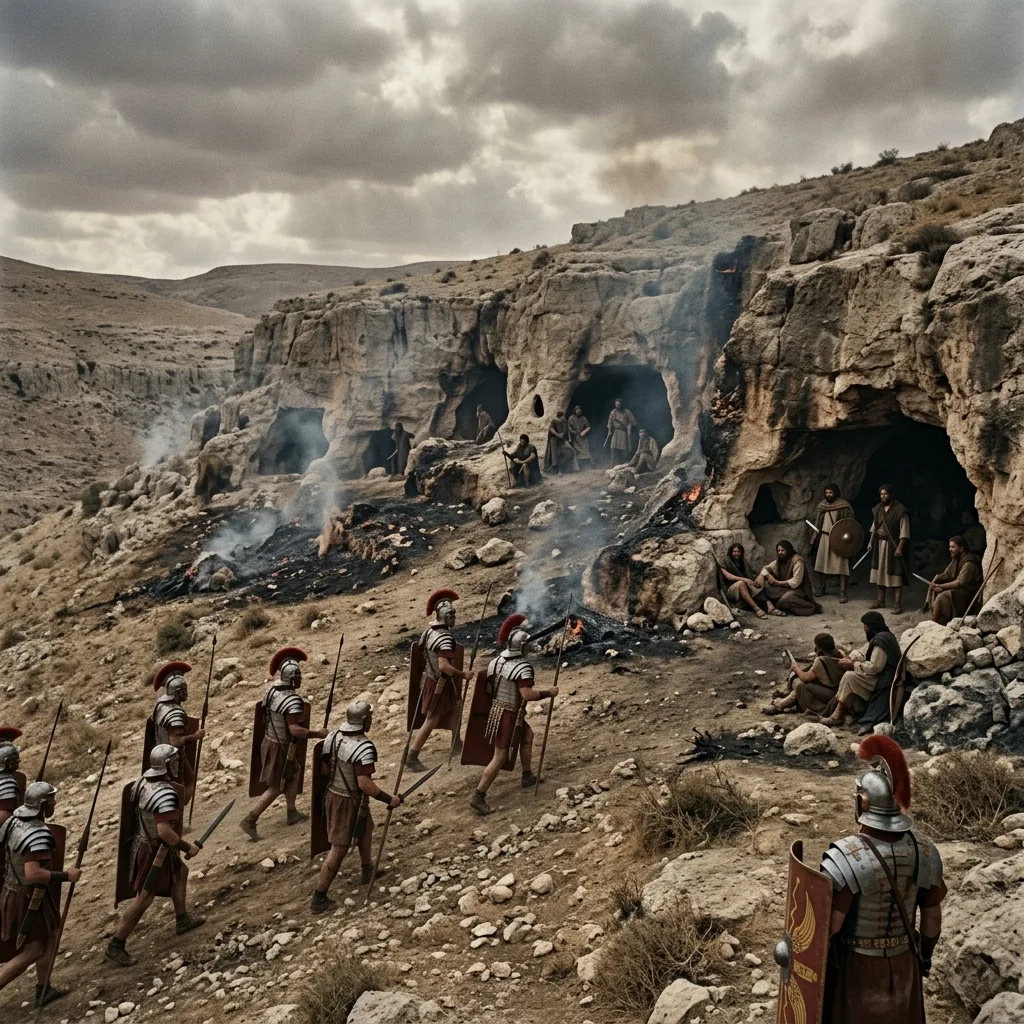
Emperor Hadrian's attempt to build a pagan temple to Jupiter on the ruined Temple Mount triggers the Bar Kokhba Revolt, the third and final major Jewish-Roman war. It results in the utter devastation of Judea.
Open in interactive timeline →Key Numbers
- War years
- 132–135/136 CE
- Jews slain (Cassius Dio)
- 580,000
- Villages razed
- 985
- Roman legions deployed
- ~9 (entire or detachments)
- Forts destroyed
- 50
Verified Facts
- The revolt was the third and final Jewish-Roman war (after the 66-73 CE Great Revolt and the 115-117 CE Kitos War) and erupted in 132 CE under Emperor Hadrian, lasting roughly three and a half years until the fall of the rebel stronghold of Betar in the summer of 135 CE.
- Cassius Dio (Roman History 69.14) reports that 50 of the Jews' most important outposts and 985 of their most famous villages were razed to the ground, and 580,000 men were slain in raids and battles, concluding that 'nearly the whole of Judaea was made desolate' — though many scholars regard these figures as exaggerated.
- Ancient sources name two principal triggers: Hadrian's plan to rebuild Jerusalem as the pagan colony Aelia Capitolina (combining his family name Aelius with Jupiter Capitolinus) with a temple to Jupiter on the Temple Mount, and a Roman ban on circumcision; archaeological evidence suggests the colony's founding preceded and helped provoke the revolt.
- The rebel leader's real name was Shimon ben Kosiba, attested on coins and in his own letters where he signs as 'Nasi (Prince/President) of Israel'; the messianic nickname 'Bar Kokhba' ('Son of a Star') derives from Numbers 24:17, applied to him by Rabbi Akiva, who hailed him as the messiah — a claim other sages rejected, mockingly calling him 'Bar Koziba' ('Son of the Lie').
- Rome's response was extraordinary: at least nine legions participated wholly or through detachments — close to a third of the Roman army — and Hadrian recalled his most capable general, Sextus Julius Severus, all the way from Britain to crush the uprising, signaling the crisis's severity.
- Cassius Dio notes that Roman losses were so heavy that when Hadrian reported the war's end to the Senate, he omitted the customary imperial opening formula, 'If you and your children are in health, it is well; I and the legions are in health.'
- Legio XXII Deiotariana is widely believed to have been destroyed or so shattered during the war that it disappears from the army lists thereafter, illustrating the cost to Rome.
- In 1960-1961 archaeologist Yigael Yadin discovered Bar Kokhba's administrative correspondence in the Cave of Letters at Nahal Hever — about fifteen letters in Hebrew, Aramaic, and Greek — containing his orders on grain and produce supplies and the Sabbath, providing direct documentary evidence of a functioning rebel state.
- The rebels minted their own coinage, often overstruck on Roman coins, bearing slogans such as 'Year One of the Redemption of Israel' and 'For the Freedom of Jerusalem,' and depicting the Temple facade, a star, and Sukkot symbols (lulav and etrog).
- In the aftermath Hadrian sought to erase Jewish ties to the land: he renamed the province Judaea as Syria Palaestina, barred Jews from entering Jerusalem/Aelia Capitolina, and the catastrophe accelerated the shift of Jewish life toward the Galilee and the diaspora — Betar's fall on the 9th of Av is still mourned in Jewish tradition.
The World at This Moment
The revolt erupted at the territorial and cultural apex of the second-century world. Hadrian (r. 117-138), having abandoned Trajan's eastern conquests, was midway through his restless empire-wide tours, consolidating frontiers (Hadrian's Wall begun c. 122) and promoting a Hellenizing classicism; his beloved Antinous had drowned in the Nile only around 130, and the cult and city Antinoöpolis were freshly founded. Eastward, the Kushan Empire under Kanishka I (c. 127-150) commanded the Silk Road and patronized Gandharan Buddhist art; Kushan envoys reportedly reached Hadrian's court. In China, the Eastern Han dynasty under the boy-emperors was sliding into rule by eunuchs and consort clans that would culminate in third-century collapse. The Parthian Arsacids governed the rival eastern superpower across the Euphrates. Within the Roman sphere, the Pax Romana looked secure, the Second Sophistic flourished in Greek letters, and provincial urbanization advanced. Against this cosmopolitan, Greco-Roman ecumene, Judaea's insistence on aniconic monotheism and Torah observance made Hadrian's plan to refound Jerusalem as a pagan colony explosively provocative.
The Paradigm Shift
The revolt's brutal suppression (c. 135-136) effectively ended Jewish political existence in their homeland for nearly two millennia and reoriented Judaism toward a diaspora, text-centered, non-messianic-activist form. Hadrian barred Jews from Aelia Capitolina, his pagan colony on Jerusalem's ruins crowned by a temple to Jupiter Capitolinus, and renamed the province Syria Palaestina—an act of toponymic erasure whose echoes persist in modern geopolitics. With Temple and territory lost, rabbinic Judaism, centered on Torah study, halakhah, and synagogue rather than sacrifice, became the dominant surviving stream, its authority migrating to Galilee and later Babylonia. The catastrophe also chastened Jewish messianism: after Rabbi Akiva had reputedly hailed Simon ben Kosiba as messiah ("Bar Kokhba," son of the star), the disaster made later sages wary of armed eschatology. It further hardened the boundary between Judaism and the Jesus movement, since Christians could not endorse a rival messiah—a key episode in the long "parting of the ways."
In Their Own Words
"Fifty of their most important outposts and nine hundred and eighty-five of their most famous villages were razed to the ground. Five hundred and eighty thousand men were slain in the various raids and battles... Thus nearly the whole of Judaea was made desolate... Hadrian in writing to the senate did not employ the opening phrase commonly affected by the emperors, 'If you and your children are in health, it is well; I and the legions are in health.'" — Cassius Dio, Roman History 69.14 (Epitome of Xiphilinus), trans. Earnest Cary, Loeb Classical Library
In Depth
The Star That Fell: Rome, Judaea, and the Unmaking of a Homeland
In 132 CE, a guerrilla leader named Simon bar Kosiba rose against the empire of the Emperor Hadrian (sv-augustus had founded the principate he inherited a century and a half earlier). For three years the rebels held an autonomous Jewish state, minting coins that proclaimed "Year One of the Freedom of Israel." By 136 it was over, and the world that emerged was so altered that we still live among its consequences. The Bar Kokhba Revolt is the hinge on which Jewish history swung from a land-bound, Temple-centered nation toward the portable, text-centered people of the diaspora.
Deep Preconditions
The revolt was the third and final act of a long Roman-Jewish tragedy. Its roots run back through the Kitos War under Trajan (sv-trajan-kitos), which devastated Jewish communities across the Mediterranean only a generation earlier, and further still to the catastrophe of 70 CE, when Titus destroyed the Second Temple (sv-second-temple) and ended the sacrificial cult forever. Our knowledge of that earlier war comes largely from Flavius Josephus (sv-josephus), whose narrative frames the desperation that still smoldered in Judaea. Two specific provocations lit the fuse, according to the historian Cassius Dio: Hadrian's plan to rebuild Jerusalem as the pagan colony Aelia Capitolina, crowned with a temple to Jupiter on the Temple Mount, and an imperial ban touching circumcision. To a people who had already lost their sanctuary, this was the erasure of even the memory of the holy city.
A Messiah and His Defeat
What made the revolt extraordinary was its messianic charge. Rabbi Akiva, the most revered sage of the age, is reported to have hailed Simon as the messiah, applying to him the prophecy of Numbers 24:17—"a star shall come out of Jacob"—and renaming him Bar Kokhba, "Son of the Star." The rebellion was savage and, at first, successful: the rebels mauled Rome's forces so badly that the Egyptian Legion XXII Deiotariana vanishes from the records, likely destroyed. Hadrian summoned his finest general, Julius Severus, from Britain. Dio records the appalling arithmetic of the reconquest—580,000 Jews killed, 985 villages razed, the land left so empty that wolves and hyenas howled through the towns. The figures may be inflated, but the demographic catastrophe was real. Akiva and other sages were executed.
The Ripple Forward
Hadrian's vengeance was deliberate and symbolic. He renamed the province Judaea as Syria Palaestina, severing the land's name from its people, and barred Jews from Jerusalem. The heart of Jewish life shifted north to the Galilee and east to Babylonia, where the great rabbinic academies would eventually produce the Talmud. With nationhood crushed and the Temple gone, Judaism became a religion of study, law, and synagogue rather than altar and king—and Jewish messianism turned cautious and abstract, wary of any new "Son of the Star." The break with the nascent Christian movement, already visible in figures like Justin Martyr (sv-justin-martyr) writing soon after, now widened into a permanent divergence as Gentile Christianity claimed the prophetic heritage for itself. Hadrian's successor era—the reign of his adopted heir's line, reaching to the philosopher-emperor Marcus Aurelius (sv-marcus-aurelius)—presided over a Mediterranean in which a homeless Judaism and a rising Christianity would both shape the religious imagination that outlasted Rome itself. The star that fell over Judaea cast a shadow nearly two millennia long.
Causes & Consequences
What led to it
- The destruction of the Second Temple and the sacking of Jerusalem by Titus in 70 CE during the First Jewish-Roman War left deep grievances over lost religious autonomy and national sovereignty that festered for six decades.
- The Roman ban prohibiting Jews from entering Jerusalem (except, by some accounts, to mourn on Tisha B'Av) kept the trauma of the Temple's loss alive and fueled enduring resentment under Roman rule.
- The Kitos War of 115-117 CE, in which diaspora Jews in Cyrenaica, Cyprus, Egypt, and Mesopotamia rose up and were brutally crushed, demonstrated both continuing Jewish unrest and the harshness of Roman reprisals across the empire.
- Hadrian's decision, made during his visit to Judaea around 130 CE, to refound Jerusalem as the pagan Roman colony Aelia Capitolina and build a temple to Jupiter Capitolinus on the site of the destroyed Jewish Temple was a direct provocation.
- Hadrian's prohibition of circumcision (which many scholars place before the revolt, though its timing and scope are debated) struck at a core marker of Jewish religious identity and is cited as a major trigger.
- The leading sage Rabbi Akiva ben Yosef hailed the rebel leader Simon bar Kosiba as the promised Messiah, giving him the name 'Bar Kokhba' ('Son of the Star'), which lent the uprising powerful religious legitimacy and mobilizing force.
What it set in motion
- The revolt's suppression caused catastrophic loss of life; Cassius Dio reports 580,000 Jews killed in the fighting, with 50 fortified towns and 985 villages razed and many more dead from famine and disease.
- Mass enslavement and dispersal of Judean survivors deepened the Jewish diaspora, scattering captives across the Roman Empire and accelerating the depopulation of Judea.
- Hadrian renamed the province Syria Palaestina, a deliberate effort to sever the land's Jewish identity, a name whose echoes persist in regional toponymy to the present.
- Galilee replaced devastated Judea as the demographic and religious center of Jewish life, where rabbinic activity and synagogue construction flourished into the late second century CE.
- Codification of foundational rabbinic texts followed in this Galilean setting, with the Mishnah compiled in the century after the revolt and the Jerusalem Talmud developing there over the following centuries.
- The catastrophic failure transformed Jewish thought toward a more spiritualized, cautious messianism, strengthening the rabbis as the dominant force in Judaism and making later Jewish leaders wary of political-military redemption schemes for nearly two millennia.
The Live Academic Debate
The central historiographical dispute concerns the revolt's trigger. One camp privileges the founding of Aelia Capitolina as a pagan colony, the immediate cause Cassius Dio names and the position numismatic and archaeological evidence is often read to support; Benjamin Isaac and Aharon Oppenheimer, among others, foreground Roman provincial policy and colonization. A rival reading credits the circumcision ban reported in the Historia Augusta (Hadrian)—a source widely distrusted—as the spark; Peter Schäfer, in Der Bar Kokhba-Aufstand and later essays, argues forcefully against the ban's causal centrality, emphasizing instead a convergence of religious, economic, and administrative provocations. Menahem Mor (The Second Jewish Revolt, 2016) reassesses the war's scale and geography, arguing it was more limited than maximalist reconstructions claim and questioning Galilean participation. Hanan and Esther Eshel's work on the documentary papyri reshaped views of Bar Kokhba's actual administration. Debate also continues over whether Rabbi Akiva truly proclaimed him messiah and over the reliability of Dio's casualty figures, which Werner Eck and others scrutinize against epigraphic and military evidence.
How This Event Connects
The Bar Kokhba Revolt (132–136 CE) represents the terminal, catastrophic conclusion to a century of escalating Jewish-Roman warfare, finalizing a demographic shift that began with the Fall of the Second Temple. While the war of 70 CE destroyed the architectural and cultic heart of Judaism in Jerusalem, the Bar Kokhba revolt effectively annihilated the physical population of Judea itself. The Rabbinic reinterpretation of this trauma—branding Bar Kokhba a false messiah—mirrored the theological crisis following the Temple's destruction, forcing a definitive shift from a Temple-based, geographic religion to a text-based, rabbinic diaspora.
This final conflagration cannot be understood without the immediate precursor of Trajan & The Kitos War. The Kitos War had systematically decimated the massive, wealthy Jewish communities of the diaspora (specifically in Egypt, Cyprus, and Cyrenaica). Consequently, the Bar Kokhba revolt was a hyper-concentrated, localized resistance in Judea, fought by a population cornered by the total collapse of diaspora support. Hadrian’s subsequent renaming of the province to Syria Palaestina was a deliberate, punitive strategy of cultural erasure, responding to the unprecedented ferocity of an insurgency that had wiped out entire Roman legions.
Crucially, the devastating aftermath of the Bar Kokhba Revolt provided the direct historical backdrop for the apologetic work of Justin Martyr. Justin’s Dialogue with Trypho is explicitly framed as a conversation taking place in Ephesus with a Jewish refugee fleeing the violence of the Bar Kokhba war. Historiographically, the revolt finalized the \"Parting of the Ways\" between Judaism and Christianity; as the Rabbis consolidated orthodox Judaism in the wake of Bar Kokhba's failure, early Christian intellectuals like Justin actively capitalized on the Jewish defeat to argue that God's favor had permanently shifted to the Hellenized Christian church.
The Counterfactual
Had Hadrian not provoked the revolt—by siting Aelia Capitolina elsewhere or refraining from the colony and, per the disputed Historia Augusta, a circumcision ban—Judaea might have retained a substantial Jewish population and conceivably a rebuilt Temple, as Bar Kokhba's coinage and letters (recovered by Yigael Yadin at Nahal Hever) aspired. Cassius Dio's report of fifty fortresses razed, 985 villages destroyed, and 580,000 slain, while perhaps exaggerated, signals demographic devastation that a different policy could have averted, leaving Jerusalem-centered Judaism more viable and rabbinic relocation to Galilee unnecessary. Yet the deeper trajectory was arguably set in 70 CE: the Temple was already gone, and Rome's tolerance for Judaean autonomy was exhausted after three wars. Scholars such as Peter Schäfer caution against treating any single Hadrianic decree as decisive, stressing accumulating grievances. A successful or unprovoked outcome would not have restored the pre-70 commonwealth, but might have softened the diasporic, quietist turn and blunted the religious antagonisms that hardened in the revolt's wake.
Myth vs. Reality
Myth: Hadrian renamed Judaea to "Syria Palaestina" as a deliberate act of revenge to erase the Jewish connection to the land, and he invented the name "Palestine."
Reality: The punitive-erasure interpretation is the popular view but is contested by specialists. Rome did not coin the name: Herodotus used a form of "Palaistine" for the region in the 5th century BCE, and "Palestine" circulated in Greek and Roman geographic writing for centuries before Hadrian. Werner Eck and others caution that provincial renamings were routine in the empire and that the choice may reflect existing classical toponymy or administrative reorganization as much as vindictiveness; the exact motive remains debated rather than settled fact.
Myth: Hadrian banned circumcision specifically to provoke or persecute the Jews, and that ban was the clear trigger of the revolt.
Reality: Whether a circumcision ban preceded and caused the revolt or was a punishment imposed afterward is genuinely disputed among historians. The later Historia Augusta tradition suggests Jews rebelled after Hadrian legislated against "genital mutilation," but the more contemporary Cassius Dio places the founding of Aelia Capitolina (not circumcision) as the cause and treats harsh measures as following the war's suppression. Hadrian's law appears to have been a general edict against castration/circumcision across the empire, not a measure aimed solely at Jews, and firm pre-revolt epigraphic confirmation is lacking.
Myth: Bar Kokhba was his real name, and he was universally embraced by the rabbis as the Messiah.
Reality: His actual name was Shimon ben Kosiba, as confirmed by letters he signed that were recovered from caves at Wadi Murabba'at and Nahal Hever. "Bar Kokhba" ("son of the star," from Numbers 24:17) was an honorific messianic nickname associated with Rabbi Akiva's endorsement. That endorsement was not universal: the Talmud records Rabbi Yochanan ben Torta rebuking Akiva ("grass will grow on your cheeks and the son of David will still not have come"), and after the defeat rabbinic sources punningly called him "bar Koziva," son of the lie.
Myth: The rebels captured Jerusalem and held it for the duration of the revolt, restoring Jewish worship there.
Reality: Although rebel coins bear slogans like "for the freedom of Jerusalem," archaeology indicates the rebels did not actually take and hold the city. Of roughly 22,000 coins excavated within ancient Jerusalem, only about four date to the revolt, and the Israel Antiquities Authority interprets even these as souvenirs carried in by Roman Tenth Legion soldiers rather than evidence of rebel control. The coin legends express an aspiration to liberate Jerusalem, not a documented conquest of it.
Myth: Cassius Dio's figure of 580,000 Jewish dead is plainly an ancient exaggeration that no serious historian accepts.
Reality: The reliability of Dio's figures (580,000 slain, 50 fortresses and 985 villages destroyed) is an open scholarly question, not a settled dismissal. Peter Schaefer argued the numbers were likely inflated, but Hannah Cotton judged them plausible against the backdrop of accurate Roman census practice, and more recent settlement-pattern and ethno-archaeological studies have argued the demographic data may rest on contemporaneous documentation. The catastrophic scale of the war is well attested; the precise body count is what remains debated.
Frequently Asked Questions
When was the Bar Kokhba Revolt and who led it?
The Bar Kokhba Revolt was a Jewish uprising against the Roman Empire in the province of Judaea, fought from 132 to 135 CE (some sources extend the final siege into 136). It was the third and last of the major Jewish-Roman wars, occurring about six decades after the destruction of the Second Temple in 70 CE. The revolt was led by Simon bar Kokhba, who took the Hebrew title nasi ('prince') and established a short-lived independent administration.
What caused the Bar Kokhba Revolt?
Scholars point to several of Emperor Hadrian's policies as triggers. He ordered Jerusalem rebuilt as a Roman colony named Aelia Capitolina, with a temple to Jupiter Capitolinus planned on the site of the former Jewish Temple. Hadrian's general ban on circumcision (part of a broader decree against bodily mutilation) was also widely seen as an attack on Jewish religious practice. These measures fueled deep hostility toward Roman rule and ignited the rebellion.
Who was Simon bar Kokhba, and was that his real name?
Documents discovered in the Judaean Desert, including letters he signed himself, show his actual name was Shimon ben Kosiba. The honorific 'Bar Kokhba,' meaning 'Son of the Star,' was likely bestowed on him as a messianic title alluding to the 'star out of Jacob' prophecy in Numbers 24:17. According to rabbinic tradition, the prominent sage Rabbi Akiva hailed him as the Messiah. After the revolt failed, later rabbis punningly called him 'Bar Koziba,' meaning 'Son of a Lie,' marking him as a false messiah.
How did the Bar Kokhba Revolt end and how costly was it?
Hadrian summoned his ablest general, Sextus Julius Severus, from Britain and committed a massive force; ancient and modern estimates suggest a large fraction of the Roman army was deployed. The rebels' final stronghold at Betar, southwest of Jerusalem, fell after a siege, and Bar Kokhba was killed there. The Roman historian Cassius Dio reported that 580,000 Jews were killed and that 50 fortified towns and 985 villages were destroyed, figures long debated by scholars but increasingly supported by archaeological evidence of severe depopulation in Judaea.
Why did Hadrian rename Judaea to Syria Palaestina?
After crushing the revolt, Hadrian renamed the province from Judaea to Syria Palaestina, a name evoking the ancient Philistines, traditional biblical enemies of the Jews. Many historians interpret this as a deliberate effort to sever the Jewish people's connection to their homeland and erase the memory of the rebellion. Such a punitive renaming of a province was unusual in Roman administrative practice, which makes it a significant and much-discussed act of imperial policy.
What happened to the Jews after the revolt?
Hadrian barred Jews from entering Aelia Capitolina (Jerusalem) on pain of death, with later tradition holding that an exception allowed entry only on Tisha B'Av to mourn the Temple. The war caused extensive depopulation and devastation in Judaea, arguably greater than that of the First Jewish-Roman War, and accelerated the shift of Jewish life toward Galilee and the diaspora. The defeat marked the effective end of Jewish political autonomy in the region until the modern era and is remembered as a major turning point in Jewish history.
Sources & Further Reading
- Bar Kokhba Revolt — Wikipedia
- Peter Schäfer, Der Bar Kokhba-Aufstand: Studien zum zweiten jüdischen Krieg gegen Rom (1981); and Schäfer (ed.), The Bar Kokhba War Reconsidered (2003)
- Menahem Mor, The Second Jewish Revolt: The Bar Kokhba War, 132-136 CE (Brill, 2016)
- Yigael Yadin, Bar-Kokhba: The Rediscovery of the Legendary Hero of the Last Jewish Revolt Against Imperial Rome (1971)
- Werner Eck, 'The Bar Kokhba Revolt: The Roman Point of View,' Journal of Roman Studies 89 (1999), 76-89
- Benjamin Isaac and Aharon Oppenheimer, 'The Revolt of Bar Kokhba: Ideology and Modern Scholarship,' Journal of Jewish Studies 36 (1985)
- Wikipedia: Bar Kokhba revolt
- Wikipedia: Hadrian
Cite This Page
AskHistoryAI. “Hadrian & The Bar Kokhba Revolt.” AskHistoryAI — Interactive Timeline of Everything. Updated 2026-09-11. https://askhistoryai.com/event/sv-hadrian-bar-kokhba/
Every fact on this page is checked against the published fact ledger and methodology; sources are listed above.