Justin Martyr
Christianity dons the philosopher's cloak.
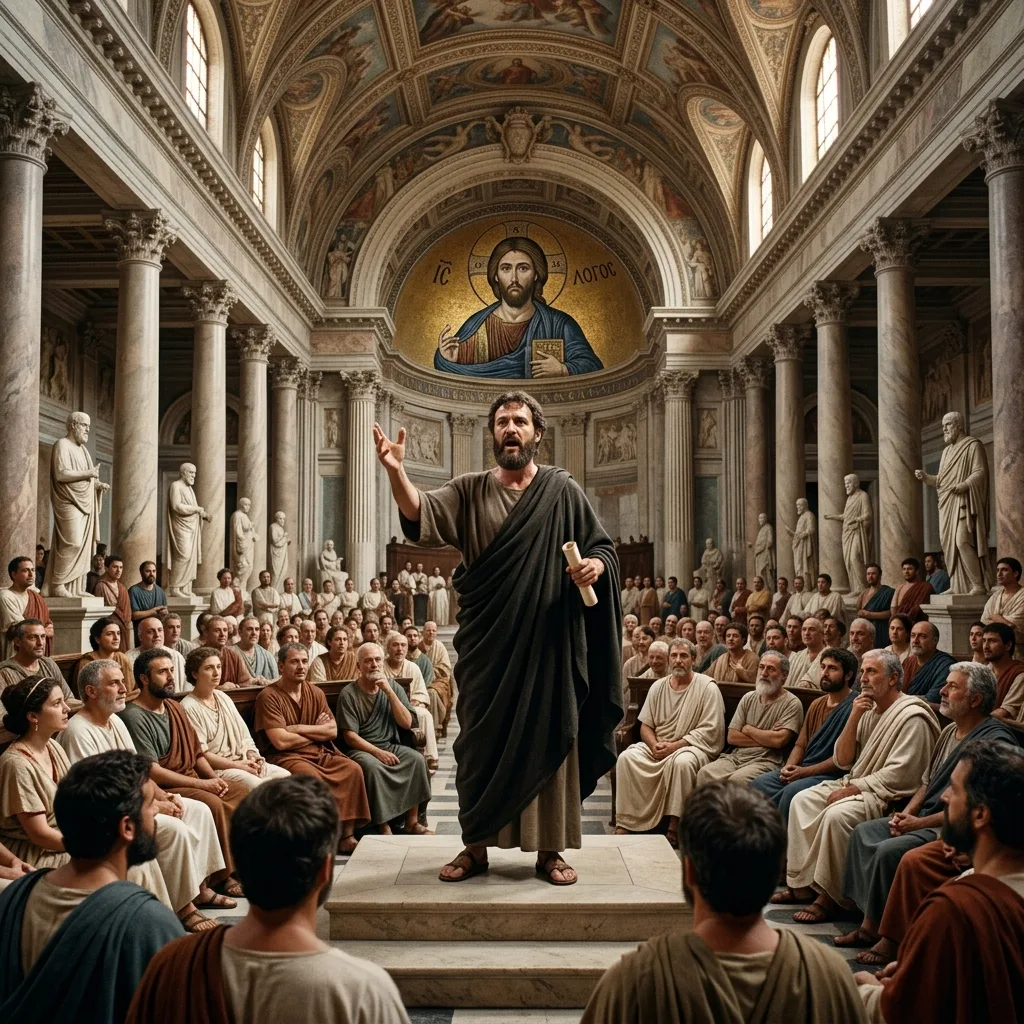
An early Christian apologist who argued that the "seeds of the Logos" (divine reason) were present in all people, meaning that noble Greek philosophers like Socrates were, in a sense, pre-Christian.
Open in interactive timeline →Key Numbers
- Lifespan
- c. 100 – c. 165 AD
- First Apology written
- c. 155–157 AD
- Martyred with
- 6 companions
- Feast day
- June 1
- Surviving authentic works
- 3 (two Apologies + Dialogue)
Verified Facts
- Justin was born around 100 AD in Flavia Neapolis (modern Nablus) in Roman Samaria/Palestine, to a pagan Greek family, and was reared in a region steeped in both Hellenistic and Jewish culture.
- Before converting, Justin sampled the leading philosophical schools of his day in sequence: Stoic, Peripatetic, Pythagorean, and finally Platonist, and he was an enthusiastic Platonist when his conversion (c. 132) occurred.
- His conversion was sparked by a chance encounter with an aged Christian man while walking on a seashore (traditionally near Ephesus), who argued that the Hebrew prophets were older and more reliable than the Greek philosophers because they were eyewitnesses rather than mere reasoners; Justin then read the prophets and the Gospels and became a Christian.
- After converting, Justin kept wearing the philosopher's pallium (a coarse rectangular cloak that publicly marked a man as a scholar, as worn by Socrates and Diogenes) and presented Christianity as the true philosophy, opening a Christian school in Rome whose pupils included the later apologist Tatian the Syrian.
- His First Apology, addressed to Emperor Antoninus Pius around 155–157 AD, contains one of the earliest surviving descriptions of Christian worship, detailing baptism, the Eucharist (food over which thanks is given becoming the flesh and blood of the incarnate Jesus), and a weekly Sunday assembly with readings from the prophets and the 'memoirs of the apostles,' prayers, a collection for the poor, and a shared meal.
- Justin developed the doctrine of the 'logos spermatikos' (seminal or seed-bearing Word), arguing that the divine Logos was sown in all people, so that virtuous pre-Christian thinkers like Socrates and Heraclitus who 'lived with reason' were in effect Christians before Christ — an influential early synthesis of Greek philosophy with Christian revelation.
- He is remembered as the foremost of the second-century Greek apologists and the first major Christian philosopher; his three surviving authentic works are the First Apology, the Second Apology, and the Dialogue with Trypho (a debate with a Jewish interlocutor, generally dated c. 155–160 AD).
- Justin was tried in Rome before the urban prefect Quintus Junius Rusticus (who held office c. 162–168, a former Stoic tutor of Emperor Marcus Aurelius) and, refusing to sacrifice to the gods, was scourged and beheaded around 165 AD together with six companions, including a woman, as recorded in the early and likely authentic 'Acts of Justin and Companions.'
- The church historian Eusebius reported that Justin's death was instigated by the Cynic philosopher Crescens, whom Justin had bested in public debate, though Eusebius's only cited evidence was a remark by Justin's pupil Tatian, who did not actually claim Crescens caused the execution.
- He is venerated as the patron saint of philosophers and apologists, with his feast celebrated on June 1; his surname 'Martyr' reflects that he sealed his lifelong defense of the faith by dying for it.
The World at This Moment
Justin wrote at Rome during the Antonine high noon of the Roman Empire. His First Apology, addressed to the emperor Antoninus Pius (r. 138–161), dates to c. 150–155; the Dialogue with Trypho followed, and he was beheaded under the urban prefect Junius Rusticus around 165, early in Marcus Aurelius's reign. This was the era of the Pax Romana, of the Second Sophistic's Greek literary revival, and of physician-philosophers like Galen (active in Rome from c. 162). Judaism had just been shattered by the Bar Kokhba revolt (132–135) and the founding of Aelia Capitolina—a backdrop visible in the Dialogue's debate with the Jew Trypho. To the east, the Parthian war (161–166) and the returning Antonine Plague were beginning; in South Asia the Kushan empire flourished and Buddhism spread along the Silk Road; Han China endured eunuch factionalism. Christianity remained an illicit, sporadically persecuted minority, with Marcionism and gnosticism as rival currents Justin also combated.
The Paradigm Shift
Justin pioneered the deliberate synthesis of Greek philosophy and Christian faith, recasting Christianity as the true philosophy rather than a barbarian superstition. Developing the Stoic notion of the logos spermatikos (seminal reason), he argued that the divine Logos, fully incarnate in Christ, had been partially present in all humanity, so that pre-Christian sages like Socrates and Heraclitus who "lived reasonably" were in effect Christians (First Apology 46). This move supplied a theological warrant for appropriating pagan learning, seeding the later patristic and medieval marriage of reason and revelation that runs through Clement, Origen, Augustine, and Aquinas. Justin is also the first author to give detailed descriptions of Christian baptism and the Eucharist (First Apology 61, 65–67), making him an indispensable early witness to liturgical practice. By engaging the emperor in the genre of the philosophical apologia, he helped establish a tradition of public, rational defense of the faith that shaped Christianity's eventual intellectual respectability and its claim to universal truth.
In Their Own Words
"We have been taught that Christ is the first-born of God, and we have declared above that He is the Word of whom every race of men were partakers; and those who lived reasonably are Christians, even though they have been thought atheists; as, among the Greeks, Socrates and Heraclitus, and men like them." — Justin Martyr, First Apology, ch. 46 (trans. Marcus Dods and George Reith, Ante-Nicene Fathers, vol. 1)
In Depth
The Philosopher's Cloak: How Justin Martyr Married Athens to Jerusalem
Around 150 CE, a man in a philosopher's pallium addressed a petition to the emperor and his sons. Justin of Flavia Neapolis—a Greek-speaking town in Samaria—was not asking for mercy but demanding justice: that Christians be judged by their deeds, not their name. With that gesture, Justin Martyr became the first Christian thinker to argue the faith in the public language of Greek philosophy, and in doing so he changed the trajectory of Western thought.
The Preconditions: A Collision of Inheritances
Justin stands at the confluence of two of antiquity's great rivers. One sprang from the Greek philosophical revolution—the rationalist turn first sketched by the Pre-Socratics (sv-presocratics) and Thales of Miletus (sv-thales), then systematized by Plato & the Academy (sv-plato), whose theory of an unchanging realm of Forms Justin embraced before his conversion. The other river was the Jewish scriptural tradition, mediated to Greek-speakers by the translation efforts surrounding the Great Library of Alexandria (sv-library-alexandria) and by the allegorizing genius of Philo of Alexandria (sv-philo), who a century earlier had already begun fusing Mosaic revelation with Platonic metaphysics. Justin inherited Philo's project and radicalized it.
The political preconditions were just as decisive. The empire forged by Augustus & the Roman Empire (sv-augustus) gave Justin a unified Mediterranean across which to travel, argue, and address petitions directly to a ruler. Yet that same empire could kill: the catastrophic Jewish defeats under Hadrian & the Bar Kokhba Revolt (sv-hadrian-bar-kokhba)—which Justin may have witnessed near his homeland—sharpened the urgency of distinguishing the nascent Church from a Judaism Rome now regarded with suspicion. His Dialogue with Trypho, a debate with a Jewish interlocutor, is the literary fruit of that fracture.
The Synthesis: Logos Spermatikos
Justin's enduring contribution was the doctrine of the logos spermatikos, the "seed-bearing Word." Borrowing a term from the Stoics, he argued that the divine Logos—identified with Christ—had scattered seeds of truth throughout all humanity, so that Socrates, Heraclitus of Ephesus (sv-heraclitus), and the Greek sages had been, in his startling phrase, "Christians before Christ." This was an act of intellectual annexation: rather than rejecting pagan wisdom, Justin claimed it as partial Christian property awaiting completion. The move made Christianity intellectually respectable to educated Romans and gave the Church a charter for absorbing classical learning rather than burning it.
The Ripple Effects
That charter shaped everything downstream. Justin's apologetic method—reasoning from shared premises toward revealed conclusions—was extended by Origen of Alexandria (sv-origen) and Augustine of Hippo (sv-augustine), whose synthesis of Platonism and scripture became the operating system of medieval thought. The respectability he won helped make possible the political turn under Constantine & Nicaea (sv-constantine-legal), when the faith Justin defended from the margins moved to the center of power. Even the recovery of Aristotle & the Lyceum (sv-aristotle) during the Italian Renaissance (sv-renaissance) inherited Justin's foundational assumption that reason and revelation could not finally contradict.
His death sealed the argument. Tried before the prefect Junius Rusticus around 165 CE—early in the reign of the philosopher-emperor Marcus Aurelius & the Meditations (sv-marcus-aurelius)—Justin refused to sacrifice and was beheaded, earning the surname by which history knows him. The irony is exquisite: a Stoic emperor sentenced the man who had baptized Stoic vocabulary into Christian theology.
Justin's wager was that the human mind, however it stumbles, is oriented toward a single truth. It is the same conviction that animates every later attempt to unify knowledge—a thread running from his seed-bearing Word to the modern dream that intelligence itself might converge. He gave the Church permission to think, and the West never quite recovered from it.
Causes & Consequences
What led to it
- Justin was born around AD 100 to pagan Greek parents in Flavia Neapolis in Samaria (a Roman colony founded by Vespasian in AD 72), placing him within a Hellenized provincial milieu where Greek philosophy and Roman administration intersected.
- His education in the major philosophical schools of his day—Stoicism, Aristotelianism, Pythagoreanism, and especially Platonism—gave him the conceptual vocabulary he would later use to articulate Christianity as the fulfillment of philosophy.
- The Stoic and Middle Platonist concept of the Logos, already adapted by the Jewish thinker Philo of Alexandria and echoed in the prologue of the Gospel of John, provided the philosophical framework Justin drew on to identify Christ as the divine Word active in the world.
- His conversion around AD 130, reportedly prompted by a conversation with an elderly Christian who showed how Christ fulfilled the Hebrew prophets, redirected his philosophical quest toward Christianity, which he came to regard as the 'true philosophy.'
- The ongoing legal vulnerability of Christians under Roman rule—who faced charges of atheism, immorality, and disloyalty even under the comparatively tolerant Antoninus Pius—created the immediate need for a reasoned public defense addressed to the emperor.
- The circulation of early Christian texts, including the 'memoirs of the apostles' (the Gospels) and Paul's letters, gave Justin authoritative sources to quote and expound in his writings.
What it set in motion
- Justin's First Apology (c. 150–155) and Second Apology established the model of Christian apologetics addressed to Roman authorities, a genre later writers such as Tatian, Athenagoras, and Tertullian explicitly built upon.
- His doctrine of the logos spermatikos—the 'seed-bearing Word' sown in all people—offered an enduring theological rationale for finding genuine truth in pagan philosophers like Socrates and Plato, shaping later Christian engagement with classical learning.
- His First Apology preserves the earliest detailed non-biblical description of Christian baptism, Sunday worship, and the Eucharist, making it a foundational source for the history of Christian liturgy.
- His frequent quotation of and allusion to the four Gospels and Paul's letters, and his use of the term 'memoirs of the apostles,' provide crucial second-century evidence for the emerging recognition of the New Testament Gospels as authoritative scripture.
- His pupil Tatian, taught at Justin's school in Rome, went on to compile the Diatessaron, an influential harmony of the four Gospels widely used in the Syriac church.
- His Dialogue with Trypho became the first elaborate Christian exposition arguing that Christ is the Messiah of the Hebrew scriptures, shaping the long tradition of Christian writings addressing Judaism.
- His martyrdom by beheading in Rome around AD 165 under the prefect Junius Rusticus, recorded in the Acts of Justin and the Martyrs, became a celebrated witness account and earned him the title 'Martyr' by which he is known.
The Live Academic Debate
A central debate concerns how thoroughly Hellenized Justin's thought really is. An older view, associated with Adolf von Harnack's "Hellenization of Christianity" thesis, reads Justin as importing Greek philosophical categories that diluted the gospel. Eric Osborn (Justin Martyr, 1973) presented a more philosophically coherent Justin who critically reworks Platonic and Stoic ideas rather than capitulating to them. Oskar Skarsaune (The Proof from Prophecy, 1987) shifted attention to Justin's Jewish-Christian roots, arguing his argument rests on testimony-source traditions and a Palestinian milieu shaped by the Bar Kokhba aftermath, downplaying the Greek veneer. Denis Minns and Paul Parvis (Justin, Philosopher and Martyr, 2009) re-examine the text's transmission and the relation of the "two" Apologies, many now treating the Second as an appendix. Scholars also dispute the precise meaning of logos spermatikos—whether Justin means a Stoic cosmic principle, a Christian doctrine of universal revelation, or an unstable hybrid—and how exclusivist his apparent inclusivism toward Socrates ultimately is.
How This Event Connects
Justin Martyr (c. 100–165 CE) represents the critical inflection point where early Christianity aggressively assimilated the intellectual heritage of Greco-Roman antiquity. His theology is fundamentally indebted to the philosophical framework of Plato & The Academy. By utilizing Middle Platonic concepts—specifically the Logos Spermatikos (the \"seed of reason\")—Justin argued that ancient Greek philosophers like Socrates and Plato had partial access to the divine truth that was fully incarnated in Christ. This radical act of \"Hellenization\" transformed Christianity from a Jewish apocalyptic sect into a sophisticated philosophical system capable of appealing to the educated Roman elite.
Justin's apologetic project was a direct, intellectual counter-offensive against the bureaucratic violence normalized by Roman administrators like Pliny the Younger. Pliny’s letters to Trajan established the grim legal precedent of executing Christians simply for the \"name,\" utilizing torture on enslaved ministrae to investigate the \"superstition.\" Justin's Apologies, addressed directly to the Roman emperors, systematically dismantled the legal and moral justifications of Pliny’s \"don't ask, don't tell\" policy, demanding that Christians be judged on their philosophical virtue rather than state-sponsored prejudice.
Furthermore, Justin's pivotal Dialogue with Trypho is deeply embedded in the trauma following Hadrian & The Bar Kokhba Revolt. Set explicitly in the aftermath of the war, the dialogue features Justin debating a Jewish refugee fleeing the devastation of Judea. Historiographically, Justin uses the crushing defeat of Bar Kokhba as polemical ammunition, arguing that the physical destruction of Jerusalem and the subsequent Roman banishment of Jews were divine punishments, thereby finalizing the ideological \"Parting of the Ways\" and claiming the mantle of \"true Israel\" for the Hellenized Christian church.
The Counterfactual
Had Justin never written, the logos-theology that legitimized Christian engagement with Hellenism would likely have emerged regardless—the conceptual materials were already circulating in Philo, Middle Platonism, and the Johannine prologue, and the Alexandrians Clement and Origen developed comparable syntheses within decades. Yet Justin's specific, optimistic formulation—that philosophy itself was a praeparatio evangelica and pagan sages partook of the Logos—was not inevitable. A Christianity shaped instead by the rejectionist stance Tertullian later voiced ("What has Athens to do with Jerusalem?") might have hardened into anti-intellectualism, weakening its appeal to the educated classes whose eventual conversion proved decisive. More concretely, without Justin we would lose our earliest detailed account of second-century Eucharistic and baptismal practice; reconstructions of early liturgy would rest on far thinner evidence. His martyrdom record (the Acts of Justin) also furnished an enduring model of the philosopher who dies for truth. The synthesis was probably overdetermined; its particular generosity toward pagan reason was not.
Myth vs. Reality
Myth: "Martyr" was Justin's surname or family name.
Reality: "Martyr" is not a family name; it is an epithet (from the Greek for "witness") attached to him only because of how he died. In his own works and in early sources he is "Justin," often "Justin the Philosopher," and he kept wearing the philosopher's cloak after his conversion. Calling him "Mr. Martyr" misreads a title of honor as a personal name.
Myth: Justin was a Jew or a religious Samaritan who converted from Judaism to Christianity.
Reality: Justin was born around 100 CE at Flavia Neapolis (ancient Shechem, modern Nablus) in Samaria, but to pagan Greek (or Greco-Roman) parents. He describes himself as uncircumcised and effectively a Gentile, and he had only a passing acquaintance with Judaism and little or no Hebrew. Though he wrote the famous Dialogue with Trypho the Jew, he came to Christianity from Greek philosophy, not from Judaism.
Myth: Justin Martyr was the very first Christian apologist.
Reality: Justin is the most important and best-preserved second-century apologist, but he was not the first. Earlier apologists such as Quadratus and Aristides of Athens addressed defenses of Christianity to the emperor Hadrian, before Justin wrote in the 150s. Jerome even reports that Aristides' Apology influenced later writers. Justin's prominence comes from the survival and quality of his work, not from being chronologically first.
Myth: Justin's doctrine of the "seed of the Word" (logos spermatikos) meant pagan philosophers like Socrates and Plato were already saved or fully knew Christ.
Reality: Justin taught that the divine Logos (identified with Christ) scattered "seeds" of truth among all people, so that figures like Socrates and Plato grasped fragments of truth and could be called "Christians before Christ." But he framed this as partial and imperfect knowledge, not saving fullness: the complete revelation comes only in the incarnate Christ. The doctrine affirmed Christianity's superiority while crediting philosophy, rather than equating the two.
Myth: Justin was thrown to the lions or killed in a dramatic arena spectacle.
Reality: According to the early Acts of Justin (the Martyrdom of Justin), Justin and several companions were tried in Rome around 165 CE before the urban prefect Quintus Junius Rusticus under Marcus Aurelius. When they refused to sacrifice to the gods, they were sentenced to be scourged and beheaded. He was executed by the sword, not devoured by beasts in an amphitheater.
Frequently Asked Questions
Who was Justin Martyr?
Justin Martyr (c. 100 – c. 165 AD) was an early Christian apologist and philosopher, widely regarded as the most important of the second-century Greek apologists. Born to a pagan family in Flavia Neapolis in Roman Palestine (modern Nablus), he studied Stoic, Platonic, and other Greek philosophies before converting to Christianity around 132. He went on to teach Christianity openly in Rome and wrote influential defenses of the faith before being executed for it, which earned him the title 'Martyr.'
What did Justin Martyr write?
His three major surviving works are the First Apology, the Second Apology, and the Dialogue with Trypho. The First Apology (written around 153–155 AD) was addressed to the emperor Antoninus Pius and his successors, defending Christians against charges of atheism and disloyalty to the state. The Dialogue with Trypho is a debate with a Hellenized Jew named Trypho and is the earliest complete surviving Christian apology directed at Judaism.
How did Justin Martyr die?
Justin was beheaded in Rome, early in the reign of Emperor Marcus Aurelius (around 165 AD), along with six companions. According to the surviving account of his trial, he had earlier debated and embarrassed a Cynic philosopher named Crescens, and was then denounced to the Roman prefect Rusticus as subversive. When he refused to renounce his faith and sacrifice to the Roman gods, he was condemned to death.
What was Justin Martyr's idea of the 'seeds of the Word' (logos spermatikos)?
Borrowing from Stoic philosophy, Justin taught that the divine Logos (which he identified with Christ) had scattered 'seeds' of truth throughout humanity before the Incarnation. This allowed pre-Christian thinkers like Socrates and Plato to grasp partial truths through reason. Justin went so far as to say that those who lived 'with the Word' (logos) were in a sense Christians even before Christ, naming Socrates among them. The idea allowed him to unite Greek philosophy with Christian faith rather than reject pagan learning outright.
Why is Justin Martyr's First Apology important for understanding early Christian worship?
The First Apology contains one of the earliest detailed descriptions of Christian worship outside the New Testament, written around 153–155 AD. Justin describes baptism, the weekly Sunday gathering, and the Eucharist, recording that believers met to hear readings from the prophets and the 'memoirs of the apostles,' to pray, to collect alms for the poor, and to share a sacred meal. He also states that Christians regarded the consecrated bread and wine as the flesh and blood of the incarnate Jesus, making the text a key witness to early Eucharistic belief and practice.
When did Justin Martyr live and where?
Justin lived in the second century, roughly from about 100 to 165 AD. He was born in Flavia Neapolis in Samaria (Roman Palestine) and, after his conversion and years of study and travel, settled in Rome during the reign of Antoninus Pius (138–161 AD). It was in Rome that he ran a Christian school, wrote his apologies, and was ultimately tried and executed.
Sources & Further Reading
- Justin Martyr — Wikipedia
- Eric F. Osborn, Justin Martyr (Tübingen: J.C.B. Mohr, 1973)
- Oskar Skarsaune, The Proof from Prophecy: A Study in Justin Martyr's Proof-Text Tradition (Leiden: Brill, 1987)
- Denis Minns and Paul Parvis, Justin, Philosopher and Martyr: Apologies (Oxford Early Christian Texts; Oxford University Press, 2009)
- Thomas B. Falls (trans.), Saint Justin Martyr: The First Apology, The Second Apology, Dialogue with Trypho... (Fathers of the Church; Catholic University of America Press)
- L.W. Barnard, Justin Martyr: His Life and Thought (Cambridge University Press, 1967)
- Read: First Apology
Cite This Page
AskHistoryAI. “Justin Martyr.” AskHistoryAI — Interactive Timeline of Everything. Updated 2026-09-11. https://askhistoryai.com/event/sv-justin-martyr/
Every fact on this page is checked against the published fact ledger and methodology; sources are listed above.