The Fall of the Second Temple
The destruction of Jerusalem — a turning point for the already-ancient Jewish diaspora and the rise of rabbinic Judaism.
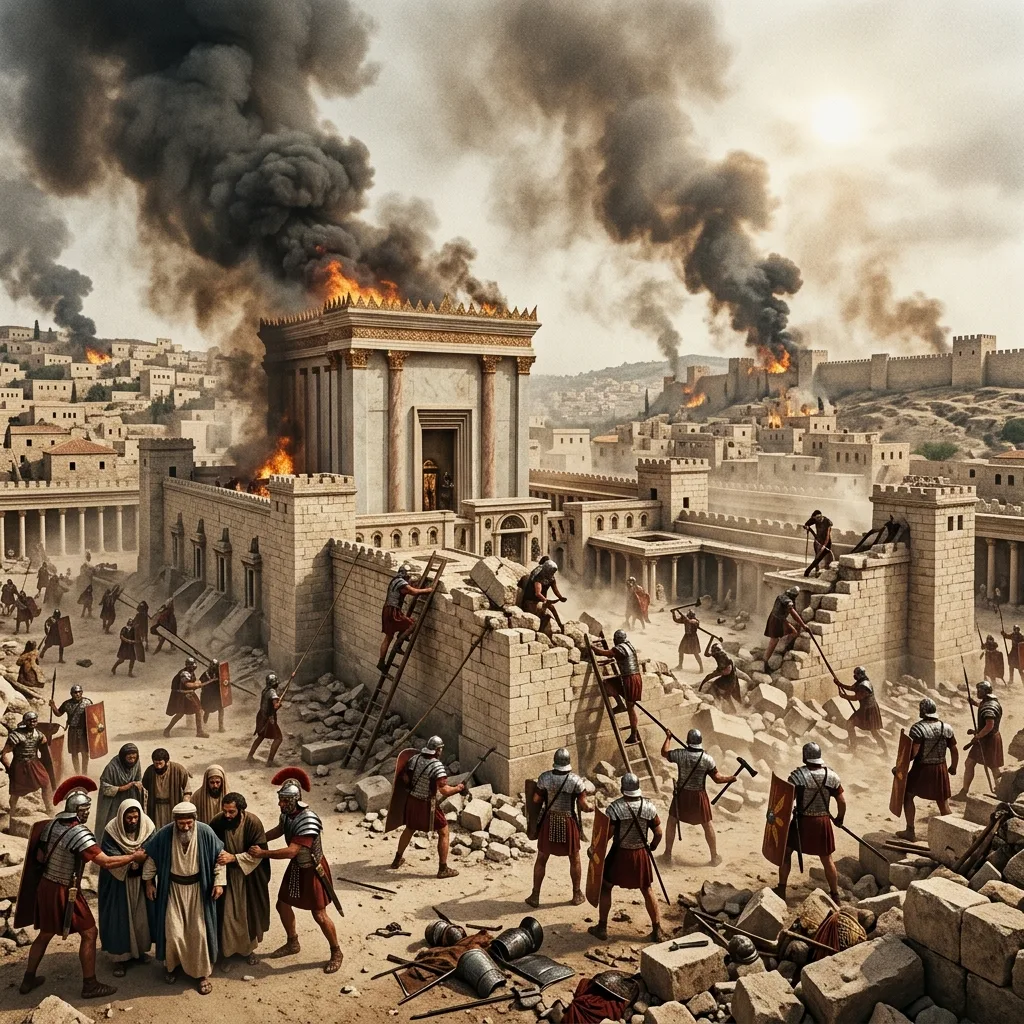
Following a massive Jewish revolt, Roman legions commanded by future emperor Titus besieged Jerusalem and completely destroyed the Second Temple, the absolute center of Jewish religious and cultural life.
Open in interactive timeline →Key Numbers
- Date Temple burned
- 9-10 Av, late Aug 70 CE
- Siege duration
- ~5 months (Apr-Sep 70 CE)
- Roman army
- ~50,000+ troops, 4 legions
- Josephus's death toll
- 1.1 million (likely exaggerated)
- Captives enslaved
- 97,000 (per Josephus)
Verified Facts
- The siege ran roughly from April to 8 September 70 CE, when the Roman general Titus, son of the newly proclaimed emperor Vespasian, broke the rebel-held city; his second-in-command was Tiberius Julius Alexander, a Jewish-born Roman of Alexandria who had renounced his ancestral faith.
- Titus assembled four legions for the assault: Legio V Macedonica, X Fretensis, XII Fulminata, and XV Apollinaris, supplemented by auxiliary cohorts and cavalry, fielding a force estimated at 50,000 or more men against a city torn by internal civil war among rival Jewish factions.
- The defenders were split among feuding zealot leaders -- John of Gischala, Simon bar Giora, and Eleazar ben Simon -- whose infighting (including the burning of the city's own grain stores) crippled the defense before the Romans even arrived in force.
- The Temple itself was set ablaze on the 9th-10th of Av; Josephus records that Titus claimed he wished to spare the sanctuary but that a soldier, against orders, hurled a firebrand that ignited the building, after which the flames spread beyond control.
- Jewish tradition commemorates the destruction on the 9th of Av (Tisha B'Av), the same calendar date traditionally assigned to the Babylonian destruction of the First Temple in 586 BCE -- a coincidence Josephus himself remarked upon as striking to first-century Jews.
- Our principal source is Flavius Josephus, born Yosef ben Matityahu, a Jewish commander who surrendered at Yodfat (Jotapata), defected to Rome, prophesied Vespasian's rise to emperor, and then wrote 'The Jewish War' as an eyewitness embedded with Titus's army.
- Josephus claimed 1.1 million people died in the siege and 97,000 were taken captive, with Tacitus separately putting the besieged population at 600,000; modern historians such as Seth Schwartz and Guy Rogers regard these as gross exaggerations and estimate deaths in the low tens of thousands.
- In the summer of 71 CE Titus and Vespasian celebrated a joint triumph in Rome, parading the Temple's sacred spoils -- the golden menorah, the Table of Showbread, and silver trumpets -- a scene later carved into the Arch of Titus erected around 81-82 CE by Domitian.
- The rebel leader Simon bar Giora was reserved as the triumph's central captive, dragged to the Roman Forum and executed by scourging and hanging at the Mamertine Prison as the ritual climax of the victory celebration.
- After the war Vespasian imposed the Fiscus Judaicus, a tax of two denarii (the former half-shekel Temple offering) levied on Jews throughout the empire and redirected to the temple of Jupiter Capitolinus in Rome; Rome also struck the 'IVDAEA CAPTA' coin series, depicting a mourning Jewish woman beneath a palm tree, over roughly 25 years.
The World at This Moment
The Temple fell at the close of the convulsive "Year of the Four Emperors" (69 CE), when Vespasian's elevation from the Judaean command ended Rome's civil war and inaugurated the Flavian dynasty. Titus, left to finish the campaign begun in 66 CE, breached Jerusalem in the summer of 70 CE; Josephus dates the burning to the 9th–10th of Av. The victory underwrote Flavian legitimacy: the Arch of Titus, the Colosseum (funded partly ex manubiis, from Judaean spoils), and the punitive fiscus Judaicus diverted the Temple tax to Jupiter Capitolinus. Beyond Rome, Han China under Emperor Ming was opening Central Asian trade and, by tradition, receiving Buddhism; the Kushan and Parthian empires controlled the routes between. In the Mediterranean, the nascent Jesus movement was still embedded within Judaism, and the Gospel of Mark was likely composed around this very moment of catastrophe. The destruction thus occurred at a hinge of empire, faith, and trade across Eurasia.
The Paradigm Shift
The Temple's loss severed Judaism from the sacrificial cult that had defined Israelite worship for a millennium, forcing a wholesale reinvention of religious practice. With altar, priesthood, and pilgrimage gone, authority migrated from hereditary priests to scholars; sacrifice gave way to prayer, Torah study, and the synagogue. The Pharisaic-rabbinic tradition consolidated at Yavneh and, over the following centuries, produced the Mishnah (c. 200 CE) and Talmuds—the textual scaffolding of a portable, diasporic Judaism that survived without a cultic center. The rupture equally shaped Christianity: it accelerated the "parting of the ways," let Christians read the destruction as divine vindication, and conditioned Gospel composition (Mark, then Matthew and Luke) under the shadow of the catastrophe. The siege also gave the West its template image of imperial conquest over a subject religion, immortalized on the Arch of Titus's menorah relief. In short, 70 CE redirected two of the world's enduring religious traditions away from a place-bound temple cult toward text, interpretation, and community.
In Their Own Words
"And thus was the holy house burnt down, without Caesar's approbation." — Flavius Josephus, The Jewish War (Bellum Judaicum), Book VI, in the Whiston translation
And thus was the holy house burnt down, without Caesar's approbation.
Flavius Josephus, The Jewish War (Wars of the Jews) 6.266 (Book VI, ch. 4, sec. 7), in William Whiston's English translation. Josephus was an eyewitness present with Titus's army at the 70 CE siege; he reports that the Temple burned despite Titus ('Caesar') ordering the fire quenched. — source
It is God, therefore, it is God himself who is bringing on this fire, to purge that city and temple by means of the Romans, and is going to pluck up this city, which is full of your pollutions.
Flavius Josephus, The Jewish War 6.110 (Book VI, ch. 2, sec. 1), Whiston translation. These are Josephus's OWN words, spoken in his account as he pleads with the rebel leader John of Gischala during the siege, framing Rome as God's instrument of judgment. — source
Give me Yavne and its Sages and do not destroy it, and spare the dynasty of Rabban Gamliel and do not kill them as if they were rebels, and lastly give me doctors to heal Rabbi Tzadok.
Babylonian Talmud, Gittin 56b (William Davidson / Koren-Steinsaltz English translation, via Sefaria). The rabbinic legend of Rabban Yoḥanan ben Zakkai's three requests to Vespasian — a later tradition (the Talmud was redacted centuries after 70 CE), not an eyewitness report, presenting the founding of the academy at Yavneh as the survival of Torah scholarship after the Temple's fall. — source
In Depth
The Burning of the Temple: How One Fire Reforged Two Religions
In August of 70 CE, Roman legions under Titus breached the walls of Jerusalem and set the Second Temple ablaze, ending nearly a thousand years of centralized Israelite sacrificial worship. The event reads, at first, as one provincial revolt crushed among many. Yet the destruction of that single building severed the cord that had bound an entire people to a place, and in doing so it forced both Judaism and the nascent Christian movement to reinvent themselves as portable, text-centered faiths. Few demolitions in history have built so much.
The Deep Preconditions
The fall was a culmination, not an accident. Judaea sat at the friction point of the imperial machine assembled by Augustus (sv-augustus), governed by procurators whose extractions and contempt repeatedly inflamed a population for whom Temple and nation were inseparable. The proximate trigger was fiscal and religious outrage — the procurator Gessius Florus plundering the Temple treasury under Nero — but the deeper cause was structural: a monotheistic, fiercely particular people embedded in a polytheistic empire that demanded accommodation. Compounding this was internal collapse. By 69 CE rival Jewish factions were fighting one another inside the walls even as Rome closed in, a civil war within a siege. The Flavian dynasty itself was newly forged in the chaos of the Year of the Four Emperors that followed Nero's fall and the Great Fire of Rome (sv-great-fire); Vespasian and Titus needed a triumph to legitimize their rule, and Judaea supplied it.
How It Reshaped What Came After
The aftermath rippled outward in stone and law. The Temple's sacred vessels — the menorah, the Table of the Showbread — were paraded through Rome and carved into the Colosseum (sv-colosseum)-era propaganda of the Arch of Titus, while the spoils and a new humiliation tax, the Fiscus Judaicus, helped fund the very amphitheater that would entertain the empire. Our richest account comes from Flavius Josephus (sv-josephus), a rebel-general-turned-Roman-client whose eyewitness Jewish War survives precisely because he wrote for the victors.
More consequentially, the loss of the Temple destroyed the institutional basis of Judaism overnight. The priesthood and its sacrifices simply ended. Into that void stepped the Pharisaic rabbis: tradition credits Yohanan ben Zakkai with founding an academy at Yavneh, pivoting Jewish life from altar to Torah, from sacrifice to study and synagogue. Rabbinic Judaism — the religion of the book that survives today — was born from this catastrophe. For the followers of Jesus, already drifting from Temple worship, the fire confirmed a theology that needed no Temple at all, accelerating the "parting of the ways." The contemporary Tacitus (sv-tacitus) recorded the war from the Roman side, and the Gospels, written in its shadow, read the destruction as prophecy fulfilled.
The Long Threads
The wound did not close. Jewish resistance flared again in the Kitos War (sv-trajan-kitos) under Trajan and catastrophically in Hadrian's Bar Kokhba revolt (sv-hadrian-bar-kokhba), after which Jerusalem was refounded as a pagan city and Jews barred from it — completing the diaspora the Temple's fall had begun. Three centuries later, Constantine (sv-constantine-legal) would Christianize the empire that destroyed the Temple, and the site itself would eventually carry Islam's Dome of the Rock (sv-dome-of-rock). The empty mount became the most contested real estate on Earth. In severing a faith from its sacred center, Rome inadvertently universalized it — proving that ideas anchored in text rather than territory can outlive any army, a lesson echoing from Yavneh to every exiled tradition since.
Causes & Consequences
What led to it
- Rome's annexation of Judea as a province in 6 CE placed the region under direct imperial rule and a Roman census-based taxation system, generating the political and fiscal resentment that would feed later rebellion.
- Decades of provocation by Roman governors—culminating in Gessius Florus's seizure of silver from the Temple treasury in 66 CE—inflamed Jewish anger and turned localized clashes into open revolt.
- The First Jewish Revolt erupted in 66 CE when rebels expelled the Roman garrison from Jerusalem and defeated the Syrian legate Cestius Gallus, committing Judea to a full-scale war that Rome was determined to crush.
- Herod the Great's monumental expansion of the Second Temple, begun around 20–19 BCE, had made it one of the grandest sanctuaries of the ancient world and the religious and economic heart of Jewish life, raising the stakes of its loss.
- Violent infighting among rival rebel factions—John of Gischala, Simon bar Giora, and the Zealots—split Jerusalem into warring enclaves and even burned the city's grain stores, crippling any unified defense against Rome.
- Vespasian's elevation to emperor in 69 CE during the civil war of the Year of the Four Emperors freed Rome to concentrate forces under his son Titus on finishing the Judean campaign at Jerusalem.
What it set in motion
- The cessation of Temple sacrifice and priesthood forced a reorientation of Jewish religious life toward Torah study, prayer, and the synagogue, giving rise to Rabbinic Judaism as the enduring mainstream form of the faith.
- Pharisaic sages led by Yohanan ben Zakkai established a center of learning and legal authority at Yavneh, whose work matured into the Mishnah and Talmud and reconstituted Jewish leadership without an altar.
- Vespasian imposed the Fiscus Judaicus, redirecting the Jews' annual Temple half-shekel to the temple of Jupiter Capitolinus in Rome, a humiliating levy that institutionalized Jewish subordination across the empire.
- The destruction accelerated the 'parting of the ways' between Judaism and the nascent Christian movement, a separation later sharpened when Nerva's reform of the Fiscus Judaicus effectively distinguished Christians from Jews in Roman eyes.
- The crushing of the revolt was commemorated in Roman propaganda—the Arch of Titus and the 'Judaea Capta' coinage—cementing the fall of Jerusalem as a showpiece of imperial triumph.
- Lingering grievances over the loss of the Temple and Jerusalem helped fuel later uprisings, including the Bar Kokhba Revolt of 132–135 CE, after whose defeat Rome barred Jews from the city and rebuilt it as the pagan Aelia Capitolina.
The Live Academic Debate
Two live debates dominate. First, responsibility for the burning: Josephus insists the fire was a soldier's act "without Caesar's approbation," whereas a tradition deriving from a fragment of Tacitus (preserved in Sulpicius Severus) holds that Titus deliberately ordered the Temple destroyed. Many modern historians, skeptical of Josephus's Flavian apologetics, lean toward deliberate destruction, though the question remains genuinely open. Second, and more contested, is "Yavneh": the long-standing reconstruction of a decisive council that defined orthodoxy, expelled heretics, and fixed the canon. Shaye J. D. Cohen ("The Significance of Yavneh," 1984) reframed Yavneh not as exclusionary but as a "grand coalition" ending sectarianism. Peter Schäfer (1975) and Daniel Boyarin went further, treating the "Synod of Yavneh" largely as a retrojected rabbinic legend rather than a datable event. Seth Schwartz, drawing on the Babatha papyri, argues rabbis were socially marginal well into Late Antiquity. The debate concerns how quickly, and how completely, rabbinic Judaism actually filled the void left in 70 CE.
How This Event Connects
The catastrophic destruction of the Second Temple in 70 CE by the Roman legions under Titus represents the most profound ideological and structural rupture in Jewish history, permanently shifting Judaism from a centralized, sacrificial cult to a text-based, rabbinic tradition. Historiographically, almost our entire narrative of this apocalyptic event is mediated through a single, highly problematic source: Flavius Josephus. As a former Jewish rebel commander who defected to the Romans, Josephus's The Jewish War is a masterpiece of complex apologetics and imperial propaganda. Modern scholars must employ rigorous source criticism to deconstruct Josephus’s text, parsing his attempts to simultaneously absolve the Roman high command of malice regarding the Temple's burning and to blame the disaster entirely on radical, "illegitimate" Jewish zealot factions.
The immediate imperial consequence of the Temple's fall was the massive injection of looted wealth and slave labor into the Roman economy, heavily subsidizing the new Flavian dynasty. The Construction of the Colosseum in Rome was literally financed by the spoils of the Jewish War, a reality confirmed by modern epigraphic reconstructions of the amphitheater's dedicatory inscription. The Colosseum thus stands as a brutal, monumental testament to Roman martial supremacy, utilizing the physical destruction of the Jewish spiritual center to permanently underwrite the political legitimacy and populist entertainment of the Roman capital.
However, the traumatic loss of the Temple did not entirely extinguish Jewish militant resistance; rather, it incubated a deeply entrenched, apocalyptic hostility toward Roman rule. The unresolved theological and political trauma of 70 CE directly set the stage for the subsequent, arguably more devastating conflict during the reign of Hadrian, the Bar Kokhba Revolt. While the initial tensions between Hellenistic imperialism and Jewish sovereignty began centuries earlier during the Seleucid Empire, the fall of the Second Temple fundamentally radicalized the conflict, ensuring that the final clash under Hadrian would result in the near-total demographic and cultural eradication of Jewish life in Judea.
The rabbinic 'Yavneh' survival narrative is partly legend (Shaye J.D. Cohen)
Historian Shaye J.D. Cohen argues that the famous story of Rabban Yoḥanan ben Zakkai securing Yavneh is a later rabbinic legend whose point is ideological — that Jewish life should continue under foreign rule, devoted to study of the law — rather than a reliable historical record. Against the popular image of a unified rabbinic 'grand coalition' instantly replacing Temple cult with study, Cohen finds that what actually characterized Yavneh was diversity and the slow end of Jewish sectarianism, with Yoḥanan ben Zakkai himself nowhere explicitly identified as a Pharisee. This cautions against reading the Gittin 56b account as straightforward history.
The Counterfactual
Had the Temple survived—whether Titus restrained his troops, as Josephus claims he wished, or the revolt been settled short of destruction—Judaism's center of gravity would plausibly have remained priestly and cultic rather than rabbinic and textual. Sacrificial worship, pilgrimage, and Sadducean–priestly authority might have persisted, slowing or preventing the Pharisaic ascendancy that produced the Mishnah and Talmud. Yet caution is warranted: scholars such as Seth Schwartz argue rabbinic influence over ordinary Jews remained limited for centuries regardless, so a surviving Temple need not have foreclosed Judaism's eventual textualization. The Bar Kokhba revolt (132–135 CE) and Hadrian's subsequent ban on Jerusalem suggest Roman–Jewish conflict was structural, not contingent on one siege; a standing Temple might simply have been destroyed later. For Christianity, a surviving Temple would have complicated the supersessionist reading of its fall and perhaps slowed the parting of the ways. The counterfactual illuminates how much later development hinged on the cult's removal, without making that removal historically inevitable.
Myth vs. Reality
Myth: The Western Wall (Wailing Wall) is a surviving piece of the Second Temple itself.
Reality: The Western Wall is not a wall of the Temple. It is a section of the western retaining wall of the Temple Mount platform that Herod the Great built to expand and level the mountaintop in the 1st century BCE. The Temple building itself was destroyed by the Romans in 70 CE; the retaining walls that held up the plaza survived. The Western Wall only became a major focus of Jewish prayer in roughly the last several centuries, long after 70 CE.
Myth: Titus ordered the Temple deliberately burned to the ground.
Reality: The sources actually disagree. Josephus, an eyewitness, claims Titus wanted to spare the Temple and that the fire began when a soldier, against orders, hurled a firebrand into a window during the chaos of battle. The later Christian chronicler Sulpicius Severus (drawing on a now-lost source often attributed to Tacitus) says Titus ordered its destruction. Many modern scholars distrust Josephus's exculpatory version, given his pro-Flavian patronage, but whether the burning was a deliberate command or battlefield disobedience remains genuinely debated rather than settled.
Myth: The destruction of the Temple in 70 CE began the Jewish diaspora and scattered the Jews across the world.
Reality: A large Jewish diaspora existed for centuries before 70 CE. It traces back to the Babylonian Exile of 586 BCE, and by the 1st century CE Jewish communities in places like Egypt (Alexandria), Babylonia, Asia Minor, and Rome were already large; diaspora Jews likely outnumbered those in Judea. The fall of the Temple was a profound religious and national catastrophe, but it did not create the diaspora, which long predated it.
Myth: After 70 CE the Romans expelled all Jews from Judea/the Land of Israel.
Reality: There was no comprehensive Roman expulsion of Jews in 70 CE. The revolt brought terrible killing, enslavement, and local displacement, but a substantial Jewish population remained. The large-scale Bar Kokhba revolt of 132–135 CE itself proves a major Jewish presence still existed decades later. After that revolt the demographic and religious center shifted to the Galilee, where the Mishnah and parts of the Talmud were later composed. The notion of a single decisive expulsion in 70 CE is a later legend, not what the sources describe.
Myth: The temple destroyed in 70 CE was a brand-new building called Herod's Temple, distinct from the Second Temple.
Reality: It was the same Second Temple. The Second Temple was originally built under Zerubbabel and dedicated around 516 BCE after the return from Babylon. Herod the Great did not replace it with a separate structure; in the 1st century BCE he massively renovated, enlarged, and beautified the existing temple and its surrounding precinct. 'Herod's Temple' is simply the expanded Second Temple, and that is the building the Romans burned in 70 CE.
Frequently Asked Questions
When was the Second Temple destroyed?
The Second Temple in Jerusalem was destroyed in 70 CE, during the First Jewish-Roman War. Roman forces under the general Titus laid siege to the city beginning around April of that year, and the Temple was burned in the Hebrew month of Av (late summer). Jewish tradition commemorates the destruction on the fast day of Tisha B'Av (the 9th of Av), though the historian Josephus places the Temple's burning on the 10th of Av.
Who destroyed the Second Temple and why?
The Temple was destroyed by the Roman army led by Titus, son of the emperor Vespasian, as Rome crushed a Jewish revolt that had broken out in 66 CE. After a months-long siege of Jerusalem, the Romans breached the walls, took the Temple Mount, and set the Temple ablaze. Josephus claims the fire was started impulsively by a soldier against Titus's wishes, while some later sources suggest Titus ordered the destruction himself; the matter remains debated.
How many people died in the siege of Jerusalem?
Ancient sources give very high figures: Josephus claimed about 1.1 million people died, which he attributed partly to crowds gathered in the city for Passover, while Tacitus put the number around 600,000. Josephus also reported that large numbers of survivors were enslaved. Most modern historians regard these ancient totals as exaggerated and estimate the actual death toll in the hundreds of thousands.
What happened to the Temple's treasures after the destruction?
After the victory, Vespasian and Titus celebrated a triumph in Rome in 71 CE, parading captives and spoils looted from the Temple. The Arch of Titus, erected in the Roman Forum around 81-82 CE under the emperor Domitian, depicts soldiers carrying Temple objects including the seven-branched golden menorah, a sacred table, and trumpets. The ultimate fate of the menorah is unknown, and its disappearance has been the subject of much speculation.
Why is the destruction of the Second Temple so significant in Judaism?
The Temple was the center of Jewish sacrificial worship, and its destruction abruptly ended the system of offerings and priestly atonement rites that could only be performed there. This forced a profound transformation of Jewish religious life, with prayer, Torah study, and the synagogue gradually replacing Temple sacrifice. The loss is mourned annually on Tisha B'Av, the same fast day associated with the destruction of the First Temple centuries earlier.
How did Judaism survive the loss of the Temple?
With the Temple gone, a stream of Jewish scholars associated with the Pharisees reconstituted around the town of Yavneh, laying the institutional and legal foundations of what became Rabbinic Judaism. This tradition centered on Torah study, prayer, and legal interpretation rather than sacrifice, and its teachings were eventually codified in the Mishnah. This portable, text-centered form of Judaism allowed the religion to endure and flourish across the Diaspora without a central Temple.
Is anything of the Second Temple still standing today?
The Temple building itself was destroyed, but a section of the retaining wall built by Herod to support the expanded Temple Mount platform survives as the Western Wall (Kotel) in Jerusalem. It is the holiest accessible site for Jewish prayer and remains a major place of pilgrimage. The Western Wall was not part of the Temple structure proper but is the closest surviving remnant of the Second Temple complex.
Sources & Further Reading
- Siege of Jerusalem (70 CE) — Wikipedia
- Flavius Josephus, The Jewish War (Bellum Judaicum), esp. Books V–VI
- Shaye J. D. Cohen, 'The Significance of Yavneh: Pharisees, Rabbis, and the End of Jewish Sectarianism,' Hebrew Union College Annual 55 (1984): 27–53
- Seth Schwartz, Imperialism and Jewish Society, 200 B.C.E. to 640 C.E. (Princeton, 2001)
- Martin Goodman, Rome and Jerusalem: The Clash of Ancient Civilizations (2007)
- Daniel Boyarin, Border Lines: The Partition of Judaeo-Christianity (2004)
- Wikipedia: Second Temple
Cite This Page
AskHistoryAI. “The Fall of the Second Temple.” AskHistoryAI — Interactive Timeline of Everything. Updated 2026-09-11. https://askhistoryai.com/event/sv-second-temple/
Every fact on this page is checked against the published fact ledger and methodology; sources are listed above.