Hiroshima & Nagasaki
Humanity crosses the threshold of self-annihilation.
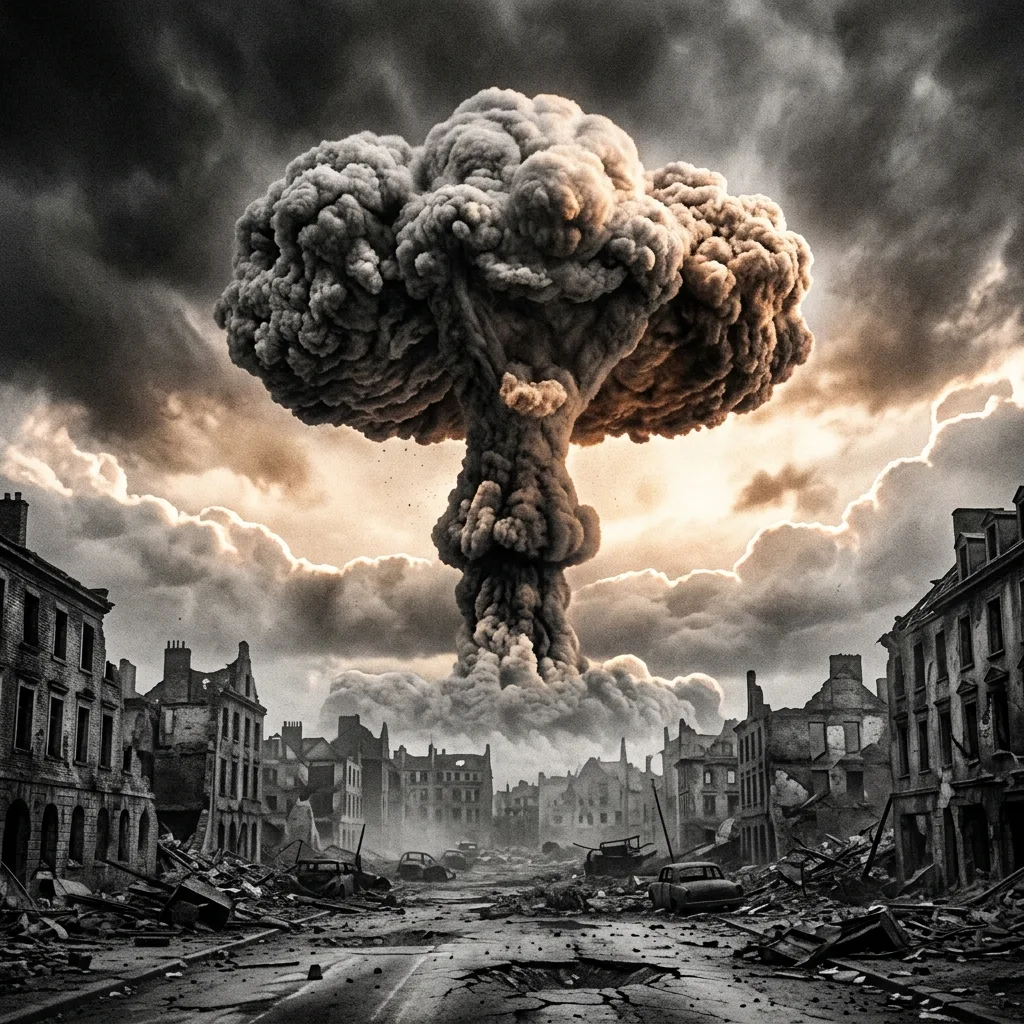
The United States detonates two atomic bombs over Japanese cities, killing hundreds of thousands of civilians instantly and ending WWII.
Open in interactive timeline →Key Numbers
- Dead by end of 1945
- ~140,000 (Hiroshima) + ~74,000 (Nagasaki)
- Days apart
- 3 (Aug 6 & Aug 9, 1945)
- Bomb yields
- ~15 kt (Little Boy) / ~21 kt (Fat Man)
- Hiroshima buildings destroyed
- ~2/3 of the city
- Days to surrender
- 6 (Hirohito broadcast Aug 15)
Verified Facts
- At 8:15 a.m. local time on August 6, 1945, the B-29 Enola Gay, piloted by Colonel Paul Tibbets of the 509th Composite Group, dropped the uranium gun-type bomb 'Little Boy' from roughly 31,000 feet; it detonated about 43 seconds later at an altitude of approximately 1,900 feet (about 580 meters) above the city.
- 'Little Boy' used the gun-type design firing one mass of uranium-235 into another, with a yield of roughly 15 kilotons of TNT; it was so confidently expected to work that it was never tested before combat use, unlike the plutonium implosion design.
- The fireball reached surface temperatures of several thousand degrees Celsius, and ground-level temperatures near the hypocenter are estimated at 3,000-4,000 degrees Celsius, instantly vaporizing or incinerating people and fusing building materials within the immediate blast zone.
- In Hiroshima roughly 70,000-80,000 people were killed almost instantly, and by the end of 1945 the death toll is estimated at around 140,000 as people died of burns, injuries, and radiation sickness; the city's pre-bomb population was roughly 350,000.
- Nagasaki was the secondary target on August 9, 1945: the B-29 Bockscar, piloted by Major Charles Sweeney, was diverted from the primary target Kokura because smoke and cloud cover obscured the aim point, then dropped the plutonium implosion bomb 'Fat Man' (yield ~21 kilotons) through a break in the clouds over the Urakami Valley at 11:02 a.m.
- Nagasaki's hilly terrain partly shielded sections of the city, so although Fat Man was the more powerful weapon, its death toll was lower than Hiroshima's: roughly 40,000 killed instantly and around 74,000 dead by the end of 1945.
- The Soviet Union declared war on Japan and invaded Japanese-occupied Manchuria on August 8-9, 1945, between the two bombings; many historians argue this Soviet entry, alongside the bombs, was decisive in Japan's decision to surrender by removing any hope of a negotiated peace mediated by Moscow.
- Thousands of Korean forced laborers were among the victims; estimates suggest Koreans made up roughly one in ten of those killed, with tens of thousands of Korean casualties across both cities, a group long overlooked in official counts.
- Emperor Hirohito announced Japan's acceptance of surrender terms in the recorded 'Jewel Voice Broadcast' aired at noon on August 15, 1945, the first time an emperor addressed the nation by radio; the night before, rebel army officers attempted a coup to seize and destroy the recording, which was smuggled out of the Imperial Palace and survived.
- Survivors, known as hibakusha ('persons affected by the bomb'), suffered elevated rates of leukemia and other cancers for decades; the radiation-induced cancer risk among exposed survivors persisted across their lifetimes, making these the first long-term human studies of low-to-high-dose radiation effects.
The World at This Moment
By August 1945 the European war was over: Germany had surrendered on 8 May, and the Allied "Big Three" had just concluded the Potsdam Conference (17 July–2 August), where Truman, newly president after Roosevelt's April death, learned of the successful 16 July Trinity test and issued the Potsdam Declaration demanding Japan's unconditional surrender. The Pacific war ground on through the bloody Okinawa campaign (ended June), kamikaze attacks, and a planned invasion (Operation Downfall). Crucially, at Yalta Stalin had pledged to enter the Pacific war within three months of Germany's defeat; the USSR declared war on Japan on 8 August and invaded Manchuria on 9 August, the same day Nagasaki was struck. The broader moment was one of transition from a hot world war to an emerging Cold War order: the United Nations Charter had been signed in San Francisco in June, decolonization pressures were building across Asia, and Anglo-American distrust of Soviet intentions in Eastern Europe was already shaping postwar diplomacy.
The Paradigm Shift
The bombings inaugurated the nuclear age, collapsing the distance between scientific theory and civilizational threat: Einstein's E=mc² and the fission discoveries of Hahn, Meitner, and Frisch were now weaponized at city scale, killing an estimated 110,000–210,000 people, the overwhelming majority civilians, many by radiation in the months after. Strategically, the bomb redefined "total war," making the deliberate annihilation of urban populations an instrument of state and seeding the doctrines of deterrence and mutually assured destruction that structured the Cold War. It accelerated the Soviet crash atomic program (first test 1949) and a decades-long arms race. Intellectually, it triggered the scientists' movement, the Bulletin of the Atomic Scientists and its Doomsday Clock, and enduring debates over the moral responsibility of researchers, captured in Oppenheimer's later anguish. It also opened the long, contested project of nuclear arms control, from the Baruch Plan through the Non-Proliferation Treaty, and made the prospect of human self-extinction a permanent feature of modern political and ethical thought.
In Their Own Words
"We have discovered the most terrible bomb in the history of the world. It may be the fire destruction prophesied in the Euphrates Valley Era, after Noah and his fabulous Ark." — Harry S. Truman, diary entry written at Potsdam, 25 July 1945 (Harry S. Truman Library, "Ross Papers" / Potsdam diary)
Sixteen hours ago an American airplane dropped one bomb on Hiroshima, an important Japanese Army base. That bomb had more power than 20,000 tons of T.N.T.
President Harry S. Truman, official White House statement announcing the bombing of Hiroshima, August 6, 1945. (The statement also declared of Japan: 'They have been repaid many fold,' referencing Pearl Harbor.) — source
I remembered the line from the Hindu scripture, the Bhagavad-Gita; Vishnu is trying to persuade the Prince that he should do his duty and, to impress him, takes on his multi-armed form and says, 'Now I am become Death, the destroyer of worlds.' I suppose we all thought that, one way or another.
J. Robert Oppenheimer, recalling the July 1945 Trinity test in a 1965 NBC television interview (filmed for 'The Decision to Drop the Bomb'). NOTE: This is his later recollection of a thought; he is not recorded as having spoken these words aloud at the test itself. The line is his English rendering of Bhagavad Gita 11:32. — source
These weapons are not a necessary evil; they are the ultimate evil.
Setsuko Thurlow, Hiroshima survivor (hibakusha), Nobel Peace Prize acceptance lecture delivered on behalf of ICAN, Oslo, December 10, 2017. She survived the bombing at age 13. — source
In Depth
The Star That Came Down to Earth
For roughly thirteen billion years, the violent fusion of atomic nuclei belonged to the stars. The first light in the cosmos was born when gravity crushed hydrogen tight enough to ignite fusion in The First Star Formations (sv-first-stars), and the elements heavier than iron were forged only in the cataclysm of The First Supernovas (sv-first-supernova). On August 6 and 9, 1945, humanity reached into that stellar physics and brought a fragment of it down onto two Japanese cities. Hiroshima and Nagasaki mark the moment a single species learned to release the binding energy of the atom — the same nuclear force that lights the heavens — and aimed it at itself.
Deep Preconditions
The bombs were the harvest of a very long intellectual chain. The atom itself was first imagined by Democritus & the Atom (sv-democritus), who argued that all matter reduced to indivisible particles in a void. That speculation became physics through the mathematical descriptions of nature pioneered by Isaac Newton & the Principia (sv-newton) and the field theory of James Clerk Maxwell & Electromagnetism (sv-james-maxwell). The decisive key came from Albert Einstein & the Theory of Relativity (sv-einstein): the equation E=mc² revealed that mass itself is frozen energy, and that splitting heavy nuclei could unlock it. In December 1938, Otto Hahn and Fritz Strassmann split uranium in a Berlin laboratory, and Lise Meitner and Otto Frisch named the result "fission." A year later, fearing Nazi Germany would build a weapon first, Einstein signed a letter (drafted by Leo Szilard) urging Roosevelt to act — a letter Einstein later called the one great mistake of his life. That warning became the Manhattan Project, the largest scientific-industrial effort yet attempted, culminating in the Trinity test of July 16, 1945, where Oppenheimer reportedly recalled the Bhagavad Gita: "Now I am become Death."
What It Reshaped
The human capacity for organized killing is ancient — it runs from the chariot clash of The Battle of Kadesh (sv-battle-kadesh) through the gunpowder of The Invention of Firearms (sv-firearms) and the mechanized carnage of The American Civil War (sv-american-civil-war). What changed at Hiroshima was scale and finality. A single bomb, "Little Boy," killed roughly 78,000 people instantly; "Fat Man" over Nagasaki killed about 40,000 more. By year's end the combined toll approached 200,000. For the first time, a technology existed that could end not merely an army or a city but civilization itself. The Industrial Revolution (sv-industrial-revolution) had promised that human power over nature was a ladder of pure progress; the mushroom cloud revealed the ladder had a trapdoor.
Threads Forward
The same rocketry and physics that delivered warheads also carried Apollo 11 Moon Landing (sv-apollo11) — the duality of the atomic age, terror and transcendence braided together. The Cold War standoff it created funded the computing networks that became The World Wide Web (sv-www), and the existential dread it introduced reframed every later debate about powerful technology. When thinkers warn about artificial intelligence — from Deep Blue Defeats Kasparov (sv-deep-blue) through the trajectory Ray Kurzweil charts toward AGI by 2029: The Turing Threshold (sv-kurzweil-agi-2029) — they reach instinctively for the nuclear analogy: a discovery too consequential to uninvent, demanding wisdom we are not sure we possess. Hiroshima is therefore a hinge in the deep arc of this timeline. It is the moment the universe's most powerful force, dormant since the first stars, passed into the hands of a creature still governed by the same tribal instincts that built Göbekli Tepe & the Dawn of Religion (sv-gobekli-tepe). The central question of the age that follows — can intelligence outgrow the violence that birthed it? — was first asked, unanswerably, in that August light.
Causes & Consequences
What led to it
- German chemists Otto Hahn and Fritz Strassmann discovered nuclear fission in late 1938, and Lise Meitner and Otto Frisch interpreted it in early 1939, revealing that splitting a uranium atom released enormous energy.
- In August 1939, Leo Szilard drafted a letter signed by Albert Einstein warning President Franklin Roosevelt that nuclear fission could be weaponized and that Nazi Germany might build such a bomb, prompting Roosevelt to create an advisory Uranium Committee.
- The Manhattan Project, formally approved by Roosevelt and launched in 1942 under General Leslie Groves with J. Robert Oppenheimer directing the Los Alamos laboratory, mobilized over 100,000 workers and roughly $2 billion to engineer a deliverable weapon.
- The successful Trinity test on July 16, 1945, near Alamogordo, New Mexico, detonated a plutonium implosion device with a yield equivalent to about 20,000 tons of TNT, proving the bomb worked.
- Fear of casualties from a planned invasion of the Japanese home islands led Truman and his advisers to seek a means of forcing surrender without a ground assault.
- The Potsdam Declaration of July 26, 1945, demanded Japan's unconditional surrender and threatened 'prompt and utter destruction,' and Japan's failure to accept it set the stage for the bombings.
What it set in motion
- By the end of 1945, the bombings had killed an estimated 140,000 people in Hiroshima and roughly 74,000 in Nagasaki from the blasts, burns, and radiation sickness, with estimates of the combined toll ranging widely up to about 210,000.
- Combined with the Soviet declaration of war and invasion of Manchuria on August 8-9, 1945, the bombings contributed to Emperor Hirohito's decision to accept surrender, which he announced by radio on August 15, formally ending World War II on September 2.
- The bombings demonstrated nuclear weapons' destructive power and helped trigger a Cold War arms race, spurring the Soviet Union to test its own atomic bomb, 'First Lightning,' on August 29, 1949.
- Surviving hibakusha suffered elevated rates of leukemia and other cancers, and the long-term radiation studies of survivors became a foundation of modern understanding of radiation's health effects.
- The horror of the bombings fueled an international arms-control and anti-nuclear movement that produced milestones such as the 1968 Nuclear Non-Proliferation Treaty, the cornerstone of the global nonproliferation regime.
- The wartime demonstration of atomic energy spurred postwar civilian nuclear initiatives, including Eisenhower's 1953 'Atoms for Peace' speech and the 1957 founding of the International Atomic Energy Agency, even as the same technology enabled further weapons proliferation.
The Live Academic Debate
The historiography splits sharply. The "orthodox" view, articulated by Truman and codified by Henry Stimson's 1947 Harper's essay, holds the bombs were militarily necessary to force surrender and avert a costly invasion. The "revisionist" position, founded by Gar Alperovitz (Atomic Diplomacy, 1965; The Decision to Use the Atomic Bomb, 1995), argues Japan was already near surrender and that the bombs were chiefly "atomic diplomacy" aimed at intimidating the Soviet Union. A third axis concerns what actually ended the war: Tsuyoshi Hasegawa emphasizes Soviet entry as decisive, whereas Sadao Asada and Richard Frank insist the atomic shock, specifically its effect on Emperor Hirohito's "sacred decision," was paramount, noting the surrender resolve solidified before Soviet pressure fully registered with the army leadership. Critics such as Robert Maddox (Hiroshima in History, 2007) accuse revisionists of selectively reading evidence. The debate remains unresolved and politically charged, intersecting with memory politics in the United States and Japan, as the 1995 Smithsonian Enola Gay controversy showed.
How This Event Connects
The atomic bombings of Hiroshima and Nagasaki mark the horrific apotheosis of total war and the genesis of the geopolitical "nuclear taboo." The devastating reality of the bombs was the direct, material culmination of abstract theoretical physics pioneered by Albert Einstein. The conversion of mass into explosive energy ($E=mc^2$) finalized the integration of theoretical science into the state military apparatus. Einstein’s tragic transition from a pacifist theoretician to a reluctant advocate for the Manhattan Project underscores the inescapable politicization of modern science.
The scale of the destruction draws a chilling historiographical parallel to the K-Pg Extinction Event. For the first time in planetary history, a single biological species possessed the technological capacity to induce an instantaneous, global extinction event. The bombings shifted the paradigm of human conflict from localized territorial conquest to the persistent, existential threat of planetary annihilation, cementing a "Cold War" dynamic governed entirely by the logic of Mutually Assured Destruction.
Furthermore, the nuclear arms race birthed by Hiroshima is the dark twin of the later techno-political spectacle of Apollo 11. Both the atomic bomb and the lunar landing were the ultimate products of the Industrial Revolution—massive, state-sponsored mobilizations of capital, labor, and engineering designed to demonstrate ideological supremacy. While Apollo 11 projected capitalist prowess through exploration, Hiroshima projected it through sheer, unprecedented destructive capacity, permanently linking the exploration of the cosmos with the terror of ICBM delivery systems.
Was it necessary? The revisionist / hibakusha challenge
Historian Gar Alperovitz, the leading 'revisionist' scholar, argued in 'The Decision to Use the Atomic Bomb' (1995) that the bombs were militarily unnecessary: that Japan was seeking terms permitting it to keep its emperor, that Truman's advisors knew this, and that the weapons were used partly to influence the postwar Soviet Union. This view is contested by 'traditionalist' historians (e.g. Robert James Maddox), who hold the bombs averted a costly invasion. The hibakusha themselves, voiced by survivors like Setsuko Thurlow, reframe the question entirely as one of an absolute moral wrong against civilians.
The Counterfactual
Had the bombs not been used, the central question is whether Japan would still have surrendered in August 1945. Tsuyoshi Hasegawa (Racing the Enemy, 2005) argues the Soviet declaration of war on 8 August was the more decisive shock, contending Japan would likely have capitulated soon after Soviet entry even without the bombs, though probably not as early as 14 August. Orthodox and "realist" scholars such as Richard Frank (Downfall, 1999) counter that the Japanese military leadership remained committed to a decisive homeland battle (ketsu-gō), so absent the bombs the war might have dragged into autumn or required Operation Downfall, with casualties on all sides, including Japanese civilians, plausibly far exceeding those at Hiroshima and Nagasaki. A divergent counterfactual, raised by revisionists, is that a clarified surrender offer preserving the emperor, or a demonstration shot, might have ended the war without mass civilian death, though evidence that Tokyo was ready to accept such terms remains genuinely disputed.
Myth vs. Reality
Myth: The atomic bombings were the single decisive factor that forced Japan to surrender.
Reality: Historians dispute that the bombs alone ended the war. In 'Racing the Enemy' (2005), Tsuyoshi Hasegawa argues the Soviet declaration of war on August 8 and the invasion of Manchuria were at least as decisive as, if not more decisive than, the bombings in pushing Japan's leadership toward surrender, noting the Supreme War Council's key decisions came after the Soviet entry rather than after Hiroshima. While other scholars still emphasize the bombs, there is broad agreement that the picture is more complicated than 'the bombs ended the war,' with the Soviet shock and the conditional-surrender question both playing major roles.
Myth: The bombs were aimed at purely military targets, and civilian deaths were unintended 'collateral damage.'
Reality: The cities were chosen as urban targets, and mass civilian death was a central aim, not an accident. The Target Committee deliberately selected large urban areas and instructed crews to aim for city centers to maximize destruction; military-industrial sites were treated as a secondary objective. Although Hiroshima held a military garrison of roughly 24,000 troops, an estimated 90 percent of those killed were civilians. The wartime U.S. press release nonetheless framed Hiroshima as a strictly 'military base.'
Myth: Dropping the bombs saved a million American lives that an invasion would have cost.
Reality: The 'million lives' figure was a postwar justification, not a wartime estimate. In a 1947 Harper's essay drafted for Secretary of War Henry Stimson, McGeorge Bundy popularized the half-million/million figure; Bundy later acknowledged the number had no solid basis. Historian Rufus E. Miles Jr. called it 'the strange myth of half a million American lives saved.' Declassified mid-1945 military planning documents projected far lower casualty estimates for the initial invasion of Kyushu (on the order of tens of thousands), nowhere near the inflated figures cited afterward.
Myth: The U.S. dropped leaflets specifically warning Hiroshima and Nagasaki residents about the atomic bomb before the attacks.
Reality: No atomic-specific warning reached either city before it was bombed. General 'LeMay leaflets' dropped beforehand warned of conventional B-29 firebombing of various cities but never mentioned an atomic weapon. Leaflets that did describe the new atomic bomb were distributed only after Hiroshima was destroyed, and by most accounts did not reach Nagasaki until after that city too had been hit. The popular claim that residents were specifically forewarned of nuclear attack is not supported by the documentary record.
Myth: Children born to atomic-bomb survivors suffered widespread birth defects and genetic damage from their parents' radiation exposure.
Reality: Decades of large-scale study have found no statistically significant increase in heritable effects in survivors' offspring. The Atomic Bomb Casualty Commission (later the Radiation Effects Research Foundation) examined tens of thousands of pregnancies beginning in 1948, and follow-up research across generations has found no significant elevation in birth defects, childhood cancer, chromosomal abnormalities, or mutations among children of survivors attributable to parental exposure. Survivors themselves faced serious radiation-related illness, including elevated leukemia and cancer rates, but the feared genetic damage to the next generation has not been demonstrated.
Frequently Asked Questions
When were the atomic bombs dropped on Hiroshima and Nagasaki?
The United States dropped the first atomic bomb on Hiroshima on the morning of August 6, 1945, detonating at 8:15 a.m. Three days later, on August 9, 1945, a second bomb was dropped on Nagasaki. These remain the only two uses of nuclear weapons in armed conflict in history. Japan announced its surrender on August 15, 1945, and signed the formal instrument of surrender aboard the USS Missouri on September 2, 1945.
How many people died in the Hiroshima and Nagasaki bombings?
Estimates vary because of the chaos and long-term radiation deaths, but most scholarship places the combined toll by the end of 1945 at roughly 110,000 to 210,000 people. In Hiroshima, tens of thousands died instantly and the death toll reached an estimated 140,000 by year's end; in Nagasaki the figure is commonly estimated around 70,000 to 74,000 by the end of 1945. Many more died in later years from burns, injuries, and radiation-related illnesses, making exact figures impossible to determine.
What were the two atomic bombs called and how were they delivered?
The Hiroshima bomb was code-named 'Little Boy,' a gun-type weapon that fired one mass of uranium-235 into another to create a supercritical mass. The Nagasaki bomb was 'Fat Man,' an implosion-type device using a plutonium core compressed by surrounding high explosives. Little Boy was dropped by the B-29 bomber Enola Gay, piloted by Colonel Paul Tibbets, while Fat Man was dropped by a separate B-29 named Bockscar.
Why did the United States drop atomic bombs on Japan?
The traditional, or 'orthodox,' view holds that President Truman authorized the bombings to force Japan's unconditional surrender quickly and avoid a costly invasion of the Japanese home islands. Revisionist historians argue the bombings were not a military necessity—pointing out that Japan was already seeking Soviet mediation—and that a motive was to intimidate the Soviet Union as the Cold War loomed. The decision remains one of the most debated in modern history, with no scholarly consensus on whether it was justified or decisive.
Did the atomic bombs or the Soviet invasion cause Japan to surrender?
This is genuinely contested among historians. The traditional view credits the two atomic bombings with breaking Japanese resistance, while historians such as Tsuyoshi Hasegawa argue the Soviet Union's declaration of war and invasion of Manchuria on August 8-9, 1945, was at least as decisive. Notably, in Emperor Hirohito's message to the military, he emphasized the Soviet entry into the war rather than the atomic bomb. Most likely both shocks, arriving within days of each other, combined to force the surrender.
What were the long-term health effects on survivors (hibakusha)?
Survivors, known as hibakusha, suffered elevated rates of cancer and other illnesses for decades. Leukemia incidence rose noticeably five to six years after the bombings, followed by higher rates of stomach, lung, liver, breast, and thyroid cancers. Long-running studies by the Radiation Effects Research Foundation have attributed a substantial share of leukemia and solid-cancer deaths among survivors to bomb radiation, and also documented increased heart disease, stroke, and cataracts. As of recent years roughly 106,000 hibakusha remained alive, with an average age in the mid-eighties.
Sources & Further Reading
- Atomic bombings of Hiroshima and Nagasaki — Wikipedia
- Tsuyoshi Hasegawa, Racing the Enemy: Stalin, Truman, and the Surrender of Japan (Harvard University Press, 2005)
- Gar Alperovitz, The Decision to Use the Atomic Bomb (Knopf, 1995)
- Richard B. Frank, Downfall: The End of the Imperial Japanese Empire (Random House, 1999)
- Sadao Asada, 'The Shock of the Atomic Bomb and Japan's Decision to Surrender: A Reconsideration,' Pacific Historical Review 67, no. 4 (1998)
- Robert James Maddox (ed.), Hiroshima in History: The Myths of Revisionism (University of Missouri Press, 2007)
- Wikipedia: Manhattan Project
Cite This Page
AskHistoryAI. “Hiroshima & Nagasaki.” AskHistoryAI — Interactive Timeline of Everything. Updated 2026-09-11. https://askhistoryai.com/event/sv-hiroshima-nagasaki/
Every fact on this page is checked against the published fact ledger and methodology; sources are listed above.