Apollo 11 Moon Landing
A species looks back at its own home from the void.
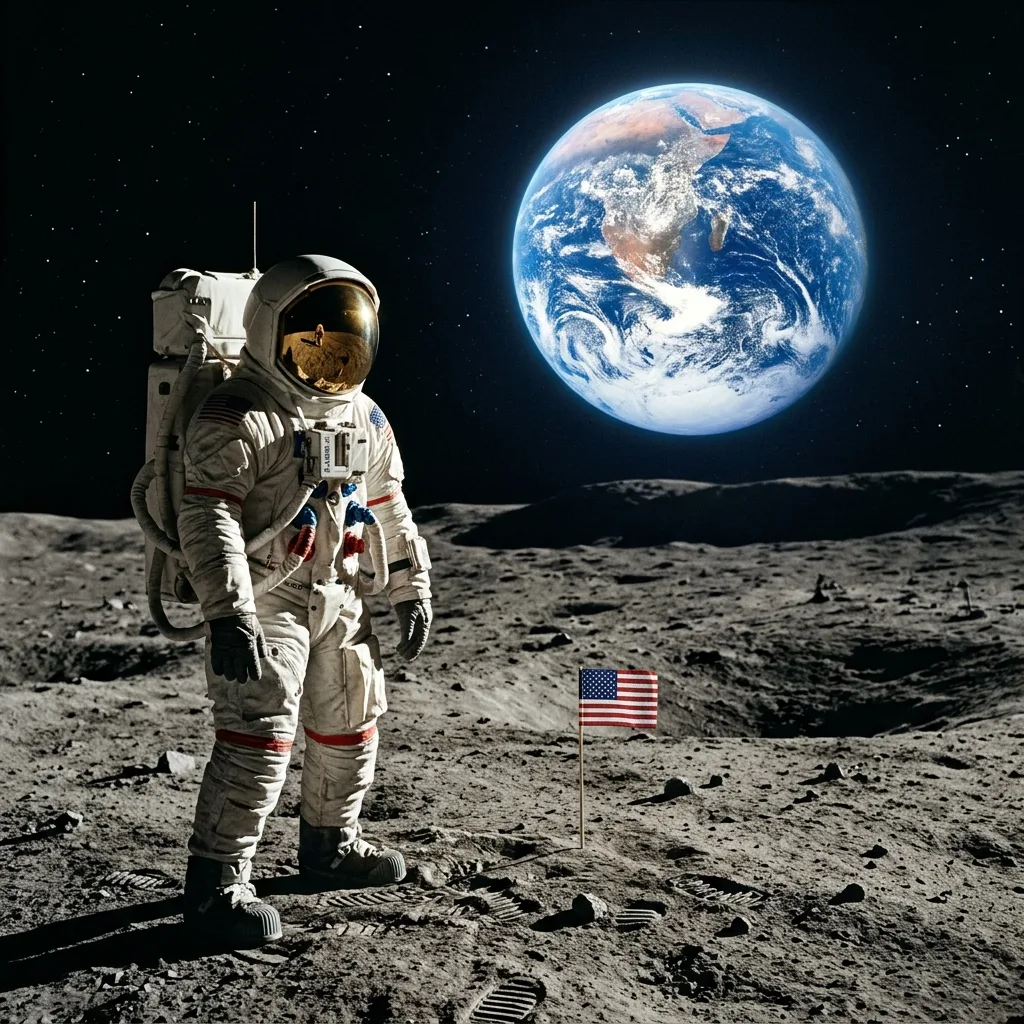
Driven by Cold War competition, the United States successfully landed humans on the Moon and returned them safely to Earth.
Open in interactive timeline →Key Numbers
- Landing date
- July 20, 1969, 20:17 UTC
- Crew
- 3 astronauts
- First moonwalk (EVA)
- 2 hr 31 min
- Lunar samples returned
- 21.5 kg (47.5 lb)
- Global TV audience
- ~600 million
Verified Facts
- Apollo 11 launched from Cape Kennedy, Florida, on July 16, 1969, at 13:32 UTC atop the three-stage Saturn V rocket, which stood 363 feet tall (taller than the Statue of Liberty) and generated about 7.6 million pounds of thrust at liftoff.
- The lunar module Eagle touched down at Tranquility Base on July 20, 1969, at 20:17 UTC, with Commander Neil Armstrong taking manual control to steer past a boulder-strewn crater; it landed with only roughly 25 seconds of descent fuel margin remaining.
- During the final descent, the Apollo Guidance Computer repeatedly flashed '1202' and '1201' program alarms (executive overflow from a misconfigured rendezvous radar); flight controller Steve Bales and engineer Jack Garman recognized the alarms were non-fatal and gave the 'go' to continue, a software resilience traced to Margaret Hamilton's MIT team.
- Armstrong became the first human to set foot on the Moon at 02:56 UTC on July 21, 1969, declaring 'That's one small step for man, one giant leap for mankind' (he intended 'a man'); Buzz Aldrin joined him about 19 minutes later, calling the scene 'magnificent desolation.'
- Michael Collins remained alone aboard the command module Columbia in lunar orbit, passing behind the Moon out of radio contact on each orbit, while Armstrong and Aldrin worked on the surface below.
- The single moonwalk lasted 2 hours, 31 minutes, during which the astronauts planted a U.S. flag, deployed scientific instruments, took a phone call from President Nixon, and collected about 21.5 kg (47.5 lb) of lunar rock and soil.
- A stainless-steel plaque left on the Eagle's descent stage, signed by the three astronauts and President Nixon, reads: 'Here men from the planet Earth first set foot upon the Moon, July 1969 A.D. We came in peace for all mankind.'
- The mission fulfilled President John F. Kennedy's May 1961 challenge to land a man on the Moon and return him safely to Earth 'before this decade is out,' achieved with about five months to spare.
- An estimated 600 million people worldwide watched the live television broadcast of the moonwalk, the largest TV audience in history at that time.
- Apollo 11 splashed down safely in the Pacific Ocean on July 24, 1969, about 13 nautical miles from the recovery ship USS Hornet; the crew was placed in quarantine afterward as a precaution against unknown lunar microorganisms.
The World at This Moment
Apollo 11 landed amid one of the most turbulent stretches of the twentieth century. The Vietnam War ground on even as Nixon announced the first U.S. troop withdrawals in June 1969; the antiwar movement and the Black Power and civil-rights struggles convulsed American cities. Three weeks earlier, the Stonewall riots (28 June 1969) ignited the modern gay-rights movement; weeks later came the Manson murders, Chappaquiddick, and Woodstock (15-18 August). The Cold War framed everything: the Soviet Union launched the robotic probe Luna 15 on 13 July, hoping to return lunar samples before Apollo, but it crashed into the Moon on 21 July as Eagle sat on the surface. China was mid-Cultural Revolution and had just clashed with the USSR at the Ussuri River. Western Europe absorbed the aftermath of the 1968 upheavals; Brezhnev's "doctrine" loomed after Czechoslovakia. The landing offered, as historians note, a rare unifying spectacle for an estimated 600 million-plus television viewers worldwide in a year otherwise defined by division.
The Paradigm Shift
Apollo 11 fulfilled Kennedy's 1961 pledge and effectively ended the superpower "space race," demonstrating that the United States could marshal industrial, scientific, and managerial resources at unprecedented scale. Roughly 400,000 workers and 2.4 percent of the federal budget at peak produced systems-engineering and project-management methods that reshaped large technological enterprise. Yet the deeper shift was conceptual. For the first time humans stood on another world, and the "Earthrise"-lineage images and Whole Earth photographs helped catalyze the environmental movement and a planetary self-consciousness. As Walter McDougall argued in his Pulitzer-winning ...the Heavens and the Earth (1985), the Space Age normalized the state-directed, technocratic mobilization of science for political prestige, a model with lasting consequences. Apollo also marked, paradoxically, an ending: having "won," both powers retreated from the Moon, and no human returned after Apollo 17 (1972). The landing thus simultaneously inaugurated the era of human spaceflight as geopolitical theater and exposed its fragility once the Cold War rationale lapsed.
In Their Own Words
"We choose to go to the moon. We choose to go to the moon in this decade and do the other things, not because they are easy, but because they are hard, because that goal will serve to organize and measure the best of our energies and skills, because that challenge is one that we are willing to accept, one we are unwilling to postpone, and one which we intend to win, and the others, too." — President John F. Kennedy, address at Rice University, Houston, Texas, 12 September 1962 ("We choose to go to the Moon" speech)
Houston, Tranquility Base here. The Eagle has landed.
Neil A. Armstrong, Apollo 11 Commander, transmission to Mission Control on landing in the Sea of Tranquility, July 20, 1969 (his own words, confirmed by NASA's History Office and Apollo 11 transcript). — source
That's one small step for [a] man, one giant leap for mankind.
Neil A. Armstrong on first stepping onto the lunar surface, July 21, 1969 (UTC). Armstrong stated he intended to say 'a man'; recordings do not clearly capture the 'a', so NASA's transcript renders it with the article in brackets/parentheses, and Armstrong annotated the American Philosophical Society's transcript to mark the 'a'. — source
Here men from the planet Earth first set foot upon the Moon July 1969, A.D. We came in peace for all mankind.
Inscription on the Apollo 11 lunar plaque affixed to the Eagle's descent stage and left on the Moon; signed by Neil A. Armstrong, Michael Collins, Edwin E. Aldrin Jr., and President Richard Nixon. Verified against NASA and the Wikipedia 'Lunar plaque' entry. — source
In Depth
One Small Step, Four Billion Years in the Making
When the lunar module Eagle settled into the Sea of Tranquility on July 20, 1969, and Neil Armstrong descended its ladder before a television audience of more than half a billion people, a species of primate became, for the first time, a multi-world species. It is tempting to read Apollo 11 as a Cold War episode and nothing more. But the deeper story is that an animal assembled from the wreckage of dead stars walked on a second world — and the wreckage is not a metaphor.
The Deep Preconditions
Every atom in the Eagle, in its aluminum hull and its astronauts' bones, was forged in events unimaginably older than the flight. The hydrogen propellant traces to The Big Bang (sv-big-bang); the heavier elements — the iron, the silicon of its computer's chips — were cooked inside stars and scattered by The First Supernovas (sv-first-supernova). The Moon itself is a relic of the Formation of the Solar System & Earth (sv-earth-formation), born (most likely) from a giant impact early in Earth's history. Biologically, the precondition was the long climb from The Origin of Life (sv-origin-of-life) through The Rise of the Great Apes (sv-great-apes) and The Human-Chimpanzee Split (sv-human-chimp-split), which produced a brain capable of orbital mechanics. Apollo 11 was the moment cosmic chemistry and primate cognition closed a loop: starstuff contemplating, and visiting, the sky.
The Engineering and the Cold War Fuse
The proximate cause was rivalry. The Soviet launch of Sputnik and Yuri Gagarin's 1961 flight panicked Washington; Kennedy's lunar pledge weaponized exploration. The Saturn V — 363 feet tall, 7.5 million pounds of thrust — was the most powerful machine humanity had built, the technological heir of The Industrial Revolution (sv-industrial-revolution) and of the physics codified by Isaac Newton & the Principia (sv-newton), whose laws of motion and gravitation literally plotted the trajectory. The mathematics of the orbit descends from a tradition reaching back through Euclid & the Elements (sv-euclid). And the destructive twin of that same rocketry — the ballistic missile born alongside the bomb at Hiroshima & Nagasaki (sv-hiroshima-nagasaki) — is why the superpowers funded space at all.
The Ripples Forward
Apollo's most consequential legacy was not lunar but terrestrial. To navigate, the program needed a computer that fit in a briefcase rather than a room, and so it became the dominant early customer for the integrated circuit: by 1963, Project Apollo consumed up to 60 percent of the United States' supply of microchips, guaranteeing the market that made mass production viable. The Apollo Guidance Computer's obsession with miniaturization and reliability helped seed the microprocessor — and with it the lineage that runs through The World Wide Web (sv-www), the deep-learning systems of AlexNet & the Deep Learning Revolution (sv-alexnet-convnets), and ultimately the frontier models of today. The "Earthrise" and "Blue Marble" images, meanwhile, gave the environmental movement its founding icon: a single fragile world.
The Threshold It Marks
In the arc this timeline traces — from physics to life to mind to machine — Apollo 11 is the hinge where intelligence first acted at planetary scale, leaving its biosphere behind. It is the proof-of-concept that the substrate Kurzweil describes in Epoch 6: The Universe Wakes Up (sv-kurzweil-epoch6) — intelligence spreading outward into dead matter — is not fantasy. We have already, once, taken the small step.
Causes & Consequences
What led to it
- The Soviet Union's launch of Sputnik 1 on October 4, 1957, shocked the United States into treating spaceflight as a Cold War priority and triggered the political will that would eventually fund a crewed lunar program.
- President Eisenhower signed the National Aeronautics and Space Act on July 29, 1958, creating NASA (operational October 1, 1958) as the civilian agency that would organize and run the Apollo program.
- After Yuri Gagarin became the first human in orbit on April 12, 1961, President John F. Kennedy declared before Congress in May 1961 the goal of landing a man on the Moon and returning him safely to Earth before the decade was out, setting Apollo's explicit deadline.
- Project Mercury (1961-1963) and the twelve Project Gemini missions (1964-1966) proved that astronauts could survive long-duration flight, perform spacewalks, and execute the orbital rendezvous and docking maneuvers that lunar-orbit rendezvous required.
- Wernher von Braun's team at NASA's Marshall Space Flight Center developed the three-stage Saturn V, the most powerful rocket built at the time, providing the heavy-lift capacity needed to send the Apollo spacecraft to the Moon.
- NASA's enormous demand for the new integrated circuit, consuming roughly 60 percent of U.S. IC production in 1963 for the Apollo Guidance Computer, drove the miniaturized, reliable onboard computing that made a crewed lunar landing technically feasible.
What it set in motion
- Apollo's intense early demand for integrated circuits transformed suppliers like Fairchild Semiconductor and collapsed chip prices (an IC falling from about $120 in 1961 to roughly $15 a year later), helping seed the microelectronics and computing industries that followed.
- NASA's Spinoff publication, begun in 1976, has since documented more than 2,000 commercialized technologies tracing to its space work, including CMOS image sensors behind modern phone cameras and temperature-responsive memory foam.
- The first crewed international spaceflight, the 1975 Apollo-Soyuz Test Project docking, used Apollo-era hardware and became a high-profile dramatization of US-Soviet detente.
- The 'Earthrise' and 'Blue Marble' style views of Earth from lunar distance gave the modern environmental movement an iconic image of a fragile, borderless planet.
- The 842 pounds of lunar rock and soil returned across the Apollo missions reshaped planetary science, supporting the giant-impact theory of the Moon's origin and decades of continuing analysis.
- Apollo's example directly inspired NASA's Artemis program, whose Artemis II mission in early 2026 carried the first crew since Apollo 17 in 1972 to fly around the Moon, aiming this time at a sustained lunar presence.
The Live Academic Debate
A central historiographical dispute concerns why Apollo happened and what it meant. John Logsdon (The Decision to Go to the Moon, 1970) frames the lunar commitment as a fundamentally political decision driven by Cold War prestige after the Bay of Pigs and Gagarin, not by scientific or military necessity. Walter McDougall (...the Heavens and the Earth, 1985) broadens this into a critique of state-directed technocracy, arguing Apollo institutionalized engineering and prestige over science and cooperation. A second debate, advanced by Roger Launius, targets the "myth" of popular support: polling shows that for most of the 1960s a majority of Americans thought too much was spent on space, with approval spiking only briefly around the landing itself, complicating nostalgic narratives of national consensus. Asif Siddiqi reframes the story comparatively, foregrounding the genuinely competitive but dysfunctional Soviet program. Others, including Andrew Chaikin (A Man on the Moon, 1994), emphasize operational and human-experience history. The competing readings turn on whether Apollo was an aberrant Cold War spasm or a durable model for organized exploration.
How This Event Connects
The Apollo 11 lunar landing is frequently analyzed by historians of technology not merely as a scientific triumph, but as the ultimate Cold War performative spectacle. The entire astrocultural project was intricately tied to the legacy of Hiroshima & Nagasaki. The underlying rocketry—most notably the Saturn V—was a direct evolutionary descendent of the militarized ICBMs designed to deliver thermonuclear warheads. The Space Race was fundamentally a proxy conflict, sublimating the threat of nuclear annihilation into a peaceful, yet highly charged, demonstration of ideological and technological supremacy.
This singular achievement stands as the pinnacle of the state-directed Industrial Revolution. The mobilization of hundreds of thousands of workers, from MIT computer scientists to Navajo textile weavers constructing core memory, showcased the absolute zenith of systemic engineering and mass production. It represented the final realization of the scientific revolution catalyzed centuries earlier by Galileo Galilei; humanity did not just observe celestial bodies through a lens, but physically traversed the vacuum to imprint on them.
Paradoxically, the outward thrust of Apollo 11 profoundly altered humanity's inward perspective, deeply impacting the historiography of the Formation of the Solar System & Earth. The broadcasted images of a fragile, isolated blue marble suspended in an infinite void birthed the modern "Spaceship Earth" paradigm. This visual realization of planetary finitude ironically catalyzed the modern terrestrial environmental movement, proving that the most profound discovery of the lunar landing was the Earth itself.
The Soviet view: many firsts, but they lost the Moon
The USSR led the early Space Race with a string of firsts (Sputnik in 1957, Yuri Gagarin's first crewed orbit in 1961), but lost the race to the Moon. Their secret N-1 lunar rocket exploded on a July 3, 1969 test just before Apollo 11 launched, and the program was hidden from the public. Soviet space journalist Yaroslav Golovanov captured the resulting cover-up: 'Secrecy was necessary so that no one would overtake us. But later, when they did overtake us, we had to maintain secrecy so that no one knew that we had been overtaken.' Historian Asif A. Siddiqi's archival history Challenge to Apollo (NASA, 2000) is the standard scholarly account of why the Soviets fell short.
The Counterfactual
Had Apollo 11 failed, the consequences were starkly imagined in advance: speechwriter William Safire drafted a contingency address for Nixon, "In Event of Moon Disaster," to be read had Armstrong and Aldrin been stranded. A catastrophic loss might have halted or sharply curtailed the program, as the Apollo 1 fire (1967) nearly did. Counterfactually, a Soviet success first is harder to sustain: historian Asif Siddiqi (Challenge to Apollo, 2000) documents that the USSR's lunar effort was crippled by the repeated failures of the N1 rocket and the death of chief designer Sergei Korolev in 1966, making a Soviet crewed landing improbable on that timeline. John Logsdon's work suggests the deeper contingency lay in 1961: absent the Bay of Pigs humiliation and Gagarin's flight, Kennedy might never have committed to so audacious a goal. Without Apollo's victory, the Cold War's symbolic register would have shifted, and the technocratic, "big-science" template Apollo legitimized might have taken a different, less moonstruck form.
Myth vs. Reality
Myth: The American flag the astronauts planted is shown waving in the wind, which proves the landing was faked because the Moon has no atmosphere.
Reality: The flag was not waving in any breeze. NASA engineer Jack Kinzler designed the flag with a horizontal telescoping rod sewn into a sleeve along its top edge so it would stay extended rather than hang limp. Armstrong and Aldrin could not fully extend that rod, which left the fabric permanently rippled, and the only motion visible in the footage occurs while they are twisting the pole into the surface. With no air resistance to damp it, the flag swung a few times from being handled and then froze in its bent shape, exactly as a vacuum would predict (Royal Museums Greenwich; HISTORY; Universe Today).
Myth: The absence of stars in the Apollo photographs taken on the lunar surface shows the images were staged in a studio.
Reality: The missing stars are a direct consequence of camera exposure, not fakery. Surface photos were shot at roughly 1/250th of a second at apertures around f/5.6 to f/11 to avoid blowing out the brilliantly sunlit landscape and the white spacesuits. Stars are far too faint to register at such short exposures; capturing them would require exposures of many seconds, which would have grossly overexposed everything else in frame. The same effect appears in ordinary daytime and bright-foreground photography on Earth (NASA Apollo Lunar Surface Journal; HISTORY; Discovery).
Myth: Neil Armstrong was chosen to step out first because he was the best pilot or because NASA judged him the most worthy astronaut.
Reality: The decision was largely driven by the spacecraft's physical layout, not a ranking of the men. The Lunar Module's hatch opened inward and was hinged on the side where Aldrin stood, so for Aldrin to exit first the two bulky, pressurized astronauts would have had to swap places in a cramped cabin full of switches and circuit breakers. Letting the commander, Armstrong, back out through the hatch was simpler and safer, and it also fit NASA's protocol that the mission commander led the way (AmericaSpace; Smithsonian National Air and Space Museum).
Myth: Armstrong's first words on the Moon were 'That's one small step for man' and he simply fluffed the line.
Reality: Armstrong always maintained he intended and believed he said 'That's one small step for a man, one giant leap for mankind' the version without 'a' is self-contradictory, since 'man' and 'mankind' then mean the same thing. After repeatedly insisting radio static obscured the word, Armstrong eventually conceded on listening to the recordings that he could not hear the 'a' and may have dropped it. Acoustic analyses since have split, some finding evidence for a clipped 'a' and others not, so the matter remains genuinely unresolved rather than a simple slip (Wikipedia 'One small step'; NBC News; American Philosophical Society).
Myth: Apollo 11 landed on the 'dark side of the Moon.'
Reality: Apollo 11 touched down on the near side of the Moon, at the Sea of Tranquility (Mare Tranquillitatis), one of the dark basins plainly visible from Earth. The phrase 'dark side' is itself a misnomer: the hemisphere facing away from Earth is correctly called the far side, and it is not permanently dark, every region of the Moon, near and far, receives roughly two weeks of sunlight followed by two weeks of night as the Moon rotates. The far side is simply never visible from Earth because the Moon is tidally locked (Britannica; BBC Sky at Night Magazine; Universe Today).
Frequently Asked Questions
When did Apollo 11 land on the Moon?
The Apollo 11 lunar module Eagle touched down on the Moon on July 20, 1969, at 20:17 UTC (4:17 p.m. EDT). Neil Armstrong then became the first human to step onto the surface about six and a half hours later, at 02:56 UTC on July 21, 1969 (10:56 p.m. EDT on July 20). The mission had launched atop a Saturn V rocket from Kennedy Space Center on July 16, 1969.
Who were the astronauts on Apollo 11?
Apollo 11 carried three astronauts: Commander Neil Armstrong, Lunar Module Pilot Edwin 'Buzz' Aldrin, and Command Module Pilot Michael Collins. Armstrong and Aldrin descended to the surface in the lunar module Eagle, while Collins remained alone in lunar orbit aboard the command module Columbia. Armstrong was a civilian test pilot, while Aldrin and Collins were U.S. Air Force officers.
What were Neil Armstrong's first words on the Moon?
As he stepped off the lunar module's ladder onto the surface, Armstrong said, 'That's one small step for [a] man, one giant leap for mankind.' Armstrong intended to say 'a man,' though the 'a' is famously difficult to hear in the transmission. Earlier, upon landing, he had radioed the equally iconic line, 'Houston, Tranquility Base here. The Eagle has landed.'
How long did the astronauts stay on the Moon?
Armstrong and Aldrin spent about 21.5 hours on the lunar surface before lifting off to rejoin Collins in orbit. Their single moonwalk (EVA) lasted roughly 2 hours and 31 minutes, during which they collected about 21.6 kilograms (47.5 pounds) of rock and soil samples, planted a U.S. flag, and deployed scientific instruments including a seismometer. They landed in the Sea of Tranquility (Mare Tranquillitatis).
How many people watched the Moon landing?
An estimated 600 million people worldwide watched the live television broadcast of the Moon landing and Armstrong's first steps, making it one of the largest audiences in history at the time. Estimates vary by source and by which moment is counted, ranging from roughly 530 million to 650 million viewers. Roughly one million spectators also gathered in person along Florida's coast to watch the Saturn V launch on July 16.
Why was the Apollo 11 Moon landing important?
Apollo 11 fulfilled President John F. Kennedy's 1961 goal of landing a man on the Moon and returning him safely before the decade's end, marking a defining victory for the United States in the Cold War Space Race against the Soviet Union. It was the first time humans set foot on another celestial body, a milestone in science and engineering. The astronauts left a plaque reading 'We came in peace for all mankind,' and the mission returned the first samples of lunar material to Earth.
Sources & Further Reading
- Apollo 11 — Wikipedia
- John M. Logsdon, The Decision to Go to the Moon: Project Apollo and the National Interest (1970)
- Walter A. McDougall, ...the Heavens and the Earth: A Political History of the Space Age (1985)
- Asif A. Siddiqi, Challenge to Apollo: The Soviet Union and the Space Race, 1945-1974 (2000)
- Roger D. Launius, Apollo's Legacy: Perspectives on the Moon Landings (2019); and Launius, 'Public opinion polls and perceptions of US human spaceflight' (Space Policy, 2003)
- Andrew Chaikin, A Man on the Moon: The Voyages of the Apollo Astronauts (1994)
- NASA: Apollo 11 Mission Overview
Cite This Page
AskHistoryAI. “Apollo 11 Moon Landing.” AskHistoryAI — Interactive Timeline of Everything. Updated 2026-09-11. https://askhistoryai.com/event/sv-apollo11/
Every fact on this page is checked against the published fact ledger and methodology; sources are listed above.