Manetho & The Aegyptiaca
Translating 3,000 years of Egyptian history for Greek rulers.
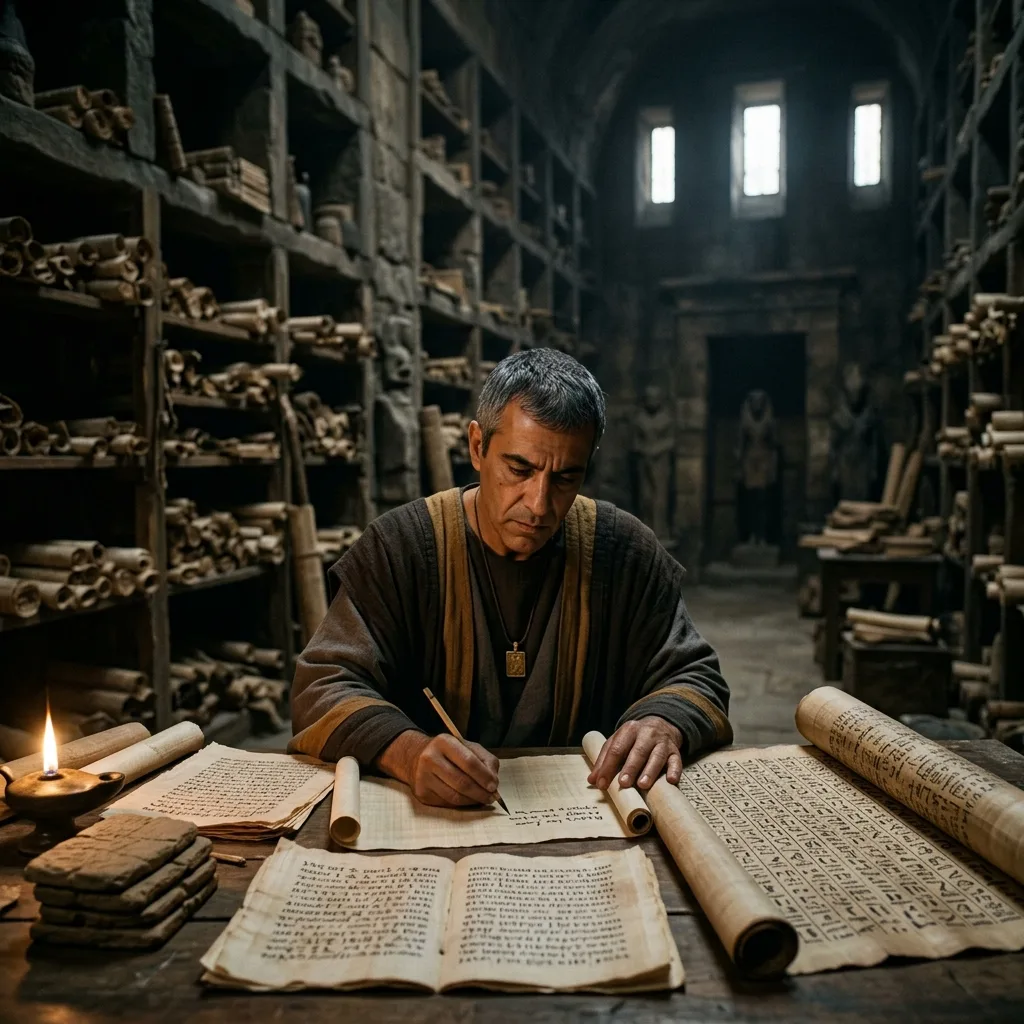
Manetho was an Egyptian priest from Sebennytos who lived during the early Ptolemaic Kingdom. He wrote the "Aegyptiaca" (History of Egypt), a massive chronical written in Greek that organized Egyptian history into the dynasties (Old Kingdom, Middle Kingdom, New Kingdom) we still use today.
Open in interactive timeline →Key Numbers
- Dynasties defined
- 30 (sometimes 31)
- Written under
- Ptolemy I & II
- Composed
- c. 300-250 BC
- Language
- Greek
- Original survives
- 0% (fragments only)
Verified Facts
- Manetho was a native Egyptian priest from Sebennytos in the Nile Delta who, according to George Syncellus, served as a chief priest, traditionally associated with the sun-cult at Heliopolis; he was literate in both Egyptian and Greek and drew on temple archives, annals, and king lists.
- His major work, the Aegyptiaca ('Egyptian Matters'), was a history of Egypt written in Greek and composed during the reigns of Ptolemy I Soter (304-285 BC) and Ptolemy II Philadelphus (285-246 BC), placing its composition roughly between 300 and 250 BC.
- Manetho's lasting innovation was dividing Egypt's rulers into 30 numbered dynasties (a 31st, covering the second Persian occupation, was added in some versions) running from the legendary first king down to the conquest of Alexander the Great, a framework Egyptologists still use today.
- He effectively gave the world the term 'dynasty,' adapting the Greek word dynasteia ('governmental power' or 'rule') to designate groups of rulers sharing a common origin or seat of power.
- Not a single copy of the original Aegyptiaca survives; the entire work is known only through fragments, quotations, and abridged epitomes preserved by much later writers, so everything we have is at best copies of copies.
- The earliest substantial narrative fragments come from the Jewish historian Flavius Josephus, who quoted Manetho in Against Apion (c. 94 AD), preserving accounts such as the Hyksos invasion and a story of expelled lepers.
- The dynastic king-lists themselves reach us mainly through Christian chronographers: Sextus Julius Africanus (c. 221 AD), Eusebius of Caesarea (c. 325 AD), and the Byzantine monk George Syncellus (c. 800 AD), whose figures often disagree, with Africanus generally giving longer reign-lengths than Eusebius.
- According to the later epitomes, the Aegyptiaca was organized into three books or volumes, though this division may reflect the abridgers rather than Manetho's original structure, which could have been considerably longer.
- Before the human kings, Manetho's history described prior ages ruled by gods, demigods, and spirits of the dead; in versions preserved through Eusebius the divine first dynasty begins with Hephaestus (the Egyptian Ptah) and Helios (Ra), with the gods assigned vast reign-spans of many thousands of years.
- Josephus seized on Manetho's account of the Hyksos, the foreign 'shepherd-kings' who ruled Egypt before the 18th Dynasty, arguing that these expelled foreigners were the ancestors of the Israelites, an interpretation that made Manetho a battleground for debates over biblical history.
The World at This Moment
Manetho wrote in the first decades of the third century BCE, in the turbulent generation after Alexander's death (323 BCE) when his marshals carved up the empire. Egypt fell to Ptolemy I Soter, and Manetho served under him and Ptolemy II Philadelphus (285–246 BCE), as Alexandria became the Mediterranean's pre-eminent center of Greek learning, home to the Museum and the nascent Library. His work belongs to a recognizable Hellenistic moment: almost simultaneously the Babylonian priest Berossos composed his Greek Babyloniaca (c. 281 BCE), dedicated in the context of Antiochus I's Seleucid accession. In the same era the Hebrew scriptures were reportedly being translated into Greek (the Septuagint tradition, linked to Philadelphus), Euclid systematized geometry, and Greek and Near Eastern intellectual worlds were colliding under Macedonian rule. Manetho thus stands among a cohort of indigenous literati translating ancient temple traditions into the conqueror's tongue, at the dawn of the cosmopolitan Hellenistic age that reshaped the eastern Mediterranean.
The Paradigm Shift
Manetho's lasting contribution was structural: he organized roughly three millennia of pharaonic rulers into thirty (in some witnesses thirty-one) numbered dynasties, running from the legendary first king Menes to Alexander's conquest. This dynastic scaffolding, transmitted only in fragments and epitomes by Josephus, Sextus Julius Africanus, Eusebius, and the Byzantine chronographer George Syncellus, became the indispensable backbone of modern Egyptian chronology. Egyptologists still speak of the Eighteenth Dynasty or the Old, Middle, and New Kingdoms using categories ultimately descended from his scheme; his framework lets archaeological, epigraphic, and astronomical evidence be slotted into a continuous sequence. Beyond chronology, the Aegyptiaca pioneered a genre: a native priest using Greek historiographic form to present his own civilization's deep past to a Hellenistic readership, drawing on temple archives, king-lists, and hieroglyphic inscriptions inaccessible to Greek writers like Herodotus. Manetho effectively translated indigenous Egyptian historical memory into the international scholarly language of the age, fixing the long-term shape of how Egypt's past is periodized.
In Their Own Words
"There was a king of ours whose name was Timaus. Under him it came to pass, I know not how, that God was averse to us, and there came, after a surprising manner, men of ignoble birth out of the eastern parts, and had boldness enough to make an expedition into our country, and with ease subdued it by force, yet without our hazarding a battle with them." — Manetho, Aegyptiaca (on the Hyksos invasion), as quoted by Flavius Josephus, Against Apion (Contra Apionem) I.14, in William Whiston's translation; Manetho's original work survives only in such fragments.
In Depth
The Priest Who Counted the Pharaohs
When Manetho, an Egyptian high priest at Heliopolis, sat down around 280 BC to write a history of his own civilization in Greek, he was performing one of the strangest and most consequential acts of cultural translation in the ancient world. The result, the Aegyptiaca, gave us the very scaffolding we still use to think about Egypt's three-thousand-year past: its division into thirty dynasties of kings. Every time a modern textbook speaks of the "Eighteenth Dynasty" or the "Old Kingdom," it is speaking Manetho's language.
A Conquered Memory Speaking to Its Conquerors
Manetho's work was a child of empire. A generation earlier, Alexander the Great (sv-alexander) had swept through Egypt, and on his death his general Ptolemy seized the country, founding the dynasty whose Ptolemaic Kingdom (sv-ptolemaic) would rule from Alexandria for three centuries. The new Greek overlords governed a land whose monuments — the Great Pyramids of Giza (sv-pyramids) — were already older to them than Rome's ruins are to us. To rule Egypt, the Ptolemies needed to understand it, and so, tradition holds, Ptolemy II Philadelphus commissioned Manetho to render Egypt's past legible in Greek.
This is the deep precondition of the Aegyptiaca: a literate temple priesthood sitting atop millennia of king-lists and annals, suddenly meeting a Greek historiographical appetite first whetted by Herodotus (sv-herodotus), who had toured Egypt and marveled at it two centuries before. Manetho mediated between two worlds — the hieroglyphic temple archive and the Greek prose book — at the same Alexandrian moment that produced the Great Library of Alexandria (sv-library-alexandria) and Euclid's geometry (sv-euclid). He was a native voice in a foreign tongue, and he was not alone: in Babylon, the priest Berossus was doing exactly the same thing, writing a Babyloniaca in Greek for the rival Seleucid Empire (sv-seleucid). The Hellenistic age had invented a new genre — the conquered civilization explaining itself to its conqueror.
Chronology as a Weapon and a Gift
Manetho's deeper achievement was time itself. By arranging Egypt's rulers into a continuous, numbered sequence, he created a chronological spine that later writers hung world history upon. This had explosive afterlives he never imagined. Christian chronographers — Julius Africanus, and especially Eusebius of Caesarea (sv-eusebius) — mined Manetho to synchronize biblical events with Egyptian and Greek timelines, building the framework that would dominate Western dating until the modern era.
Manetho's other long shadow falls on the Bible. His account of the "Hyksos" expulsion and of a renegade priest named Osarsiph became, in the hands of Josephus (sv-josephus) in Against Apion, one of antiquity's first polemical engagements with the Exodus story. Indeed, the scholar Russell Gmirkin has argued that the Pentateuch may itself respond to, or even depend on, the Hellenistic histories of Manetho and Berossus — making this Egyptian priest an unexpected participant in the formation of Jewish scripture, the same scripture whose Second Temple (sv-second-temple) would fall under Rome.
Fragments and Permanence
The cruel irony is that the Aegyptiaca itself is lost. We possess it only as quotations embedded in Josephus, Africanus, Eusebius, and the Byzantine monk Syncellus — a text surviving as the negative space inside other books. Yet its bones outlasted its body. When modern Egyptology arose and scholars began deciphering hieroglyphs after the printing press (sv-printing-press) had already spread Eusebius's tables across Europe, they found Manetho's dynastic count broadly confirmed by the stones. A single priest's act of remembering, performed in a borrowed language for a foreign king, became the permanent grammar of an entire civilization's history.
Causes & Consequences
What led to it
- Egypt's native temple scribal tradition had maintained king lists for millennia, including the Old Kingdom Royal Annals (the Palermo Stone) and the New Kingdom Turin Royal Canon, giving Manetho documentary chronological sources to draw on.
- As a priest connected to the temple cults (associated with Heliopolis and the cult of Serapis), Manetho had privileged access to Egyptian religious archives and the ability to read the hieratic and hieroglyphic records that ordinary Greeks could not.
- The conquest of Egypt by Alexander the Great and the establishment of the Greek-speaking Ptolemaic dynasty created a ruling class that wanted Egypt's deep past explained to them in their own language and idiom.
- The founding of the Library and Museion at Alexandria under Ptolemy I and Ptolemy II created an institutional appetite for collecting and translating the knowledge of subject peoples into Greek.
- Koine Greek had become the lingua franca of the eastern Mediterranean, making it the natural language for a learned Egyptian to reach an international Hellenistic audience.
- The roughly contemporary precedent of the Babylonian priest Berossus, who wrote a Greek-language Babyloniaca for the Seleucid court around 290-278 BCE, established the genre of a native priest presenting his nation's history to Greek rulers.
What it set in motion
- Manetho's grouping of the pharaohs into thirty (or thirty-one) dynasties remains the fundamental organizing framework that Egyptologists still use today to structure the entire span of pharaonic history.
- The very word 'dynasty' as a unit of royal succession entered historical vocabulary through Manetho's scheme and is now applied far beyond Egypt.
- Because the original Aegyptiaca was lost, its survival depended on later quotation, so its dynasty tables were transmitted through Josephus, Sextus Julius Africanus, Eusebius, and George Syncellus, feeding directly into Christian and Byzantine world-chronicle traditions.
- Josephus mined Manetho's account of the Hyksos and the Osarseph story in Against Apion, embedding Manetho at the center of long-running debates over the historicity and dating of the biblical Exodus.
- When hieroglyphs were deciphered, Champollion and later scholars cross-checked cartouches such as Ramesses and Thutmosis against Manetho's named kings and dynasties, so his list helped anchor the new science of Egyptology to real monuments.
- Manetho's reign-lengths and dynastic sequence still serve as a skeleton that modern chronologists test, correct, and supplement with archaeological, astronomical, and inscriptional evidence rather than discard.
The Live Academic Debate
A live debate concerns the purpose and intellectual character of the Aegyptiaca. One view, associated with Peter Green's caricature of "imperial bootlicking," casts Manetho and Berossos as flattering native servants writing to legitimate their Macedonian masters. Ian Moyer (Egypt and the Limits of Hellenism, 2011) pushes hard against assimilationist readings, arguing Manetho's work "owed little to Greek historiography" and was largely the product of indigenous Egyptian historical traditions, asserting native priestly authority rather than Hellenizing capitulation. John Dillery (Clio's Other Sons, 2015) occupies a mediating position: Manetho and Berossos responded to the shared shock of Macedonian conquest by adapting Greek historiographic form to project their peoples' antiquity to Greek audiences while preserving each civilization's integrity. Adjacent controversies concern textual reliability—reconciling the divergent reign-figures of Africanus (generally longer) and Eusebius (shorter), and the role of Felix Jacoby's fragment-collecting on editions like Verbrugghe and Wickersham's. Russell Gmirkin further uses Manetho to argue for a late, Hellenistic dating of Pentateuchal sources, a sharply contested thesis.
How This Event Connects
The historiographical legacy of Manetho and his Aegyptiaca is inextricably bound to the broader phenomenon of Hellenistic cultural translation, serving as a profound counterpart to the historiographical traditions inaugurated by Herodotus. While Herodotus is classically lauded as the "Father of History" in the Greek tradition, Manetho's project was driven by an explicit desire to correct the perceived arrogant errors of Hellenic chroniclers. By weaponizing Greek historiographical methodologies and writing in the language of the Ptolemaic conquerors, Manetho asserted the superior antiquity and cultural primacy of indigenous Egyptian civilization. This dynamic fundamentally challenges older colonial paradigms that viewed such native informants as mere imperial flatterers, repositioning Manetho as an active cultural mediator who utilized syncretism—such as his role in the formulation of the Serapis cult—to negotiate power within a dominant foreign regime.
This paradigm of the elite native informant leveraging imperial language to preserve and defend indigenous identity finds a striking parallel in the later work of Flavius Josephus. Both Manetho and Josephus operated in the fraught space between a conquered ancient culture and a dominant Greco-Roman overlord. Interestingly, it is through Josephus's polemical works that the most controversial fragments of Manetho survive, specifically the anti-Exodus "Osarseph narrative." Both historians thus embody the complex, often contradictory necessities of writing apologetic national histories under the constraints of imperial patronage, where ancient religious and dynastic traditions had to be made intelligible—and respectable—to a Hellenistic or Roman audience.
Furthermore, Manetho’s context within the Ptolemaic kingdom mirrors the complex cultural synthesis occurring simultaneously in the Seleucid Empire. Just as Manetho sought to integrate Egyptian chronologies with Greek historiography, the Seleucids integrated Achaemenid administrative structures and Babylonian theological frameworks to legitimize their rule. In both the Ptolemaic and Seleucid spheres, the simplistic binary of "Greek versus Native" is dismantled by the reality of profound structural syncretism. Manetho's Aegyptiaca is not merely an isolated chronological list, but a vital intellectual artifact of a Mediterranean world where ancient near-eastern traditions actively shaped, rather than passively received, Hellenistic cultural dominance.
The Counterfactual
Had Manetho never written, Egyptian chronology would rest far more heavily on the surviving native king-lists, the Turin Royal Canon, the Palermo Stone, the Abydos and Saqqara lists, plus Herodotus and inscriptional data. Modern scholars would likely still have constructed a workable sequence, but without the convenient dynastic numbering that organizes the field; the very vocabulary of dynasties is Manetho's gift. The losses would be greatest for periods thinly attested in stone, where Manetho's reign-lengths and dynastic groupings supply a framework even when corrupt. Equally, the broader Hellenistic experiment of native priests writing apologetic histories in Greek might look impoverished: Manetho and Berossos together define that phenomenon, and without Manetho the comparative study of indigenous responses to Macedonian rule would lose its Egyptian pole. Josephus's polemics in Contra Apionem, which quarry Manetho for the Hyksos and an anti-Jewish exodus tradition, would also lack their target, reshaping later debates about biblical and Egyptian intersections. The contingency is real but bounded: the data largely survives; the organizing schema would not.
Myth vs. Reality
Myth: We still have Manetho's Aegyptiaca — it's the ancient book historians read to reconstruct Egyptian history.
Reality: No copy of the Aegyptiaca survives. The work is lost, and we know it only through quotations, summaries, and a condensed epitome preserved by much later writers — the Jewish historian Josephus (1st century AD), the Christian chronographers Sextus Julius Africanus (early 3rd century) and Eusebius (4th century), and George Syncellus (around 800 AD). These sources frequently contradict one another, give different reign lengths and king names for the same dynasties, and reflect centuries of copying errors and editorial alteration, so what reaches us is a fragmentary, secondhand skeleton rather than Manetho's actual text.
Myth: Manetho's 'dynasties' are royal families defined by bloodline, the way we use the word today.
Reality: Manetho's grouping into dynasties does not consistently track family descent. Scholars note he appears to have started a new dynasty wherever he perceived a discontinuity — a change in the ruling city or seat of power, a shift in the political center, or a break in tradition — not strictly a change of lineage. Some divisions look schematic rather than historical: the split between the 1st and 2nd Dynasties, for example, is widely regarded as artificial. The modern genealogical sense of 'dynasty' is read back onto a framework Manetho built on different, partly geographic and partly traditional, criteria.
Myth: Adding up Manetho's reign lengths gives a reliable absolute chronology of Egypt.
Reality: Manetho's figures cannot simply be summed into a trustworthy timeline. The reign lengths transmitted by Africanus and Eusebius often diverge sharply from each other and from the monuments — Africanus's totals for the 4th and 5th Dynasties, for instance, run more than a century beyond what archaeology supports. A further problem is that some of Manetho's dynasties were not strictly sequential: several were regional houses ruling different cities simultaneously (notably in the Intermediate Periods), so treating every dynasty as following the last inflates the total. Egyptologists therefore anchor chronology in contemporary records, astronomical data, and archaeology, using Manetho mainly for his dynastic skeleton.
Myth: Manetho himself identified the Hebrew Exodus with the expulsion of the Hyksos and equated Moses with the figure Osarseph.
Reality: It was Josephus, not Manetho, who argued that Manetho's expelled 'Shepherds' (Hyksos) were the Israelites of the Exodus; Manetho's own text drew no such connection. Many scholars further hold that the gloss identifying Moses with Osarseph — the leader of the lepers and impure in the second, polemical tale — was a later interpolation rather than Manetho's own words. The Hyksos expulsion belongs to roughly the 16th century BCE, and the Osarseph story blends memories of the Hyksos, the Amarna period, and later anti-Jewish polemic; conflating all of this into a single Manethonian 'Exodus account' misreads how the material was layered and transmitted.
Myth: The standard list of 31 Egyptian dynasties is exactly the scheme Manetho devised.
Reality: Manetho's Aegyptiaca organized the pharaohs into thirty dynasties, from Menes to the end of native rule. The familiar 31st Dynasty — the second period of Persian (Achaemenid) domination, about 343–332 BCE — was appended by later tradition, not part of Manetho's original thirty. The framework also proved more durable and useful than its details: Champollion leaned on Manetho's dynastic sequence to order royal cartouches while deciphering hieroglyphs, even though many of Manetho's specific names, numbers, and dates have since been corrected or discarded.
Frequently Asked Questions
Who was Manetho?
Manetho was an Egyptian priest and historian from Sebennytos in the Nile Delta who lived during the early Ptolemaic period, around the 3rd century BC. He served under Ptolemy I Soter and Ptolemy II Philadelphus and is associated with the priesthood of the sun god Ra. Literate in both Egyptian and Greek, he drew on temple records, inscriptions, and king-lists to write a history of Egypt for his Greek-speaking rulers.
What is the Aegyptiaca?
The Aegyptiaca ("Egyptian Matters" or "History of Egypt") was Manetho's history of Egypt, written in Greek and dedicated to Ptolemy II Philadelphus. It chronicled the rulers of Egypt from the legendary first king Menes down to the Ptolemaic era. No copy of the original work survives intact; it is known only through fragments and summaries preserved by later writers.
Did Manetho invent the system of 30 dynasties?
Yes. Manetho organized the long line of Egyptian rulers into thirty dynasties (ruling houses), often noting the city or region each family came from, and this framework is still the backbone of Egyptian chronology today. Egyptologists continue to speak of the Old, Middle, and New Kingdoms in terms of his dynasty numbers. Later tradition added a 31st dynasty (the second Persian period) beyond Manetho's original scheme.
How do we know what Manetho wrote if the original is lost?
The Aegyptiaca survives only as quotations and epitomes in later authors. The earliest excerpts appear in the Jewish historian Josephus (1st century AD), and further summaries were preserved by the Christian chronographers Sextus Julius Africanus (3rd century) and Eusebius of Caesarea (early 4th century), later transmitted by the Byzantine monk George Syncellus (around 800 AD). Because these sources copied and condensed Manetho centuries apart, they frequently disagree on names, reign lengths, and totals.
How accurate is Manetho's chronology?
Manetho preserved a genuine native tradition, and his dynastic structure correlates with older Egyptian sources such as the Turin Royal Canon, whose divisions broadly match his. However, his surviving numbers are corrupted by centuries of recopying and a tendency toward inflated reign lengths, so scholars do not treat them as reliable on their own. Modern Egyptology uses a composite approach, combining Manetho's framework with king-lists like the Turin Canon and Abydos list and with archaeological and astronomical evidence.
Why did Josephus link Manetho's Hyksos to the Exodus?
In his work Against Apion, Josephus quoted Manetho's account of the Hyksos, foreign rulers who, after being expelled from Egypt, were said to have crossed to Syria and founded Jerusalem. Josephus seized on this to argue that the Hyksos were the ancestors of the Jews and evidence for the biblical narrative. Most modern scholars reject the equation: the Hyksos were expelled rulers driven out by Ahmose centuries before the traditional Exodus date, not enslaved people fleeing pursuit, and the parallels appear to result from later conflation rather than a single historical event.
Sources & Further Reading
- Aegyptiaca (Manetho) — Wikipedia
- John Dillery, Clio's Other Sons: Berossus and Manetho, with an Afterword on Demetrius (University of Michigan Press, 2015)
- Ian S. Moyer, Egypt and the Limits of Hellenism (Cambridge University Press, 2011)
- Gerald P. Verbrugghe and John M. Wickersham, Berossos and Manetho, Introduced and Translated: Native Traditions in Ancient Mesopotamia and Egypt (University of Michigan Press, 1996)
- W. G. Waddell (ed. and trans.), Manetho, Loeb Classical Library (Harvard University Press, 1940)
- Russell E. Gmirkin, Berossus and Genesis, Manetho and Exodus: Hellenistic Histories and the Date of the Pentateuch (T&T Clark/LHBOTS 433, 2006)
- Wikipedia: Manetho
- World History: Manetho
Cite This Page
AskHistoryAI. “Manetho & The Aegyptiaca.” AskHistoryAI — Interactive Timeline of Everything. Updated 2026-09-11. https://askhistoryai.com/event/sv-manetho/
Every fact on this page is checked against the published fact ledger and methodology; sources are listed above.