Nikola Tesla & Alternating Current
The eccentric wizard who electrified the world.
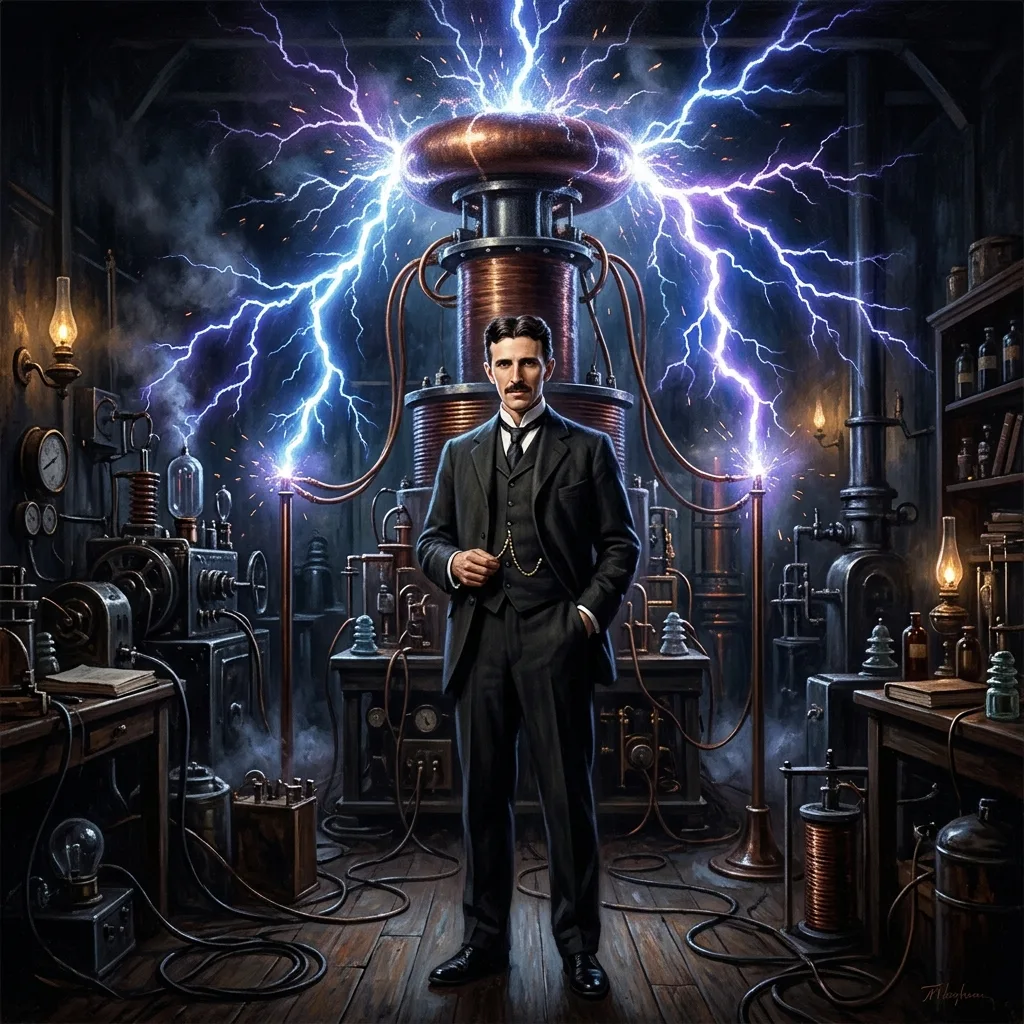
Nikola Tesla successfully demonstrates his Alternating Current (AC) electrical system at the World's Columbian Exposition in Chicago, winning the "War of the Currents" and establishing the foundational technology for the modern global electrical grid.
Open in interactive timeline →Key Numbers
- Westinghouse deal (1888)
- $25K cash + $50K notes + $2.50/hp royalty
- Niagara generators
- 10 units, 5,000 hp each, 25 Hz
- Cash on arrival in U.S.
- 4 cents (1884)
- Niagara-to-Buffalo transmission
- ~22-26 miles, AC (1896)
- 1893 World's Fair bid
- $399K (AC) beat ~$554K DC bid
Verified Facts
- Tesla conceived the rotating magnetic field — the principle behind the AC induction motor — in early 1882 while walking through Budapest's City Park at sunset with his friend Anton Szigeti, reportedly reciting verses from Goethe's 'Faust'; he later said he sketched the design in the dirt with a stick on the spot.
- He arrived in New York in June 1884 with about four cents in his pocket, some of his own poetry, and sketches for a flying machine, carrying a letter of introduction that connected him to Thomas Edison's organization, where he worked briefly before the two split over differences in approach and pay.
- On May 16, 1888, Tesla read his landmark paper 'A New System of Alternate-Current Motors and Transformers' before the American Institute of Electrical Engineers (AIEE) in New York; AIEE papers chairman Thomas Commerford Martin recalled having great difficulty persuading Tesla to present, and that the paper was written hastily the night before.
- Tesla's foundational AC patents — including U.S. Patent No. 381,968 for the 'Electro-Magnetic Motor,' filed October 12, 1887 and granted May 1, 1888 — covered an integrated polyphase system of generators, transformers, transmission, and brushless motors, not merely a single motor.
- In July 1888 George Westinghouse licensed Tesla's polyphase patents; widely cited terms were roughly $25,000 in cash, $50,000 in notes, and a royalty of $2.50 per horsepower of installed motor capacity, and Tesla was hired as a consultant at Westinghouse's Pittsburgh works.
- The AC induction motor's key innovation was eliminating the commutator and brushes used in DC motors: alternating currents offset in phase produce a rotating magnetic field that drags the rotor around, making the design simpler, more reliable, and capable of long-distance power transmission via transformers.
- During the 'War of the Currents,' Edison's camp ran an aggressive fear campaign against AC, publicly electrocuting animals and promoting AC for the first electric chair (used on William Kemmler in 1890) to brand it as deadly — yet AC's efficiency over distance won out.
- By 1897 Westinghouse Electric was financially strained from the currents war and a looming recession; accounts hold that Tesla relinquished his lucrative per-horsepower royalty to save the company, with Westinghouse later paying a lump sum (commonly cited around $216,000) for perpetual rights — a sacrifice that cost Tesla an enormous future fortune.
- The 1893 World's Columbian Exposition in Chicago was a turning point: Westinghouse won the lighting contract with a bid near $399,000 using Tesla's AC system, undercutting the rival General Electric/Edison DC proposal, and lit the fair with roughly hundreds of thousands of lamps as a mass public demonstration of AC's safety and scale.
- The Adams Power Plant at Niagara Falls, built by Westinghouse to designs rooted in Tesla's patents (with engineer Benjamin Lamme), began generating with 5,000-horsepower, 25 Hz polyphase generators in 1895, and on November 16, 1896 first delivered AC power to Buffalo over a transmission line of roughly 22-26 miles — cementing AC as the global standard.
- Tesla was born July 10, 1856 in Smiljan (then Austrian Empire, now Croatia) to a Serbian family and died nearly penniless on January 7, 1943 in room 3327 of the Hotel New Yorker; the polyphase AC system he pioneered remains the basis of electrical grids worldwide.
The World at This Moment
The pivotal years 1887–1893 sit in the high tide of the Second Industrial Revolution. Edison had opened his Pearl Street DC station in 1882; in Europe, Werner von Siemens, Sebastian de Ferranti (Deptford station, 1889), and Galileo Ferraris in Turin were independently pushing electrical power forward. The same moment produced Hertz's experimental confirmation of electromagnetic waves (1887–88) and the consolidation of Maxwellian field theory by Heaviside, Lodge, and FitzGerald. Industrially, the 1890s brought the Niagara Falls hydroelectric project, steel-frame skyscrapers, and the telephone's spread. Politically, the United States was an immigrant-fueled Gilded Age economy of trusts and patent wars; Tesla himself was a Serbian-American emigrant who arrived in New York in 1884. Globally, this was the era of European imperial expansion, the Berlin Conference's aftermath, and Japan's Meiji industrialization. Electrification was becoming the defining infrastructure of modernity, and the contest over whether it would run on direct or alternating current carried enormous economic stakes.
The Paradigm Shift
Tesla's contribution—the polyphase AC system anchored by the rotating-magnetic-field induction motor, covered by seven U.S. patents issued 1 May 1888 and licensed to George Westinghouse that July—resolved the central obstacle to electrification: long-distance transmission. DC could not be efficiently stepped up to high voltage for transmission and back down for use; AC, via transformers, could, but until Tesla had lacked a practical motor. The induction motor, needing no commutator or brushes, made AC a complete generation-transmission-utilization system. Demonstrated at the 1893 World's Columbian Exposition and built out at Niagara Falls (operational 1895–96), it settled the "War of the Currents" against Edison's DC. The paradigm shift was infrastructural: it enabled the centralized power grid, decoupled factories from rivers and steam, and made universal electrification economically feasible. Carlson argues Tesla reframed the problem from incremental device-tinkering to systemic design. The polyphase AC standard Tesla helped establish remains the backbone of global electrical grids today.
In Their Own Words
"The idea came like a flash of lightning and in an instant the truth was revealed." — Nikola Tesla, recalling his 1882 conception of the rotating magnetic field in a Budapest park while reciting Goethe's Faust, in My Inventions: The Autobiography of Nikola Tesla (Electrical Experimenter, 1919)
As I uttered these inspiring words the idea came like a flash of lightning and in an instant the truth was revealed. I drew with a stick on the sand the diagrams shown six years later in my address before the American Institute of Electrical Engineers, and my companion understood them perfectly.
Nikola Tesla, in his own words, describing his 1882 conception of the rotating magnetic field (the basis of his AC induction motor) while walking in a Budapest park. From his autobiography 'My Inventions,' first published in Electrical Experimenter magazine, 1919. — source
Just as certain as death Westinghouse will kill a customer within six months after he puts in a system of any size.
Thomas Edison, in a private letter to his associate Edward Johnson, November 1886, attacking Westinghouse's alternating-current system. Reported and quoted in Maury Klein, 'The Power Makers' (2010), p. 257; also cited by Smithsonian Magazine. Edison's own words (private correspondence), not a public statement. — source
The alternating current will kill people, of course. So will gunpowder, and dynamite, and whisky, and lots of other things; but we have a system whereby the deadly electricity of the alternating current can do no harm unless a man is fool enough to swallow a whole dynamo.
George Westinghouse, defending the safety of alternating current (c. 1884). As quoted in his biographer Francis E. Leupp, 'George Westinghouse: His Life and Achievements' (1918), p. 149. This is a later biographer reporting Westinghouse's words; sources vary on the exact date/occasion. — source
In Depth
The Spinning Field: How a Rotating Idea Wired the Modern World
Nikola Tesla's alternating-current system is the moment when electricity stopped being a laboratory marvel and became the circulatory system of civilization. Its preconditions reach back through the whole physics of the nineteenth century. The phenomenon Tesla harnessed — that a changing magnetic field induces a current — was discovered by Michael Faraday (sv-michael-faraday) in 1831, and the mathematics that let engineers calculate how those fields behave in motors and transformers came from James Clerk Maxwell (sv-james-maxwell), whose equations Tesla studied as a student. Further back still lies the playful kite-and-key empiricism of Benjamin Franklin (sv-benjamin-franklin), who first dragged electricity into the realm of the knowable. Tesla's genius was synthetic rather than foundational: around 1882 he conceived the rotating magnetic field, produced by feeding two or more currents offset in phase into coils set at right angles. This polyphase trick solved the problem that had stumped everyone — how to make alternating current spin a motor smoothly — and he patented it in 1888.
From insight to infrastructure. The deep significance of AC is economic and geographic. Direct current, the system championed by Thomas Edison (sv-thomas-edison), could practically travel about a mile before losses crippled it, forcing a power station onto nearly every block. Alternating current could be stepped up to high voltage, sent hundreds of miles, then stepped back down. That single property is the reason a waterfall could light a distant city. When George Westinghouse bought Tesla's polyphase patents in 1888, the stage was set for the so-called War of the Currents — a struggle that was, beneath the propaganda, settled by physics and arithmetic. The decisive proofs came fast: Westinghouse lit the 1893 Chicago World's Columbian Exposition with Tesla's system, and in November 1896 power generated at Niagara Falls flowed to Buffalo, demonstrating long-distance transmission at scale.
The amplifier of the Industrial Revolution. Tesla's grid did not begin the machine age — the Industrial Revolution (sv-industrial-revolution) was already a century old, powered by steam and coal. What AC did was unbind power from place. A factory no longer had to sit beside a river or a coal seam; it could draw energy down a wire. This decentralization of motive force reshaped cities, labor, and the home, and it made possible the assembly-line abundance soon realized by Henry Ford (sv-henry-ford), whose moving lines ran on electric motors descended directly from Tesla's induction design.
Ripples toward the present. The arc from Tesla runs straight into our own era. Every server farm humming behind the World Wide Web (sv-www), every GPU cluster that trained AlexNet (sv-alexnet-convnets) and ignited the deep-learning revolution, draws on alternating-current grids whose architecture Tesla fixed in the 1890s. The artificial-intelligence ascent — and the energy-hungry projections of thinkers like Kurzweil's Law of Accelerating Returns (sv-kurzweil-law) — presupposes cheap, abundant, transmissible electricity. In a real sense, the rotating field that Tesla pictured while pacing a Budapest park in 1882 is the substrate on which the climb toward machine intelligence now runs.
The shape of the inventor. Tesla also crystallized a modern archetype: the visionary engineer whose imagination outruns his finances and whose name becomes a byword for the future. He tore up his Westinghouse royalty contract to save the company, and died in relative poverty in 1943 — a reminder that the people who lay civilization's deepest infrastructure are not always its chief beneficiaries. Yet his fingerprint is inescapable. The SI unit of magnetic flux density bears his name, and so, a century later, does the world's most famous electric carmaker. Tesla took the abstract field-theory of Faraday and Maxwell and made it turn a shaft — and that turning has not stopped since.
Causes & Consequences
What led to it
- Michael Faraday's 1831 discovery of electromagnetic induction proved that a changing magnetic field induces an electric current, supplying the fundamental physical principle on which every AC generator, transformer, and induction motor would later depend.
- James Clerk Maxwell's mathematical formulation of electromagnetism in the 1860s gave the changing-field phenomena a rigorous theoretical framework, letting engineers reason quantitatively about alternating currents rather than relying on intuition alone.
- The 1885 ZBD transformer of Hungarian engineers Ottó Bláthy, Miksa Déri, and Károly Zipernowsky introduced an efficient closed-iron-core design that could step AC voltage up for transmission and down for use, making long-distance AC distribution practical and roughly 3.4 times more efficient than the earlier open-core Gaulard-Gibbs device.
- Galileo Ferraris independently conceived and demonstrated the rotating magnetic field in 1885, using two stationary coils fed by currents phase-shifted ninety degrees, establishing that the very effect Tesla would harness was a discoverable feature of polyphase AC.
- George Westinghouse's purchase of the Gaulard-Gibbs patents in 1886 and his assignment of William Stanley to build a working American AC lighting system created an industrial sponsor already committed to alternating current, providing the capital and manufacturing base Tesla's motor would need.
- Tesla's own conception of the polyphase rotating magnetic field, which he reduced to practice and patented in May 1888 with a motor that needed no commutator or brushes, was the immediate technical breakthrough that turned AC from a lighting curiosity into a complete motive-power system.
What it set in motion
- George Westinghouse licensed Tesla's polyphase patents and paid him roughly $65,000 for the manufacturing rights, building the first commercial AC induction motors in 1888 and giving the alternating-current camp a decisive technical edge in the commercial market.
- Tesla's AC system won the 'War of the Currents' against Edison's direct current, demonstrated spectacularly when Westinghouse underbid General Electric to illuminate the 1893 Chicago World's Columbian Exposition with hundreds of thousands of AC-powered lamps.
- The Niagara Falls hydroelectric project, awarded to Westinghouse using Tesla's polyphase patents, began transmitting AC power to Buffalo, New York in 1896, proving that electricity could be generated centrally and delivered economically over long distances.
- Tesla's polyphase principles became the global standard for electrical grids, so that today's worldwide power system, built on three-phase AC transmission and transformer voltage conversion, operates fundamentally according to the architecture he established in the 1880s and 1890s.
- The AC induction motor became one of the most ubiquitous machines on Earth, quietly running refrigerator compressors, washing machines, air conditioners, pumps, fans, and factory conveyors in homes and industry more than a century after its patent.
- Modern electric vehicles revived Tesla's exact design, with the company that bears his name using AC induction motors in its early cars, illustrating how a nineteenth-century invention remains central to twenty-first-century transportation.
The Live Academic Debate
The sharpest debate concerns priority and the "lone genius" myth. A long tradition, amplified by popular culture, credits Tesla as the singular inventor of the rotating magnetic field. Italian scholarship and the IEEE (which in 2021 recognized Ferraris's theoretical priority) counter that Galileo Ferraris independently demonstrated the principle by 1885; the recent IEEE study "Galileo Ferraris Versus Nikola Tesla" (2025) reframes attribution as theory (Ferraris) versus industrial realization (Tesla). W. Bernard Carlson's Tesla: Inventor of the Electrical Age (2013) deliberately demystifies Tesla, situating him within networks of capital, patent strategy, and self-promotion rather than isolated brilliance, and emphasizes his "ideal" rather than experimental method. Against more hagiographic accounts (Margaret Cheney; Marc Seifer), Carlson and historians of technology like Thomas Hughes (Networks of Power) treat electrification as a systems phenomenon in which no single inventor is decisive. A subsidiary debate questions how much the dramatic Edison-versus-Tesla "War of the Currents" narrative distorts a more incremental engineering and corporate history.
How This Event Connects
Nikola Tesla’s position in the history of science is deeply paradoxical, suspended between rigorous electrical engineering and pervasive techno-mythology. The foundational dialectic of his career was his relationship and subsequent rivalry with Thomas Edison. Historiographically, this conflict is no longer viewed simply as the "War of the Currents," but as a profound clash of paradigms: Edison’s pragmatic, financially integrated "system building" versus Tesla’s visionary, yet often commercially unviable, conceptual leaps. Tesla’s inability to adapt to the aggressive realities of Gilded Age corporate capitalism ultimately led to his historical marginalization during his own lifetime.
Tesla’s actual engineering triumphs were fundamentally rooted in the classical physics of James Clerk Maxwell. Tesla mathematically translated Maxwell's equations of electromagnetic fields into physical realities, most notably through alternating current induction motors. However, Tesla’s strict adherence to 19th-century mechanical aether models caused him to violently reject the relativistic universe proposed by Albert Einstein. Historians analyze Tesla’s philosophical isolation as an epistemological tragedy; his refusal to accept curved spacetime and quantum mechanics rendered him an archaic figure in the very field he helped construct.
In the 21st century, the historiography of Tesla has been entirely hijacked by internet culture and the discourse surrounding The Singularity Is Near. Tesla has been posthumously drafted as the ultimate mascot for Silicon Valley disruption and Transhumanist techno-utopianism. The modern "Cult of Tesla" weaponizes his unproven theories of wireless power to construct pseudo-scientific narratives of suppressed "free energy," illustrating how his historical reality as a flawed but brilliant engineer has been overwritten by the eschatological desires of the modern technological age.
Edison as principled rival, not cartoon villain (revisionist history of science)
The scholarly Thomas A. Edison Papers project at Rutgers University argues that the popular 'War of the Currents' narrative — Edison the electrocuting propagandist versus Tesla the martyr — flattens a more complicated reality. The essay holds that while some of Edison's opposition to AC was 'plainly self-serving,' he also acted on 'principled beliefs' about real high-voltage public-safety hazards (New York City suffered at least five overhead-line deaths in late 1889 alone) and pushed for municipal regulation of unsafe, unregulated utilities. It further notes that the gruesome animal electrocutions and the Kemmler electric-chair episode were largely orchestrated by Harold P. Brown and the Edison lighting interests rather than directed personally by Edison, and that AC ultimately won on economic and technical merit — a case of technological inevitability rather than simple villainy.
The Counterfactual
Had Tesla never patented and licensed his polyphase system, AC electrification would likely still have arrived, but more slowly and via different actors. Galileo Ferraris had independently conceived the rotating magnetic field by 1885 (publishing 1888) yet declined to patent it, treating it as a scientific result; without Tesla's patents and Westinghouse's commercial drive, the practical induction motor might have emerged later from European laboratories—Ferraris, the Dolivo-Dobrovolsky three-phase work at AEG (the 1891 Lauffen-Frankfurt transmission), or Westinghouse's own engineers. Historians like W. Bernard Carlson stress that Tesla's specific genius lay less in lone discovery than in furnishing patents robust enough to anchor a system and a celebrity narrative that mobilized capital. A delayed AC standard could have prolonged DC's dominance in urban cores, fragmenting early grid standards. The deeper counterfactual is modest: the rotating field was "in the air," so the outcome was probably overdetermined, but its timing, the speed of Niagara-scale transmission, and the eventual global standardization on polyphase AC plausibly hinged on the Tesla–Westinghouse alliance.
Myth vs. Reality
Myth: Nikola Tesla invented alternating current.
Reality: AC predates Tesla by decades. Hippolyte Pixii built the first alternator producing alternating current around 1832, building on Faraday's and Henry's discovery of electromagnetic induction, and AC technology was developed throughout the 19th century. What Tesla actually contributed was a practical polyphase AC induction motor and a complete polyphase system (patented 1888). Even there, Italian physicist Galileo Ferraris independently devised an AC induction motor and published on it in 1888, and the transformers that made AC commercially viable came from Europeans like Lucien Gaulard and the Hungarian team of Zipernowsky, Blathy, and Deri. Tesla's genius lay in engineering and realizing AC's potential, not in inventing AC itself.
Myth: The 'War of the Currents' was a personal duel between Tesla and Edison.
Reality: The commercial and legal battle of the late 1880s was primarily between two companies and their investors: Edison's electric-light companies (later Edison General Electric) and George Westinghouse's Westinghouse Electric. Tesla's role was as the inventor whose AC motor patents Westinghouse licensed. Historians note there is no record that Tesla and Edison ever actually met during this period, and the intense personal rivalry depicted in popular culture and films like 'The Current War' is largely a modern dramatization. The chief antagonist to Edison was Westinghouse, not Tesla.
Myth: Thomas Edison electrocuted Topsy the elephant to scare people away from Tesla's AC.
Reality: Topsy was killed at Coney Island's Luna Park on January 4, 1903, by her owners after she had killed handlers, using a combination of poison, strangulation, and electrocution. This was roughly a decade after the War of the Currents had effectively ended, so it had nothing to do with discrediting AC. The Edison Manufacturing Company filmed the event, but according to the Thomas Edison Papers project at Rutgers, no surviving Edison correspondence links Edison himself to ordering or staging the killing. The popular claim that 'Edison electrocuted an elephant to smear Tesla' conflates a film credit with personal authorship.
Myth: Edison personally invented the electric chair to make AC look deadly.
Reality: Edison did wage a propaganda campaign against AC, including publishing alarmist pamphlets and quietly funding animal electrocutions. But the electric chair itself was developed by Harold P. Brown, an electrical contractor whom Edison supported behind the scenes, and it was adopted by New York State, which carried out the first execution of William Kemmler on August 6, 1890. Edison lent his prestige and laboratory to the effort and testified in favor of the method, but he did not invent the chair himself. Notably, Westinghouse funded Kemmler's legal appeal against the practice.
Myth: Tesla would have become the world's first billionaire if he hadn't torn up his Westinghouse royalty contract, and AC made him rich.
Reality: The 'billionaire' figure is an internet-era exaggeration. Tesla did relinquish his per-horsepower royalty rights when Westinghouse Electric was in financial distress, and according to Margaret Cheney's biography 'Tesla: Man Out of Time,' Westinghouse's 1897 annual report records a roughly $216,000 lump-sum payment for outright purchase of his patents, rather than Tesla receiving nothing. Historians estimate the forfeited royalties were worth hundreds of millions in today's dollars, considerable but well short of a billion. Tesla's later poverty stemmed largely from unprofitable projects like Wardenclyffe, not simply from giving up AC riches.
Frequently Asked Questions
Did Nikola Tesla invent alternating current (AC)?
No. Alternating current itself was not invented by any single person; AC phenomena had been studied since the 1830s, building on Michael Faraday's 1831 discovery of electromagnetic induction, and AC transformers were developed by Lucien Gaulard and John Dixon Gibbs in the early 1880s. Tesla's actual breakthrough was the practical polyphase AC induction motor and a complete polyphase system for generating, transmitting, and using AC power. That system, more than AC itself, is what made long-distance electricity practical.
What did Tesla actually contribute to alternating current?
Tesla's key contribution was the AC induction motor, which used a rotating magnetic field created by multiple out-of-phase alternating currents rather than electrical connections (brushes and commutators) to the rotor. He conceived the rotating magnetic field idea while walking in a Budapest park in 1882 and filed his foundational U.S. patents in 1887-1888. He also developed the broader polyphase system that let transformers step voltage up for efficient transmission and down for safe use.
What was the War of the Currents?
The War of the Currents was the late-1880s and 1890s commercial and public-relations battle between Thomas Edison's direct current (DC) system and the alternating current (AC) system backed by George Westinghouse and based on Tesla's patents. Edison's DC could not transmit power efficiently beyond roughly a mile, while AC could be stepped up to high voltage and sent long distances with little loss. To protect his DC interests, Edison ran a campaign portraying AC as dangerous, including public electrocutions of animals. AC ultimately prevailed.
How did George Westinghouse become involved with Tesla's patents?
After Tesla demonstrated his AC motor at the American Institute of Electrical Engineers on May 16, 1888, George Westinghouse acquired Tesla's AC patents in July 1888 for his electric company. Westinghouse, who was already building an AC transmission business, saw the polyphase induction motor as the missing piece that AC power needed. This partnership put Tesla's technology at the center of the Westinghouse push to electrify America.
What role did Tesla and AC play at Niagara Falls?
In 1893 Westinghouse, using Tesla's polyphase AC system, won the contract to build the hydroelectric power plant at Niagara Falls. The first large generator was successfully tested on April 15, 1895, and on November 16, 1896, power was transmitted to Buffalo, New York, about 26 miles away, lighting streets and running streetcars. It was the first large-scale AC generating plant of its kind in the world and helped settle the War of the Currents in AC's favor.
Why did AC ultimately win out over Edison's DC?
AC won mainly because of efficient long-distance transmission: transformers can step AC up to high voltages that travel far with minimal loss, then step it back down for safe household use, something DC could not do well at the time. The high-profile 1893 Chicago World's Fair contract, which Westinghouse won with an AC bid far cheaper than the DC alternative, and the 1896 Niagara Falls success demonstrated AC's superiority at scale. Even General Electric eventually adopted AC. Today AC and DC coexist, but the AC grid remains the backbone of electricity distribution.
Sources & Further Reading
- Nikola Tesla — Wikipedia
- W. Bernard Carlson, Tesla: Inventor of the Electrical Age (Princeton University Press, 2013)
- Thomas P. Hughes, Networks of Power: Electrification in Western Society, 1880–1930 (Johns Hopkins University Press, 1983)
- Nikola Tesla, 'A New System of Alternate Current Motors and Transformers,' Transactions of the AIEE, Vol. 5 (1888); and My Inventions (1919)
- G. Pagani et al., 'Galileo Ferraris Versus Nikola Tesla: Discovering the Rotating Magnetic Field [History],' IEEE Industry Applications Magazine (2025)
- Jill Jonnes, Empires of Light: Edison, Tesla, Westinghouse, and the Race to Electrify the World (Random House, 2003)
- History: The War of the Currents
Cite This Page
AskHistoryAI. “Nikola Tesla & Alternating Current.” AskHistoryAI — Interactive Timeline of Everything. Updated 2026-09-11. https://askhistoryai.com/event/sv-nikola-tesla/
Every fact on this page is checked against the published fact ledger and methodology; sources are listed above.