Alexander the Great
The violent unification of the East and West.
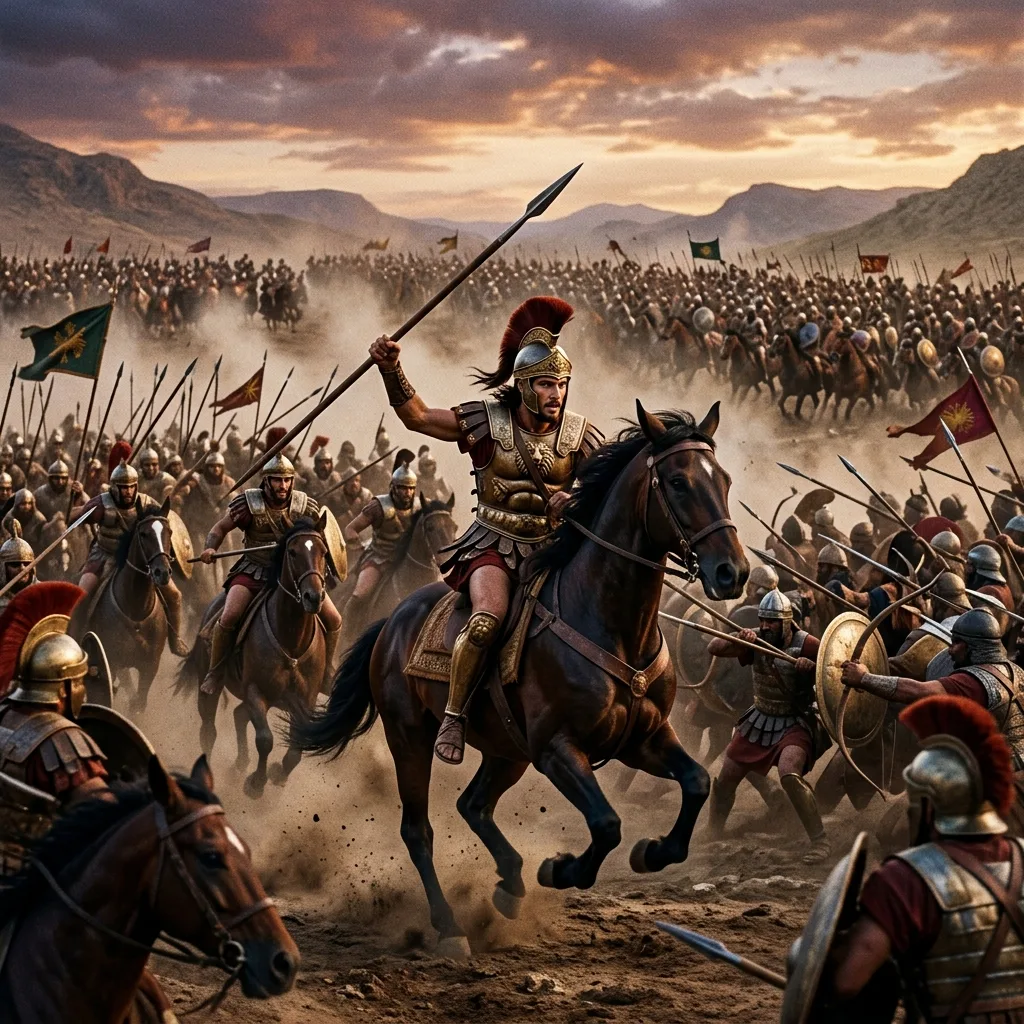
In just 13 years, Alexander conquers the known world from Greece to India. After his sudden death in 323 BCE, his empire fractures into Hellenistic kingdoms that last until the Roman conquest of Egypt in 30 BCE.
Open in interactive timeline →Key Numbers
- Empire at its peak
- ~2 million sq mi
- Years to conquer it
- 11 (334-323 BC)
- Age at death
- 32
- Major battles lost
- 0
- Cities founded
- ~70
Verified Facts
- Alexander III of Macedon became king in 336 BC at age 20 after his father, Philip II, was assassinated at Aegae by his bodyguard Pausanias of Orestis during a celebration; Alexander secured the throne by executing rival claimants.
- As a boy he was tutored by the Athenian philosopher Aristotle, who shaped his lifelong interest in Greek literature, science, and especially Homer's Iliad, a copy of which he reportedly kept with him on campaign.
- His conquests rested on the military reforms of his father Philip II, chiefly the Macedonian phalanx armed with the sarissa, a pike roughly 5 to 7 meters (16 to 23 feet) long that let up to five rows of points project ahead of the front rank.
- At the Battle of Gaugamela on October 1, 331 BC near Arbela (modern Erbil, Iraq), Alexander's roughly 47,000 men decisively defeated the far larger army of Darius III, breaking the Achaemenid Persian Empire; Darius fled and was later killed by his own satrap Bessus.
- His seven-month siege of the island fortress of Tyre in 332 BC saw Alexander's engineers build a causeway (mole) out to the city; ancient sources report about 8,000 Tyrians killed and some 30,000 sold into slavery after it fell.
- The Battle of the Hydaspes River in 326 BC against King Porus in the Punjab (modern Pakistan) was Alexander's last great battle, fought against an army that included some 200 war elephants; he won but his exhausted, homesick troops then mutinied and refused to march farther east.
- After the Hydaspes victory Alexander founded the city of Bucephala in honor of his warhorse Bucephalus, who died around that time; the horse, tamed by the young Alexander when he noticed it feared its own shadow, is thought to lie near the modern city of Jhelum.
- Alexander died in Babylon in June 323 BC (June 10 or 11) at age 32 after a fever following a banquet; modern scholarship most often points to malaria or typhoid fever, though poisoning was rumored in antiquity and the true cause remains debated.
- He founded some 70 cities, the most enduring being Alexandria in Egypt (331 BC), which under his successor Ptolemy became the greatest center of Hellenistic learning, home to the famed Library and Museum.
- He left no viable heir, and his generals, the Diadochi ('successors'), fought decades of wars that by about 300 BC split the empire into major Hellenistic kingdoms, chiefly Ptolemy's in Egypt and Seleucus's across Asia, spreading Greek language and culture from the Mediterranean to India.
The World at This Moment
Alexander's campaigns (334–323 BCE) unfolded while Eurasia was densely populated with rival powers. The Achaemenid Persian Empire he toppled under Darius III still stretched from Anatolia to the Hindu Kush. In India, his 326 BCE incursion across the Indus and the Battle of the Hydaspes against Porus coincided with the conditions from which Chandragupta Maurya soon forged the Mauryan Empire (c. 321 BCE); Greek authors knew him as Sandracottus, and Seleucus later ceded eastern provinces to him. In China, the Warring States period (c. 475–221 BCE) saw competing kingdoms a century before Qin unification. Rome was a regional Italian power fighting the Second Samnite War (326–304 BCE), not yet Mediterranean. Carthage dominated the western seas. Aristotle, Alexander's former tutor, was teaching at the Lyceum in Athens, where Demosthenes had resisted Macedonian hegemony. Thus Alexander acted at a hinge moment when no single Eurasian power yet spanned continents.
The Paradigm Shift
Alexander's conquests inaugurated what historians call the Hellenistic age (conventionally 323–31 BCE), restructuring the political and cultural map of the eastern Mediterranean and western Asia. By destroying the Achaemenid Empire and seeding Greek-style poleis—above all Alexandria in Egypt—from the Nile to Bactria, he created conditions for sustained Greek–Near Eastern interchange. Koine Greek became a lingua franca of administration, commerce, and scholarship; Alexandria's Library and Museum became the foremost centers of science, where Euclid, Eratosthenes, and later Aristarchus worked. Religious syncretism flourished (e.g., Serapis, Zeus-Ammon). The successor kingdoms—Ptolemaic, Seleucid, Antigonid—institutionalized monarchy on a scale Greeks had not known, models Rome later inherited. Crucially, this was not one-way "Hellenization": recent scholarship (Pierre Briant) stresses Achaemenid administrative continuities the Macedonians absorbed. Alexander also became an enduring archetype of the world-conqueror, shaping imperial self-fashioning from Caesar and Augustus to medieval Alexander Romance traditions across Persian, Arabic, and European literatures.
In Their Own Words
"For this reason it seems to me that a hero totally unlike any other human being could not have been born without the agency of the deity." — Arrian, Anabasis of Alexander, Book VII, ch. 30 (2nd century CE), his concluding assessment of Alexander
Alexander to Aristotle, greeting. You have not done well to publish your books of oral doctrine; for what is there now that we excel others in, if those things which we have been particularly instructed in be laid open to all? For my part, I assure you, I had rather excel others in the knowledge of what is excellent, than in the extent of my power and dominion.
A letter from Alexander to his tutor Aristotle, as REPORTED (and translated) by Plutarch, Life of Alexander, ch. 7 (John Dryden translation). These are Alexander's words only as quoted by a later author, not a directly preserved document. — source
But Alexander said that he wished to take vengeance on the Persians, in retaliation for their deeds in the invasion of Greece, when they razed Athens to the ground and burnt down the temples. He also desired to punish the Persians for all the other injuries they had done the Greeks. But Alexander does not seem to me to have acted on this occasion with prudence; nor do I think that this was any retributive penalty at all on the ancient Persians.
Arrian, Anabasis of Alexander, Book III, ch. 18, on the burning of the royal palace at Persepolis (E. J. Chinnock translation, 1884). Arrian reports Alexander's stated motive, then adds his own critical judgement. — source
the accursed Alexander, the Roman, who was dwelling in Egypt... he burned them up. And he killed several Dasturs and judges and Herbads and Mobads and upholders of the religion, and the competent and wise of the country of Iran.
Arda Viraf Namah (Ardā Wīrāz Nāmag), ch. 1, a Zoroastrian Middle Persian (Pahlavi) text on the destruction of the Avesta; the Persian/Zoroastrian view of Alexander as a sacrilegious destroyer (translation in C. F. Horne, ed., The Sacred Books and Early Literature of the East, 1917, drawing on the Haug & West / Hoshangji Asa Pahlavi edition). — source
In Depth
The World That Greek Built: Alexander and the First Globalization
In thirteen years a Macedonian king reorganized the map of the known world, and in doing so he set the cultural operating system on which much of the next millennium would run. Alexander III of Macedon came to the throne in 336 BC at twenty, inherited the disciplined army and unified Greece his father Philip II had forged, and in 334 BC crossed into Asia. By his death in Babylon in 323 BC he had toppled the vast Achaemenid Persian Empire and pushed Greek arms to the Indus. The empire shattered almost immediately; the world it created did not.
Deep Preconditions
Alexander was the product of a long convergence. He absorbed his cosmology and method from a single tutor, Aristotle (sv-aristotle), who was himself the student of Plato (sv-plato), making the conqueror a third-generation heir to the intellectual revolution that ran back through the Pre-Socratic philosophers (sv-presocratics) to the very birth of natural inquiry with Thales of Miletus (sv-thales). The political confidence behind Hellenism—the conviction that the Greek polis represented a superior form of life worth exporting—drew on the civic self-awareness forged in the Birth of Democracy in Athens (sv-athenian-democracy) and the cultural memory of the heroic past kept alive by Homer & the Epic Tradition (sv-homer). Alexander famously carried a copy of the Iliad, annotated by Aristotle, and modeled himself on Achilles. The target itself, Persia, was the same imperial colossus whose earlier wars Herodotus, the Father of History (sv-herodotus) had already cast as a clash of Greek freedom against Eastern despotism.
What It Reshaped
Alexander's true legacy was not the empire but the cultural template now called Hellenism. He founded roughly twenty cities bearing his name, seeding Greek language, coinage, gymnasia, and theaters from Egypt to Central Asia. After his death his generals carved the realm into successor kingdoms, chiefly the Ptolemaic Kingdom (sv-ptolemaic) in Egypt and the Seleucid Empire (sv-seleucid) across the old Persian heartland. These states made Greek the lingua franca of administration and learning across the Near East for centuries—the linguistic substrate into which, much later, the Christian Gospels and Philo of Alexandria (sv-philo) would be written. The new cosmopolitan capitals became engines of inquiry: Ptolemaic Alexandria produced the Great Library of Alexandria (sv-library-alexandria), the geometry of Euclid & the Elements (sv-euclid), and a synthesizing scholarship that gathered the Mediterranean's knowledge under one roof. Hellenistic science and mathematics, embodied by figures like Archimedes of Syracuse (sv-archimedes), flowered precisely because Alexander had fused Greek rationalism with Babylonian astronomy and Egyptian craft.
Threads Forward
The Hellenistic world Alexander created was eventually absorbed, kingdom by kingdom, by the rising Roman Republic (sv-roman-republic), which conquered Greece politically but surrendered to it culturally—Roman elites learned Greek, copied Greek art, and adopted Greek philosophy. Through Rome, Hellenism became the shared inheritance of Western civilization, carrying Aristotle's logic and Euclid's geometry forward across the centuries until they were recovered and amplified during the Italian Renaissance (sv-renaissance). Even the modern habit of measuring an individual against the giants of the past owes something to Plutarch & the Parallel Lives (sv-plutarch), who set Alexander beside Julius Caesar as the archetype of world-shaping ambition.
Alexander stands, then, as a hinge: the moment when a regional culture of philosophy and the polis became a continental and intercontinental system. He demonstrated that ideas travel on the backs of armies and merchants, that conquest can be a vector for thought, and that a single generation of integration can reset the categories through which civilizations understand themselves for a thousand years to come.
Causes & Consequences
What led to it
- Philip II of Macedon restructured the Macedonian army around the sarissa-armed pike phalanx and the elite Companion Cavalry (hetairoi), forging the disciplined combined-arms war machine that Alexander would inherit and lead.
- Philip II subdued and unified the Greek city-states under Macedonian hegemony after his victory at Chaeronea in 338 BCE, creating the League of Corinth that gave the Macedonian king command over a combined Greek force.
- The League of Corinth named Alexander hegemon and 'general of the Greeks' for the war against Persia after Philip's assassination, granting him the panhellenic mandate and military authority to invade the Achaemenid Empire.
- A century-old panhellenic ideal of avenging the Persian invasions of Greece during the Greco-Persian Wars gave Alexander's campaign a unifying ideological justification that helped rally Greek support.
- Alexander was tutored in his youth by the philosopher Aristotle, an education that shaped his intellectual outlook and later expressed itself in the botanists, surveyors, and scholars who accompanied his expedition.
- The Achaemenid Persian Empire had grown internally unstable and militarily vulnerable, making its vast but loosely held territories susceptible to a swift and decisive invasion.
What it set in motion
- Alexander's death in 323 BCE without a viable heir triggered the Wars of the Diadochi, in which his generals carved the empire into successor states including Ptolemaic Egypt, the Seleucid Empire, and Antigonid Macedonia.
- His conquests inaugurated the Hellenistic period, an era of cosmopolitan culture blending Greek and local Near Eastern, Egyptian, and Persian elements across the eastern Mediterranean and Asia.
- He founded roughly twenty cities bearing his name, most notably Alexandria in Egypt, which became a leading Mediterranean metropolis and home to the Great Library, the foremost center of ancient learning.
- The mixing of Greeks from many regions in his army and the cities he founded helped spread Koine Greek as the common lingua franca of the Hellenistic world, the language that would later carry the New Testament and the ancestor of modern Greek.
- The Greek-speaking culture of Hellenistic Alexandria produced the Septuagint, the Greek translation of the Hebrew scriptures that made Jewish texts accessible across the Hellenistic world and shaped early Christianity.
- His brief campaign into the northwestern Indian subcontinent seeded centuries of cultural exchange that produced Greco-Buddhist art in Gandhara, fusing Greek sculptural techniques with Buddhist religious imagery.
The Live Academic Debate
A central, still-live debate concerns Alexander's character and aims. The mid-20th-century idealizing portrait of W.W. Tarn—Alexander as visionary promoting a "brotherhood of mankind"—was demolished by Ernst Badian and developed by A.B. Bosworth and Peter Green, who depicted a ruthless, increasingly autocratic conqueror, sometimes invoking comparisons to modern tyrants. N.G.L. Hammond defended a more favorable "King, Commander and Statesman" reading, closer to Tarn's idealism. A second, methodological axis pits source-critical pessimists against optimists: how far can we trust Arrian (drawing on Ptolemy and Aristobulus), versus the "vulgate" tradition of Diodorus, Curtius, and Justin? A third reorientation, led by Pierre Briant, decenters the Greek sources entirely, reading Alexander as "the last of the Achaemenids" who inherited and continued Persian imperial structures rather than inaugurating a purely Hellenic order. These debates also reflect post-colonial reassessments of conquest, empire, and the very category of "Hellenization."
How This Event Connects
The conquests of Alexander the Great (356–323 BCE) fundamentally redrew the geopolitical and cultural map of the ancient world, inaugurating the Hellenistic Age. Tutored by Aristotle, Alexander did not merely conquer the Persian Empire; he actively pursued a policy of syncretism, blending Greek and Oriental cultures. His rapid subjugation of territories stretching from Greece to the Indus Valley dismantled the old, localized city-state model in favor of massive, multicultural empires.
The most profound legacy of Alexander was the widespread dissemination of Koine Greek as the lingua franca of the known world. This linguistic unification allowed for an unprecedented cross-pollination of philosophical, scientific, and religious ideas. The cities he founded, most notably Alexandria in Egypt, became the cosmopolitan incubators for the next several centuries of intellectual advancement, directly leading to the establishment of institutions like the Library of Alexandria and the syncretic environment that would eventually foster early Christianity.
The Persian / Zoroastrian view: Alexander as 'the accursed' destroyer
To Greeks and Romans he was 'the Great,' but Zoroastrian Iran remembered Eskandar as gizistag ('the accursed'), the wrecker who burned the Avesta, extinguished sacred fires and slew the magi. As Kotwal and Kreyenbroek note in the Encyclopaedia Iranica entry 'Alexander the Great ii. In Zoroastrian Tradition,' Sasanian-era texts such as the Ardā Wīrāz Nāmag and the Bundahishn cast him as an agent of Ahriman who scattered the religion's teachings. The historian Touraj Daryaee (Refashioning the Zoroastrian Past: From Alexander to Islam) argues this 'accursed' memory was partly a later literary construction, shaped to explain the loss of Zoroastrian scripture and to demonize a foreign conqueror.
The Counterfactual
Had Alexander not campaigned, or died earlier (he nearly did at the Granicus in 334 and at the Mallian town in 325), the Achaemenid Empire might have persisted longer, delaying or reshaping the diffusion of Greek culture eastward. His actual early death at Babylon in June 323 BCE—without a competent heir, his son Alexander IV posthumous and his half-brother Philip III Arrhidaeus incapacitated—is itself the pivotal counterfactual: a longer reign might have consolidated a unified Greco-Persian empire rather than the fragmentation of the Diadochi Wars (323–281 BCE). A.B. Bosworth cautioned against romanticizing Alexander's "unity of mankind," arguing his rule was coercive and that durable consolidation was unlikely given Macedonian factionalism. Conversely, without the Hellenistic kingdoms, the institutional and cultural matrix Rome later absorbed—and the Greek-speaking eastern Mediterranean within which early Christianity spread—would look markedly different. Most counterfactual claims remain speculative; the firmest inference is that his premature death, not merely his conquests, determined the multipolar Hellenistic outcome.
Myth vs. Reality
Myth: Alexander wept because "there were no more worlds to conquer."
Reality: This famous line appears in no ancient source and is essentially a modern invention, popularized in 20th-century fiction (a 1963 Twilight Zone episode and the 1988 film Die Hard, which misattributes it to Plutarch). The actual passage in Plutarch's Moralia has Alexander weep on hearing the philosopher Anaxarchus argue there are infinite worlds: "Do you not think it a matter worthy of lamentation that when there is such a vast multitude of worlds, we have not yet conquered one?" The sentiment is frustrated ambition amid infinity, not despair at running out of conquests.
Myth: Alexander cut the Gordian Knot with his sword.
Reality: The ancient sources do not agree on how he solved it. Arrian, drawing on Aristobulus, records an alternative in which Alexander simply pulled the linchpin out of the wagon pole, exposing the cord's ends so the knot could be undone without cutting. Arrian himself presents both versions and notes he cannot be certain which is true; the dramatic sword-stroke is only one tradition among several (also in Plutarch, Curtius, and Justin), not an established fact.
Myth: Alexander conquered India.
Reality: Alexander never reached most of the Indian subcontinent. After defeating King Porus at the Hydaspes (Jhelum) River in 326 BCE, his exhausted troops mutinied at the Hyphasis (Beas) River and refused to go further east toward the powerful Nanda and Gangaridai kingdoms. He turned back, campaigning down the Indus through the Punjab and Sindh. His conquests reached only the northwestern fringe of the subcontinent, not the Ganges plain or the bulk of India.
Myth: Alexander was definitely poisoned (or definitely died of natural illness) at Babylon.
Reality: The cause of his death in 323 BCE remains genuinely unresolved. Ancient writers were already divided between assassination plots and natural illness. Most modern medical and historical scholarship favors an infectious disease, with typhoid fever and malaria the leading candidates given his prolonged fever in malaria-endemic Babylon, though other diagnoses have been proposed. Poisoning cannot be conclusively ruled out, but it is not the consensus; honest scholarship treats the question as open rather than settled.
Myth: The burning of Persepolis was a spontaneous drunken accident sparked by the courtesan Thais.
Reality: The vivid story, in which Thais, amid a wine-soaked feast, urges the Macedonians to torch the palace in revenge for Xerxes' sack of Athens, comes mainly from Diodorus and Cleitarchus and is questioned by modern historians such as Bosworth and Briant. Archaeological evidence of the destruction points to a deliberate, coordinated burning rather than a chaotic accident, suggesting it was more likely a calculated political act marking the end of the Achaemenid empire than an impulsive drunken whim.
Frequently Asked Questions
How did Alexander the Great die?
Alexander died in June 323 BC in Babylon (in modern Iraq) at age 32, after falling ill following a banquet and suffering about twelve days of fever, abdominal pain, and progressive weakness. The true cause has never been settled: leading theories include infectious disease such as typhoid fever or malaria, complications of heavy drinking and liver disease, poisoning, and more recent proposals like Guillain-Barré syndrome. Modern toxicologists have largely cast doubt on the poisoning story because most poisons would have acted faster than the slow twelve-day decline that ancient sources describe.
How much territory did Alexander the Great conquer, and did he ever lose a battle?
In roughly twelve years of campaigning (334-323 BC), Alexander built an empire of about two million square miles stretching across three continents, from Macedonia and Egypt in the west to the borders of India and present-day Afghanistan in the east, toppling the vast Persian Empire along the way. He is famous for never having suffered a decisive defeat in a major pitched battle, winning landmark victories such as Granicus, Issus, and Gaugamela. This undefeated record is a major reason he is widely ranked among history's greatest military commanders.
Who was Alexander the Great's teacher?
Alexander's most famous tutor was the philosopher Aristotle, whom his father, King Philip II of Macedon, hired around 343 BC when Alexander was about thirteen. Aristotle taught him at Mieza, covering subjects such as philosophy, ethics, politics, rhetoric, natural science, and Greek literature, and is often credited with deepening Alexander's lifelong love of Homer. Aristotle's own father had served as a court physician in Macedon, a family connection that likely helped him win the appointment.
Where is Alexander the Great buried?
Alexander's body was first taken to Memphis in Egypt by his general Ptolemy, then later moved to Alexandria, where it was entombed in a grand monument known as the Soma. The exact location of that tomb has since been lost; by around 400 AD the Christian writer John Chrysostom noted that no one knew where Alexander's grave was anymore. Despite well over a hundred officially sanctioned excavations in and around Alexandria, the tomb has never been definitively found, making it one of archaeology's most enduring mysteries.
What happened to Alexander the Great's empire after he died?
Alexander left no capable heir, and his generals, known as the Diadochi ("Successors"), soon fought a series of civil wars from 323 to 281 BC over the spoils. His half-brother Philip III and infant son Alexander IV were nominal kings but were eventually murdered, and the empire fragmented permanently. By the early third century BC it had settled into the major Hellenistic kingdoms: the Ptolemaic in Egypt, the Seleucid in the east, and the Antigonid in Macedonia.
Why is Alexander called "the Great" and what was his lasting legacy?
He earned the title through his extraordinary military success and the sheer scale of his conquests, achieved in only about thirteen years of rule. His more lasting legacy was cultural: by founding some twenty cities (most famously Alexandria in Egypt) and settling Greek colonists across his territories, he spread Greek language, art, and ideas, blending them with Persian, Egyptian, and Indian traditions. This fusion created the Hellenistic world, with Alexandria becoming one of antiquity's great centers of learning and home to its famous library.
Sources & Further Reading
- Alexander the Great — Wikipedia
- A.B. Bosworth, Conquest and Empire: The Reign of Alexander the Great (Cambridge University Press, 1988)
- Pierre Briant, From Cyrus to Alexander: A History of the Persian Empire (Eisenbrauns, 2002)
- Peter Green, Alexander to Actium: The Historical Evolution of the Hellenistic Age (University of California Press, 1990)
- Arrian, The Campaigns of Alexander (Anabasis Alexandrou), trans. Aubrey de Sélincourt (Penguin Classics)
- Ernst Badian, Collected Papers on Alexander the Great (Routledge, 2012)
- World History: Campaigns of Alexander
Cite This Page
AskHistoryAI. “Alexander the Great.” AskHistoryAI — Interactive Timeline of Everything. Updated 2026-09-11. https://askhistoryai.com/event/sv-alexander/
Every fact on this page is checked against the published fact ledger and methodology; sources are listed above.