Aristotle's Empiricism
The birth of empirical observation and logic.
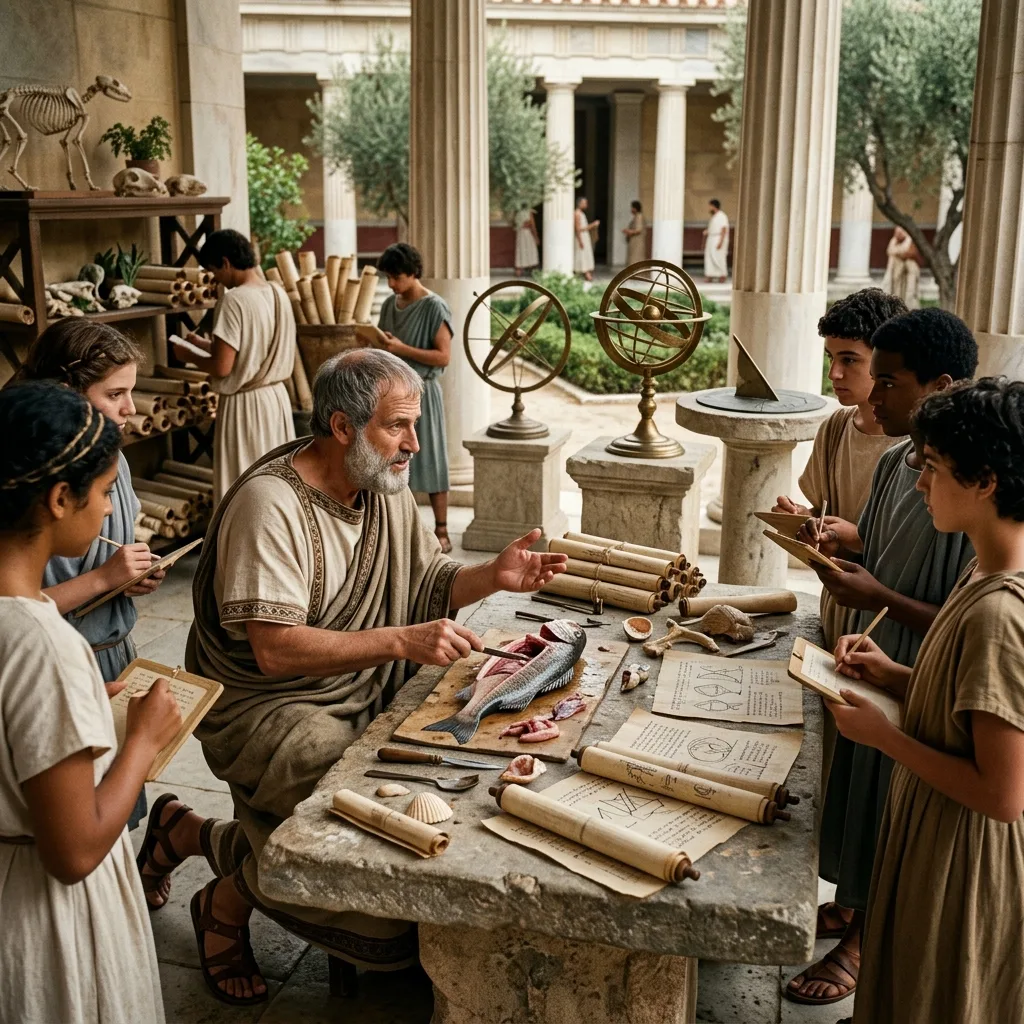
A student of Plato and tutor to Alexander the Great, Aristotle rejects the Theory of Forms to focus on observing the natural world, categorizing biology, physics, and inventing formal logic.
Open in interactive timeline →Key Numbers
- Founded
- c. 335 BCE, Athens
- Species classified
- 500+ animals
- Treatises surviving
- ~31 of ~200
- Theophrastus's tenure
- 35 years, 2,000+ students
- Aristotle's lifespan
- 384–322 BCE (age ~62)
Verified Facts
- Aristotle founded the Lyceum around 335 BCE after returning to Athens, renting buildings in a grove sacred to Apollo Lyceios; because he lectured while strolling its covered walkways (peripatoi), the school and its members became known as the Peripatetics, from the Greek for 'walking around.'
- As a resident foreigner (metic), Aristotle could not own Athenian land, so the Lyceum was an informal community rather than a property he held — a key difference from Plato's Academy, where Aristotle had studied for roughly twenty years before leaving around 347 BCE.
- Before founding the school, Aristotle had served from about 343–342 BCE as tutor to the 13-year-old Alexander the Great at Mieza in Macedon, at the invitation of King Philip II; the connection later proved double-edged, fueling Athenian suspicion of Aristotle as a Macedonian sympathizer.
- Aristotle's 'History of Animals' systematically described and classified over 500 species, drawing on direct dissection and observation — including years spent studying marine life on Lesbos — making it the first known attempt at systematic biological classification and earning him the title 'father of zoology.'
- The Lyceum is credited with assembling what is often called the first great research library in Europe, paired with collections of biological specimens; ancient tradition holds that Alexander's campaigns supplied exotic plant and animal material for study.
- Aristotle's output was vast: Diogenes Laertius catalogued a body of work he reckoned at 445,270 lines, and ancient sources credit him with around 200 treatises — yet only about 31 works survive, meaning we possess perhaps a fifth of what he wrote.
- The polished dialogues that made Aristotle famous in antiquity (his 'exoteric' works, such as 'Eudemus' and 'On Philosophy') are almost entirely lost; what survives are mostly the technical 'esoteric' lecture treatises used inside the Lyceum, which is why the extant corpus reads as dense and unliterary.
- On his deathbed in 322 BCE, Aristotle named Theophrastus as his successor; Theophrastus then led the school for about 35 years, growing it to a reported 2,000 students at its height and bequeathing his garden, house, and colonnades to the school in a will preserved by Diogenes Laertius.
- Theophrastus's own botanical works — 'Enquiry into Plants' and 'On the Causes of Plants' — extended the Lyceum's empirical program to the plant kingdom and earned him the parallel title 'father of botany.'
- After Alexander's death in 323 BCE triggered anti-Macedonian feeling in Athens, Aristotle was charged with impiety; he fled to Chalcis on Euboea, reportedly so the city would not 'sin twice against philosophy' (an allusion to Socrates' execution), and died there in 322 BCE at about age 62.
- According to an account in Strabo and Plutarch, Aristotle's library passed to Theophrastus and then to Neleus of Scepsis, whose heirs allegedly hid the manuscripts in a cellar for over a century; they were later bought by Apellicon, carried to Rome by Sulla after 86 BCE, and edited by Andronicus of Rhodes — whose 1st-century-BCE arrangement underlies modern editions. Many scholars treat the dramatic cellar tale as partly legendary, but Andronicus's editorial role is well attested.
The World at This Moment
Aristotle established the Lyceum around 335 BCE in a precarious geopolitical moment. Athens had lost autonomy after Philip II's victory at Chaeronea (338), and Macedon dominated Greece. Aristotle's former pupil, Alexander III, was campaigning eastward; by 334-330 he toppled the Achaemenid Persian Empire, and in 326 invaded the Punjab. As Alexander's garrisons withdrew, Chandragupta Maurya (Greek Sandrakottos) seized power around 322, founding the Mauryan Empire that would unify much of India. In China's Warring States period, contending kingdoms patronized rival thinkers; Mencius and the Zhuangzi tradition flourished roughly contemporaneously. Aristotle himself was a resident alien (metic) who could not own Athenian property, so the Lyceum operated on public ground near a sanctuary of Apollo Lykeios. His teaching coincided with—and depended upon—Macedonian power; when Alexander died in 323 and anti-Macedonian feeling surged, Aristotle prudently withdrew to Chalcis, reportedly saying he would not let Athens "sin twice against philosophy," dying there in 322.
The Paradigm Shift
The Lyceum institutionalized empirical, collaborative research as a method, distinguishing it from Plato's more metaphysical Academy. Aristotle and his associates—above all Theophrastus, his successor—pursued systematic observation, dissection, and classification across an unprecedented range: zoology (the History of Animals catalogues observations on hundreds of species), botany, anatomy, meteorology, politics (the lost collection of 158 constitutions), rhetoric, poetics, and the doxographical history of earlier thought. This program treated knowledge as cumulative, divisible by subject-matter, and grounded in particulars before universals—a sharp methodological reorientation that shaped the very idea of a scientific discipline. Aristotle's invention of formal syllogistic logic (the Organon) supplied a deductive framework that governed Western reasoning until the nineteenth century. The corpus's later transmission—organized, ancient tradition holds, by Andronicus of Rhodes in the first century BCE—made Aristotle "the master of those who know" for Islamic falsafa (al-Farabi, Ibn Rushd) and Latin scholasticism (Aquinas). Few institutions so durably redirected the structure of inquiry itself.
In Their Own Words
"All men by nature desire to know. An indication of this is the delight we take in our senses; for even apart from their usefulness they are loved for themselves; and above all others the sense of sight." — Aristotle, Metaphysics, Book I (Alpha), 980a, opening lines (W. D. Ross translation)
In Depth
The Empire of the Eye: Aristotle and the Birth of Organized Knowledge
When Aristotle returned to Athens around 335 BC and began teaching among the colonnaded walkways of the Lyceum—the peripatoi that gave his "Peripatetic" school its name—he did something quietly revolutionary. He was not merely opening a rival to Plato & the Academy (sv-plato), where he had studied for two decades. He was inventing a new posture toward the world: that knowledge begins not in a realm of perfect Forms glimpsed by the soul, but in the patient cataloguing of things one can see, dissect, and count. The Lyceum housed what may be the first research library in European history and pioneered the collaborative, specimen-gathering inquiry we would now recognize as science.
The Preconditions of a Catalogue
Aristotle's empiricism did not appear from nowhere. It was the culmination of a two-century Greek experiment in explaining nature without myth, begun by The Pre-Socratic Philosophers (sv-presocratics) and crystallized when Thales of Miletus (sv-thales) first proposed that the cosmos ran on impersonal principles. Aristotle absorbed Heraclitus, Pythagoras, and the atomism of Democritus & the Atom (sv-democritus)—often to refute them—and inherited the disciplined narrative empiricism of Herodotus, the Father of History (sv-herodotus). As a metic, a resident foreigner barred from owning Athenian property, he rented the Lyceum grounds rather than buying them; the very informality of the school, with no fixed curriculum or fees, freed it to become a workshop of questions rather than a temple of doctrine.
There was also a geopolitical precondition. In 342 BC Aristotle had tutored a Macedonian prince who would become Alexander the Great (sv-alexander). Ancient tradition holds that Alexander, on campaign, shipped plant and animal specimens back to his old teacher—knowledge flowing along the same roads as conquest. The Lyceum was, in a sense, the intellectual organ of an empire just being born.
The Ripples Outward
Aristotle's reach is almost unrivaled in intellectual history. His logic, biology, physics, ethics, and poetics became a near-total system. After his death in 323 BC he passed the school to Theophrastus, whose botanical work extended the master's method—but the corpus itself had a perilous afterlife, reportedly hidden in a cellar in Mysia for generations before resurfacing.
That afterlife is where the deep arc bends. Aristotle's texts were preserved and expanded during The Islamic Golden Age (sv-islamic-golden-age), where commentators like Averroes kept his science alive while Europe forgot it. When the corpus flooded back into Latin Christendom in the twelfth century, it became the scaffolding of the medieval university—"Aristotelian scholasticism"—and Thomas Aquinas welded it to Christian theology, fixing Aristotle as "the Philosopher" for four hundred years. That authority became so total that the Scientific Revolution defined itself against him: Galileo Galilei & the Telescope (sv-galileo) and Isaac Newton & the Principia (sv-newton) had to overthrow Aristotelian physics to build the modern world, even as they kept his foundational conviction that nature is to be read by observation.
A Thread to the Present
The Lyceum's true legacy is the institution itself—the idea that inquiry should be collective, archival, and specialized. That template ran through the Great Library of Alexandria (sv-library-alexandria), the medieval universities, and on to the research laboratories of the Industrial Revolution (sv-industrial-revolution) and modern AI. When Aristotle organized animals into a branching hierarchy of shared traits, he was performing, by hand, the work of classification that machine learning would one day automate. Every taxonomy, every structured dataset, every system that turns raw observation into ordered knowledge carries the signature of those walking lessons in the Athenian groves.
Causes & Consequences
What led to it
- Aristotle spent roughly twenty years (from about 367 BC) as a student in Plato's Academy in Athens, the institutional model on which he later based his own school while moving away from Plato's theory of Forms toward empirical observation of nature.
- Aristotle's father Nicomachus served as court physician to King Amyntas III of Macedon, giving Aristotle an early exposure to medicine, dissection, and biological observation that shaped the Lyceum's empirical bent.
- From about 343 BC Aristotle tutored the young Alexander the Great at the request of Philip II of Macedon, forging the Macedonian connections that gave him standing and protection when he returned to Athens.
- Athens fell under Macedonian hegemony after Philip II's victory at the Battle of Chaeronea in 338 BC, creating the secure political conditions under which Aristotle, a non-citizen from Stagira, could safely teach in the city around 335 BC.
- Because Aristotle was a resident foreigner (metic) who could not own Athenian property, he established his school on the public grounds of the Lyceum, a grove sacred to Apollo Lyceios that had long been used by philosophers and teachers including Socrates.
- Aristotle's years of independent research after leaving Athens (including biological fieldwork on Lesbos with Theophrastus around 345 BC) gave him the accumulated method and collaborators needed to launch a research-driven institution.
What it set in motion
- The Lyceum pioneered organized collaborative research and is credited with first dividing knowledge into distinct disciplines such as logic, physics, biology, ethics, rhetoric, and politics, a structure that still underlies the modern division of the sciences.
- Aristotle assembled an extensive library and collection of specimens at the Lyceum, with material reportedly sent back from Alexander's eastern campaigns, establishing one of antiquity's first systematic research collections.
- Theophrastus succeeded Aristotle as head of the school for over three decades and used the garden and library to produce foundational works in botany, extending the Lyceum's empirical program beyond Aristotle's lifetime.
- Aristotle's syllogistic logic in the Organon became the dominant framework for deductive reasoning in the West for nearly two thousand years, remaining the standard until modern symbolic logic emerged in the 19th century.
- After near-loss and damage (the tradition that Neleus's heirs stored the manuscripts in a cellar at Scepsis), the corpus was edited by Andronicus of Rhodes around 60 BC, producing the systematic arrangement of Aristotle's treatises that survives and is still cited today.
- Translated and commented upon by Islamic scholars such as Averroes ("the Commentator"), Aristotle's works re-entered Latin Europe in the 13th century and became the backbone of medieval Scholasticism, most famously synthesized with Christian theology by Thomas Aquinas.
The Live Academic Debate
A central debate concerns the corpus's transmission and the so-called Andronicus legend. Strabo and Plutarch report that Aristotle's books, bequeathed to Theophrastus then Neleus, were hidden in a Scepsis cellar and later edited by Andronicus of Rhodes (c. 60 BCE), who imposed the ordering and the esoteric/exoteric distinction. Older scholarship (notably Werner Jaeger's 1923 developmental thesis) treated the surviving treatises as evolving lecture courses and reconstructed Aristotle's intellectual biography from them. More recent work—reflected in Jonathan Barnes's skepticism and the Stanford Encyclopedia treatment by scholars such as Myriam Hecquet-Devienne and others—questions how decisive Andronicus actually was, arguing that some Aristotelian texts circulated continuously and that the dramatic "rediscovery" narrative obscures messier realities. A second live dispute concerns the Lyceum's institutional character: Lynch and others debate whether it was a formal, property-holding "school" or a looser association, complicated by Aristotle's metic status. A third concerns how far the biological works reflect genuine firsthand observation versus inherited report.
How This Event Connects
Aristotle executed a massive paradigm shift in classical thought by domesticating the transcendent idealism of his teacher, Plato. Rejecting the Platonic separation of Forms into an inaccessible realm, Aristotle argued for hylomorphism: the concept that substance is an inextricable composite of matter and form. This foundational shift redirected intellectual inquiry away from mystical contemplation and toward rigorous empirical observation, taxonomy, and the systematic categorization of the natural world, effectively birthing the biological and physical sciences.
The survival and subsequent dominance of the Aristotelian corpus were profoundly dependent on the intellectual labor of the Islamic Golden Age. Scholars such as Averroes and Avicenna not only preserved the texts but produced monumental commentaries that synthesized Aristotelian logic with monotheistic theology. It was this highly sophisticated, Arabic-mediated Aristotelianism that subsequently flooded medieval Europe, entirely structuring the scholastic framework of universities for centuries.
However, the very success of Aristotelian physics—which posited a geocentric universe and teleological motion—eventually became the primary epistemological obstacle to the Scientific Revolution. It required the radical empiricism and mathematical mechanics of figures like Galileo to violently dismantle the Aristotelian cosmos. Yet, in the realm of biology, Aristotle's teleological methodology remained profoundly influential; even Charles Darwin marveled at Aristotle's taxonomic genius, demonstrating that while Aristotelian physics fell, his biological methodologies possessed enduring structural validity.
The Counterfactual
Had Aristotle not founded a research community, the consequences would have been less the loss of his individual genius than the loss of a sustained collective program. Much of what survives—the polished biological treatises, Theophrastus's botany and the Characters, Eudemus's history of mathematics, Aristoxenus on music, Dicaearchus's geography—issued from a continuing school, not a lone author. Without the Lyceum's institutional momentum, the encyclopedic, problem-driven model of organized inquiry might not have crystallized as a transmissible template; the later Library and Museum of Alexandria drew partly on Peripatetic precedent. Counterfactually, Plato's more contemplative Academy could have monopolized the prestige of philosophy, plausibly steering Greek thought toward mathematical idealism over naturalistic observation. The transmission also hung by a thread: ancient sources (Strabo, Plutarch) report Aristotle's library suffering neglect before Andronicus's reconstitution. Had that recovery failed, medieval Europe and the Islamic world might have inherited a thinner, more Neoplatonized Aristotle—altering scholasticism and, arguably, the conceptual scaffolding of later European science.
Myth vs. Reality
Myth: The Peripatetics were called that because Aristotle taught while walking around with his students.
Reality: The name derives from the peripatoi (the covered colonnaded walkways) of the Lyceum where members gathered, not from a teaching style. The image of Aristotle lecturing on the move is a later legend traced to the biographer Hermippus of Smyrna, writing generations after Aristotle's death. The Greek peripatos meant a walkway or covered walk, so the school was 'those from the walk' in reference to the architecture of the site.
Myth: Aristotle founded the Lyceum, building it as his own school from scratch.
Reality: The Lyceum was a long-established public gymnasium and sacred grove dedicated to Apollo Lyceus that predated Aristotle by centuries; the precinct may go back to Pisistratus or Pericles. It was already a venue for military drill, civic assembly, and philosophical talk: figures such as Protagoras, Prodicus, Isocrates, Socrates, and Plato are associated with it before him. In 335 BC Aristotle began teaching on these public grounds rather than founding the place itself.
Myth: Aristotle owned the Lyceum and ran it as a formal university with enrolled students and degrees.
Reality: As a metic (a resident foreigner from Stagira in the north), Aristotle was legally barred from owning land or buildings in Athens, so he used the public grounds. Scholars describe the early Peripatetic gatherings as informal, with likely no set curriculum, formal enrollment, or fees, and many lectures open to the public. Only under his successor Theophrastus, who acquired property near the Lyceum around the 310s BC, did the school gain its own premises; 'university,' with credentials, is an anachronism.
Myth: Aristotle tutored Alexander the Great at the Lyceum in Athens.
Reality: Aristotle tutored the young Alexander years earlier and elsewhere. Around 343 BC Philip II of Macedon engaged Aristotle to educate his son, and the lessons took place in Macedonia, by tradition at Mieza, not in Athens. Aristotle only returned to Athens to begin teaching at the Lyceum around 335 BC, after the tutoring period had ended and as Alexander was launching his campaigns.
Myth: The works of Aristotle we read today are the polished books he wrote for the public at the Lyceum.
Reality: Most of the surviving corpus consists of dense treatises that read like lecture material for internal use, not the polished 'exoteric' dialogues he published in his lifetime, which are now largely lost. Ancient tradition (reported by Strabo and Plutarch) holds that his personal manuscripts passed to Theophrastus and then Neleus, were stored at Scepsis and reportedly hidden, later bought by Apellicon of Teos, carried to Rome after Sulla's capture of Athens, and edited there by Andronicus of Rhodes in the 1st century BC. Whatever the exact details, the texts reached us through a long and damaged transmission rather than as finished books from the Lyceum.
Frequently Asked Questions
When and where did Aristotle found the Lyceum?
Aristotle founded the Lyceum in Athens around 335 BC, after returning to the city following years away that included tutoring the young Alexander the Great in Macedon. The school was located in a grove sacred to Apollo Lyceius, just outside the city walls, where Aristotle rented buildings and set up his teaching and research community. He led it for roughly twelve years, until political turmoil forced him to leave Athens in 323 BC.
Why is Aristotle's school called the Peripatetic school?
The name comes from the Greek word peripatos, meaning a covered walkway or colonnade, of which the Lyceum had several where members met and discussed ideas. The school's followers thus became known as Peripatetics, meaning roughly 'those of the walkways.' A popular later tradition, traced to Hermippus of Smyrna, instead attributed the name to Aristotle's alleged habit of walking about while lecturing, though scholars regard the connection to the physical walkways as the more reliable explanation.
What made the Lyceum different from Plato's Academy?
Whereas Plato's Academy emphasized abstract Forms and dialectic reasoning, Aristotle's Lyceum stressed empirical observation, the systematic collection of data, and the practical study of the natural world. Aristotle organized collaborative research across many fields, and his students gathered and classified everything from animal specimens to political constitutions. This grounding in direct observation laid important groundwork for the later development of scientific inquiry.
What subjects were studied and what did Aristotle build at the Lyceum?
Research at the Lyceum spanned an enormous range, including biology, botany, logic, physics, metaphysics, astronomy, ethics, politics, rhetoric, psychology, and the history of philosophy. Aristotle assembled a major library, gathered manuscripts widely, and directed large collaborative projects, such as a compilation of 158 Greek and non-Greek constitutions. Many of his surviving treatises, including the Physics, Metaphysics, Nicomachean Ethics, and Politics, took shape and were revised during these Lyceum years.
Why did Aristotle leave Athens in 323 BC?
After Alexander the Great died in 323 BC, anti-Macedonian sentiment surged in Athens, and Aristotle, long associated with the Macedonian court, was charged with impiety. Ancient sources link the charge to a poem he had written honoring his friend Hermias. Rather than risk the fate of Socrates, Aristotle left for Chalcis on the island of Euboea, reportedly saying he would not let Athens 'sin twice against philosophy'; he died there of a digestive illness in 322 BC.
Who took over the Lyceum after Aristotle?
Aristotle's close colleague Theophrastus succeeded him as head of the Lyceum and led it for roughly the next thirty-five years, inheriting Aristotle's library and writings. Under Theophrastus the school became more institutionalized, and ancient sources claim it drew very large audiences. Theophrastus made major contributions of his own, especially in botany through works such as Enquiry into Plants, and was in turn succeeded by Strato of Lampsacus.
Sources & Further Reading
- Peripatetic school — Wikipedia
- Jonathan Barnes (ed.), The Cambridge Companion to Aristotle (Cambridge University Press, 1995)
- John Patrick Lynch, Aristotle's School: A Study of a Greek Educational Institution (University of California Press, 1972)
- Werner Jaeger, Aristotle: Fundamentals of the History of His Development (Oxford, 1934; orig. German 1923)
- Stanford Encyclopedia of Philosophy, 'The Textual Transmission of the Aristotelian Corpus' (2025)
- Carlo Natali, Aristotle: His Life and School, ed. D. S. Hutchinson (Princeton University Press, 2013)
- Wikipedia: Aristotle
- Stanford Encyclopedia: Aristotle
Cite This Page
AskHistoryAI. “Aristotle's Empiricism.” AskHistoryAI — Interactive Timeline of Everything. Updated 2026-09-11. https://askhistoryai.com/event/sv-aristotle/
Every fact on this page is checked against the published fact ledger and methodology; sources are listed above.