The Seleucid Empire
The massive, chaotic Hellenistic behemoth of the East.
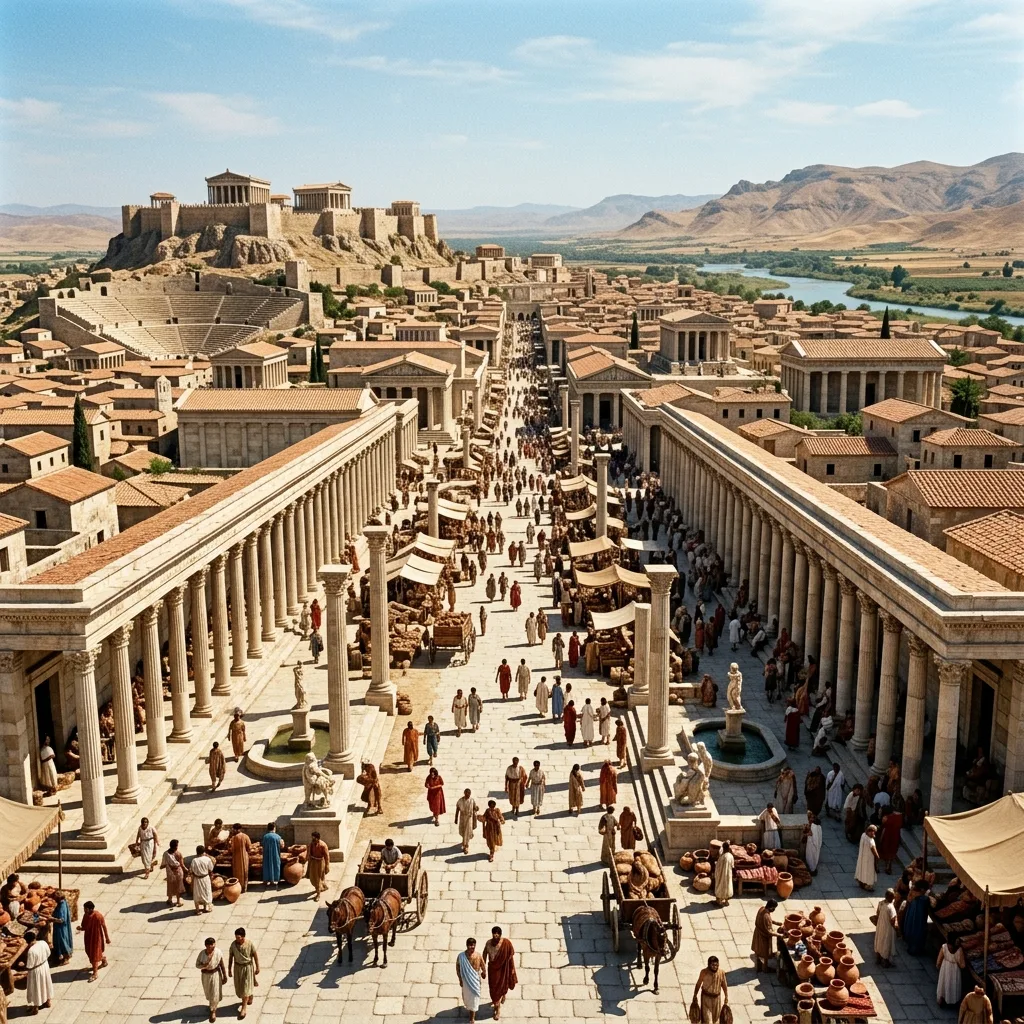
Founded by Seleucus I Nicator after Alexander's death, this was the largest of the successor states, stretching from modern-day Turkey to India. It was characterized by forced Hellenization, massive Greek-style cities (like Antioch), and military reliance on war elephants and phalanxes.
Open in interactive timeline →Key Numbers
- Span
- 312–63 BCE (~250 yrs)
- Peak territory
- ~3.9 million km² (c. 281 BCE)
- Peak population
- ~30 million (c. 301 BCE)
- War indemnity to Rome
- 15,000 talents (~400 tons of silver)
- Crowned rulers
- ~25 Seleucid kings
Verified Facts
- The empire was founded in 312 BCE when Seleucus I Nicator, one of Alexander the Great's generals (a Diadochus), seized Babylonia after defeating Antigonid forces; he later took the epithet 'Nicator' (the Victor) and crowned himself king around 305 BCE.
- Around 305 BCE Seleucus ceded his eastern Indian frontier provinces (Arachosia, Gedrosia, the Paropamisadae and part of the Punjab) to the Mauryan emperor Chandragupta in exchange for 500 war elephants, sealing the deal with a marriage alliance.
- Those Indian elephants proved decisive at the Battle of Ipsus in 301 BCE, where Seleucus fielded roughly 480 of them to help defeat Antigonus the One-Eyed, a victory that made Seleucus the dominant successor king in Asia.
- The empire reached its greatest extent around 281 BCE after Seleucus defeated his former ally Lysimachus at the Battle of Corupedium, briefly stretching from Thrace in Europe across Anatolia, Syria, Mesopotamia and Iran to the borders of India.
- Seleucus founded twin capitals around 300 BCE: Seleucia-on-the-Tigris in Mesopotamia and Antioch in Syria; Antioch grew into one of the largest cities of the ancient world, eventually reaching a population near half a million.
- The Seleucid Era, beginning in 312/11 BCE, is regarded as the first continuously counted calendar in history (it did not restart with each new king); it was institutionalized by Seleucus's successor Antiochus I Soter and influenced later dating systems.
- The empire's fortunes turned at the Battle of Magnesia in 190 BCE, where a Roman army under Lucius Cornelius Scipio, aided by Eumenes II of Pergamon, crushed Antiochus III 'the Great' despite his larger force.
- The Treaty of Apamea in 188 BCE forced Antiochus III to surrender all territory west of the Taurus Mountains and pay a crushing indemnity of 15,000 talents of silver, beginning the empire's long decline.
- In 167 BCE Antiochus IV Epiphanes desecrated the Second Temple in Jerusalem, outlawing Jewish worship and reportedly installing an altar to Zeus, which sparked the Maccabean Revolt led by Judas Maccabeus; the Temple was rededicated in 164 BCE, commemorated by Hanukkah.
- The Parthians captured Seleucia and the Iranian plateau by about 141–139 BCE, and after a century of dynastic civil wars the rump kingdom in Syria was finally annexed by the Roman general Pompey in 63 BCE, ending the Seleucid dynasty with Antiochus XIII.
The World at This Moment
When Seleucus I retook Babylon in 312 BCE, the Mediterranean and Near Eastern worlds were convulsed by the Wars of the Diadochi, Alexander the Great's generals partitioning his empire after his death in 323. Ptolemy held Egypt, Antigonus Monophthalmus and his son Demetrius contested Anatolia and the Aegean, and Cassander controlled Macedon. Further west, the Roman Republic was fighting the Second Samnite War, still a regional Italian power. In the east, Chandragupta Maurya had founded the Mauryan Empire (c. 321), and Seleucus would cede the eastern satrapies to him around 305–303 in exchange for 500 war elephants—the famous beasts of Kosmin's "elephant kings." In China, the Warring States period was approaching its climax before Qin unification (221). The Seleucid realm thus arose at a hinge moment, inheriting Achaemenid administrative structures while grafting on Macedonian kingship, spanning from the Aegean to the Hindu Kush at its greatest extent under Seleucus and Antiochus III.
The Paradigm Shift
The Seleucid Empire's most enduring legacy is conceptual: the invention of continuous, numbered, era-based time. As Paul Kosmin argues in "Time and Its Adversaries" (2018), the Seleucid Era—counting forward from 312/311 BCE with no terminus and no reset at each king's accession—was history's first such system, the template behind later Christian, Islamic, and modern chronologies. Beyond chronometry, the empire pioneered systematic Hellenistic colonization: Seleucus and his successors founded scores of poleis (Antioch, Seleucia-on-the-Tigris, Apamea, Laodicea), seeding Greek language, institutions, and urbanism across Syria, Mesopotamia, and Iran, and constructing what Kosmin's "Land of the Elephant Kings" (2014) calls a deliberately ideologized imperial space. This fusion of Greek and Near Eastern administrative traditions defined Hellenism as a cross-cultural phenomenon, shaping the Parthian and even Roman East. Seleucid pressure on Judaea under Antiochus IV provoked the Maccabean revolt (167 BCE), a pivotal moment for Second Temple Judaism and apocalyptic literature.
In Their Own Words
"He founded cities through the whole length of his empire; there were sixteen called Antioch after his father, five Laodicea after his mother, nine named Seleucia after himself, four called after his wives, three Apamea and one Stratonicea." — Appian of Alexandria, The Syrian Wars (Syriaca) 57, 2nd century CE (Horace White translation)
In Depth
The Empire of the Road: How the Seleucids Stitched a World Together
When Alexander the Great (sv-alexander) died at Babylon in 323 BC, he left behind the largest contiguous territory the Mediterranean world had ever known and no clear heir to hold it. The Seleucid Empire is the answer to a single brutal question that haunted the next half-century: what happens to a world-spanning conquest when the conqueror is gone? The answer, written in the wars of Alexander's generals, was fragmentation — and the largest fragment fell to Seleucus I Nicator, who seized Babylonia in 312 BC and built outward until his realm ran from Thrace to the edge of India.
A Greek Skin Over a Persian Body
The Seleucids inherited far more than land. They governed the bones of the old Achaemenid Persia, and their genius — and tragedy — was the attempt to administer a Near Eastern empire with a thin Greek-Macedonian elite. Seleucus planted Greek cities like Antioch and Seleucia-on-the-Tigris as nodes of a new cosmopolitan culture, the Hellenistic world, where Babylonian astronomy and mathematics met Greek geometry. This was the same intellectual ferment that flourished under their rivals the Ptolemies (sv-ptolemaic) at the Great Library of Alexandria (sv-library-alexandria), where Euclid (sv-euclid) systematized the deductive method. The Seleucid contribution was the eastward and Mesopotamian channel: cuneiform astronomical diaries — heirs to the scribal tradition begun with cuneiform (sv-cuneiform) itself — continued under Seleucid patronage, feeding mathematical knowledge that would echo for centuries.
The Fault Line That Made Hanukkah
The empire's most consequential act was not a conquest but a catastrophe of cultural policy. Under Antiochus IV Epiphanes (175-164 BC), the Hellenizing pressure that the dynasty had long applied turned coercive in Judea. He outlawed Sabbath observance and circumcision and rededicated the Jerusalem Temple to Zeus. The result was the Maccabean Revolt (167-160 BC), the Temple's rededication in 164 BC commemorated as Hanukkah, and an independent Hasmonean Judea. The reverberations are enormous: this episode forged a Jewish tradition of resistance to imperial assimilation that would resurface in the Roman destruction of the Second Temple (sv-second-temple) and the Bar Kokhba revolt under Hadrian (sv-hadrian-bar-kokhba). The book of Daniel, the apocalyptic imagination, and much of the religious world into which Christianity (sv-justin-martyr) was born were shaped in the furnace Antiochus lit.
Crushed Between Two Millstones
The Seleucid story is also a parable of overextension. Holding a realm that vast required constant war on every frontier, and the empire bled outward from both ends. To the east, the Parthians under Mithridates I took Seleucia and the Iranian plateau by 141 BC, severing the empire from its richest provinces. To the west loomed the rising Roman Republic (sv-roman-republic), which had already humbled Antiochus III. By 63 BC the rump Seleucid state in Syria was extinguished by Pompey, the same generation whose internal convulsions — Sulla's march on Rome (sv-sulla) and soon Caesar crossing the Rubicon (sv-julius-caesar) — were turning the Republic into the empire of Augustus (sv-augustus).
The Seleucids thus form a crucial hinge in the long arc from Alexander's dream of fusion to Rome's machinery of administration. They proved that a conquest could be inherited but not easily held; that culture imposed from above breeds revolt; and that the Hellenistic synthesis they spread — Greek as a world language, the city as an engine of learning — would outlive their dynasty entirely. Rome conquered the body of the Seleucid world, but it kept the Greek soul the Seleucids had grafted onto the East, carrying it forward into the intellectual life of late antiquity.
Causes & Consequences
What led to it
- Alexander the Great's conquest of the Achaemenid Persian Empire (334-323 BCE) brought Mesopotamia, Persia, and Central Asia under Macedonian rule, creating the vast eastern territories the Seleucids would later govern.
- Alexander's sudden death at Babylon in June 323 BCE without a competent adult heir triggered a succession crisis that fragmented his empire among his generals, the Diadochi.
- At the Partition of Triparadisus in 321 BCE, the regent Antipater appointed Seleucus as satrap of Babylon, giving him the territorial base from which his empire would eventually grow.
- Seleucus's return to Babylon in 312 BCE after the Macedonian-Ptolemaic victory at the Battle of Gaza, followed by his survival of the Babylonian War against Antigonus (311-309 BCE), secured his hold on Mesopotamia and is the conventional founding date of the empire.
- Seleucus's settlement with Chandragupta Maurya around 305-303 BCE ceded the eastern Indian satrapies in exchange for roughly 500 war elephants, freeing him to focus westward and arming him for the decisive battles to come.
- The coalition victory over Antigonus Monophthalmus at the Battle of Ipsus in 301 BCE, in which Seleucus's Indian elephants played a major role, eliminated his most dangerous rival and won him Syria and access to the Mediterranean.
What it set in motion
- Seleucus founded Antioch-on-the-Orontes (around 300 BCE) and Seleucia-on-the-Tigris, along with dozens of other Greek-style cities, which became enduring centers of commerce, administration, and learning across the Near East.
- The Seleucid program of city foundation and colonization spread the Greek language, the polis model, and Hellenistic institutions deep into Mesopotamia, Persia, and Central Asia, making Greek a lingua franca of the region.
- Seleucid rule fostered cultural and religious syncretism, in which local deities were identified with Greek gods and Greek and indigenous Near Eastern traditions blended in art, religion, and administration.
- Antiochus IV Epiphanes's suppression of Jewish religious practice provoked the Maccabean Revolt (167-160 BCE), which eventually produced an independent Hasmonean Jewish state and shaped Jewish identity and tradition for centuries.
- The secession of the satrap Diodotus around 250 BCE created the Greco-Bactrian Kingdom, which extended Hellenistic culture into Central Asia and gave rise to the later Indo-Greek kingdoms of the Indian subcontinent.
- The empire's eastern collapse opened the way for the rise of the Parthian Empire under the Arsacids, which by the mid-2nd century BCE under Mithridates I absorbed Seleucid territory and became Rome's great eastern rival.
- Roman intervention against Antiochus III, culminating in the Treaty of Apamea (188 BCE), stripped the Seleucids of most of Anatolia and drew Rome decisively into the politics of the Hellenistic East, foreshadowing eventual Roman dominance of the region.
The Live Academic Debate
The central historiographical dispute concerns the empire's fundamental character: was it a Greco-Macedonian colonial superstate, an essentially Iranian/Near Eastern continuation of the Achaemenid order, or genuinely "between East and West"? An older view (Edwyn Bevan, and in colonial-tinged form Bevan's successors) cast the Seleucids as fragile, overextended Greeks ruling alien subjects. The "Achaemenid continuity" school—Pierre Briant, Amélie Kuhrt, Susan Sherwin-White ("From Samarkhand to Sardis," 1993)—rehabilitated the dynasty as a stable, Babylonian- and Iranian-rooted polity that drew legitimacy from local traditions, not merely a Greek veneer. Paul Kosmin reframes the debate around space and time, arguing the Seleucids actively manufactured a unified imperial ideology rather than passively inheriting one. A further controversy, advanced by John Ma and others, concerns how "negotiated" versus coercive royal power over Greek cities actually was. Debate also persists over the causes and timing of decline—whether Magnesia (190) and Apamea (188) were truly decisive or merely symptomatic.
How This Event Connects
The historiographical re-evaluation of the Seleucid Empire represents one of the most profound paradigm shifts in classical scholarship, fundamentally dismantling the Eurocentric myth of "Hellenization." Rather than viewing the Seleucids as Western colonizers imposing Greek culture upon a passive Orient, modern historians recognize the empire as a dynamic continuation of Achaemenid administrative and theological models. Methodologically, this shift was made possible by moving away from biased Greek literary sources and embracing native Babylonian records, specifically those written in cuneiform, such as the Astronomical Diaries. These clay tablets provide irrefutable evidence that Seleucid monarchs actively participated in indigenous Mesopotamian rituals to legitimize their rule, proving that their imperial strategy relied heavily on profound cultural syncretism and polycentric governance rather than rigid Hellenic imposition.
The limits and failures of this complex imperial framework are most starkly illustrated by the explosive conflicts in Judea, which serve as crucial precursors to the eventual Fall of the Second Temple. Traditional narratives frame the Maccabean Revolt as a simplistic ideological clash between Judaism and Hellenism, driven by the tyrannical persecution of Antiochus IV. However, cutting-edge scholarship interprets this crisis as a violent local civil war between orthodox and reformist Jewish factions, severely exacerbated by the geopolitical pressures of the Seleucid state. Antiochus's intervention was less an ideological crusade than a punitive political measure against a rebellious province, highlighting how localized religious friction could fatally destabilize the broader Hellenistic syncretic model.
Ultimately, the complex, polycentric structure of the Seleucid Empire proved vulnerable to the systemic, centralized aggression of the Roman Republic. The Republic's relentless expansion into the Eastern Mediterranean systematically dismantled the Hellenistic successor states, replacing the flexible, itinerant patronage networks of the Seleucid kings with rigid Roman administrative and economic control. The eventual absorption of the Seleucid territories into the Roman provincial system marks the definitive end of the Hellenistic geopolitical paradigm, shifting the center of gravity in the ancient world from the syncretic courts of the East to the militarized, oligarchic Senate of Rome.
The Counterfactual
Had Seleucus failed to seize Babylon in 312—he returned with barely a thousand men—the eastern satrapies might have fallen permanently to Antigonus, producing a single dominant Macedonian power rather than the fragmented Hellenistic balance that actually emerged. Without a Seleucid bulwark in the east, the Mauryan frontier and Iranian plateau could have developed quite differently, and the dense network of Greek foundations from Syria to Bactria—the demographic backbone of later Hellenism and of the Greco-Bactrian and Indo-Greek kingdoms—might never have arisen. Most consequentially, absent the Seleucid Era there would have been no precedent for irreversible numbered time; Kosmin contends this conceptual innovation was genuinely unprecedented, so its non-emergence is hard to substitute. More concretely, without Antiochus IV's Judaean policy there would have been no Maccabean revolt, no Hanukkah tradition, and a markedly altered trajectory for Jewish apocalypticism—developments that, as scholars from Elias Bickerman onward stress, fed directly into nascent Christianity.
Myth vs. Reality
Myth: The Seleucid Empire was essentially a Greek state ruled over passive natives, with power concentrated in a single Greek capital.
Reality: Recent scholarship rejects this hellenocentric picture. Sherwin-White and Kuhrt's 'From Samarkhand to Sardis: A New Approach to the Seleucid Empire' (1993) stressed the empire's Near Eastern and Achaemenid foundations and the tenacity of non-Greek cultures. Rolf Strootman characterizes it as a 'multipolar network polity' with an itinerant court and multiple imperial centers, including Babylon, Seleucia on the Tigris, Susa, Ecbatana, Bactria, and Sardis. Iranian and Babylonian populations were integral, not merely subordinate, contributing troops such as Achaemenid-style cataphract cavalry.
Myth: The Seleucid Empire was a perpetually declining, dysfunctional 'sick man' of the Hellenistic world from start to finish.
Reality: This decline-from-the-outset narrative has been heavily revised. Scholars now describe the empire as having been 'exoticized' and unfairly cast as a sprawling, dysfunctional Oriental state. The timing of real Seleucid decline is debated, and revisionist work argues the empire retained administrative sophistication and periods of genuine stability. The treaty of Apamea (188 BCE) was a serious blow, but the empire was not in full collapse during the reign of Antiochus IV, and studies challenge the idea of uninterrupted decay in the post-Antiochus III era.
Myth: Antiochus IV launched the Maccabean crisis as a campaign of pure religious persecution aimed at wiping out Judaism for its own sake.
Reality: The motives are debated and more complex than the religious-persecution framing in 1-2 Maccabees and Daniel. Victor Tcherikover argued a prior Jewish revolt provoked Antiochus's retaliation, while Sylvie Honigman has argued the measures grew out of administrative and fiscal restructuring whose consequences were later remembered as religious persecution. Many scholars hold that Antiochus mistook an internal conflict among the Jerusalem priesthood for a full-scale rebellion. The repression's religious dimension was real in effect, but framing it as a premeditated war on Judaism oversimplifies the evidence.
Myth: The Seleucids ran a deliberate top-down program to force Greek culture onto their subjects (forced Hellenization).
Reality: Scholars find little evidence of systematic forced Hellenization. Greek rulers generally did not impose explicit programs of cultural conversion; much of the cultural change came from local elites, including Jews, voluntarily engaging with Greek ideas for their own reasons. Post-colonial approaches show Hellenism and pre-existing Near Eastern cultures coexisting and interacting rather than the former simply erasing the latter, and scholars now caution against reductionist definitions of 'Hellenism' and 'Hellenization.'
Myth: The Seleucid Empire was a minor breakaway fragment of Alexander's empire.
Reality: It was in fact the largest of the kingdoms that succeeded Alexander the Great. Founded by Seleucus I Nicator, one of Alexander's generals, after Alexander's death in 323 BCE, at its height it stretched from Thrace and Anatolia in the west across Syria and Mesopotamia to the Iranian plateau and the borders of India. Seleucus I ruled longer (roughly three decades) and conquered more territory than any later Seleucid king.
Frequently Asked Questions
Who founded the Seleucid Empire and when?
The Seleucid Empire was founded by Seleucus I Nicator ('Nicator' meaning 'Victor'), one of the generals (Diadochi) of Alexander the Great. After Alexander died in 323 BCE, his empire was divided among his commanders; Seleucus seized Babylonia in 312 BCE, the date conventionally used to mark the empire's founding. He took the royal title of king and ruled until his assassination in 281 BCE.
How large was the Seleucid Empire at its height?
At its greatest extent in the early 3rd century BCE, the Seleucid Empire stretched from Thrace in Europe and Asia Minor in the west, across Syria and Mesopotamia, to the Iranian plateau and the borders of India. This made it the largest of the kingdoms that succeeded Alexander the Great. Its core, however, centered on Syria and Mesopotamia, and its vast, ethnically diverse expanse proved difficult to hold together over time.
What were the capitals of the Seleucid Empire?
The empire had two principal capitals. Seleucia-on-the-Tigris in Mesopotamia served as the eastern center of government, while Antioch-on-the-Orontes in Syria, founded by Seleucus I around 300 BCE, governed the western half. As Seleucid power contracted eastward over the centuries, Antioch became the dominant royal capital and grew into one of the largest cities of the ancient world.
How did the Seleucids spread Greek culture?
The Seleucids promoted Hellenization by founding numerous Greek-style cities across their territory, including Antioch, Seleucia, Edessa, Beroea, and Dura-Europos. These cities attracted Greek and Macedonian settlers and were laid out on Greek models with grid plans, agoras, gymnasia, and theaters, spreading Greek language, art, and institutions. They became centers of cultural exchange where Hellenic traditions blended with local Near Eastern customs.
Why did the Seleucid Empire decline and fall?
The empire's decline came from multiple directions. In the east, the Parthians gradually took Iran and Mesopotamia from the mid-3rd century BCE onward, capturing Seleucia around 141 BCE and severing the empire's eastern half. In the west, Rome crushed Antiochus III at the Battle of Magnesia (190 BCE), stripping away Asia Minor, while the Maccabean Revolt (167-160 BCE) under Antiochus IV cost the Seleucids control of Judea. Decades of dynastic civil war left only a rump state in Syria.
When and how did the Seleucid Empire officially end?
The Seleucid Empire formally ended in 63 BCE, when the Roman general Pompey annexed Syria and made it a Roman province. By then the kingdom had shrunk to little more than the region around Antioch and was wracked by rival claimants to the throne. Pompey deposed the last Seleucid rulers, bringing the dynasty founded by Seleucus I to a close after roughly 250 years.
Sources & Further Reading
- Seleucid Empire — Wikipedia
- Paul J. Kosmin, The Land of the Elephant Kings: Space, Territory, and Ideology in the Seleucid Empire (Harvard University Press, 2014)
- Paul J. Kosmin, Time and Its Adversaries in the Seleucid Empire (Harvard University Press, 2018)
- Susan Sherwin-White and Amélie Kuhrt, From Samarkhand to Sardis: A New Approach to the Seleucid Empire (Duckworth/University of California Press, 1993)
- John Ma, Antiochos III and the Cities of Western Asia Minor (Oxford University Press, 1999)
- Appian, The Syrian Wars (Syriaca), trans. Horace White (Loeb Classical Library / Livius.org)
- World History: Seleucid Empire
Cite This Page
AskHistoryAI. “The Seleucid Empire.” AskHistoryAI — Interactive Timeline of Everything. Updated 2026-09-11. https://askhistoryai.com/event/sv-seleucid/
Every fact on this page is checked against the published fact ledger and methodology; sources are listed above.