The Birth of Democracy in Athens
Power shifts from the aristocrats to the citizens.
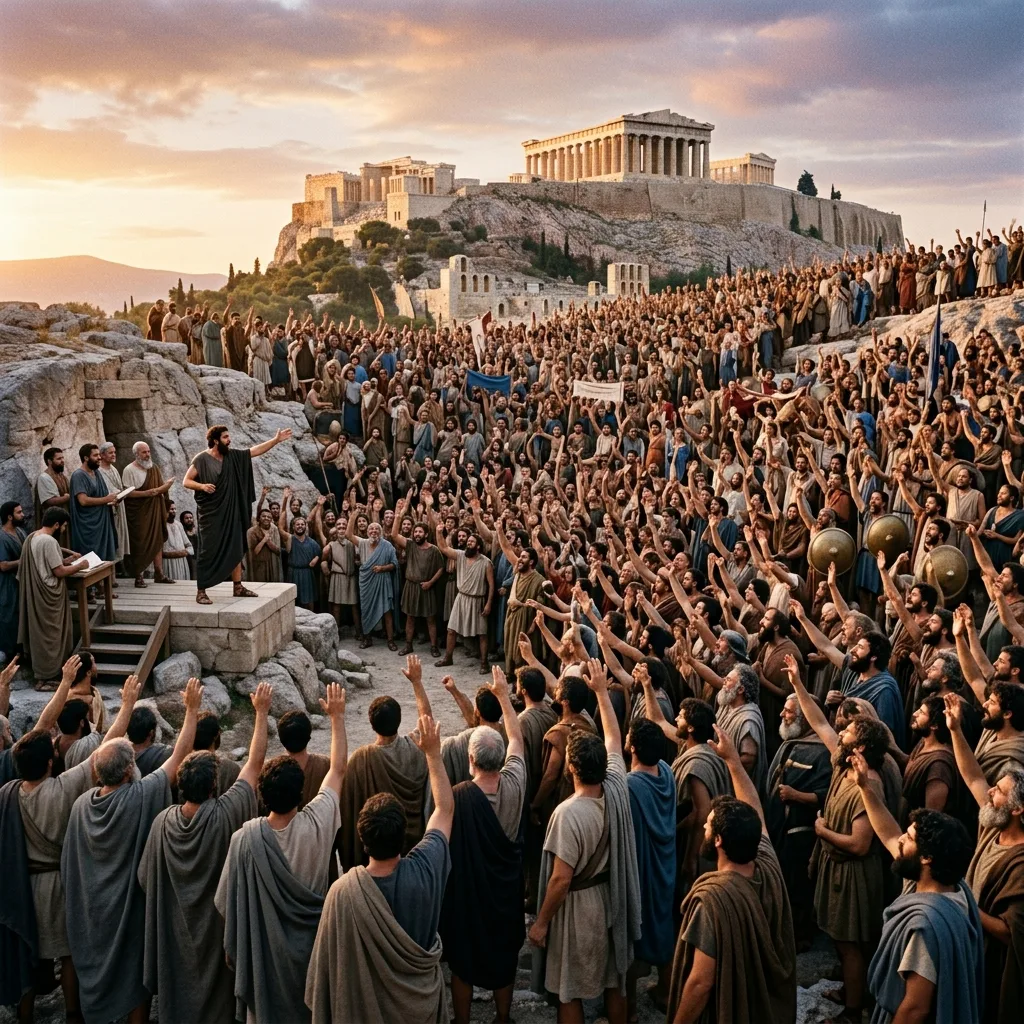
Following a populist uprising and the expulsion of the ruling tyrants, the Athenian aristocrat Cleisthenes fundamentally reforms the city's constitution, establishing the first documented democratic system in human history ("demokratia").
Open in interactive timeline →Key Numbers
- Founding reforms
- 508/507 BC
- New civic tribes
- 10 (from 4)
- Council of 500
- 50 men x 10 tribes
- Ostracism quorum
- 6,000 votes
- Adult male citizens
- ~30,000-40,000
Verified Facts
- The reforms credited with founding Athenian democracy were enacted by the aristocrat Cleisthenes around 508/507 BC, after the fall of the Peisistratid tyranny, and the Greeks themselves did not yet call the system demokratia but isonomia ('equality under the law').
- Cleisthenes' core innovation was to abolish the four old kinship-based Ionian tribes and reorganize the entire citizen body into 10 new artificial tribes, each deliberately mixing demes from the city, the inland, and the coast to break up the regional power blocs that had fueled aristocratic feuding.
- The fundamental administrative unit became the deme (a village or neighborhood); Attica was divided into roughly 139 demes, and a man's hereditary registration in his father's deme became the very definition of Athenian citizenship.
- Cleisthenes created the Boule, a Council of 500, filled by lot with 50 citizens drawn from each of the 10 tribes; it ran day-to-day government and set the agenda for the Assembly, with its tribal contingents (prytaneis) taking turns presiding through the year.
- Ostracism, traditionally attributed to Cleisthenes as a guard against renewed tyranny, allowed citizens to exile a man for 10 years by scratching his name on a pottery shard (ostrakon); a vote was only valid if at least 6,000 ballots were cast, and the first recorded victim was Hipparchus son of Charmus around 487 BC.
- Democracy's deeper roots reach back to Solon, who as archon around 594 BC enacted the seisachtheia ('shaking off of burdens'), cancelling debts and outlawing debt-slavery, and replaced birth with wealth as the basis of political rank through four property classes (pentakosiomedimnoi, hippeis, zeugitai, thetes).
- Many historians date the start of Athens' 'radical' democracy to 462 BC, when Ephialtes stripped the aristocratic Areopagus council of its political oversight powers and transferred them to the Assembly, Council, and popular courts; he was assassinated soon after.
- Pericles deepened the system by introducing state pay for public service around 461 BC, beginning with jury pay of two obols (later three) per day, which let poor citizens (thetes) afford to take part rather than lose a day's wages.
- The Assembly (Ekklesia) of all adult male citizens met about 40 times a year on the Pnyx hill, whose earliest form held roughly 6,000 people, matching the quorum required for major business such as ostracism.
- Despite its radical equality for members, the citizen body was a narrow slice of Attica's population, perhaps 30,000-40,000 adult males, since women, resident foreigners (metics), and the large enslaved population were entirely excluded.
The World at This Moment
The reforms unfolded amid a remarkable late-sixth-century convergence. Just a year earlier, Roman tradition dates the expulsion of Tarquinius Superbus and the founding of the Republic (509 BCE) — another aristocratic experiment in shared rule, though oligarchic rather than popular. To the east, Darius I ruled the Achaemenid Empire at near its greatest extent, having subjugated Thrace around 513–512 BCE; Persian power loomed over the Aegean and would soon collide with the Greeks. Athens itself, having just thrown off the Peisistratid tyranny (Hippias expelled 510 BCE with Spartan help), faced renewed Spartan intervention under Cleomenes I. Intellectually, this was the age later called "axial": Confucius (b. 551) was teaching in Lu, the Buddha (traditional dates c. 563–483) and Mahavira in India, and the Ionian natural philosophers (Heraclitus, soon Parmenides) reframing cosmology. Across the Greek world, isonomia ("equality before law") was becoming a contested political slogan, not unique to Athens but realized there with unusual institutional depth.
The Paradigm Shift
Cleisthenes' reorganization of the citizen body into ten artificial tribes drawn from coastal, urban, and inland demes deliberately fractured the regional power blocs of aristocratic clans, basing political identity on residence (the deme) rather than kinship. The Council of 500 (boulē), chosen by lot from the demes, prepared business for a sovereign Assembly. This institutionalized the radical premise that ordinary citizens, not birth or wealth, should collectively govern — what fifth-century Athenians named dēmokratia, "power of the people." The shift was not merely Athenian: it supplied the West's foundational vocabulary and template for self-government, direct participation, sortition, and accountability. Later thinkers from Aristotle's Politics and the Athēnaiōn Politeia to Enlightenment theorists and the American framers (often critically) measured their own constitutions against it. The reforms also helped catalyze Athens' fifth-century ascent — its naval empire, drama, philosophy, and historiography — by mobilizing citizen energy. Athenian democracy thus redirected political thought from rule by elites toward the still-debated ideal of collective popular sovereignty.
In Their Own Words
"Thus Athens went from strength to strength, and proved, if proof were needed, how noble a thing equality before the law is... for while they were oppressed under tyrants, they had no better success in war than any of their neighbours, yet, once the yoke was flung off, they proved the finest fighters in the world." — Herodotus, Histories 5.78 (on isēgoria / equality of speech and Athens' flourishing after the tyranny; A.D. Godley / Loeb-tradition translation)
Our constitution does not copy the laws of neighbouring states; we are rather a pattern to others than imitators ourselves. Its administration favours the many instead of the few; this is why it is called a democracy.
Pericles' Funeral Oration as reported by Thucydides, History of the Peloponnesian War 2.37 (Richard Crawley translation). Note: these are Thucydides' reconstruction of the speech, not a verbatim transcript of Pericles' own words. — source
And as for the fact that the Athenians have chosen the kind of constitution that they have, I do not think well of their doing this inasmuch as in making their choice they have chosen to let the worst people be better off than the good.
Pseudo-Xenophon, the so-called "Old Oligarch," Constitution of the Athenians 1.1 (trans. cited as E. C. Marchant). An anonymous oligarchic critic, c. 420s BC; the work was traditionally but wrongly ascribed to Xenophon. — source
These and other kindred characteristics are proper to democracy, which is a charming form of government, full of variety and disorder, and dispensing a sort of equality to equals and unequals alike.
Plato (in the voice of Socrates), Republic, Book VIII, 558c (Benjamin Jowett translation). Plato's critique of democracy. — source
In Depth
Rule by the Many: How Athens Invented the Citizen
Around 508/507 BC, the Athenian aristocrat Cleisthenes did something no ruler in the long human story had quite done before: he handed power, deliberately and structurally, to the ordinary free men of his city. The word that crowned the experiment was isonomia — equality before the law — and the institution that embodied it was a council of 500, the Boule, with its seats filled by lot from local communities called demes rather than by birth or wealth. It is one of the rare moments in history when an idea about how humans should govern themselves was not merely written down, as in the Code of Hammurabi (sv-hammurabi), but built into the daily machinery of a state.
The Long Approach March
Democracy did not erupt from nothing. Its deepest precondition was the Greek world's recovery from the Late Bronze Age Collapse (sv-bronze-collapse), which swept away the palace-kingships and left small, fiercely independent city-states to reinvent political life from the ground up. Into that vacuum came a shared culture stitched together by the epic tradition of Homer (sv-homer) and the moral cosmos of Hesiod (sv-hesiod), and a restless intellectual ferment — the Pre-Socratic Philosophers (sv-presocratics) of nearby Ionia, beginning with Thales of Miletus (sv-thales), who insisted the world could be explained by reason rather than royal decree. A society learning to question the cosmos was primed to question its kings.
The proximate cause was economic agony. Solon's reforms of 594 BC abolished debt-slavery — the seisachtheia, the "shaking off of burdens" — and opened the assembly to even the poorest citizens. The near-simultaneous Invention of Coinage (sv-coins) was monetizing Greek life, sharpening the divide between landed aristocrats and an emergent class of merchants and farmers who wanted a voice. Cleisthenes inherited Solon's half-finished work and finished it; in 462 BC, Ephialtes and the young Pericles stripped the aristocratic Areopagus of its powers, ushering in the "radical democracy" in which the popular assembly and juries of ordinary men held nearly absolute sway.
The Ripples Outward
What democracy unleashed was an extraordinary cultural detonation. The same civic confidence that let citizens debate war in the assembly produced Herodotus, the Father of History (sv-herodotus), who treated human events as worth explaining; the searching civic theater of Euripides' Bacchae (sv-bacchae); and, in reaction against democracy's excesses, the philosophical revolution of Plato & the Academy (sv-plato) and Aristotle & the Lyceum (sv-aristotle) — the latter cataloguing 158 constitutions to ask what the good polity actually was. Democracy thus seeded even its own most brilliant critics.
We should be honest about its limits. Athenian democracy excluded women, enslaved people, and resident foreigners; the "demos" was a minority of adult males. It was direct, not representative, and it could be cruel and impulsive — the very volatility that later thinkers feared.
That fear became its most consequential inheritance. When the architects of the modern world rediscovered Athens, they recoiled even as they borrowed. James Madison, in The Federalist Papers (sv-federalist-papers), warned that pure democracies were swept by passion, and the American Revolution (sv-american-revolution) deliberately chose a representative republic — a model owing as much to the Roman Republic (sv-roman-republic) as to Athens. Yet the foundational claim Cleisthenes made real — that legitimate authority flows upward from equal citizens — survived. It is the thread that connects a dusty Attic council chamber to nearly every constitution written since, an idea that took twenty-five centuries to become, for much of the world, simply assumed.
Causes & Consequences
What led to it
- Solon's reforms of 594 BC, including the seisachtheia or 'shaking off of burdens' that cancelled debts and abolished debt-slavery, eased the crushing class conflict between Athens' aristocrats and indebted poor that might otherwise have made any later power-sharing impossible.
- Solon also created wealth-based census classes, granted the right of any citizen (not just the injured party) to bring lawsuits, and established a right of appeal to a popular court, planting the procedural seeds of broader popular participation in governance.
- The tyranny of Peisistratus and his sons weakened the entrenched regional clans and factional aristocratic feuds, so that when it fell, no single noble house could simply reimpose the old order unchallenged.
- The overthrow of the Peisistratid tyranny in 510 BC, achieved when the exiled Alcmaeonid family secured the intervention of the Spartan king Cleomenes I, removed the autocratic regime and opened a contest over who would govern Athens next.
- After being defeated in the post-tyranny power struggle by his rival Isagoras, Cleisthenes made the decisive move of 'taking the people into his party,' appealing for support far beyond the usual aristocratic factions to the ordinary demos.
- When Cleomenes and Isagoras tried to dissolve the council and install a narrow oligarchy in 508-507 BC, the ordinary Athenian citizens rose up and besieged them on the Acropolis, forcing the Spartans to withdraw and clearing the way for Cleisthenes to enact his reforms.
What it set in motion
- Cleisthenes reorganized the citizen body into ten new tribes built from local demes spread across Attica, basing political identity on residence rather than kinship and thereby dissolving the regional clan loyalties that had long fueled civil strife.
- His reforms created the Council of 500 (the Boule) chosen from the demes and strengthened the citizen Assembly (ekklesia) as the sovereign body for laws, war, and foreign policy, establishing the institutional machinery of direct democracy.
- The practice of ostracism, attributed to Cleisthenes' program, gave the demos a tool to exile for ten years any figure judged too dangerous to the state, serving as a popular safeguard against the re-emergence of tyranny.
- Ephialtes' reforms of 462 BC stripped the aristocratic Areopagus council of its supervisory powers and transferred them to the popular courts and Assembly, a step many historians treat as the beginning of Athens' 'radical' democracy.
- Pericles extended popular access to government by introducing pay for jurors (and later other officeholders), enabling poorer citizens who could not afford to lose a day's wages to take a sustained part in public life.
- Athenian democracy bequeathed to later ages the foundational idea that ordinary people could collectively govern themselves, an ideal that, though revived through the Roman Republic and the Renaissance and reshaped into modern representative forms, continues to underpin democratic thought today.
The Live Academic Debate
Scholars dispute both the agent and the moment of democracy's birth. In Origins of Democracy in Ancient Greece (2007), Josiah Ober argues that the decisive act was a spontaneous, leaderless rising of the dēmos against Cleomenes; Cleisthenes responded to an already-awakened people rather than single-handedly inventing democracy (his "Athenian Revolution" thesis). Kurt Raaflaub counters that Cleisthenes' settlement was at most a "hoplite republic," with genuine demokratia — and the radical equality it implied — emerging only with the mid-fifth-century reforms of Ephialtes (462 BCE) and Pericles. A third strand, associated with Robert Wallace and earlier with the constitutional reading of the Athēnaiōn Politeia, stresses Solon's earlier sixth-century groundwork. Christian Meier and Paul Cartledge further debate when the very word dēmokratia was coined and how self-conscious the actors were. The disagreement turns on thin, late, and partisan sources (chiefly Herodotus and the Aristotelian Constitution of the Athenians) and on definitional questions: was democracy a sudden event, an evolving process, or a retrospective label?
How This Event Connects
The institutionalization of Athenian Democracy under Cleisthenes and Pericles constituted a radical sociopolitical experiment, replacing aristocratic kinship networks with a civic structure based on sortition, direct participation, and isonomia (equality before the law). This paradigm of popular sovereignty profoundly influenced the structural evolution of the Roman Republic, which, while far more oligarchic, similarly relied on complex checks and balances and the theoretical mandate of the citizen body (the populus) to legitimize state authority.
However, the chaotic reality of the Athenian assembly generated fierce contemporary critique, most famously articulated by Plato. Traumatized by the democratic execution of his mentor Socrates, Plato theorized democracy as fundamentally flawed—a "mob rule" driven by demagoguery and base appetites, inevitably devolving into tyranny. This anti-democratic intellectual tradition permeated Western political thought for centuries, establishing a profound skepticism toward direct majoritarian governance.
This historical anxiety directly informed the architects of the American Revolution. The Founding Fathers, deeply versed in classical history, explicitly sought to avoid the perceived instability of Athenian direct democracy. As detailed meticulously in the Federalist Papers, figures like Madison and Hamilton engineered a representative, constitutional republic specifically designed to filter popular passions through representative institutions, consciously attempting to synthesize the democratic ethos of Athens with the structural stability of the Roman Senate.
Democracy for the few: who was excluded
Pericles' celebration of rule by "the many" applied only to adult male citizens. As scholars of Athenian democracy such as Mogens Herman Hansen have emphasized, the demos systematically excluded women, enslaved people (a large share of the population), and metics (resident foreigners). Estimates hold that enfranchised adult male citizens were probably no more than about 30 percent of the adult population, and Pericles' own citizenship law of 451 BC narrowed the franchise further by requiring Athenian parentage on both sides.
The Counterfactual
Had Cleomenes I succeeded in 508/507 BCE — he expelled Cleisthenes and 700 households and tried to install Isagoras with a narrow oligarchic council — Athens might have become a Spartan-aligned oligarchy rather than a democracy. Herodotus (5.72–73) records that the Athenian dēmos besieged Cleomenes on the Acropolis and forced his withdrawal, a popular uprising that made the reforms possible. Without that resistance, the distinctive institutions of mass sortition and an empowered Assembly might never have crystallized, and the fifth-century naval democracy that funded the Delian League, tragedy, and the Periclean building program could have been stillborn. Counterfactual reasoning must stay cautious: isonomia ideals circulated elsewhere (Chios, perhaps, shows early council institutions), so some participatory politics might still have arisen in the Greek world. But the specific, deeply institutionalized Athenian model — the one antiquity and later Europe inherited as the paradigm of dēmokratia — was contingent on this fragile victory. Its loss would have impoverished the West's entire vocabulary of self-rule.
Myth vs. Reality
Myth: Cleisthenes (or Solon, or Pericles) single-handedly 'founded' Athenian democracy in one stroke in 508 BC.
Reality: Athenian democracy emerged through a chain of reforms across generations rather than a single founding act. The standard scholarly outline runs Solon (594 BC) to Cleisthenes (508/507 BC) to Ephialtes (462 BC) to Pericles. Cleisthenes' tribal and deme reorganization is usually treated as the decisive impulse, but Solon's earlier measures (ending debt-slavery, the right of appeal to the assembly) laid groundwork, and Ephialtes' stripping of the Areopagus' powers in 462 was crucial to the fuller democracy. Notably, later Athenians themselves tended to credit Solon and even the legendary Theseus as founders and increasingly ignored Cleisthenes, a perception modern scholars correct.
Myth: Athens was the world's first democracy, and democracy spread outward from Athens to the rest of Greece.
Reality: Eric W. Robinson's 'The First Democracies: Early Popular Government Outside Athens' (1997) challenged this view, arguing that by the time of Cleisthenes' reforms (c. 508 BC) numerous other Greek poleis had likely already adopted broadly democratic or popular constitutions, among them Argos, Megara, Chios, Syracuse, and others. The word 'demokratia' itself was coined only around the mid-fifth century (first attested in Herodotus); earlier Greeks described popular rule with terms like isonomia (equality under law) and isegoria (equal right to speak). Athens is best described as the most fully documented and influential early democracy, not provably the first.
Myth: In Athenian democracy, the people voted to elect their leaders and officials, much like a modern representative democracy.
Reality: Athenian democracy was a direct democracy in which most officials were selected by lot (sortition), not by election. The Council of Five Hundred (Boule), the large juries, and roughly six hundred administrative magistrates were filled by random selection, on the rationale that ordinary citizens were 'expert enough' and that the lot expressed civic equality (Mogens Herman Hansen, 'The Athenian Democracy in the Age of Demosthenes', 1991). Election was reserved for offices requiring special expertise, most famously the ten annually elected strategoi (generals), which is how figures like Pericles retained influence through repeated re-election.
Myth: Ostracism was a criminal punishment, a way of exiling and disgracing wrongdoers.
Reality: Ostracism was a political safety mechanism, not a penalty for any crime. A citizen voted out by ostracism left Athens for ten years but kept his property and citizenship and suffered no loss of honor or legal standing. Ancient sources (e.g. Plutarch) describe it as a means of lowering the standing of men who had grown too powerful rather than punishing guilt. Recent scholarship such as Marek Wecowski's 'Athenian Ostracism and its Original Purpose: A Prisoner's Dilemma' (Oxford, 2022) reinterprets it as a device for forcing compromise among rival elites and defusing dangerous political rivalries.
Myth: Athenian democracy meant rule by all the people, an inclusive system broadly resembling modern democracy.
Reality: Participation was restricted to adult male citizens, who formed a minority of the population. Women, enslaved people, and resident foreigners (metics) were entirely excluded from political rights, and after Pericles' citizenship law of 451/450 BC citizenship generally required two Athenian-citizen parents. Estimates commonly put those eligible to participate at only a fraction of Attica's inhabitants. The system was radically participatory and egalitarian among that enfranchised body, but it was not inclusive by modern standards, and treating it as such obscures both its achievement and its limits.
Frequently Asked Questions
Who founded democracy in Athens?
The Athenian statesman Cleisthenes is traditionally called "the father of Athenian democracy" for the reforms he introduced around 508-507 BCE, after allying himself with the popular assembly against the aristocracy. His reforms reorganized the citizen body into ten new tribes based on local demes and created a Council of 500 (the boule). Earlier groundwork was laid by Solon around 594 BCE, who opened the assembly to all citizens and eased debt burdens, but Solon's system balanced power among economic classes rather than giving rule to the demos. Democracy was further radicalized by Ephialtes and Pericles in the 460s-450s BCE.
When did Athenian democracy begin?
Athenian democracy is conventionally dated to the reforms of Cleisthenes in 508-507 BCE, often cited as the world's first known democracy. Some historians point earlier to Solon's reforms around 594 BCE as a foundation, while others emphasize the reforms of Ephialtes in 462 BCE, which stripped the aristocratic Areopagus council of most of its powers, as the start of "radical" democracy. The system reached its most developed form under Pericles in the mid-5th century BCE.
What does the word "democracy" mean and where does it come from?
The word comes from the Greek "demokratia," combining "demos" (the people or citizen body) and "kratos" (power or rule), meaning "rule by the people." The term itself emerged in connection with the Athenian system in the 5th century BCE. It described a form of government in which sovereign authority lay with the assembled citizens rather than with a king (monarchy) or a small elite (oligarchy).
Who was allowed to vote in ancient Athens?
Voting and political participation were limited to free-born adult male citizens aged 18 and older, and after Pericles' citizenship law of 451 BCE both parents had to be Athenian. Women, enslaved people, and resident foreigners (metics) were all excluded from political rights. At its height Athens had perhaps 30,000-40,000 eligible citizens out of a total population of around 200,000 to 300,000, meaning only a minority of inhabitants could take part in government.
How did Athenian democracy actually work?
It was a direct democracy: citizens voted on laws and policy themselves rather than electing representatives. The main bodies were the Ekklesia (the assembly of all eligible citizens, which met roughly 40 times a year on the Pnyx hill and decided laws, war, and foreign policy), the Boule (a council of 500 chosen by lot to set the agenda), and the dikasteria (large popular jury courts staffed by lottery-selected citizens). Most public offices were filled by lot rather than election, on the principle that any citizen was fit to govern, and Pericles introduced state pay for office so poorer citizens could afford to serve.
What was ostracism in Athenian democracy?
Ostracism was a procedure by which Athenian citizens could vote to banish a fellow citizen from the city for ten years, without confiscating his property or branding him a criminal. Once a year the assembly decided whether to hold an ostracism; if so, citizens scratched a name onto a pottery shard called an "ostrakon," and the man with the most votes was exiled, provided a quorum (traditionally said to be 6,000 votes) was met. It was designed as a safeguard against any individual growing powerful enough to threaten the democracy or become a tyrant.
Sources & Further Reading
- Cleisthenes — Wikipedia
- Kurt A. Raaflaub, Josiah Ober, and Robert W. Wallace, Origins of Democracy in Ancient Greece (University of California Press, 2007)
- Josiah Ober, The Athenian Revolution: Essays on Ancient Greek Democracy and Political Theory (Princeton University Press, 1996)
- Herodotus, The Histories, Book 5 (esp. 5.66, 5.69–73, 5.78)
- Aristotle (attrib.), The Constitution of the Athenians (Athēnaiōn Politeia), chs. 20–22
- Paul Cartledge, Democracy: A Life (Oxford University Press, 2016)
- Wikipedia: Athenian democracy
- World History: Athenian Democracy
Cite This Page
AskHistoryAI. “The Birth of Democracy in Athens.” AskHistoryAI — Interactive Timeline of Everything. Updated 2026-09-11. https://askhistoryai.com/event/sv-athenian-democracy/
Every fact on this page is checked against the published fact ledger and methodology; sources are listed above.