Herodotus: The Father of History
The invention of history as an investigative discipline.
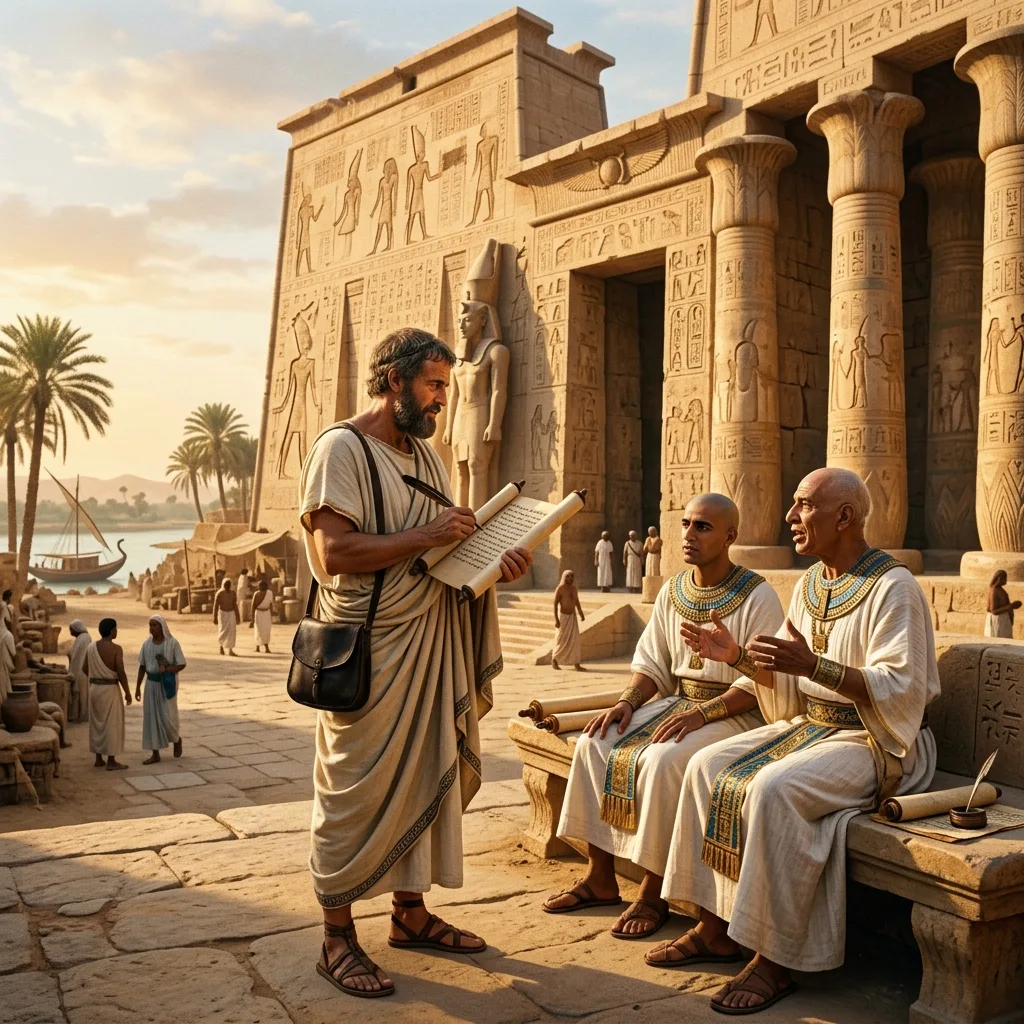
Herodotus publishes "The Histories," chronicling the Greco-Persian Wars. He travels, interviews people, and attempts to separate fact from myth, though he still includes tall tales.
Open in interactive timeline →Key Numbers
- Born / Died
- c. 484 - c. 425 BC
- The Histories published
- c. 425 BC
- Books (Muse-named)
- 9
- Length
- ~190,000 Greek words
- War covered
- Greco-Persian, 499-479 BC
Verified Facts
- Herodotus was born around 484 BC in Halicarnassus, a Greek city on the coast of Asia Minor (modern Bodrum, Turkey) that was then under Persian rule, making him a subject of the very empire whose wars he would later chronicle.
- The honorific 'Father of History' comes from the Roman orator Cicero, who in his treatise De Legibus (On the Laws, 1.5), written in the first century BC, called Herodotus 'pater historiae' (the father of history) -- though in the same breath Cicero noted his work was full of fabulous tales.
- Herodotus's Greek title, Historiai, literally means 'inquiries' or 'investigations'; the word historie did not yet mean 'study of the past' as we use it today, and his application of it to human events helped give the modern word 'history' its meaning.
- The famous division of the Histories into nine books, each named after one of the nine Muses (Clio, Euterpe, Thalia, Melpomene, Terpsichore, Erato, Polymnia, Urania, and Calliope), was not Herodotus's own doing but was imposed later by the scholars of the Library of Alexandria; the scheme is first attested in the first century BC.
- Herodotus's central subject is the Greco-Persian Wars (499-479 BC), including the legendary stands at Thermopylae and the naval victory at Salamis, but he frames the conflict within a sweeping ethnographic survey of Egypt, Persia, Scythia, Babylon, and other peoples.
- His proem states his purpose explicitly: to preserve the memory of human achievements so that 'the great and marvellous deeds of both Greeks and barbarians may not lose their glory (kleos),' and to set down the cause (aitie) of why the two sides came to war.
- Herodotus pioneered a method of inquiry that distinguished between opsis (what he saw himself, or 'autopsy'), akoe (what he heard from others), and ta legomena (tradition or report), generally privileging firsthand evidence while still recording -- and sometimes openly doubting -- hearsay.
- Around 443 BC Herodotus reportedly joined the Athenian-sponsored colony of Thurii in southern Italy, where ancient tradition holds he spent his later years and died around 425 BC.
- Because of his inclusion of marvels, tall tales, and unverifiable wonders, critics from antiquity onward also dubbed him the 'Father of Lies'; the biographer Plutarch even wrote a treatise titled 'On the Malice of Herodotus' attacking his reliability.
- Herodotus is widely regarded as the first prose historian in the Western tradition whose work survives intact, predating the more austere, war-focused method of his younger contemporary Thucydides, who pointedly distanced himself from Herodotus's storytelling style.
The World at This Moment
Herodotus (c. 484–c. 425 BCE) wrote during the high classical Athens of Pericles, likely reciting portions in the 440s–430s and circulating the finished Histories around the outbreak of the Peloponnesian War (431 BCE). The Acropolis building program (Parthenon, 447–432) was underway; Sophocles and Euripides dominated the tragic stage; the Sophists professionalized rhetoric and inquiry. Tradition links Herodotus to the panhellenic colony of Thurii in Italy (founded 444/443). Eastward, the Achaemenid Persian empire he chronicled remained the era's dominant power. Further afield, the Chinese Spring and Autumn period was giving way to the Warring States; the Buddha (d. c. 483) and Confucius (d. 479) had recently died, and a roughly contemporaneous turn toward systematic reflection across Eurasia is what Karl Jaspers later termed the "Axial Age." Herodotus thus belongs to a moment when inquiry, argument, and prose narrative were emerging as tools for explaining the human world without recourse to myth alone, alongside Hippocratic medicine and early natural philosophy.
The Paradigm Shift
Herodotus' achievement was to convert memory and hearsay into historiē — systematic "inquiry" — and to commit it to extended prose narrative. His proem announces a deliberately secular, evidentiary purpose: to preserve great deeds from oblivion and to investigate the aitia (causes) of the Greco-Persian conflict. Where Homer attributed events to divine will and the Muses, Herodotus interrogates witnesses, weighs competing accounts, signals his own doubts ("I am obliged to report what is said, but I am not obliged to believe it," 7.152), and distinguishes autopsy from report. He embedded ethnography, geography, and comparative cultural relativism (famously, "custom is king of all," 3.38) into the explanatory frame. This established history as a distinct genre separable from epic and myth, supplying the template Thucydides would tighten into rigorous political-military analysis. The very word "history" descends from his historiē. By making human causation, evidence-weighing, and narrative explanation central, Herodotus inaugurated a mode of understanding the past that runs continuously to modern critical historiography.
In Their Own Words
"This is the display of the inquiry [historiē] of Herodotus of Halicarnassus, so that things done by man not be forgotten in time, and that great and marvelous deeds, some displayed by the Hellenes, some by the barbarians, not lose their glory, including among others what was the cause of their waging war on each other." — Herodotus, Histories, proem (1.1), opening sentence (trans. after A. D. Godley / R. Waterfield)
In Depth
The Inquiry That Made Time Legible
When Herodotus of Halicarnassus opened his great work around the 440s BC with a promise that "the deeds of men not be erased by time," he was doing something that, on the scale of this timeline, is almost vanishingly recent. The universe had spent roughly fourteen billion years — from the first instant (sv-big-bang) through the forging of heavy elements in dying stars (sv-first-supernova) and the slow accretion of a habitable world (sv-earth-formation) — with no observer capable of recording its own past. Even after life learned to encode information chemically (sv-origin-of-life), memory was biological, mute, and unconscious. Herodotus represents the moment a species began deliberately to assemble, criticize, and narrate the record of itself.
Deep Preconditions
His achievement rested on a tall stack of human innovations. Durable record-keeping required the first writing systems (sv-cuneiform); the habit of explaining a shared past began with epic memory, the oral tradition crystallized by Homer (sv-homer) and the cosmic genealogies of Hesiod (sv-hesiod). But Herodotus broke decisively from these. Where epic credited events to the will of gods, he inherited a more radical solvent: the Ionian Pre-Socratics (sv-presocratics), beginning with Thales of Miletus (sv-thales), who insisted the world be explained in natural rather than divine terms. Herodotus borrowed his very method from these Milesians — his predecessor Hecataeus had already written prose geographies — and turned their rationalizing impulse from physics toward human affairs. The Greek word he chose, historiē, simply meant "inquiry" or "investigation"; only because of his book does it now mean the study of the past itself.
The Subject and the Method
His subject was the Greco-Persian Wars of 499–479 BC, but he treated them as the climax of a vast story: the rise of the Persian empire and the improbable resistance of a fractious, newly self-governing Greece. The conflict mattered partly because Athens had just invented a startling form of politics (sv-athenian-democracy), and Herodotus was fascinated by why free men fought differently than subjects. To explain Xerxes, he digressed across Egypt, Scythia, and Babylon, interviewing witnesses, weighing hearsay, and often telling readers when he doubted his own sources. Cicero, writing four centuries later, would crown him pater historiae — the Father of History.
Ripple Effects
The form he created proved astonishingly durable. His younger contemporary Thucydides sharpened it into hard political analysis, and the lineage runs straight through the great biographer Plutarch (sv-plutarch) and the Roman historian Tacitus (sv-tacitus), down to the modern discipline. When the Library of Alexandria (sv-library-alexandria) gathered the world's texts, it was Herodotus's model of the critical, written record that justified the whole enterprise of preserving knowledge across generations. The Hellenistic world that Alexander (sv-alexander) flung open — and the cosmopolitan curiosity about Egyptian, Persian, and Babylonian custom that drove writers like Manetho — is unimaginable without the Herodotean assumption that other peoples' pasts are worth recording accurately rather than mythologizing.
That assumption is, ultimately, the precondition for this very timeline. A civilization that can write down its own history, criticize its sources, and trace causation across centuries is also one that can eventually reconstruct the deep past it never witnessed — the supernovae, the extinctions, the human-chimpanzee split. Every later instrument of accumulated knowledge, from the printing press (sv-printing-press) to the searchable digital record of the World Wide Web (sv-www), extends the same gamble Herodotus made first: that organized inquiry can rescue the human story from oblivion. Cosmic time produced one creature stubborn enough to insist that what happened should be known. He lived in Halicarnassus, and he began with the word inquiry.
Causes & Consequences
What led to it
- The adaptation of the Phoenician alphabet into a full Greek writing system, with vowels, gave Greeks of the Archaic and Classical periods the practical means to record long, complex prose narratives that earlier oral cultures could not fix in durable form.
- The sixth-century BCE Ionian Enlightenment centered on Miletus, where thinkers such as Thales and Anaximander (credited with one of the first Greek prose works, 'On Nature') sought natural rather than divine explanations, established the habit of reasoned, evidence-based inquiry that Herodotus inherited.
- Hecataeus of Miletus and the earlier logographers pioneered prose genealogies and geographies that rationalized myth, and Herodotus openly drew on Hecataeus's method of sorting legend from likely fact while criticizing his predecessors' disconnected 'logographies.'
- Homer's epics supplied Herodotus with his model of grand scale and his governing aim that great deeds 'not go unrecorded,' so much so that his fellow Halicarnassians called him 'the Homer of prose.'
- The Achaemenid Persian Empire's infrastructure, including the roughly 2,500-kilometer Royal Road from Susa toward the Aegean that Herodotus himself described, opened the vast, interconnected world he traveled through Egypt, Babylonia, Lydia, and beyond to gather his eyewitness 'autopsies' and local informants.
- The Greco-Persian Wars of 499-449 BCE provided a single momentous subject of pan-Hellenic significance whose causes and course Herodotus could investigate as a unified narrative, giving his inquiry a coherent theme rather than scattered tales.
What it set in motion
- Herodotus gave the Western world its very concept and name for the discipline: his opening word 'historie,' Ionian Greek for 'inquiry' or 'investigation,' became the root of the word 'history' in European languages.
- Around the first century BCE the Roman orator Cicero, in his 'On Laws' (De Legibus), named Herodotus 'the Father of History' (pater historiae), a title that has fixed his foundational status in Western thought ever since.
- His near-contemporary Thucydides reacted against Herodotus's digressions and fabulous elements to write a tighter, more austere political and military history, so that the two together established the twin poles of Western historiography.
- By immersing himself in foreign cultures and reporting their customs without assuming Greek superiority, Herodotus pioneered ethnographic description and a form of cultural relativism, captured in his story of Darius showing that 'custom is king of all,' which later commentators credit as a root of social anthropology.
- His method of gathering multiple accounts, weighing their credibility, and sometimes reporting a story while withholding personal belief established source criticism and evidence-based investigation as the working standard for later historians.
- Because his 'Histories' is the earliest surviving prose history and preserves vast detail on the Persian Empire, the Royal Road, Egypt, Scythia, and the wars, it remains a primary, often irreplaceable, documentary source for reconstructing the ancient Mediterranean and Near Eastern world.
The Live Academic Debate
A live debate concerns Herodotus' reliability and the status of his cited sources. The "Liar School," named for W. Kendrick Pritchett's polemical The Liar School of Herodotos (1993), targets Detlev Fehling (Die Quellenangaben bei Herodot, 1971; English ed. Herodotus and His Sources, 1989), who argued that Herodotus' source-citations are largely a literary fiction — invented authorities deployed for narrative effect rather than records of genuine inquiry. Pritchett, mobilizing archaeology and topography, defended Herodotus as a substantially accurate reporter. Between these poles stand mediating positions: the older view of Felix Jacoby (RE article, 1913), who treated Herodotus as a serious if developing researcher, and narratological readings (e.g., John Marincola, Carolyn Dewald) that bracket the truth question to analyze Herodotus' self-presentation as inquirer. Recent scholarship (Rosaria Vignolo Munson, Robert Fowler) increasingly reads his "lies" as conventions of oral tradition and rhetorical framing rather than deliberate deception, while acknowledging genuine errors. The debate remains unresolved: how much of Herodotus is reportage, how much artful construction?
How This Event Connects
Herodotus of Halicarnassus fundamentally ruptured the mythopoetic continuum by inventing the discipline of historiê (inquiry). By transitioning the cultural narrative from the divinely inspired epic tradition of Homer to a methodical, prose-based investigation of human causality, Herodotus secularized the past. He replaced the absolute authority of the Muse with critical ethnographic observation, actively juxtaposing conflicting accounts to construct a multi-vocal, rationalized narrative of the Greco-Persian Wars.
The thematic core of Herodotus's Histories is deeply intertwined with the ideological defense of Athenian Democracy. Herodotus frames the conflict not merely as a territorial dispute, but as a cosmic and structural clash between Oriental despotism and Hellenic eleutheria (freedom). His text serves as a foundational ideological document justifying the nascent Athenian hegemony, intertwining the survival of Greece with the unique vitality of its democratic institutions.
In the broader historiographical tradition, Herodotus established the narrative and ethnographic templates that later historians would simultaneously emulate and critique. While Roman historians like Tacitus would adopt the Herodotean project of diagnosing cultural decline and the moral consequences of imperialism, later biographers such as Plutarch would explicitly distinguish their character-driven moral philosophy from Herodotus's sprawling geopolitical canvas, ensuring that the epistemological parameters of "history" remained a site of perpetual methodological contestation.
The Counterfactual
Had Herodotus not composed a continuous prose inquiry on this scale, the genre of history would not have vanished — logographers like Hecataeus of Miletus were already writing prose geography and genealogy, and Ionian rationalism was in the air. But the specific shape of Western historiography would likely differ. Thucydides explicitly defines his method against a Herodotean predecessor whose ethnographic digressions and source-citations he both inherits and disciplines; without that foil, the austere "scientific" Thucydidean model might lack its counterweight, and history could have remained closer to antiquarian chronicle or rhetorical display. The wholesale preservation of Persian War memory — Marathon, Thermopylae, Salamis — depends heavily on Herodotus; absent his account, our knowledge of the Achaemenid world and of fifth-century Greek self-definition against "the barbarian" would be drastically thinner, forcing reliance on fragmentary inscriptions and later compilers. As Arnaldo Momigliano argued, Herodotus' fusion of ethnography with political narrative was not inevitable; its loss would have impoverished the conceptual repertoire later historians took for granted.
Myth vs. Reality
Myth: Herodotus was the first person ever to write history or prose, inventing the genre from nothing.
Reality: Herodotus was working within an existing tradition of Ionian prose writers known as logographers. Dionysius of Halicarnassus names several predecessors, the best attested being Hecataeus of Miletus, whose Genealogia and Periodos Ges ('Trip Around the World') predate Herodotus's Histories. Hecataeus had already opened a work by declaring he would write 'what I consider the truth,' rejecting the contradictory tales of the Greeks. Herodotus's genuine innovation was not prose itself but the scale and ambition of his project: explaining the causes of a great war and exploring whole cultures at epic length, rather than compiling unadorned local genealogies.
Myth: Cicero called him 'the Father of History' because his account was regarded as accurate and authoritative.
Reality: The phrase pater historiae comes from Cicero's De Legibus (1st century BC), but in the very same passage Cicero noted that Herodotus's work contains countless fabulous stories (innumerabiles fabulae). The title honored Herodotus for being the first in the West to investigate the causes of events and weave them into a long causal narrative, not for factual reliability. The compliment was qualified from the start.
Myth: Plutarch literally titled a book 'The Father of Lies' to brand Herodotus a fraud.
Reality: The damning reputation traces to Plutarch's essay De Herodoti malignitate ('On the Malice of Herodotus'), written in the 1st-2nd century AD, which accused Herodotus of prejudice and misrepresentation. The catchy 'Father of Lies' epithet is a later characterization that grew out of this hostile tradition, not a phrase Plutarch coined as a title. Scholars also note Plutarch's attack was partly motivated by local pride: Herodotus had reported that Plutarch's own people, the Boeotians, sided with the invading Persians.
Myth: The Histories was meant as a collection of myths and entertaining tall tales rather than serious investigation.
Reality: The Greek title, historiai, did not yet mean 'history' in the modern sense; it meant 'inquiries' or 'investigations,' so a more literal rendering is 'The Inquiries of Herodotus.' Herodotus applied a methodology, ranking eyewitness testimony (opsis) above hearsay (akoe) and frequently flagging which reports he doubted or merely passed along without endorsing. He transformed the word historie from 'inquiry' into the name of an entire discipline precisely because his project was investigative, not merely a storybook.
Myth: Herodotus personally traveled to and witnessed everything he describes, such as Egyptian embalming and the pyramids.
Reality: Many historians doubt that Herodotus saw firsthand much of what he reports. His Egyptian account, for example, gives detailed descriptions of the great pyramids yet never mentions the Sphinx, a suspicious omission, and he himself often states he is relaying secondhand reports rather than personal observation. Scholars take a middle position: he likely did travel and see something of Egypt and the Black Sea region, but a large share of his material came from local informants and oral tradition, which he recorded faithfully without always vouching for its truth.
Frequently Asked Questions
Why is Herodotus called the "Father of History"?
The title comes from the Roman orator Cicero, who in the 1st century BC called Herodotus the "father of history" (pater historiae). He earned it because he was the first known writer to investigate the past systematically, gather accounts from many sources, and try to explain events through cause and effect rather than divine myth or epic poetry. His work essentially invented the genre of prose history as a distinct field of inquiry.
When did Herodotus live and where was he from?
Herodotus was born around 484 BC in Halicarnassus, a Greek city on the southwestern coast of Asia Minor (modern Bodrum, Turkey), then under Persian influence. He lived through the mid-5th century BC and traveled widely across the ancient world, including Egypt, Babylonia, and the Black Sea region, before settling at the Athenian colony of Thurii in southern Italy. He is traditionally thought to have died around 425 BC.
What is Herodotus's "The Histories" about?
The Histories is a long prose work, first circulated around 430 BC, that recounts the Greco-Persian Wars of the early 5th century BC, including the famous clashes at Marathon, Thermopylae, and Salamis. Beyond the war itself, it is a sweeping survey of the peoples, geography, and customs of the known world, woven together with the question of why the Greeks and Persians came into conflict. The Greek title means "inquiries" or "investigations," which is the root of the modern word "history."
Why is Herodotus also called the "Father of Lies"?
Some ancient and modern critics gave him this nickname because The Histories includes fantastical material, such as giant gold-digging ants, flying snakes in Arabia, and tales he could not verify. The Spanish humanist Juan Luis Vives (1493–1540) is often credited with inverting Cicero's praise into the "father of lies" label. In fairness, Herodotus frequently distinguished between what he saw, what he was told, and what he personally doubted, often reporting stories while noting that he did not necessarily believe them.
How is Herodotus different from Thucydides?
Both were foundational Greek historians, but they differ sharply in method. Herodotus drew heavily on oral accounts, travel observation, and colorful digressions, and he reported many stories without passing firm judgment on them. Thucydides, who wrote about the later Peloponnesian War between Athens and Sparta, took a more analytical and austere approach, focusing on political and military causes and is often called the first "scientific" historian.
Were any of Herodotus's strange stories later proven true?
Several accounts once dismissed as fiction have found plausible real-world explanations. His "gold-digging ants" of India may reflect Himalayan marmots, which burrow in gold-bearing soil on the Deosai Plateau in present-day Pakistan, where locals have long gathered gold dust; one theory holds Herodotus confused a Persian word for marmot with one for ant. Archaeological and ethnographic findings have corroborated some of his geographic and cultural details, which is why scholars caution against dismissing him outright even where he repeats hearsay.
Sources & Further Reading
- Herodotus — Wikipedia
- Detlev Fehling, Herodotus and His Sources: Citation, Invention and Narrative Art (1989; orig. Die Quellenangaben bei Herodot, 1971)
- W. Kendrick Pritchett, The Liar School of Herodotos (1993)
- Arnaldo Momigliano, 'The Place of Herodotus in the History of Historiography' (1958), in Studies in Historiography
- John Marincola, Greek Historians (Greece & Rome New Surveys in the Classics, 2001)
- Carolyn Dewald and John Marincola (eds.), The Cambridge Companion to Herodotus (2006)
- Read: The Histories
Cite This Page
AskHistoryAI. “Herodotus: The Father of History.” AskHistoryAI — Interactive Timeline of Everything. Updated 2026-09-11. https://askhistoryai.com/event/sv-herodotus/
Every fact on this page is checked against the published fact ledger and methodology; sources are listed above.