Augustus & The Roman Empire
The foundation of the Empire and the Pax Romana.
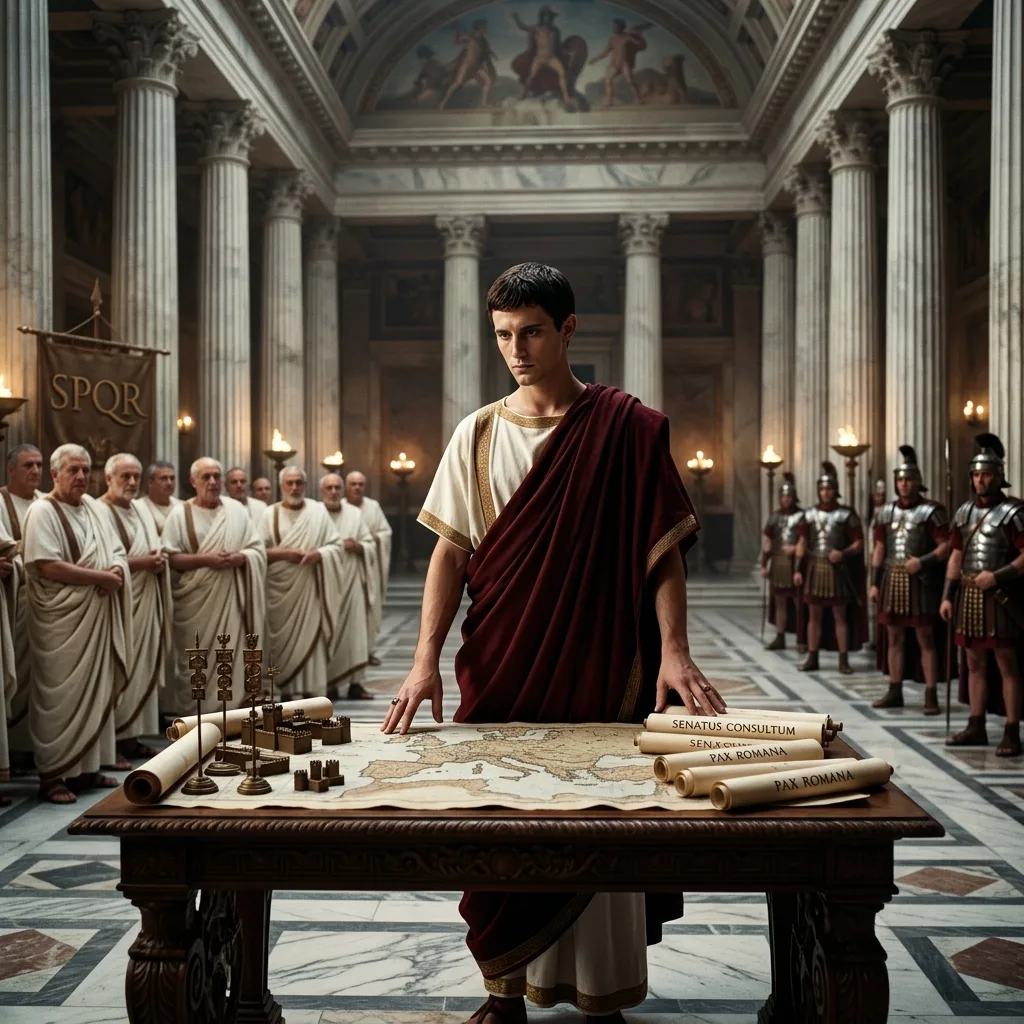
After the assassination of Julius Caesar and years of civil war, Octavian is granted the title "Augustus," effectively becoming the first Roman Emperor. He initiates a two-century period of relative peace known as the Pax Romana.
Open in interactive timeline →Key Numbers
- Reign
- 27 BC – AD 14 (~41 years)
- Empire population
- ~45-60 million
- Standing army
- 28 legions
- Roman citizens (AD 14 census)
- 4.94 million
- Pax Romana span
- ~200 years
Verified Facts
- Born Gaius Octavius on 23 September 63 BC, he became the adopted heir of Julius Caesar and, after defeating Mark Antony and Cleopatra at the naval Battle of Actium on 2 September 31 BC, emerged as sole master of the Roman world.
- In 27 BC the Senate granted him the honorific title 'Augustus' ('the revered one') along with extraordinary proconsular powers and control over the provinces holding most of Rome's legions, an arrangement that quietly converted the Republic into a monarchy he disguised as restored Republican government.
- He ruled until his death on 19 August AD 14, a reign of roughly 41 years that was the longest of any Roman emperor and inaugurated the Pax Romana, a period of relative peace across the Mediterranean lasting until the death of Marcus Aurelius in AD 180.
- His own first-person memorial inscription, the Res Gestae Divi Augusti, records three censuses of Roman citizens: 4.06 million in 28 BC, 4.23 million in 8 BC, and 4.94 million in AD 14, figures historians still debate as to whether they count adult males only or include women and children.
- Modern scholars estimate the total population of the empire at his death at roughly 45 to 60 million people, with some high-count estimates (e.g. Kyle Harper) reaching as high as 75 million at the demographic peak.
- Suetonius reports that Augustus boasted he 'found Rome a city of brick and left it a city of marble' (Life of Augustus 28), a claim about his vast building program that scholars treat as partly propagandistic, since digital reconstructions show the physical transformation was less total than the boast implies.
- He professionalized the Roman military, reducing the number of legions from over 60 to a permanent standing army of about 28 legions, instituting fixed terms of service (extended to 20 years in AD 6) funded by a dedicated military treasury, the aerarium militare, and creating the elite Praetorian Guard.
- In AD 9 the Germanic leader Arminius ambushed and annihilated three legions (XVII, XVIII, and XIX) under Publius Quinctilius Varus in the Teutoburg Forest; Suetonius records that the grief-stricken Augustus beat his head against a door crying 'Quinctilius Varus, give me back my legions,' and the three legion numbers were never reused.
- The Teutoburg disaster convinced Augustus to abandon plans to push the frontier to the Elbe River, effectively fixing Rome's northern boundary at the Rhine and shaping European geography for centuries.
- In 8 BC the Senate renamed the month Sextilis to 'Augustus' (our August) in his honor, choosing that month because several pivotal events of his rise to power, including the fall of Alexandria, had occurred in it.
The World at This Moment
Augustus consolidated power after Actium (31 BC) and the settlements of 27 and 23 BC in a world of contemporaneous mature empires. In China, the Western Han under Emperor Cheng (r. 33–7 BC) governed a comparably vast bureaucratic state from Chang'an; scholars in the "comparative studies of the Roman and Han empires" literature treat the two as the era's twin "imperial anchors." In the Near East, Herod the Great ruled Judaea as a Roman client king, rebuilding the Jerusalem Temple, while the recently annexed Egypt (30 BC) became Augustus's personal grain-source. Parthia remained Rome's great rival east of the Euphrates until the diplomatic standards-return of 20 BC. The Hellenistic kingdoms born of Alexander's conquests had now been absorbed, leaving the Mediterranean a single Roman lake. India's post-Mauryan polities traded across the Indian Ocean monsoon routes that Augustan Egypt opened. The Pax Romana that historians date from 27 BC thus coincided with a Eurasia-wide moment of large, centralized, literate empires linked by emerging long-distance commerce.
The Paradigm Shift
Augustus engineered the transition from the Roman Republic's oligarchic res publica to a veiled monarchy that endured, in some form, until 1453. Refusing the title rex, he fused republican magistracies—proconsular imperium over the armed provinces and tribunician power—into a permanent personal supremacy he glossed as mere auctoritas. This "restored Republic" (res publica restituta) preserved the Senate, consuls, and traditional vocabulary while relocating sovereignty in one man and, crucially, in his control of a standing professional army loyal to its paymaster. The system, the Principate, solved the structural crisis whereby Republican institutions could no longer govern a Mediterranean empire, ending a century of civil war from the Gracchi to Actium. It established dynastic succession (however unstable), provincial administration, a fiscus, and an imperial cult, and underwrote the cultural efflorescence of Virgil, Horace, Livy, and Ovid. By demonstrating that autocracy could masquerade as continuity, Augustus created the template that every subsequent emperor, and many later monarchs, would imitate.
In Their Own Words
"Post id tempus auctoritate omnibus praestiti, potestatis autem nihilo amplius habui quam ceteri qui mihi quoque in magistratu conlegae fuerunt. ("After that time I excelled all in authority [auctoritas], but I had no more power [potestas] than the others who were my colleagues in each magistracy.")" — Augustus, Res Gestae Divi Augusti 34.3 (the emperor's own funerary account of his deeds, composed by AD 14 and inscribed on bronze tablets, surviving chiefly in the Monumentum Ancyranum)
In my sixth and seventh consulships, when I had extinguished the flames of civil war, after receiving by universal consent the absolute control of affairs, I transferred the republic from my own control to the will of the senate and the Roman people. After that time I took precedence of all in rank, but of power I possessed no more than those who were my colleagues in any magistracy.
Augustus, in his own Res Gestae Divi Augusti, 34 (Shipley translation) — his first-person account, inscribed across the empire — source
[He] so beautified it that he could justly boast that he had found it built of brick and left it in marble.
Suetonius, Life of Augustus, 28 — reporting Augustus's boast (commonly misquoted as the emperor's own first-person words; it is Suetonius's, not from the Res Gestae) — source
Augustus won over the soldiers with gifts, the populace with cheap corn, and all men with the sweets of repose, and so grew greater by degrees, while he concentrated in himself the functions of the Senate, the magistrates, and the laws.
Tacitus, Annals, 1.2 (Church and Brodribb translation) — the classic charge that he bought autocracy rather than seizing it — source
In Depth
The Architecture of a Peace: How One Man Turned a Republic Into a World
Augustus did not conquer the Roman world so much as inherit its wreckage and refuse to let go. When he emerged victorious at the Battle of Actium in 31 BC, defeating Mark Antony and Cleopatra, he stood atop the ruins of a constitution that had been dying for a century. The deep precondition of his reign was that long collapse: the senatorial oligarchy of The Roman Republic (sv-roman-republic) had outgrown the city-state institutions meant to govern it, and the resulting strain produced a sequence of warlords. Sulla Marches on Rome (sv-sulla) first proved that legions loyal to a general could override the Senate; Julius Caesar Crosses the Rubicon (sv-julius-caesar) carried that logic to dictatorship and assassination. Octavian, Caesar's adopted heir, learned the era's central lesson — that civil war was endemic — and built a system designed to end it.
Inventing the Principate
What makes 27 BC a hinge of history is the genius of its disguise. Rather than crown himself king, Augustus claimed to have "restored the Republic," accepting from the Senate the cultic name Augustus ("the revered one") and the modest title princeps, "first citizen." Beneath this republican costume he held the substance of power: command of the armies, control of the treasury, and a personal authority (auctoritas) no rival could match. This fiction inaugurated the Pax Romana, two centuries of relative peace stretching from Britain to the Euphrates. The machinery he assembled — standing professional legions, a provincial census, a road and postal network, and an emerging civil bureaucracy — would shelter every figure who came after. The Stoic moralist Seneca the Younger (sv-seneca), the philosopher-emperor of Marcus Aurelius & the Meditations (sv-marcus-aurelius), and the historian who indicted the whole experiment in Tacitus: the Annals & Histories (sv-tacitus) all wrote inside the political space Augustus designed.
Marble, Census, and a Child in Bethlehem
Augustus understood that power must be made visible. Suetonius reports his boast that he "found Rome a city of brick and left it a city of marble" — a building program that fused state and spectacle, later echoed in monuments like Construction of the Colosseum (sv-colosseum). He also fused state and religion: the imperial cult that grew around him gave the sprawling empire a shared object of devotion and, after his death in AD 14, his formal deification. That sacralized authority set the template a later emperor would repurpose for a new faith at Constantine & Nicaea (sv-constantine-legal).
The ripple most familiar to the modern reader is administrative. The Gospel of Luke opens its nativity by dating Jesus' birth to a census "when Augustus decreed that all the world should be registered." Whatever the historical tangles of that passage, it captures a real truth: the bureaucratic reach of Augustus' state is the stage on which the Christian story is set, and the friction his order generated would erupt at The Fall of the Second Temple (sv-second-temple) and again under Hadrian & the Bar Kokhba Revolt (sv-hadrian-bar-kokhba).
The Long Shadow
Augustus' deepest legacy is conceptual. He demonstrated that a vast, diverse territory could be held together by a single durable institution rather than by the personal charisma that had dissolved the empire of Alexander the Great (sv-alexander) within a generation of his death. The word Kaiser, the word Czar, and the very idea of a transcendent imperial sovereignty descend from his name and his settlement. For four hundred years the Mediterranean world would imagine order itself in Augustan terms — a peace bought with armies, sanctified by cult, and dressed in the borrowed language of a Republic that no longer existed.
Causes & Consequences
What led to it
- The breakdown of Roman Republican government in the era of Marius and Sulla, including Sulla's marches on Rome and his dictatorship (88-79 BCE), shattered the norm against using armies in politics and set the precedent of one-man rule that Augustus would later inherit.
- The Marian reforms and the rise of professional armies loyal to their generals rather than the state meant that commanders like Pompey and Caesar could command personal armies, a dynamic Octavian exploited by raising private legions to enter politics.
- Julius Caesar's crossing of the Rubicon in 49 BCE and his victory in the ensuing civil war made him dictator and demonstrated that sole power over Rome was attainable, providing both the model and the inheritance for his heir.
- Caesar's assassination on the Ides of March, 44 BCE, and his will adopting the 18-year-old Octavian as his son and heir gave Octavian the Caesarian name, fortune, and loyalty of Caesar's veterans that launched his political career.
- The Second Triumvirate of 43 BCE, legally uniting Octavian with Mark Antony and Lepidus, allowed them to defeat Caesar's assassins Brutus and Cassius at Philippi in 42 BCE and proscribe their enemies, consolidating Octavian's faction.
- Octavian's naval victory over Antony and Cleopatra at the Battle of Actium in 31 BCE, following his earlier sidelining of Lepidus, left him the sole master of the Roman world and ended decades of civil war.
What it set in motion
- The settlement of 27 BCE, in which the Senate granted Octavian the name Augustus and a privileged position as princeps, created the Principate, a system that preserved republican forms while concentrating real power in the emperor and lasted until the Crisis of the Third Century.
- Augustus inaugurated the Pax Romana, a roughly two-century period of relative internal peace and prosperity across the Mediterranean that enabled trade, urbanization, and cultural flourishing throughout the empire.
- Augustus transformed Rome's military into a permanent standing army of professional legions paid from a central military treasury and created the Praetorian Guard, institutionalizing imperial control of armed force for centuries.
- Augustus founded the Julio-Claudian dynasty, and his transfer of power to his stepson Tiberius established hereditary imperial succession that shaped the next several emperors and the very institution of monarchy in Rome.
- The imperial cult initiated under Augustus, including his posthumous deification, became a unifying religious and political institution across the provinces and a model of ruler-worship that later emperors continued.
- Augustus's administrative reforms, including regular provincial censuses, restructured taxation, and reorganized provinces, built a durable bureaucratic framework whose legal and governmental legacy influenced Western law, governance, and even the calendar month named in his honor.
The Live Academic Debate
The central debate concerns the nature of the Augustan settlement. Ronald Syme's The Roman Revolution (1939), written under the shadow of fascism, portrayed Augustus's "restored Republic" as "a screen and a sham," masking a coup by a new oligarchy bound to a warlord enriched by proscription—a regime built on "fraud and bloodshed." Against this cynical, prosopographical reading, Karl Galinsky's Augustan Culture (1996) advanced an "evolutionary," continuity-minded interpretation, arguing Syme projected his own era's totalitarianisms onto Rome and that Augustan ideology genuinely engaged Republican values and shared moral renewal rather than mere propaganda. Werner Eck's biography stresses the practical, administrative achievement, while debate continues over whether auctoritas (Res Gestae 34) was a real constitutional category or rhetorical gloss—as analyzed in J. A. Crook's and more recent JRS scholarship (e.g., Galinsky's reassessments; the "Reconsidering the Auctoritas of Augustus" discussions). Most current scholars reject the stark Syme/Galinsky binary as too simple, favoring dynamic models of negotiated consensus between princeps, Senate, army, and populace.
How This Event Connects
The regime of Augustus represents the most successful and enduring political sleight-of-hand in classical history, permanently solving the crisis of the Roman Republic by destroying it from within. Modern legal and political historians analyze the "First Settlement" of 27 BCE not as a genuine restoration of Republican norms, but as an unprecedented masterpiece of institutional hypocrisy. By retaining absolute control of the military provinces through imperium proconsulare while ostentatiously returning control of the state to the Senate, Augustus managed to consolidate autocracy without triggering the aristocratic gag reflex. This sophisticated ideological camouflage was essential to ending a century of civil war, successfully replacing the chaotic, hyper-competitive oligarchy with a stable, dynastic Principate masked in traditional semantic clothing.
This masterful political architecture was a direct, calculated response to the failure of his adoptive father, Julius Caesar. Caesar had possessed the raw military brilliance to conquer the Republic, but he lacked the political subtlety to institutionalize his victory, flaunting the title of dictator perpetuo and thereby provoking his own assassination. Augustus acutely learned from Caesar’s hubris, realizing that absolute power in Rome required the illusion of shared governance. However, the path to this stable autocracy was paved with immense blood; during his early rise as the young Octavian, he ruthlessly employed the terrifying mechanism of proscriptions, directly utilizing the brutal blueprint established when Sulla Marches on Rome to systematically liquidate his political opposition and fund his private legions.
The long-term legacy of Augustus’s methodology—specifically his use of massive public works and architectural propaganda to embed imperial ideology into the daily spatial reality of Rome—became the gold standard for subsequent dynasties. When the Julio-Claudian line collapsed into civil war, the triumphant Flavian dynasty sought to legitimize their new regime by consciously emulating Augustan stability. The monumental Construction of the Colosseum, built over the site of Nero's private lake, was a brilliant execution of Augustan-style populist propaganda, physically demonstrating the new emperors' commitment to the public good and violently reinforcing the hierarchical social order that Augustus had originally engineered.
The edge of empire — Germania, 9 CE
The Res Gestae projects an unbroken golden age, but Augustus's reign had hard limits. In 9 CE the Germanic leader Arminius annihilated three legions under Varus in the Teutoburg Forest, permanently halting Roman expansion east of the Rhine. Suetonius reports that the aging emperor was so shaken he let his hair grow and would strike his head against a door, crying for Varus to give him back his legions. When Roman troops reached the site years later, Tacitus described "the whitening bones of men, as they had fled or stood their ground, strewn everywhere or piled in heaps" — a memorial to the peoples who refused to be pacified.
The Counterfactual
Had Antony and Cleopatra prevailed at Actium, the empire's center of gravity might have shifted eastward toward Alexandria, with a Hellenistic-flavored monarchy openly acknowledging kingship rather than Augustus's republican camouflage; yet most historians doubt the Republic's collapse was reversible, given the militarized politics Syme traced from Sulla onward. Had Augustus died at Actium's eve or in his serious illness of 23 BC—before institutionalizing succession—the more plausible counterfactual is renewed civil war among rival warlords, since no settled mechanism for transferring sole power yet existed. Augustus's long reign (44 years) was itself decisive: it normalized one-man rule across two generations, so that by AD 14 a return to genuine Republican government was, as Tacitus implies, literally unimaginable to most living Romans ("how few were left who had seen the Republic"). The durability of the Principate, then, was contingent less on Actium than on Augustus's longevity and his patient constitutional bricolage; a shorter reign likely yields fragmentation, not Republican revival.
Myth vs. Reality
Myth: Augustus 'restored the Roman Republic' after the chaos of civil war.
Reality: Augustus advertised a 'res publica restituta' (restored republic), most famously in his own Res Gestae, but modern historians read this as carefully managed propaganda rather than fact. Ronald Syme's influential 'The Roman Revolution' (1939) characterized the settlement as a revolution disguised as a restoration: republican forms (Senate, elections, magistracies) were preserved while real power concentrated in one man. By the time the Senate granted him the name Augustus in 27 BCE, the Republic as a functioning system of competing aristocrats no longer existed to restore.
Myth: Augustus called himself 'emperor' and ruled openly as a monarch.
Reality: Augustus deliberately avoided monarchical language; he was murdered relatives' cautionary example fresh, and Romans loathed the title 'rex' (king). He styled himself princeps ('first citizen' / 'first man'), and his power rested on an accumulation of republican offices and grants such as tribunician power and proconsular imperium. The word 'emperor' derives from 'imperator,' which in his lifetime still primarily meant a victorious military commander. The system he founded is therefore called the Principate, not an open monarchy.
Myth: Augustus literally 'found Rome a city of brick and left it a city of marble,' transforming the whole city.
Reality: Suetonius (Divus Augustus 29) reports this boast, but it is rhetorical exaggeration. Archaeology shows only a limited number of structures were faced in marble; most of Rome remained brick, timber, and tuff. Cassius Dio preserves a variant ('found it built of mud, leave it firm as rock') that reads the line metaphorically, as a claim about political stability rather than a literal building census. The phrase is a memorable slogan about Augustus's monumental program, not an accurate description of the cityscape.
Myth: The Pax Romana under Augustus meant Rome laid down its arms and enjoyed unbroken peace.
Reality: The 'Roman Peace' inaugurated by Augustus mainly meant the absence of large-scale internal civil war, not an absence of fighting. Roman armies campaigned almost continuously on the frontiers throughout the period, including the conquest of parts of Germania (cut short by the loss of three legions under Varus in 9 CE), wars in Hispania, the Balkans, and ongoing friction with Parthia. Romans conceived of 'pax' as the condition imposed after enemies were beaten into submission, so the Pax Romana was secured and extended by conquest rather than a pacifist withdrawal from war.
Myth: Augustus and Julius Caesar are essentially the same figure, and Augustus single-handedly toppled the Republic overnight.
Reality: They were different people: Augustus was born Gaius Octavius, the great-nephew of Julius Caesar, and became his posthumously adopted heir after Caesar's assassination in 44 BCE. Equally, the Republic's collapse was a long process, not Augustus's sudden act. Historians trace its breakdown across roughly a century, from the Gracchi and the marches on Rome by Marius and Sulla through Caesar's own civil war. Augustus's settlement was the culmination of that prolonged institutional decay rather than its trigger.
Frequently Asked Questions
Who was Augustus and was he really the first Roman emperor?
Augustus, born Gaius Octavius in 63 BC and known earlier as Octavian, is conventionally regarded as the first Roman emperor and the founder of the Roman Empire. He was the grand-nephew of Julius Caesar, who posthumously adopted him as his son and heir. After winning the civil wars that followed Caesar's assassination, he consolidated sole power, and in 27 BC the Senate granted him the honorific title 'Augustus,' the moment usually marked as the birth of the empire. He ruled until his death in AD 14.
When did Augustus become emperor?
Augustus's reign as emperor is traditionally dated to 27 BC, when the Senate granted him extraordinary powers and the title 'Augustus' in what historians call the First Settlement. In a carefully staged gesture, Octavian publicly handed his powers back to the Senate, which then returned them along with control over most of Rome's provinces and armies. This arrangement created the 'principate,' a system that preserved republican forms while concentrating real authority in one man. He held power continuously from 27 BC until AD 14.
Why was Augustus not called 'king' even though he ruled Rome?
Romans deeply distrusted monarchy after overthrowing their last king centuries earlier, and the title 'rex' (king) was politically toxic, so Augustus deliberately avoided it. Instead he styled himself 'princeps,' meaning 'first citizen' or 'leading man,' presenting himself as the restorer of the Republic rather than its master. This careful fiction let him hold autocratic power while maintaining the outward appearance of traditional republican government. The deliberately modest framing helped his rule endure where Caesar's open ambition had provoked assassination.
What was the Pax Romana and how did Augustus create it?
The Pax Romana ('Roman Peace') was a roughly two-century span of relative stability across the Mediterranean world that began under Augustus. By ending the civil wars and establishing a stable government, he brought an unprecedented cessation of major internal conflict to the Roman state. Augustus reorganized the provinces, established a professional standing army, reformed taxation and finance, and launched extensive building projects in Rome. He recorded his accomplishments in the 'Res Gestae Divi Augusti,' a first-person inscription completed near his death in AD 14.
What happened at the Battle of Actium?
The Battle of Actium, fought on 2 September 31 BC off the western coast of Greece, was the decisive naval clash in which Octavian defeated the combined forces of Mark Antony and Cleopatra. During the battle Cleopatra's fleet withdrew and Antony followed, and the couple fled to Egypt, where they took their own lives the following year. The victory left Octavian the unchallenged master of the Roman world and led to Egypt becoming a Roman province. Historians often treat Actium as the effective end of the Roman Republic and the prelude to the empire.
How did Augustus die and who succeeded him?
Augustus died of natural causes on 19 August AD 14 at Nola, near Naples, at the age of 75. He was succeeded by his adopted son Tiberius, whom the Senate confirmed as the new emperor shortly afterward. Tiberius had become Augustus's heir largely by default, after several earlier intended successors, including his grandsons Gaius and Lucius, died young. The peaceful transfer of power demonstrated that the principate Augustus built could outlast its founder, cementing one-man rule as Rome's enduring system of government.
Sources & Further Reading
- Augustus — Wikipedia
- Ronald Syme, The Roman Revolution (Oxford University Press, 1939)
- Karl Galinsky, Augustan Culture: An Interpretive Introduction (Princeton University Press, 1996)
- Werner Eck, The Age of Augustus, trans. D. L. Schneider (Blackwell, 2003)
- Augustus, Res Gestae Divi Augusti, ed./trans. Alison E. Cooley (Cambridge University Press, 2009)
- Walter Scheidel (ed.), Rome and China: Comparative Perspectives on Ancient World Empires (Oxford University Press, 2009)
- Wikipedia: Pax Romana
Cite This Page
AskHistoryAI. “Augustus & The Roman Empire.” AskHistoryAI — Interactive Timeline of Everything. Updated 2026-09-11. https://askhistoryai.com/event/sv-augustus/
Every fact on this page is checked against the published fact ledger and methodology; sources are listed above.