Construction of the Colosseum
The grand arena built on the spoils of Jerusalem.
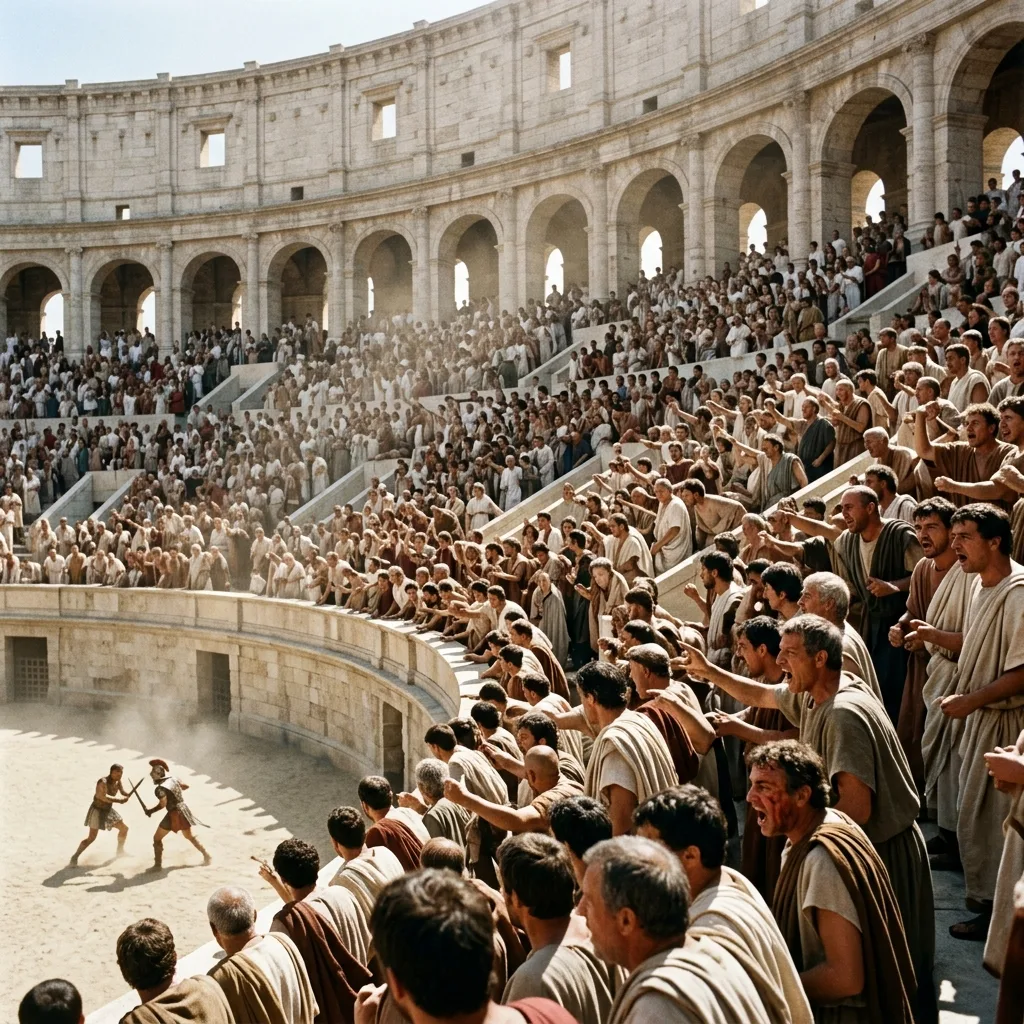
The Flavian Amphitheatre, the largest ancient amphitheatre ever built, is constructed in the center of Rome under Emperor Vespasian and completed by his son Titus in 80 CE.
Open in interactive timeline →Key Numbers
- Built
- c. AD 72-80
- Seating capacity
- ~50,000 spectators
- Dimensions
- 189 x 156 m (620 x 513 ft)
- Inaugural games
- 100 days, ~9,000 animals
- Travertine used
- ~100,000 m3
Verified Facts
- Construction began under Emperor Vespasian around AD 72, was largely completed and inaugurated by his son Titus in AD 80, and received final additions (including the top tier) under his second son Domitian, the three Flavian emperors who give it its formal name, the Flavian Amphitheatre.
- The monument was financed largely by the spoils of the Jewish War: a reconstructed dedicatory inscription (CIL VI 40454a), deciphered by epigrapher Geza Alfoldy in the 1990s from the surviving holes that once held bronze letters, records that Vespasian ordered the amphitheatre built 'ex manubiis' (from the spoils of war), referring to the sack of the Temple in Jerusalem in AD 70.
- The Colosseum rose on the drained site of the artificial lake (the stagnum) of Nero's vast palace, the Domus Aurea, a deliberate political gesture returning land Nero had seized for private luxury back to the Roman people for public entertainment.
- The popular name 'Colosseum' does not derive from the building's own size but from the nearby Colossus of Nero, a roughly 30-metre bronze statue that stood beside it; the name 'Colyseus' for the amphitheatre is attested only from the medieval period.
- Measuring about 189 by 156 metres with an outer wall once standing around 48-50 metres tall, it remains the largest amphitheatre ever built, ringed at ground level by 80 entrance arches.
- The exterior arcades stacked the classical orders by tier, with engaged half-columns of the Doric (Tuscan) order on the ground level, Ionic on the second, and Corinthian on the third, a textbook hierarchy of Roman architectural orders.
- Estimates hold that roughly 100,000 cubic metres of travertine stone were used, the blocks fastened with some 300 tons of iron clamps, the looting of which in later centuries left the pockmarked holes still visible on the facade.
- A retractable awning called the velarium shaded spectators; it was supported by 240 mast corbels around the top of the structure and worked by a detachment of sailors brought from the imperial fleet base at Misenum and housed nearby in the Castra Misenatium.
- Titus's inaugural games in AD 80 lasted 100 days; the historian Cassius Dio records that some 9,000 animals were killed, while Suetonius reports as many as 5,000 beasts slain in a single day.
- The hypogeum, the elaborate two-level network of underground tunnels, cells, and lifts beneath the arena floor used to stage animals and gladiators, was a later addition built under Domitian and did not exist during Titus's first games.
The World at This Moment
The Colosseum rose during the early Flavian decade, a moment of consolidation after the chaos of AD 69, Rome's "Year of the Four Emperors." Its construction was bracketed by violence and catastrophe: in AD 70 Titus had stormed Jerusalem and destroyed the Second Temple, ending the major phase of the First Jewish-Roman War; on 24 August AD 79 (the traditional date, now debated) Vesuvius buried Pompeii and Herculaneum, killing Pliny the Elder. Across Eurasia, the Eastern Han dynasty ruled from Luoyang, with Ban Chao soon extending Chinese influence into Central Asia along the trade routes the rising Kushan empire would dominate in Bactria and northern India. In the Mediterranean, the Flavians were stabilizing imperial finances after Nero's extravagance and the civil wars. The amphitheatre was thus a deliberate instrument of dynastic legitimation by a non-aristocratic family (Vespasian was a "new man"), built to recast Rome's political landscape and broadcast Flavian restoration of order and public benefaction following Neronian self-indulgence.
The Paradigm Shift
The Colosseum redirected both the urban politics and the architecture of mass spectacle. Sited on the drained stagnum (artificial lake) of Nero's Domus Aurea, it converted appropriated imperial pleasure-grounds into public space—a calculated reversal that propagandists like Martial celebrated. As the largest amphitheatre ever built, holding perhaps 50,000 spectators, it monumentalized the munera (gladiatorial games) as a permanent civic institution at Rome's heart, fixing the emperor-people relationship in stone. Architecturally it perfected the integration of the arch, barrel vault, and Roman concrete on a vast freestanding ellipse, using radial walls and travertine piers to channel huge crowds through numbered entrances (vomitoria)—a circulation logic that remains the template for stadia today. It also crystallized a model of imperial euergetism whereby legitimacy was performed through spectacle and bread-and-circuses largesse. The building became, and remains, the archetypal symbol of Rome itself: of its engineering mastery, its political theater, and—in later Christian and modern memory—its institutionalized cruelty.
In Their Own Words
"Hic ubi conspicui venerabilis amphitheatri / erigitur moles, stagna Neronis erant... reddita Roma sibi est et sunt te praeside, Caesar, / deliciae populi, quae fuerant domini. ("Here where the awe-inspiring bulk of the conspicuous amphitheatre rises up, were once Nero's pools... Rome has been restored to herself, and under your guardianship, Caesar, what had been a master's delights are now the people's.")" — Martial, Liber Spectaculorum (Liber de Spectaculis) 2, written c. AD 80; Latin text and the substance of the translation per Kathleen Coleman, M. Valerii Martialis Liber Spectaculorum (Oxford University Press, 2006).
In Depth
Blood, Stone, and the Theater of Power
The Flavian Amphitheatre, which a later age would call the Colosseum, rose between roughly 72 and 80 CE on a spot heavy with meaning: the drained lake of Nero's Golden House. After Nero's suicide and the chaotic year of four emperors, the new Flavian dynasty needed to give the Roman people back what one tyrant had seized for himself. Vespasian's gesture was deliberate. Where Nero had built a private pleasure palace, Vespasian built a public arena for 50,000 or more citizens. The Colosseum was, before it was anything else, a building-sized political argument about who Rome belonged to.
Spoils and Captives
That argument was paid for in blood and gold. A reconstructed dedicatory inscription records that Vespasian funded the amphitheatre ex manubiis — from the spoils of war — and the war in question was the brutal suppression of the Jewish Revolt that ended in the burning of Jerusalem and the destruction of the Second Temple (sv-second-temple) in 70 CE. The treasure of the Temple and tens of thousands of Jewish captives flowed into Rome; many of those prisoners quarried the travertine and hauled the stone. The Colosseum is thus the architectural twin of the catastrophe chronicled by Flavius Josephus (sv-josephus), whose patrons were the very Flavians celebrating their triumph. The same imperial machine that crushed Judaea would keep grinding through the Kitos War under Trajan (sv-trajan-kitos) and the annihilation of Bar Kokhba's revolt under Hadrian (sv-hadrian-bar-kokhba). The arena was a monument to conquest as much as to leisure.
The Inheritance of Empire
None of this was possible without the long consolidation of Roman power. The Republic (sv-roman-republic) had built the legions and the appetite for spectacle; Augustus (sv-augustus) had converted that machinery into a permanent monarchy with the wealth and stability to undertake megaprojects. The Colosseum perfected a Roman idea older than the empire — that watching organized death could bind a city together — and gave it a permanent home. Titus inaugurated the arena in 80 CE with games said to last a hundred days, in which thousands of animals and people died; his brother Domitian later added the subterranean hypogeum, a hidden machinery of lifts and trapdoors that conjured beasts and scenery as if by magic. The building was a technology of awe, and Rome's engineers — heirs in their way to the geometry of Euclid (sv-euclid) and the mechanics of Archimedes (sv-archimedes) — bent arch and vault and concrete to the service of crowds.
The Long Echo
The Colosseum outlasted the world that made it. When Theodosius outlawed paganism (sv-theodosius) and Christianity became the empire's faith, the games slowly faded; the arena that had executed criminals and, in Christian memory, martyrs, was later sanctified by the very religion it had once persecuted, the faith that had moved from Justin Martyr (sv-justin-martyr) to imperial legitimacy under Constantine (sv-constantine-legal). Its travertine was quarried for medieval palaces, yet enough survived to make it the emblem of Rome itself. When the Italian Renaissance (sv-renaissance) rediscovered antiquity, architects measured its arches to relearn how the ancients built. Today it draws millions, a ruin that still teaches the oldest lesson of monumental architecture: that power makes itself visible in stone, and asks to be remembered. The Colosseum remembers — but read against the Temple it was built to replace, it remembers more than its builders intended.
Causes & Consequences
What led to it
- Rome's victory in the First Jewish-Roman War, culminating in Titus's sack of Jerusalem and the destruction of the Second Temple in 70 AD, delivered the war booty (manubiae) that financed the amphitheatre, as recorded by a reconstructed dedicatory inscription reading that Vespasian had the new amphitheatre built 'ex manubiis' (from the spoils of war).
- The fall of Nero in 68 AD and the chaotic 'Year of the Four Emperors' that followed brought Vespasian to power in 69 AD and left his Flavian dynasty needing to legitimize itself by repudiating the hated previous regime.
- Nero's seizure of more than 200 acres of central Rome after the Great Fire of 64 AD to build his sprawling Domus Aurea, complete with a private artificial lake, created the resented site that Vespasian pointedly reclaimed for the public by draining the lake and erecting the Colosseum on it.
- Centuries of Roman experience with stone amphitheatres in Campania, beginning with the stone amphitheatre at Pompeii built around 70 BC, established the elliptical arena form and tiered seating that the Flavian Amphitheatre would scale up to monumental size.
- The Roman mastery of the arch, the barrel vault, and hydraulic concrete (opus caementicium) made it possible to build a free-standing, multi-story structure on the marshy valley floor, supporting the seating tiers on a radial system of vaults rather than an earthen embankment.
- A long-standing Roman tradition of munera (gladiatorial games) and venationes (wild-beast hunts) as instruments of political euergetism created the cultural demand for a permanent, purpose-built venue that an emperor could provide to win popular favor.
What it set in motion
- Titus inaugurated the completed amphitheatre in 80 AD with a reported 100 days of games, beginning roughly four centuries of gladiatorial combat, beast hunts, and public spectacle that made the building the centerpiece of imperial Roman mass entertainment.
- The Colosseum's elliptical plan, tiered seating for optimal sightlines, and radial vaulted circulation with numbered entrances and 'vomitoria' for rapid crowd egress became the foundational template that modern stadium and arena designers still study and emulate.
- After the games ended, the abandoned structure was converted into a fortified residence by the medieval Frangipani family in the early 13th century before Pope Innocent IV expropriated it for the Church in 1244.
- Following the destructive earthquake of 1349 that toppled much of the outer south wall, the Colosseum was quarried for centuries, with an estimated two-thirds of its travertine and marble carted off to build Renaissance landmarks such as St. Peter's Basilica, Palazzo Venezia, and Palazzo Barberini.
- In 1749 Pope Benedict XIV halted the quarrying by consecrating the arena to the Passion of Christ on the (historically unsupported) belief that Christians had been martyred there, installing the Stations of the Cross and seeding the papal Good Friday 'Via Crucis' procession that popes still lead at the site today.
- Having become the enduring symbol of Rome and of Italy itself, the Colosseum was inscribed as a UNESCO World Heritage Site in 1990 and voted one of the New Seven Wonders of the World in 2007, drawing millions of visitors annually as one of the most-visited monuments on Earth.
The Live Academic Debate
The sharpest current debate concerns the dedicatory inscription reconstructed by Géza Alföldy (1995) from the dowel-holes (the so-called "ghost inscription") beneath a later fifth-century text. Alföldy restored a Vespasianic dedication recording that the amphitheatre was built ex manubiis—from war spoils—widely taken to mean the Judaean plunder of AD 70. Werner Eck endorsed the reconstruction as "convincing" and Fergus Millar called it "spectacular," and it now anchors the popular "Jewish-financed Colosseum" narrative discussed by Louis Feldman and Sarah Bond. Yet the reading is an epigraphic reconstruction from empty holes, not a surviving text, and some scholars treat the manubiis restoration and its specific link to Judaea as plausible but not certain. A separate debate, advanced by Keith Hopkins and Mary Beard, reassesses the games' meaning—how far the arena functioned as ideology, social control, and ritualized civic order versus mere bloodthirst—cautioning against anachronistic moralizing. Dating questions (the Vesuvius eruption's day, the precise phases of construction under Vespasian versus Titus and Domitian) remain actively contested.
How This Event Connects
The Construction of the Colosseum stands as the ultimate architectural manifestation of Roman imperial propaganda, brilliantly designed to stabilize the state following a period of profound dynastic and urban trauma. Commissioned by Vespasian, the Flavian Amphitheater was deliberately constructed over the drained artificial lake of Nero’s Domus Aurea, a direct ideological response to the lingering resentment caused by the Great Fire of Rome. By reclaiming this vast, privatized tract of the city center and dedicating it to public entertainment, the Flavian dynasty successfully distanced themselves from Julio-Claudian megalomania. The Colosseum effectively functioned as spatial propaganda, symbolically "returning" Rome to its people while simultaneously imposing a rigidly stratified seating arrangement that physically reinforced the hierarchical social order.
Crucially, this monumental project was made economically viable only through catastrophic imperial violence in the East. Modern epigraphic analysis of the Colosseum's reconstructed dedicatory inscription proves that the amphitheater was financed ex manubiis—from the spoils of war. Specifically, it was funded by the immense treasure and slave labor generated by the Fall of the Second Temple in 70 CE. The Colosseum is therefore inextricably linked to the Jewish War, serving as a permanent, stone-and-concrete monument to Roman military supremacy, transmuting the trauma and wealth of a destroyed province into the political capital required to legitimize a new dynasty in Rome.
In executing this massive public works project, the Flavians were consciously emulating the highly successful political playbook originally established by Augustus, who understood that monumental architecture was essential to projecting imperial permanence and pax. Interestingly, the Colosseum's dedication under Titus in 80 CE occurred almost simultaneously with another major crisis: the Eruption of Mount Vesuvius in 79 CE. This temporal proximity highlights the stark dichotomy of the Flavian era, where the apex of Roman engineering and man-made spectacle in the capital stood in sharp contrast to the empire's utter vulnerability to catastrophic natural disasters in the Italian periphery.
The Counterfactual
Had Vespasian not built the amphitheatre on Nero's lake, the most plausible alternative is that the Domus Aurea's grounds remained a semi-private imperial estate, blunting the Flavian message of restoring Rome "to herself" (Martial, Spec. 2). Rome would still have had permanent venues—Statilius Taurus's stone amphitheatre (29 BC) and wooden structures existed—but no monument of comparable scale or symbolic centrality; gladiatorial culture would have continued without its defining stage. The deeper counterfactual concerns funding: the Alföldy-reconstructed dedicatory inscription suggests the project was financed ex manubiis, from the spoils of the Jewish War. Absent the sack of Jerusalem and its treasure (and captive labor), a structure on this scale and timetable—completed in roughly a decade—would have been far harder to realize. Without the Colosseum, the West would lack its preeminent emblem of Roman engineering and imperial spectacle; medieval and Renaissance imaginations, which read the ruin as a measure of Rome's grandeur and fall, would have lacked their central reference point. The institution of the games, however, would likely have persisted regardless.
Myth vs. Reality
Myth: The Romans called it the 'Colosseum' from the start.
Reality: Its name in antiquity was the Amphitheatrum Flavium (Flavian Amphitheatre), after the Flavian dynasty (Vespasian, Titus, Domitian) that built it. The name 'Colosseum' derives not from the building's size but from the Colossus of Nero, a roughly 30-meter bronze statue that stood beside it. The term was not applied to the amphitheatre itself until the medieval period; the monk Bede's much-quoted 8th-century line refers to the Colossus statue, and 'Colosseum' for the building proper becomes common only well after 1000 AD.
Myth: The Colosseum was built by 100,000 Jewish slaves who did all the work.
Reality: War spoils and captives from the Jewish-Roman War (the sack of Jerusalem in 70 AD) genuinely helped fund the project and supply labor, and a reconstructed dedicatory inscription points to booty financing. But scholars such as Keith Hopkins and Mary Beard stress that monumental Flavian construction was not carried out by slave gangs alone: skilled stonemasons, surveyors, engineers and craftsmen were paid professionals, working alongside free laborers and slaves. The neat figure of '100,000 Jewish slaves' is a modern embellishment, not a documented headcount.
Myth: Early Christians were regularly thrown to the lions and martyred in the Colosseum.
Reality: There is no contemporary evidence that Christians were martyred in the Colosseum specifically. The popular image largely took shape in the early modern period (the building was consecrated to Christian martyrs in the 18th century under Pope Benedict XIV). The famous Neronian persecution is chronologically impossible here: Nero died in 68 AD and construction did not begin until the 70s. Christians were persecuted and killed in the Roman world, but linking that to this arena is mostly later tradition rather than ancient documentation.
Myth: The Colosseum went up on an empty plot of land.
Reality: It was deliberately built over the artificial lake (stagnum) of Nero's sprawling Domus Aurea ('Golden House'), the palace complex Nero built after the fire of 64 AD. Vespasian drained the lake and gave the valley back to the public as a mass-entertainment venue, a pointed political reversal of Nero's private luxury. The pre-existing lake bed and drainage on the site also shaped the building's foundations and water engineering.
Myth: It took only a few years and the same emperor saw it finished.
Reality: Construction began under Vespasian around 72 AD, but he died in 79 AD before completion; his son Titus inaugurated the building in 80 AD with 100 days of games when it still had its upper level and the underground hypogeum unfinished. The second son, Domitian, added the top story and the elaborate basement of tunnels and lifts in the early-to-mid 80s. So it spanned three emperors of one dynasty, and the structure people picture (with its full hypogeum) was a later phase, not the 80 AD original.
Frequently Asked Questions
When was the Colosseum built and how long did it take?
Construction of the Colosseum began under the emperor Vespasian around 70-72 CE, and the completed building was inaugurated by his son Titus in 80 CE with 100 days of games, meaning the main structure took roughly 8 to 10 years to build. A final top story was added under the third Flavian emperor, Domitian, around 82 CE. Because all three of these emperors belonged to the Flavian dynasty, the building's original name was the Flavian Amphitheatre.
Who built the Colosseum and why?
The Colosseum was commissioned by the emperor Vespasian, founder of the Flavian dynasty, and completed by his sons Titus and Domitian. Vespasian deliberately built it on the site of the drained artificial lake of Nero's private Golden House (Domus Aurea), reclaiming land the hated former emperor had seized for himself and returning it to the Roman public as a venue for free entertainment. The amphitheater served as a tool of political legitimacy and popular goodwill for the new dynasty, hosting gladiatorial combat, wild-animal hunts, and public spectacles.
How was the Colosseum funded and who provided the labor?
Ancient evidence indicates the Colosseum was financed largely by the spoils of the First Jewish-Roman War, including treasure looted from the Temple in Jerusalem after its sack in 70 CE. A reconstructed Latin inscription read by scholar Geza Alföldi records that the emperor ordered the amphitheater built 'ex manubiis' — from the spoils of war. Thousands of Jewish prisoners brought to Rome after the revolt are widely believed to have provided much of the heavy labor, though the often-cited figure of 100,000 enslaved workers is an estimate that some historians treat with caution.
Why is it called the Colosseum if its real name was the Flavian Amphitheatre?
The building was officially the Amphitheatrum Flavium (Flavian Amphitheatre) for centuries. The name 'Colosseum' derives from the Colossus of Nero, a roughly 30-meter (about 100-foot) bronze statue that stood next to the amphitheater, originally depicting Nero and later reworked into a sun god. The nickname referring to the building itself only became common in the medieval period, around 1000 CE.
How many spectators could the Colosseum hold?
Estimates of the Colosseum's capacity vary widely among scholars, commonly ranging from about 50,000 up to 80,000 or more spectators, with many modern assessments favoring a figure around 50,000. Seating was strictly arranged by social rank: senators and elites sat closest to the arena floor, with progressively lower classes seated higher up, and women and the poor relegated to the top tier. The wide range reflects uncertainty about how ancient standing room and seating space are counted.
Did the Colosseum have a roof?
The Colosseum was never fully roofed, but it featured a retractable awning called the velarium that shaded much of the seating from sun and rain. This canvas covering was supported by a system of masts and ropes anchored around the top of the structure, and ancient sources indicate it was deployed and managed by trained sailors, who were experienced with the rigging of ship sails. The arena floor itself was open, covering an elaborate underground network of chambers and lifts known as the hypogeum.
Sources & Further Reading
- Colosseum — Wikipedia
- Kathleen M. Coleman, M. Valerii Martialis Liber Spectaculorum (Oxford University Press, 2006)
- Keith Hopkins and Mary Beard, The Colosseum (Harvard University Press / Wonders of the World, 2005)
- Géza Alföldy, 'Eine Bauinschrift aus dem Colosseum,' Zeitschrift für Papyrologie und Epigraphik 109 (1995), 195-226
- Louis H. Feldman, 'Financing the Colosseum,' Biblical Archaeology Review 27.4 (2001)
- Filippo Coarelli (ed.), The Colosseum (Getty / Electa, 2001)
- National Geographic: The Colosseum
Cite This Page
AskHistoryAI. “Construction of the Colosseum.” AskHistoryAI — Interactive Timeline of Everything. Updated 2026-09-11. https://askhistoryai.com/event/sv-colosseum/
Every fact on this page is checked against the published fact ledger and methodology; sources are listed above.