Julius Caesar Crosses the Rubicon
The death of the Roman Republic and the rise of dictatorship.
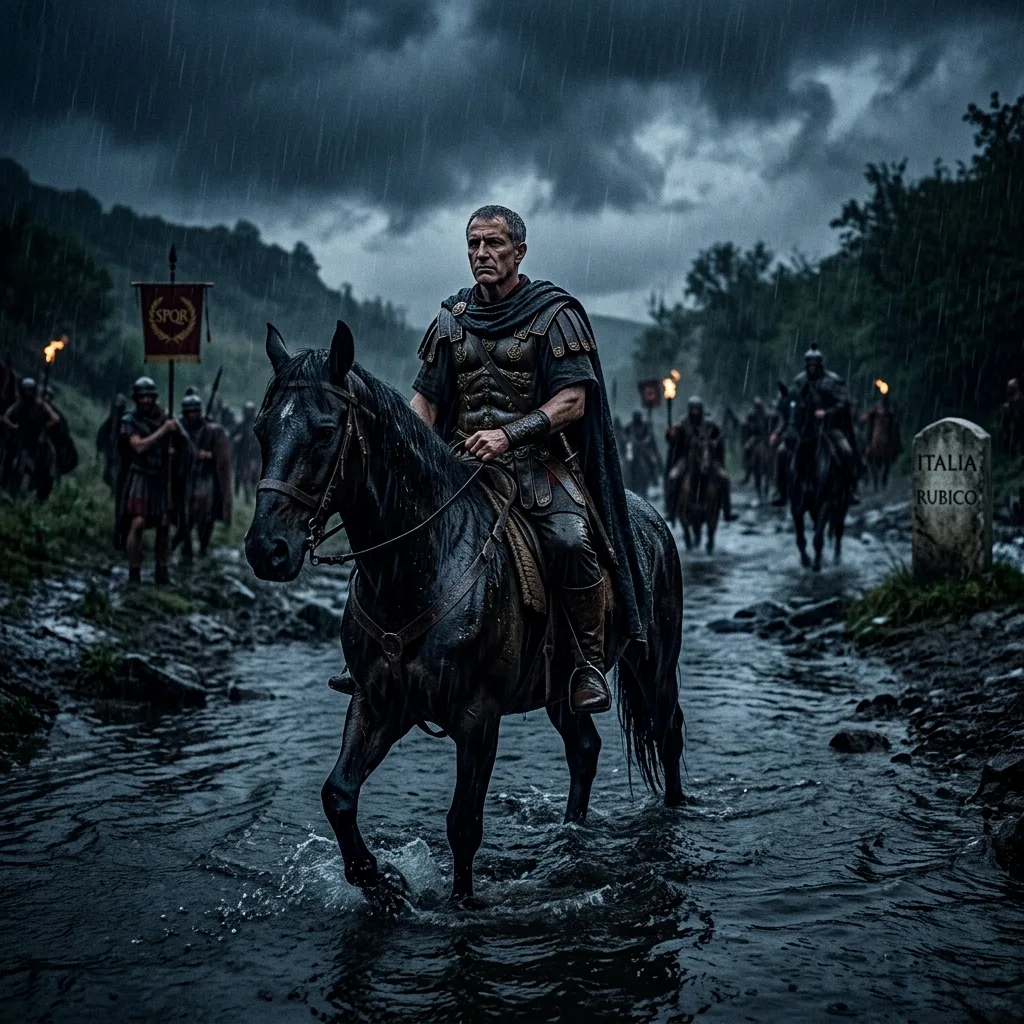
Defying the Senate, Julius Caesar marched his legions across the Rubicon river into Italy, sparking a civil war that ended the nearly 500-year-old Roman Republic and consolidated absolute power in his hands.
Open in interactive timeline →Key Numbers
- Date
- ~10-11 Jan 49 BC (Roman cal.)
- Force crossed
- 1 legion (Legio XIII)
- Legionaries
- ~5,000 + 300 cavalry
- Civil war length
- 49-45 BC (4-5 yrs)
- Ended at
- Battle of Munda, 45 BC
Verified Facts
- The Rubicon was a small stream in northern Italy (the modern Rubicone, emptying into the Adriatic near Rimini) whose only importance was legal: it marked the southern boundary of Caesar's province of Cisalpine Gaul, and a Roman promagistrate forfeited his command and committed treason the moment he led troops across it into Italy proper.
- Caesar crossed with only a single legion, Legio XIII (later XIII Gemina); ancient sources put its strength at roughly 5,000 infantry and about 300 cavalry, though figures vary (Plutarch and Appian say 5,000, while Orosius after Livy implies only about five cohorts, some 2,500 men).
- The crossing is traditionally dated to about 10-11 January 49 BC, but that is by the badly drifted pre-reform Roman calendar; converted to our proleptic Julian reckoning the event actually fell in late autumn (around November) of 50 BC, before Caesar's own calendar reform fixed the seasons.
- The trigger was the senatus consultum ultimum ('final decree') passed around 7 January 49 BC, which ordered Caesar to disband his army and effectively branded him an enemy of the state; the tribunes Mark Antony and Quintus Cassius, having vetoed the anti-Caesarian motions, fled Rome to join Caesar at Ravenna.
- The most famous line, alea iacta est ('the die is cast'), comes from Suetonius (Divus Iulius 31-33); Plutarch instead reports that Caesar spoke it in Greek, anerriphtho kybos ('let the die be cast'), quoting a line from the comic playwright Menander.
- Caesar's own war memoir, the Commentarii de Bello Civili, never mentions the Rubicon or the famous quotation at all — the dramatic river scene survives only in later writers like Suetonius, Plutarch, and Appian, which is why scholars treat the vivid details with caution.
- Suetonius preserves a separate line of hesitation at the bank — 'we may still draw back; but once across that little bridge, the whole issue is with the sword' — and even adds a portent of a supernatural piper who seized a trumpet and sounded the advance, framing Caesar as wavering until a divine sign decided him.
- One eyewitness to Caesar's deliberations was Gaius Asinius Pollio, who was present in Caesar's entourage and later became a historian; Plutarch cites Pollio as the source for Caesar quoting the Menander line, making him the closest thing to a firsthand witness behind the surviving accounts.
- The crossing's immediate military payoff was the bloodless seizure of Ariminum (modern Rimini): Caesar relied on speed and surprise, and his lightning advance triggered panic in Rome, prompting Pompey and much of the Senate to abandon the city rather than fight for it.
- The resulting civil war against Pompey and the Senate ran from 49 BC through Caesar's victories at Pharsalus (48 BC), Thapsus (46 BC), and finally Munda (45 BC); 'crossing the Rubicon' has since become an idiom for passing an irreversible point of no return.
The World at This Moment
Caesar crossed in the consular year of L. Cornelius Lentulus and C. Claudius Marcellus, nominally 10 January 49 BCE—though the unreformed Roman calendar ran roughly weeks ahead of the seasons, a drift Caesar himself would correct in 46. The Mediterranean was a knot of Roman client-states: Ptolemaic Egypt under the boy-king Ptolemy XIII and Cleopatra VII (acceding 51 BCE) was sliding toward its own dynastic war, soon to draw Caesar in. Eastward, the Parthian Empire, fresh from annihilating Crassus at Carrhae (53 BCE), loomed as Rome's great rival under the line that would produce Phraates IV. In China, the Western Han reached its territorial zenith: Emperor Xuan died in 49 BCE and was succeeded by Emperor Yuan, inaugurating Confucian dominance at court. India saw post-Mauryan fragmentation among Indo-Greek, Indo-Scythian, and Shunga-successor powers. Thus a single legion fording a minor river in Cisalpine Gaul coincided with two of antiquity's largest empires—Han and Parthia—at moments of consolidation, while Rome's republican constitution began its terminal convulsion.
The Paradigm Shift
The crossing converted a constitutional standoff into open civil war and, ultimately, into the structural transformation of the Roman state from oligarchic Republic to monarchy. By leading Legio XIII across the boundary of his province under arms, Caesar violated the promagistrate's obligation to lay down imperium on entering Italy, an act tantamount to treason. The ensuing war (49–45 BCE) destroyed the Pompeian faction, made Caesar dictator perpetuo, and—after his assassination in 44 and a further decade of conflict—produced Octavian's Principate (27 BCE). The episode became Western civilization's archetype of the irrevocable political gamble: "crossing the Rubicon" entered the lexicon as a metaphor for any point of no return. More structurally, it crystallized a lesson that armies loyal to a commander rather than the state could override civilian institutions—the dynamic that governed Roman politics for the next three centuries of imperial succession and military usurpation, and that later European theorists of civil-military relations would repeatedly invoke.
In Their Own Words
"Iacta alea est. ("The die is cast.")" — Attributed to Julius Caesar by Suetonius, Divus Iulius 32 (Caesar's own Bellum Civile does not record the crossing; Plutarch, Life of Caesar 32 and Life of Pompey 60, instead reports it in Greek as ἀνερρίφθω κύβος, "let the die be cast")
Take we the course which the signs of the gods and the false dealing of our foes point out. The die is cast," said he.
Suetonius REPORTING Caesar at the Rubicon, The Lives of the Caesars, "Divus Iulius" (Life of the Deified Julius) 32, c. 121 AD (J.C. Rolfe Loeb translation). Suetonius gives the Latin as "iacta alea est"; the common form "alea iacta est" is a later reordering. Several scholars and Plutarch hold Caesar actually spoke the line in Greek (a tag from Menander, "let the die be cast"), so this is a historian's report, not Caesar's verbatim words. — source
In his Pontic triumph he displayed among the show-pieces of the procession an inscription of but three words, "I came, I saw, I conquered," not indicating the events of the war, as the others did, but the speed with which it was finished.
Suetonius, The Lives of the Caesars, "Divus Iulius" 37, c. 121 AD (J.C. Rolfe Loeb translation). Important: Suetonius describes the Latin "veni, vidi, vici" as a placard/INSCRIPTION carried in Caesar's Pontic triumph after defeating Pharnaces II at Zela (47 BC) — NOT a sentence Caesar exclaimed on the battlefield. Plutarch (Caesar 50) and Appian instead report it as the wording of a written dispatch to a friend in Rome. — source
although it was not full ten years that he waged war in Gaul, he took by storm more than eight hundred cities, subdued three hundred nations, and fought pitched battles at different times with three million men, of whom he slew one million in hand to hand fighting and took as many more prisoners.
Plutarch, Life of Caesar 15.5, c. 100 AD (Bernadotte Perrin Loeb translation). Plutarch's own summation of the human cost of the Gallic Wars; the figures are ancient and likely inflated, but they are Plutarch's reported totals, not a modern estimate. — source
In Depth
The River That Ended a Republic
On the tenth of January, 49 BC, a single man led a single legion across a shallow stream in northern Italy and, in doing so, dissolved five centuries of constitutional order. The Rubicon was unremarkable as a river — so minor that scholars still argue about its exact course. Its significance was entirely legal. It marked the southern boundary of Caesar's province, Cisalpine Gaul; to cross it at the head of an army was, by Roman law, treason. Suetonius records that Caesar paused, then spoke a gambler's phrase: alea iacta est, "the die is cast." Whether he said it or not, the metaphor was exact. There was no walking back.
The Long Fuse
The crossing was not a thunderbolt but the detonation of a charge laid over generations. The Roman Republic (sv-roman-republic) had been engineered to prevent exactly this — its consulships, term limits, and divided commands all designed to stop any one citizen from becoming a king. Yet the very conquests that made Rome rich also broke that machine. Generals like Caesar commanded standing armies whose loyalty was personal, paid in plunder and land rather than civic duty. The precedent that mattered most was set a generation earlier when Sulla marched on Rome (sv-sulla), the first Roman to turn his legions against the city itself and live as dictator. Caesar, who had survived Sulla's proscriptions as a young man, understood the lesson: in the late Republic, constitutional legitimacy had quietly become a function of who controlled the soldiers. When the Senate, backed by Pompey, ordered him to disband his army or be declared an enemy of the state, Caesar faced ruin or rebellion. He chose the river.
What Flowed Downstream
The civil war that followed shattered the Optimates, ended with Pompey murdered in Egypt, and made Caesar dictator for life — until the daggers of the Ides of March answered him. But assassination could not restore the Republic; it only cleared the stage for his heir. Out of the second round of civil war rose Octavian, who as Augustus (sv-augustus) built the Principate, draping monarchy in republican costume. Every emperor afterward — the builders of the Colosseum (sv-colosseum), the philosopher-ruler Marcus Aurelius (sv-marcus-aurelius), the Constantine who would summon Nicaea (sv-constantine-legal) — inherited a system whose founding act of force was Caesar's crossing. The historians who shaped how Rome remembered itself wrote in this imperial shadow: Plutarch (sv-plutarch) made Caesar a study in ambition, and Tacitus (sv-tacitus) dissected the autocracy his crossing inaugurated with cold precision.
The Pattern and the Phrase
Caesar's act belongs to a recurring theme in the human story — the moment ambition outgrows the institutions meant to contain it. The Athenian experiment in self-rule (sv-athenian-democracy) had already shown how fragile collective government could be against a determined individual; Alexander the Great (sv-alexander), whose career Caesar reportedly envied, had demonstrated that a single charismatic commander could redraw the world. The Rubicon distilled this into one image so durable that "crossing the Rubicon" still means an irreversible commitment, more than two thousand years after the water dried on Caesar's boots.
The deeper resonance is about thresholds themselves. History is punctuated by points of no return — the first cell that copied itself, the first city that wrote down its laws. Caesar's genius, and his crime, was to recognize that some lines, once crossed, cannot be uncrossed, and to cross anyway. He bet that the Republic was already dead and that he was merely the one honest enough to bury it. The bet paid. Rome would not see a functioning republic again for two millennia, and the West would inherit, from a muddy stream in 49 BC, both the dream of self-government and the standing fear of the general who will not lay down his sword.
Causes & Consequences
What led to it
- Caesar's roughly nine-year conquest of Gaul (58-50 BC) gave him a battle-hardened, intensely loyal army and the wealth and prestige needed to challenge his rivals, transforming a politician into a military force the Senate could not ignore.
- The First Triumvirate, the informal alliance Caesar formed with Pompey and Crassus around 60 BC to bypass the Senate, gave Caesar his initial path to power, and its eventual collapse set the stage for the confrontation.
- The death of Caesar's daughter Julia in 54 BC, who had been married to Pompey, severed the marriage tie that had restrained the two men and personally bound them together.
- The death of Crassus at the Battle of Carrhae against the Parthians in 53 BC removed the third partner who had balanced and mediated between Caesar and Pompey, leaving the two most powerful men in Rome as direct rivals.
- As Caesar's proconsular command neared its end, the Senate (with Pompey's backing) demanded he disband his army and return to Rome while forbidding him from standing for the consulship in absentia, leaving him to fear prosecution and political ruin if he entered the city without immunity or an army.
- On 7 January 49 BC the Senate passed the senatus consultum ultimum, effectively declaring Caesar a public enemy and driving the tribunes who supported him to flee Rome, which gave Caesar the pretext to march in defense of the tribunes' violated rights.
What it set in motion
- By crossing the Rubicon with his legion in January 49 BC, an act of treason since a general was forbidden to lead an army into Italy proper, Caesar ignited a civil war between himself and the Pompeian forces of the Senate.
- Caesar's victory over Pompey at the Battle of Pharsalus in 48 BC, followed by Pompey's murder in Egypt and Caesar's final triumph at Munda in 45 BC, left Caesar as the undisputed master of the Roman world.
- Caesar was eventually named dictator perpetuo (dictator for life) in early 44 BC, concentrating unprecedented permanent power in one man and alarming defenders of republican government.
- Caesar's accumulation of power provoked his assassination on the Ides of March (15 March) 44 BC by a conspiracy of senators including Brutus and Cassius, who hoped to restore the Republic.
- The renewed wars after Caesar's death led to Octavian's defeat of Mark Antony and Cleopatra at Actium in 31 BC and his transformation into Augustus by 27 BC, ending the Roman Republic and inaugurating the Roman Empire.
- The episode gave Western languages the enduring idiom 'crossing the Rubicon,' meaning to take an irreversible step past a point of no return, along with the phrase attributed to Caesar by Suetonius, 'alea iacta est' ('the die is cast').
The Live Academic Debate
The central modern debate concerns Caesar's motive and culpability. The traditional view—associated with Theodor Mommsen's heroic Caesar and refined through Matthias Gelzer—held that Caesar crossed chiefly to escape prosecution and political annihilation once stripped of his command's immunity. Robert Morstein-Marx (Julius Caesar and the Roman People, 2021; and Historia 56, 2007) has forcefully dismantled the "fear of prosecution" thesis, arguing the evidence for any credible prosecution is thin and that Caesar acted to defend his dignitas and the people's tribunician liberties against an aggressive senatorial faction—casting the Senate, not Caesar, as the war's instigator. Erich Gruen (The Last Generation of the Roman Republic, 1974), with D. R. Shackleton Bailey, likewise treats the prosecution plan as a "red herring." Against this stands a more Caesar-skeptical line emphasizing his autocratic ambition. The factual question of the crossing's exact date and even Caesar's reported words ("alea iacta est") remains genuinely uncertain, since Caesar's own Bellum Civile omits the episode entirely.
How This Event Connects
The crossing of the Rubicon by Gaius Julius Caesar stands as the definitive terminal event of the Roman Republic. Historiographically, Caesar represents the ultimate synthesis of the Republic’s systemic flaws: a system that mandated hyper-competitive militarism among its elite, yet possessed no constitutional mechanism to safely absorb a politician who had acquired infinitely more wealth and military power than the state itself. When faced with political ruin by a hostile senatorial faction, Caesar utilized his fiercely loyal, battle-hardened Gallic legions to invade Italy. This action was not a sudden aberration, but the logical culmination of a century of institutional decay, cementing the reality that the Republic had devolved from a constitutional government into an arena for competing oligarchic warlords.
In this regard, Caesar was directly executing the terrifying blueprint established a generation earlier when Sulla Marches on Rome. Sulla had proven that the sacred boundary of the city could be breached and the constitution rewritten by force. However, Caesar fundamentally deviated from Sulla’s template in the aftermath of victory. Whereas Sulla utilized horrific proscriptions to purge his enemies and then resigned to restore senatorial dominance, Caesar instituted a policy of clementia (mercy) and accepted the unprecedented, un-Republican title of dictator perpetuo. This perpetual autocracy deeply humiliated the surviving aristocracy, directly provoking his assassination on the Ides of March. Caesar successfully conquered the state, but failed to institutionalize his supremacy.
The resolution of this constitutional crisis fell to his adopted heir, Augustus. Augustus acutely analyzed the fatal flaw of Caesar’s regime: the naked, unapologetic display of monarchical power. By orchestrating the "First Settlement," Augustus secured absolute military and economic control while masterfully cloaking his autocracy in the traditional semantic architecture of the Republic. Furthermore, the immense historical memory of Caesar—his genius, his populism, and his hubris—was heavily curated for posterity by later biographers like Plutarch. In his Parallel Lives, Plutarch utilized Caesar not merely as a historical subject, but as a complex moral archetype, shaping the enduring historiographical debate over whether Caesar was a visionary democratic reformer or the ultimate tyrant who murdered Roman liberty.
The Gallic cost — conquest as catastrophe, not glory
Read from the side of the conquered, Caesar's march to the Rubicon was financed by one of antiquity's bloodiest campaigns. Plutarch (Life of Caesar 15.5) records that in under ten years in Gaul Caesar stormed more than 800 towns, subdued 300 nations, and of three million who fought him "slew one million in hand to hand fighting and took as many more prisoners" — i.e. enslaved. Modern scholars such as Kathryn Welch and historians of Roman imperialism treat these numbers as propaganda-tinged yet indicative of genocide-scale violence and mass enslavement that funded Caesar's political rise; the same general who "liberated" Rome from the Senate had annihilated the Gallic peoples who, under Vercingetorix, had resisted him.
The Counterfactual
Had Caesar accepted disarmament and prosecution—the outcome the optimates demanded—the immediate civil war would have been averted, but most scholars doubt the Republic's deeper crisis would have resolved. Ronald Syme's thesis (The Roman Revolution, 1939) implies the collapse was systemic: a narrow nobility could no longer absorb the ambitions of provincial command and client armies, so another Sulla or Pompey would likely have precipitated comparable rupture. Erich Gruen counters that the institutions were robust and that war was a contingent product of brinkmanship, not inevitability—on his reading, a negotiated settlement (variants were floated by Cicero and Curio in late 50) was genuinely possible, potentially preserving senatorial government longer. Yet even Gruen concedes the extraordinary commands of Pompey and Caesar were destabilizing. A different counterfactual: had Pompey held Italy instead of evacuating to Greece, Caesar might have been crushed early, yielding a Pompeian autocracy rather than a Caesarian one—a change of dynasty more than of system.
Myth vs. Reality
Myth: Caesar declared 'The die is cast' (alea iacta est) in Latin, coining the phrase as he crossed.
Reality: The line is reported by later authors, not by Caesar himself, and the wording is contested. Plutarch says Caesar spoke in Greek, quoting a line associated with the comic playwright Menander ('let the die be cast'), so the expression predates Caesar rather than originating with him. Suetonius gives the Latin 'iacta alea est.' Since these writers worked over a century after the event, we cannot be certain Caesar said any version of it.
Myth: The Rubicon was a mighty, formidable river that posed a serious physical obstacle.
Reality: The Rubicon is a small, shallow stream, easily forded, and notably modest even in antiquity. Its importance was entirely legal and symbolic, not geographic: it marked the boundary between the province of Cisalpine Gaul and Italy proper. A general who led an army across it without Senate permission was committing treason, which is what made the crossing momentous, not the water itself.
Myth: We know exactly where the Rubicon was and the crossing is precisely documented.
Reality: The river's identity was actually lost for centuries; scholars debated candidates such as the Pisciatello, the Uso, and the Fiumicino. A commission in 1933 identified the Fiumicino as the historical Rubicon, but the matter remained disputed into the 1990s. Caesar's own war commentaries do not even mention the Rubicon crossing, so the dramatic scene comes entirely from later sources like Plutarch, Suetonius, and Appian, likely drawing on the lost history of Asinius Pollio.
Myth: Caesar marched on Rome with a vast army, overwhelming the Republic by force of numbers.
Reality: Caesar crossed with only a single legion, the Thirteenth (Legio XIII). The act was a calculated political gamble rather than an overwhelming invasion; the bulk of his Gallic legions were still north of the Alps. Its power lay in the precedent it set and the war it triggered, not in the size of the force that initially entered Italy.
Myth: The crossing happened on a winter night, 10 January 49 BC, exactly as we would date it today.
Reality: Scholars place the crossing around 10 to 11 January 49 BC by the official Roman calendar, but that calendar had drifted badly out of sync with the seasons. By the actual solar year it was closer to autumn than deep winter, one reason Caesar himself later reformed the calendar into the Julian system. The traditional date is also a reconstruction; the precise day is inferred from the speed of messengers, not recorded with certainty.
Frequently Asked Questions
When did Julius Caesar cross the Rubicon?
Ancient sources place the crossing in early January 49 BC, with scholars usually dating it to around January 10–11, 49 BC. That date is given in the unreformed pre-Julian Roman calendar, which had drifted out of step with the seasons, so the actual point in the solar year was closer to autumn. Caesar reformed the calendar only later, in 46 BC.
What does "crossing the Rubicon" mean today?
It has become a proverbial phrase meaning to pass a point of no return — to take a decisive, irreversible step that commits you to a risky course. The expression comes directly from Caesar's act of leading his army across the river into Italy, which by law he could not do, making civil war unavoidable. Today people use it for any momentous decision that cannot be undone.
Why was crossing the Rubicon illegal and such a big deal?
The Rubicon marked the boundary between Caesar's assigned province of Cisalpine Gaul and Italy proper, and Roman law forbade a general from bringing his army across it into Italy. A commander who did so was effectively declaring war on the Roman state and committing treason punishable by death. By crossing with his legion, Caesar defied the Senate's authority and triggered the civil war against Pompey and the Republic's leadership.
What did Caesar say when he crossed the Rubicon?
He is famously quoted as saying "alea iacta est" ("the die is cast"), reported by the biographer Suetonius writing more than a century later. Plutarch, however, says Caesar spoke in Greek, quoting a line associated with the comic playwright Menander, roughly "let the die be cast." No contemporary source from 49 BC records the words, so the exact phrasing is uncertain, and Caesar's own account of the war does not mention it.
Where was the Rubicon River, and why was its location lost?
The Rubicon was a small stream in northeastern Italy's Emilia-Romagna region, flowing from the Apennines to the Adriatic between the towns of Rimini and Cesena. Because it was minor and its ancient name fell out of use, its exact course was uncertain for centuries, with the Pisciatello, Fiumicino, and Uso rivers all proposed as candidates. The Fiumicino was officially identified as the historical Rubicon and renamed in 1933.
What happened after Caesar crossed the Rubicon?
Caesar's advance into Italy with his battle-hardened legion caught Pompey and the Senate unprepared, and they fled Rome rather than fight him there immediately. This began the civil war of 49–45 BC, which Caesar ultimately won, decisively defeating Pompey at the Battle of Pharsalus in 48 BC. His victory ended the effective power of the Roman Republic and set the stage for his dictatorship and, after his assassination in 44 BC, the rise of imperial Rome.
Sources & Further Reading
- Crossing the Rubicon — Wikipedia
- Robert Morstein-Marx, Julius Caesar and the Roman People (Cambridge University Press, 2021)
- Erich S. Gruen, The Last Generation of the Roman Republic (University of California Press, 1974)
- Ronald Syme, The Roman Revolution (Oxford University Press, 1939)
- Matthias Gelzer, Caesar: Politician and Statesman, trans. Peter Needham (Harvard University Press, 1968)
- Suetonius, Divus Iulius 31–33, and Plutarch, Lives of Caesar and Pompey (Loeb Classical Library)
- Wikipedia: Julius Caesar
Cite This Page
AskHistoryAI. “Julius Caesar Crosses the Rubicon.” AskHistoryAI — Interactive Timeline of Everything. Updated 2026-09-11. https://askhistoryai.com/event/sv-julius-caesar/
Every fact on this page is checked against the published fact ledger and methodology; sources are listed above.