The Eruption of Mount Vesuvius
The catastrophic volcanic burial of Pompeii — the only site preserving a complete snapshot of daily life in an ancient Roman city.
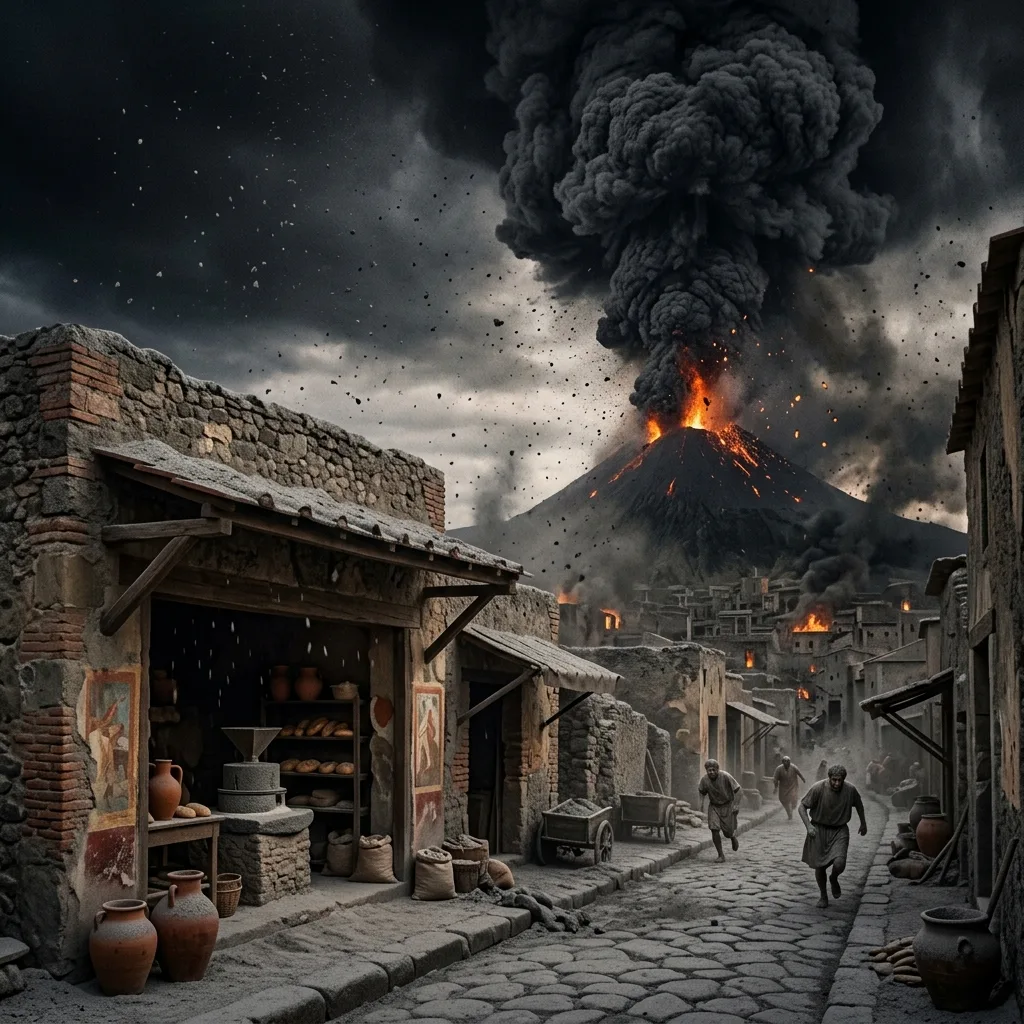
Mount Vesuvius catastrophically erupts in one of the most famous volcanic disasters in human history, completely burying the wealthy Roman cities of Pompeii (population ~11,000–20,000) and Herculaneum under 4–6 meters of volcanic ash and pumice. The eruption occurred in two devastating phases: first, an 18-hour rain of pumice that collapsed roofs, then superheated pyroclastic surges (up to 300°C) that killed everyone remaining instantly. The volcanic material created an airtight seal that preserved organic materials, architecture, art, food, and even the shapes of human bodies with extraordinary fidelity—making Pompeii the single most important archaeological site for understanding Roman daily life. Nearly three centuries of excavation (1748–2026) have produced a staggering wealth of discoveries, yet approximately one-third of the city remains deliberately unexcavated, preserved for future generations with better technology.
Open in interactive timeline →Key Numbers
- Year
- AD 79
- Eruption column
- up to ~33 km high
- Material ejected
- ~6 km3 of tephra
- Surge heat (Herculaneum)
- over 500 C
- Cities buried
- Pompeii, Herculaneum, Stabiae, Oplontis
Verified Facts
- The only surviving eyewitness account comes from Pliny the Younger, who as a teenager at Misenum across the bay later wrote two letters to the historian Tacitus describing the eruption and his uncle's death — making this one of the first natural disasters in history documented by a firsthand observer.
- Pliny the Elder, the famous naturalist and a fleet commander at Misenum, sailed toward the eruption partly to rescue friends and observe the phenomenon; he came ashore at Stabiae and died there, overcome by ash and toxic fumes (likely asphyxiation or cardiac failure), his body found intact when daylight returned.
- Pliny the Younger's description of the towering ash column that spread out at the top 'like an umbrella pine' was so vivid and accurate that volcanologists named this explosive eruption style 'Plinian' in his honor.
- The traditional date of August 24 derives from a medieval copy of Pliny's letter and is now widely disputed: a charcoal inscription uncovered at Pompeii in 2018 reads 'the 16th day before the calends of November' (October 17), and autumn fruits like pomegranates and walnuts plus wind-direction analysis of ash fall point to an October eruption.
- The eruption column fluctuated dramatically in height — geological studies put it between roughly 14 and 33 km — and during the main Plinian phase about 6 km3 of pumice and ash fell, burying Pompeii under several meters of debris over roughly 18-19 hours.
- Pompeii and Herculaneum died in fundamentally different ways: Pompeii was first pelted by pumice for about 12 hours (collapsing roofs and trapping those who stayed) before pyroclastic surges arrived, while Herculaneum was struck by superheated surge clouds exceeding 500 C that killed its victims almost instantly.
- The famous lifelike body 'casts' of Pompeii are not the bodies themselves but plaster poured into the voids left by decomposed corpses in the hardened ash, a technique pioneered by archaeologist Giuseppe Fiorelli in the 1860s that captured victims in their final postures.
- For centuries Herculaneum was thought to have evacuated successfully because almost no bodies were found, until excavations of the ancient shoreline boat sheds in 1980-82 and the 1990s uncovered roughly 300 skeletons of people who had fled to the beach and were killed by the surges.
- In 2020 researchers reported that the heat had vitrified part of one young man's brain into glass — the only confirmed case of brain vitrification at any archaeological site — implying his brain reached above ~510 C before rapid cooling.
- Pompeii was rediscovered after Domenico Fontana cut a tunnel through the site around 1592-1600, but systematic excavation only began in 1748 under the Bourbon kings; today about a third of Pompeii remains deliberately unexcavated, left for future archaeologists with better methods.
The World at This Moment
The eruption struck early in the reign of the emperor Titus (79-81 CE), barely two months after he succeeded his father Vespasian, founder of the Flavian dynasty that had ended the civil "Year of the Four Emperors" (69 CE). Titus would inaugurate the Colosseum in 80 CE; the Jewish War he and Vespasian had crushed lay only a decade past (Jerusalem fell 70 CE). The disaster thus unfolded at the apex of Roman imperial confidence in the Bay of Naples, a fashionable resort and commercial hub dense with villas and Greek culture. Eastward, the Han dynasty of China flourished under Emperor Zhang (r. 75-88 CE), an era of Confucian consolidation and renewed contact with the Western Regions. In Central and South Asia the Kushan Empire was expanding under rulers such as Vima Takto, linking Rome to India and China along the Silk Road. The Parthian Empire mediated the lucrative overland trade between these spheres. The Mediterranean world Pliny inhabited was, in 79 CE, both prosperous and interconnected.
The Paradigm Shift
The eruption's enduring significance is paradoxically archaeological rather than historical: by entombing whole towns under meters of ash, lapilli, and pyroclastic deposits, Vesuvius preserved an unparalleled cross-section of Roman daily life. Excavations begun in the 1700s at Herculaneum and Pompeii furnished frescoes, graffiti, furnishings, food, and the haunting body-cavity casts pioneered by Giuseppe Fiorelli in 1863, transforming antiquarian looting into stratigraphic discipline and shaping modern archaeology and the Neoclassical aesthetic. Pliny the Younger's eyewitness letters to Tacitus (6.16, 6.20) became the founding text of volcanology: the sustained, pine-tree-shaped eruption column he described gave its name to the "Plinian" eruption type. The carbonized Herculaneum papyri from the Villa of the Papyri preserved the only library to survive intact from classical antiquity. Since 2023 the Vesuvius Challenge, using machine-learning ink detection on X-ray tomography (Brent Seales, Nat Friedman), has begun virtually unrolling and reading these scrolls, recovering lost Epicurean philosophy and redirecting the trajectory of papyrology itself.
In Their Own Words
"Its general appearance can best be expressed as being like that of a pine tree, for it rose to a great height on a sort of trunk and then split off into branches... in some places looking white, in others blotched and dirty, according to the amount of soil and ashes it carried with it." — Pliny the Younger, Letters 6.16 (to Tacitus), describing the eruption cloud over Vesuvius; trans. Betty Radice (Loeb Classical Library)
In Depth
The City That History Forgot to Bury Properly
When Mount Vesuvius erupted in the autumn of AD 79, it did something paradoxical: it destroyed two Roman towns and, in the same convulsion, preserved them more completely than any peace ever could. Pompeii and Herculaneum were entombed under meters of ash and pyroclastic surge, their bread still in the ovens, their graffiti still on the walls. The catastrophe that ended thousands of lives froze a single ordinary day of the Roman Empire in amber. To understand why this matters to the long arc of history, we have to see Vesuvius as both a geological inevitability and a cultural accident.
Deep Causes: A Mountain Older Than Rome
The eruption was written into the planet long before there were people to fear it. Vesuvius sits on the Campanian volcanic arc, where the African plate grinds beneath the Eurasian—a process whose machinery traces back to the molten differentiation of our world at the Formation of the Solar System & Earth (sv-earth-formation). The very explosivity that doomed Pompeii came from silica-rich magma and dissolved gases, the same restless chemistry that, billions of years earlier, helped vent the atmosphere within which the Origin of Life (sv-origin-of-life) became possible. The Romans built villas on Vesuvius's slopes precisely because volcanic soil is fertile; they were farming the residue of past eruptions while ignorant of the next. Plinian eruptions are named for what happened here—a permanent marriage of geology and human memory.
The Witness and the Record
What makes AD 79 extraordinary is not the eruption but the testimony. Pliny the Younger (sv-pliny-younger) watched the column rise from across the bay, then wrote two letters to the historian Tacitus (sv-tacitus) describing the cloud "like an umbrella pine," the falling pumice, the darkness "not like a moonless night but a sealed room." His uncle, Pliny the Elder—naturalist and admiral—sailed toward the disaster to rescue friends and died on the shore. This is among the earliest detailed eyewitness accounts of a natural catastrophe in the Western tradition, an heir to the documentary impulse pioneered by Herodotus (sv-herodotus). The eruption thus enters history twice: as event and as text.
A Snapshot of a Civilization at Its Height
Pompeii froze the world of Augustus (sv-augustus) and his successors. The same imperial peace that had recently raised the Colosseum (sv-colosseum) and survived the Great Fire of Rome (sv-great-fire) had made a provincial town wealthy, literate, and gloriously mundane. Election notices, brothel price lists, Latin puns, household shrines, imported Alexandrian glass—Pompeii preserved the texture of daily Roman life that grand narratives omit. It is the most democratic archive antiquity left us, capturing not emperors but bakers and barmaids.
The Long Afterlife
Then Pompeii vanished for sixteen centuries—long enough for the Empire to fall, for Theodosius to Outlaw Paganism (sv-theodosius), and for the medieval world to forget the town existed. Its rediscovery and systematic excavation, begun in 1748 under the Bourbon kings of Naples, detonated through European culture. Pompeian frescoes and clean classical lines fed the Neoclassical aesthetic that shaped the Italian Renaissance (sv-renaissance)'s antiquarian heirs and the visual language of the American Revolution (sv-american-revolution)'s founders—think of the columned capitols built by a generation steeped in idealized Rome. Scientifically, the eruption became the type specimen of volcanology, its ash layers a Rosetta Stone for hazard modeling that protects the three million people living near Vesuvius today. In the longest view, Pompeii is a lesson the species keeps relearning on the road toward the Dawn of AGI (sv-ai-dawn): that the same Earth which birthed us remains indifferent to us, and that what we manage to record—an umbrella-pine cloud, a loaf of bread—may outlast everything we build.
Causes & Consequences
What led to it
- Mount Vesuvius sits on the Campanian volcanic arc, built by the slow subduction of the African plate beneath the Eurasian plate, a tectonic setting that generated the volatile-rich, potassium-alkaline magma feeding the volcano.
- Over preceding centuries Vesuvius accumulated a large, gas-charged magma chamber beneath its cone, the reservoir whose buildup of pressure and dissolved volatiles like water, CO2, and sulfur ultimately drove the explosive Plinian eruption of 79 AD.
- A powerful earthquake on 5 February 62 AD, estimated at roughly magnitude 5 to 6, severely damaged Pompeii and Herculaneum and is widely interpreted as an early warning sign of the magma chamber inflating beneath the volcano.
- In the years and final days before the eruption, swarms of smaller earthquakes shook the region as the system reached failure, though the Romans did not recognize them as volcanic precursors because Vesuvius had long been dormant and was not understood to be an active volcano.
- Pompeii and Herculaneum had grown into prosperous, densely settled Roman towns on Vesuvius's fertile volcanic slopes, placing thousands of people and richly furnished houses directly in the path of any major eruption.
- Pliny the Younger was present at Misenum across the Bay of Naples during the eruption and later, at the request of the historian Tacitus, wrote two detailed letters recording the event, supplying the only surviving eyewitness account.
What it set in motion
- The eruption buried Pompeii under up to roughly 2.8 meters of pumice and ash and entombed Herculaneum, sealing both towns so completely that everyday Roman life was preserved in extraordinary detail for nearly seventeen centuries.
- Systematic excavations beginning at Herculaneum in 1738 and Pompeii in 1748 helped launch the modern discipline of archaeology and produced finds that astonished and excited audiences across Europe.
- Giuseppe Fiorelli, appointed director at Pompeii in 1860, developed the plaster-cast technique in 1863, pouring plaster into the voids left by decomposed bodies to recover haunting three-dimensional forms of victims at the moment of death.
- The rediscovered cities fueled the rise of Neoclassicism and the Grand Tour, inspiring artists, architects, and manufacturers such as Josiah Wedgwood to copy Pompeian motifs and helping replace the Rococo style across late-eighteenth-century Europe.
- The carbonized papyrus scrolls recovered from the Villa of the Papyri at Herculaneum preserved an ancient library of mostly Epicurean philosophical works, including texts associated with Philodemus, that survives nowhere else.
- The Vesuvius Challenge, an open AI and computer-vision competition launched in 2023 and backed by Nat Friedman, enabled researchers to virtually unroll and read the charred Herculaneum scrolls, recovering the first words and passages of previously unreadable Greek text from 2023 to 2024.
The Live Academic Debate
The sharpest live controversy concerns the eruption's date. The traditional 24 August derives from manuscripts of Pliny the Younger's letter (6.16), reading "nonum kal. Septembres." Since the seventeenth century scholars have noted textual corruption in the transmitted date, and a growing body of material evidence favors autumn: braziers and warm clothing, autumnal fruits and fermenting wine, a coin in a Pompeian hoard hailing Titus as imperator (an acclamation датable to September 79), and ashfall dispersal consistent with autumn rather than summer wind patterns. A charcoal inscription uncovered in 2018 reading "XVI K Nov" (17 October) prompted the Pompeii Archaeological Park, under director Massimo Osanna, to endorse a 24 October eruption. Defenders of August counter that the inscription's year is unproven and that the manuscript reading should stand. Volcanologists including Haraldur Sigurdsson and Raffaello Cioni have reconstructed the eruption's phasing (Plinian fallout followed by collapsing column and pyroclastic density currents) from deposits, but the calendrical question remains genuinely unresolved.
How This Event Connects
The eruption of Mount Vesuvius in 79 CE, devastating Pompeii and Herculaneum, represents a unique nexus of archaeological preservation, natural catastrophe, and imperial social history. The closest historiographical and methodological parallel lies in the work of Pliny the Younger. Pliny's firsthand letters to Tacitus not only provide the foundational textual framework for modern volcanological analysis of the eruption but also demonstrate how Roman elites constructed literary narratives out of catastrophe, casting his uncle, Pliny the Elder, as a \"scientific martyr\" to Roman virtus. Without Pliny, Pompeii remains merely an archaeological site; with him, it becomes a crucial intersection of scientific observation and elite self-fashioning.
This paradigm of sudden, catastrophic urban destruction in the first century CE mirrors the Great Fire of Rome. Both events forced profound shifts in Roman urban planning, disaster response, and the social memory of the populace. Just as the ash of Vesuvius preserved the intricate, often subversive epigraphic landscape of Pompeii's lower classes, the devastation of the Great Fire revealed the vulnerabilities of Rome's teeming insulae and paved the way for grand imperial architectural projects under the Flavians, underscoring the precariousness of urban life in the early Empire.
Furthermore, the eruption occurred precisely during the era defining the monumental legacy of the Flavian dynasty, notably the Construction of the Colosseum. The dynamic social fabric frozen at Pompeii—evident in its gladiatorial barracks, bustling taverns, and stark economic inequalities—is the exact same societal structure that fueled the massive spectacles of the Colosseum in the capital. The sophisticated network of patronage, public entertainment, and imperial propaganda crystallized in the Colosseum’s construction is perfectly mirrored in the micro-cosmic urban layout of Pompeii, offering an unparalleled dual perspective on Roman society at its zenith.
The Counterfactual
Had Vesuvius not erupted in 79 CE, the towns of Campania would simply have continued their unremarkable provincial existence and decayed, been rebuilt, and been quarried like every other Roman site, leaving only fragmentary ruins. Our picture of Roman domestic life, painting, diet, and urbanism would be vastly poorer and more conjectural; concepts now treated as canonical, the Plinian eruption type and Fiorelli's casting technique, would lack their type-site. Most consequentially, the Villa of the Papyri's library would not have been carbonized and thus would almost certainly have perished entirely, as virtually all other classical libraries did, depriving us of substantial Epicurean texts by Philodemus and the prospect, now being realized through the Vesuvius Challenge, of recovering lost works of antiquity. Conversely, had the eruption come without warning or struck Rome's wider hinterland, casualties might have been far higher. The relatively low recovered death toll partly reflects flight during early phases; a different timing or wind pattern, an issue central to the August-versus-October dating debate, would have altered both mortality and the archaeological record.
Myth vs. Reality
Myth: Pompeii's residents were killed by slow-moving lava engulfing the city.
Reality: Vesuvius produced almost no flowing lava in 79 CE. The cities were buried first by a rain of pumice and ash (the "Plinian" fallout phase) and then destroyed by pyroclastic surges and flows — fast, turbulent clouds of superheated gas and ash. Volcanological and forensic studies indicate the majority of victims died during these surges, not from any lava stream, which moved too fast to outrun.
Myth: The victims slowly suffocated to death on volcanic ash.
Reality: For a long time asphyxiation was assumed to be the main killer, but field and laboratory research on the remains points to extreme heat as the primary cause of death. At Pompeii the surges reached roughly 250-300°C, hot enough to kill almost instantly even for those sheltering indoors; at Herculaneum, closer to the volcano, temperatures were far higher. Suffocation and the force of the surge contributed, but thermal shock was decisive.
Myth: Vesuvius erupted on August 24, AD 79.
Reality: The traditional August 24 date comes from manuscripts of Pliny the Younger's letters, whose text is corrupt and variously transmitted. Multiple lines of evidence — autumnal fruits and nuts found in the ruins, heavier autumn clothing on victims, and a charcoal inscription uncovered in 2018 dated to "the 16th day before the calends of November" (October 17) — point instead to an autumn eruption, likely in October. The date remains debated, but August 24 is no longer treated as settled.
Myth: Pliny the Younger personally witnessed Pompeii being destroyed and wrote down what he saw as it happened.
Reality: Pliny the Younger watched from Misenum, across the Bay of Naples, and could not see Pompeii or Herculaneum themselves. His famous two letters (Epistulae 6.16 and 6.20) were written to the historian Tacitus roughly 25 years after the event, drawing on memory and second-hand reports — including his uncle Pliny the Elder's fatal rescue mission. They are invaluable but are a recollection composed long afterward, not a real-time eyewitness log of the cities' destruction.
Myth: The famous human "bodies" of Pompeii are petrified or mummified corpses preserved in ash.
Reality: They are plaster casts, not bodies. As the ash hardened around the dead and the soft tissue decomposed, it left body-shaped cavities. In the 1860s excavation director Giuseppe Fiorelli pioneered pouring plaster into these voids and chipping away the surrounding deposit, reproducing the victims' postures in detail. The casts often contain only scattered bones inside the plaster; the lifelike forms are reconstructions of the hollows the bodies left behind.
Frequently Asked Questions
When did Mount Vesuvius erupt, and why do some experts dispute the date?
The eruption is traditionally dated to August 24, AD 79, based on a manuscript reading of Pliny the Younger's eyewitness letters to the historian Tacitus. Many archaeologists now favor an autumn date around October 24-25, AD 79. The strongest evidence is a charcoal inscription found in Pompeii's Regio V in 2018 dated to the 16th day before the Kalends of November (about October 17), alongside finds of autumn fruits, victims wearing heavy clothing, and charcoal braziers suggesting cooler weather. The debate remains unresolved, but the October dating has gained considerable support.
How many people died when Vesuvius erupted?
The exact death toll is unknown, but estimates for the entire region around Vesuvius range up to around 16,000 people across Pompeii, Herculaneum, and other towns. So far roughly 1,000-2,000 victims have been recovered at Pompeii itself, where archaeologists estimate perhaps 15-20 percent of the population died, while a few hundred bodies have been found at Herculaneum. Many residents are thought to have fled during the eruption's early phases, so the recovered remains represent only those who stayed behind or were caught while escaping.
How did the people of Pompeii and Herculaneum actually die?
Most victims were killed by pyroclastic surges, fast-moving clouds of superheated gas and ash, rather than by slow suffocation as once believed. Research published in PLOS ONE argues that surges reaching at least 250 degrees Celsius even 10 kilometers from the vent caused near-instant death from thermal shock. Herculaneum, being closer, was struck by surges estimated around 500 degrees Celsius; in one famous case the intense heat and rapid cooling vitrified a victim's brain tissue into glass, the first such find ever documented. Suffocation from ash and gases also contributed, especially for those who survived the initial pumice fall.
How do we know what happened during the eruption?
Our principal written source is Pliny the Younger, who as a young man watched the eruption from Misenum across the bay and later described it in two letters to the historian Tacitus (Epistulae 6.16 and 6.20). His account records the towering eruption column, falling ash, earthquakes, and the death of his uncle, Pliny the Elder, a naval commander and naturalist who sailed toward the disaster partly to rescue people and died on the shore. This is one of the earliest detailed eyewitness descriptions of a volcanic eruption, and the explosive style it describes is now called 'Plinian' in his honor.
When was Pompeii rediscovered, and how were the famous body casts made?
Pompeii was buried under several meters of ash and forgotten for centuries; systematic Bourbon-sponsored excavation began in 1748 under Charles III of Spain, and an inscription found in 1763 confirmed the site as Pompeii. The haunting plaster casts were the innovation of archaeologist Giuseppe Fiorelli, who from the 1860s realized that decomposed bodies had left cavities in the hardened ash. By pouring liquid plaster into these voids and then removing the surrounding material, his team produced detailed three-dimensional forms of victims frozen in their final moments.
Is Mount Vesuvius still active, and is it dangerous today?
Yes. Vesuvius is the only active volcano on mainland Europe and is considered one of the world's most dangerous because of the dense population around it. Its last eruption was in 1944, which killed 21 people and damaged nearby towns; it has been quiescent since, currently showing only minor fumarolic activity and a 'green' alert level. Italian authorities maintain a designated 'red zone' of about 800,000 residents who would need to be evacuated ahead of a future eruption.
Sources & Further Reading
- Eruption of Mount Vesuvius in 79 AD — Wikipedia
- Pliny the Younger, Letters 6.16 and 6.20 (to Tacitus), ed. and trans. Betty Radice, Loeb Classical Library (Harvard University Press, 1969)
- Haraldur Sigurdsson, Stanford Cashdollar, and Stephen R. J. Sparks, 'The Eruption of Vesuvius in A.D. 79: Reconstruction from Historical and Volcanological Evidence,' American Journal of Archaeology 86 (1982)
- Raffaello Cioni et al., 'The 79 CE eruption of Vesuvius: a lesson from the past and the need of a multidisciplinary approach,' Earth-Science Reviews / Journal of Volcanology (2022)
- Mary Beard, Pompeii: The Life of a Roman Town (Profile Books, 2008)
- Vesuvius Challenge / Scroll Prize project (Nat Friedman, Daniel Gross, W. Brent Seales), scrollprize.org, 2023-2024 grand prize results on the Herculaneum papyri
- 🏛️ Official Pompeii Archaeological Park
- 📸 Pompeii In Pictures (Photo Archive)
- 🏺 Naples National Archaeological Museum
- 📜 Vesuvius Challenge: AI Reading Herculaneum Scrolls
- ✍️ Ancient Graffiti Project
- 📖 Pliny the Younger's Eyewitness Letters
- 📰 Latest Excavation News
- 🧬 2024 DNA Study (Current Biology)
- 📚 Wikipedia: Pompeii
- 📚 Wikipedia: Herculaneum
- 📚 Wikipedia: Villa of the Papyri
- 📚 Wikipedia: Villa of the Mysteries
- 📚 Wikipedia: Alexander Mosaic
- 📚 Wikipedia: House of the Faun
- 📚 Wikipedia: Lupanar (Pompeii)
- 📚 World History: Pompeii
- 📍 Mount Vesuvius on Google Maps
- 📍 Pompeii Ruins on Google Maps
- 📍 Herculaneum Ruins on Google Maps
Cite This Page
AskHistoryAI. “The Eruption of Mount Vesuvius.” AskHistoryAI — Interactive Timeline of Everything. Updated 2026-09-11. https://askhistoryai.com/event/sv-pompeii/
Every fact on this page is checked against the published fact ledger and methodology; sources are listed above.