Pliny the Younger
The epistolary window into the Roman elite.
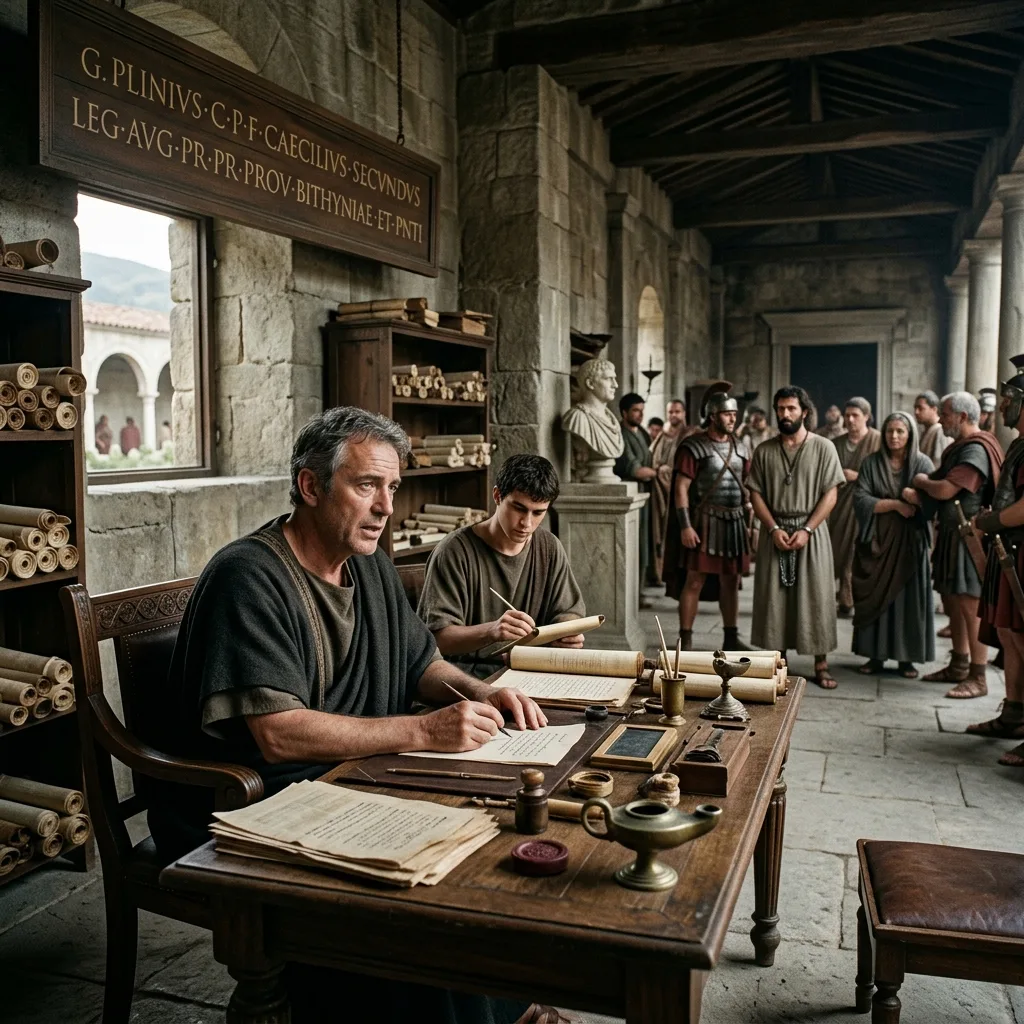
A Roman lawyer, author, and magistrate under Emperor Trajan. He is most famous for his hundreds of surviving letters (Epistulae), which provide an incredibly intimate and detailed look into the daily lives, administration, and values of the Roman elite.
Open in interactive timeline →Key Numbers
- Lived
- c. AD 61 – c. AD 113
- Age at Vesuvius
- 17–18 years old
- Surviving letters
- ~247 across 10 books
- Reached consulship
- AD 100
- Eyewitness accounts of Pompeii
- Only 1 that survives
Verified Facts
- Born Gaius Caecilius Secundus around AD 61 at Comum (modern Como) in northern Italy, he became Gaius Plinius Caecilius Secundus after his maternal uncle, the naturalist Pliny the Elder, adopted him posthumously by will, requiring him to take the family name.
- He was about 17 or 18 and staying at Misenum with his mother Plinia when Vesuvius erupted; his uncle, commander of the Roman fleet at Misenum, sailed toward the disaster on a rescue mission and died at Stabiae, overcome by ash and toxic fumes.
- Pliny recorded the eruption decades afterward in two letters (6.16 and 6.20) addressed to the historian Tacitus, who had requested the details for his own historical work, making it a deliberate piece of testimony rather than a contemporaneous diary.
- His description of the eruption column rising and spreading 'like an umbrella pine' is so iconic to volcanology that the most violent class of explosive eruption is now called a 'Plinian eruption' in his honor.
- His roughly 247 surviving letters span nine books of carefully edited personal correspondence plus a tenth book of official dispatches, offering an unusually rich window into elite Roman social, legal, and political life.
- As imperial governor of Bithynia and Pontus (in modern Turkey) around AD 110–112, he wrote Letter 10.96 to Emperor Trajan asking how to handle accused Christians — the earliest detailed non-Christian account of the religion, describing how they met before dawn and sang a hymn 'to Christ as to a god.'
- In that same correspondence he reported executing Christians who refused to recant, citing their 'stubbornness and inflexible obstinacy,' and even tortured two enslaved deaconesses to learn more; Trajan's brief reply established that Christians should not be hunted down but punished if formally accused and proven.
- He had a fast-rising public career under several emperors — quaestor, praetor around AD 93, and the suffect consulship in AD 100, an honor he marked by delivering the Panegyricus, an elaborate published speech praising Trajan.
- His third wife, Calpurnia, is the addressee of several tender surviving letters, and his correspondence also records his grief over her miscarriage, giving rare personal glimpses into a Roman marriage.
- The August 24, AD 79 date long assigned to the eruption rests on the manuscript tradition of Pliny's letters, but a charcoal inscription found at Pompeii in 2018 reading the equivalent of October 17 reopened a scholarly debate over whether the catastrophe actually struck in autumn.
The World at This Moment
Pliny's career spans the Flavian and "Five Good Emperors" eras of the high Roman Empire. He witnessed Vesuvius from Misenum in August (or autumn) 79 CE at about seventeen, during Titus's brief reign; he later flourished under Trajan (r. 98–117), reaching the consulship in 100 CE and governing Bithynia-Pontus around 110–112. His lifetime coincided with Trajan's Dacian Wars and the empire's greatest territorial extent, the Parthian campaigns, and the literary high point of Tacitus, Suetonius, Juvenal, and Martial. Eastward, the Kushan Empire bridged Rome and Han China along the Silk Road; the Han dynasty, though past its peak, still controlled much of East Asia. In Judaea, the aftermath of the 70 CE destruction of the Temple reshaped Judaism toward rabbinic forms, while nascent Christianity spread through Anatolian cities—precisely the communities Pliny would interrogate. His correspondence thus opens an unusually intimate window onto provincial administration, elite self-presentation, and religion in the empire's stable, expansive zenith.
The Paradigm Shift
Pliny redirected two trajectories. First, his letters to Tacitus (Ep. 6.16, 6.20) furnished the only surviving eyewitness narrative of the Vesuvius eruption, giving modern volcanology the type-name "Plinian eruption" for the towering eruption column he described and anchoring the scientific reconstruction of the disaster that buried Pompeii and Herculaneum. Second, Epistulae 10.96–97—his query to Trajan about prosecuting Christians and the emperor's rescript—became the earliest substantial external evidence for Christian worship and Roman legal policy toward the movement, documenting Christians who "sang a hymn to Christ as to a god," refused to curse him, and were punished for the "name" itself. Trajan's reply, instructing that Christians not be sought out nor anonymous accusations entertained, shaped Roman policy for generations. Beyond content, Pliny perfected the carefully edited "literary letter" as an artful prose genre, modeling epistolary self-fashioning that influenced later Latin literature and Renaissance humanist letter collections.
In Their Own Words
"They affirmed, however, that the whole of their guilt, or their error, was, that they were in the habit of meeting on a certain fixed day before it was light, when they sang in alternate verses a hymn to Christ, as to a god, and bound themselves by a solemn oath, not to any wicked deeds, but never to commit any fraud, theft, or adultery." — Pliny the Younger, Epistulae 10.96, to the Emperor Trajan (William Melmoth translation, rev. Bosanquet).
In Depth
The Bureaucrat Who Wrote History Without Meaning To
Gaius Plinius Caecilius Secundus — Pliny the Younger — was not a general, a philosopher, or a prophet. He was a lawyer, a senator, and a conscientious provincial administrator, the kind of man whose name should have dissolved into the anonymous machinery of empire. Instead, two of his private letters became among the most consequential documents of antiquity. His significance lies in a paradox the wider arc of history keeps repeating: the most enduring records are often kept by people who think they are merely doing their jobs.
A Mind Forged in Catastrophe
Pliny's preconditions were the institutions of high empire. He rose under the stability inaugurated by Augustus (sv-augustus), educated in the literary culture that descended from Homer (sv-homer) through the rhetorical schools, and shaped personally by his uncle Pliny the Elder, the polymath naturalist who died trying to rescue civilians during the eruption of Vesuvius (sv-pompeii) in 79 AD. The younger Pliny, then eighteen, watched the catastrophe from Misenum. Roughly twenty-five years later, prompted by his friend the historian Tacitus (sv-tacitus), he set down two letters (6.16 and 6.20) describing the disaster and his uncle's death. They are the only surviving eyewitness account of that eruption — so precise that volcanologists named the column-collapse style of eruption "Plinian" in his honor. Without this bored survivor's careful memory, we would understand the most famous geological event of the ancient world almost entirely through ash and bone.
The Letter That Defined a Persecution
His second great document came around 112 AD, when Trajan (sv-trajan-kitos) appointed him imperial legate of Pontus-Bithynia. There, Letters 10.96 and 10.97 record Pliny interrogating accused Christians, uncertain whether the crime was the name itself or attendant offenses. He describes them gathering before dawn, singing to Christ "as to a god," and binding themselves by oath against theft and adultery. Finding only "depraved, excessive superstition," he nonetheless executed the obstinate and asked Trajan for guidance. The emperor's reply — do not seek them out, do not accept anonymous accusations, but punish the confessed — became the de facto legal framework for Roman policy toward the church for over a century.
This makes Pliny one of the earliest non-Christian witnesses to the movement, alongside Tacitus and Josephus (sv-josephus). His detached, administrative tone is precisely its value: he had no theological stake. For modern scholars probing the historical origins of Christianity, his letter is bedrock evidence that organized Christ-worship existed in Asia Minor barely eighty years after the crucifixion — a thread running forward to the apologists like Justin Martyr (sv-justin-martyr) and Origen (sv-origen), and ultimately to the moment Constantine (sv-constantine-legal) reversed the entire policy Pliny helped formalize.
Ripples Across the Long Arc
Pliny embodies the transition by which information becomes durable through writing — a power born with cuneiform (sv-cuneiform) and amplified by every later leap, down to the printing press (sv-printing-press) and the World Wide Web (sv-www). His letters survived because Rome valued epistolary literature as art; he wrote for posterity even when reporting bureaucratic minutiae, and posterity obliged.
There is a deeper lesson here for a timeline that ends in machine intelligence. Pliny shows that the historical record is radically contingent on who happens to be observing and writing. A single literate official standing in the right province at the right moment fixed our knowledge of a volcano and a faith. As we build systems that record and interpret everything (sv-ai-dawn), Pliny is a quiet warning: history is not what happened, but what someone troubled to write down — and the writer rarely knows which sentence will outlive the empire.
Causes & Consequences
What led to it
- After his father Lucius Caecilius Cilo died during his childhood, Pliny the Younger was raised under the guardianship of his maternal uncle, Pliny the Elder, who later adopted him by the terms of his will, giving him the name Gaius Plinius Caecilius Secundus.
- Pliny received an elite Roman education in rhetoric and oratory in Rome, studying under the celebrated teacher Quintilian and under Nicetes Sacerdos of Smyrna, which equipped him with the literary skill that shaped his polished letters.
- His uncle Pliny the Elder commanded the Roman fleet stationed at Misenum, placing the teenaged Pliny across the Bay of Naples roughly 30 km from Vesuvius when it erupted in 79 CE and making him a surviving eyewitness to the disaster.
- Pliny the Elder sailed toward the eruption to mount a rescue and observe the phenomenon and died at Stabiae, an event whose details Pliny the Younger later reconstructed and recorded.
- Pliny rose through the full Roman cursus honorum, serving as quaestor, tribune, praetor, prefect of the military treasury and of the Treasury of Saturn, and reaching the suffect consulship in 100 CE, which gave him the imperial standing later reflected in his correspondence.
- Pliny's friendship with the historian Tacitus, who was gathering material on the deaths of notable men, prompted Tacitus to ask Pliny for an account of his uncle's death, directly occasioning the two famous Vesuvius letters written about 30 years after the event.
What it set in motion
- Pliny's two letters to Tacitus became the only surviving firsthand eyewitness account of the 79 CE eruption, and his stated date of 24 August was reaffirmed as the official date by the Director of the Pompeii Archaeological Park, even amid scholarly debate over an alternative autumn dating.
- Early-20th-century geologists who studied Vesuvius's stratigraphic deposits coined the term 'Plinian eruption' for tall, sustained, gas-driven ash columns, a classification still used in modern volcanology and hazard assessment for events such as the 1980 Mount St. Helens eruption.
- As governor of Bithynia-Pontus around 112 CE, Pliny wrote to Emperor Trajan asking how to handle Christians, producing the earliest surviving non-Christian (pagan) description of Christian beliefs and practices apart from the contested references in Josephus.
- Trajan's reply to Pliny established that Christians were not to be sought out and that anonymous accusations should be ignored, providing key evidence that no systematic empire-wide persecution of Christians existed at the time and shaping later understanding of Roman policy toward the faith.
- Pliny's collected Epistulae, comprising nine books of literary letters plus a tenth book of official correspondence with Trajan, are credited with helping establish the literary letter written for publication as a genre, influencing later epistolary writing.
- Pliny's documented philanthropy in his hometown of Comum, including large endowments for a library, a school, and an alimenta-style charity supporting children, became a frequently cited model of Roman elite civic euergetism in studies of ancient social welfare.
- The survival and transmission of Pliny's letters through medieval manuscripts gave historians a uniquely detailed window into senatorial life, provincial administration, and law under the emperors Domitian, Nerva, and Trajan.
The Live Academic Debate
Debate centers less on authenticity—10.96–97's text is stable and rarely doubted—than on interpretation and the letters' constructed nature. A.N. Sherwin-White's monumental commentary (1966) treated the Epistulae as a largely transparent historical and social record. More recent scholars (e.g., Roy Gibson and Ruth Morello, John Henderson, Stanley Hoffer) read the collection as a meticulously edited literary artifact of self-fashioning, cautioning that Pliny stages an idealized persona, so the letters cannot be naively mined as documentary. On the Christians, scholars dispute whether a formal anti-Christian law existed or whether prosecution rested on governors' coercitio and the offense of the "name"; Sherwin-White and Fergus Millar discussed the procedural questions, while others debate how representative Bithynian Christianity was. The Vesuvius dating is also contested: the traditional 24 August rests on a textually uncertain manuscript reading, and recent archaeological finds (a charcoal inscription, autumnal produce) have led many to favor an October–November 79 eruption, reframing how literally Pliny's report can be read.
How This Event Connects
Pliny the Younger's meticulously curated Epistulae offer an unparalleled window into the administrative, social, and literary realities of the Roman Empire's \"Golden Age.\" His most famous historiographical contribution is his detailed eyewitness account of The Eruption of Mount Vesuvius. Pliny’s letters to Tacitus concerning the disaster not only provide the empirical foundation for modern volcanology (coining the term \"Plinian eruption\") but also serve as a masterpiece of elite Roman self-fashioning. By immortalizing his uncle as a stoic \"scientific martyr,\" Pliny transformed a chaotic natural catastrophe into a literary monument of Roman virtus.
This deliberate construction of an idealized Roman persona must be read in direct dialogue with his contemporary and correspondent, Tacitus: The Annals & Histories. While Pliny projected the image of the moderate, cultured senator thriving under the supposedly benevolent reign of Trajan, Tacitus wrote a cynical, searing critique of the inherent corruption of the imperial autocracy. Together, their works represent the dual coping mechanisms of the Roman elite surviving the aftermath of Domitian’s \"Reign of Terror\": Pliny’s optimistic collaboration and literary networking versus Tacitus’s dark, retrospective dissection of tyranny.
Finally, Pliny’s crucial correspondence with Trajan in Book 10 regarding the execution of Christians in Bithynia sets the grim legal precedent that deeply informs the later apologetic work of Justin Martyr. Pliny's administrative, \"don't ask, don't tell\" policy and his use of torture on enslaved ministrae reveal the brutal pragmatism of Roman justice. Decades later, Justin Martyr would directly challenge this exact legal framework, utilizing sophisticated Greco-Roman philosophy to argue against the state-sponsored violence that Pliny had bureaucratically enforced, marking a profound evolution in the intellectual war between early Christianity and the Empire.
The Counterfactual
Had Pliny not published his letters—or had they not survived—our grasp of two pivotal subjects would be markedly poorer. Without 6.16 and 6.20, no contemporary eyewitness account of Vesuvius would exist; reconstruction would rest solely on archaeology and later, derivative sources, and the very term "Plinian" would never have entered geology. Without 10.96–97, scholars would lack the earliest Roman governmental description of Christian practice and the foundational precedent governing persecution under the "name." Christian apologists from Tertullian onward leaned on Trajan's measured rescript; its absence would have altered the legal and rhetorical landscape of church–state debate. Crucially, the letters survived by a fragile manuscript tradition (the tenth book, with the Christian correspondence, by an especially thin thread), so their loss is plausible, not idle speculation. Counterfactually, early-Christian historiography would depend more heavily on internal Christian texts of contested reliability, weakening independent corroboration of second-century practice—a point stressed by scholars who prize Pliny precisely as a non-Christian witness.
Myth vs. Reality
Myth: Pliny the Younger wrote the famous encyclopedia 'Natural History' (Naturalis Historia).
Reality: That 37-volume encyclopedia was written by his uncle, Pliny the Elder (Gaius Plinius Secundus, c. 23-79 CE), who died during the Vesuvius eruption. Pliny the Younger (Gaius Plinius Caecilius Secundus, c. 61-c. 113 CE) was the Elder's nephew and adopted son, and is remembered for a different body of work: his published collections of literary 'Letters' (Epistulae) and panegyric oratory. The confusion is fueled by the shared name and the adoption, after which the younger man took on his uncle's name.
Myth: Pliny the Younger's letters are a real-time, on-the-spot diary of the eruption he watched.
Reality: Pliny wrote his two famous eruption letters to the historian Tacitus around 106-108 CE, roughly 25 years after the event of 79 CE, at Tacitus's request for material on his uncle's death. They are crafted literary compositions, not contemporaneous notes, and scholars caution that memory and rhetorical shaping affect the details. Pliny was also at Misenum, across the bay, and explicitly states he did not witness his uncle's death firsthand; he relied on others' reports for parts of the account.
Myth: Pliny the Younger reliably fixes the eruption on 24 August 79 CE.
Reality: The August 24 date comes from medieval manuscript copies of Pliny's letter, since the original is lost, and the transmitted dating has long been textually unstable. Archaeological evidence, including autumn fruits and braziers at Pompeii and a 2018 charcoal inscription in the Casa del Giardino reading 'XVI K NOV' (16 days before the Kalends of November, i.e. October 17), has led many scholars to favor an October eruption, around October 24-25. The date remains debated rather than settled by Pliny's testimony alone.
Myth: A 'Plinian eruption' is named for Pliny the Elder, who died in the disaster.
Reality: The volcanological term honors Pliny the Younger, because it was his written description, comparing the towering ash column to an umbrella pine, that gave science its classic account of this high, sustained, gas-and-ash plume style of eruption. His uncle, Pliny the Elder, died in the events but left no surviving description of the column itself.
Myth: Pliny the Younger's letter to Trajan documents a systematic, empire-wide Roman persecution of Christians.
Reality: Writing as governor of Bithynia-Pontus around 112 CE (Epistulae 10.96), Pliny describes ad hoc trials prompted largely by anonymous accusations, and admits he had never participated in such proceedings before, indicating there was no established empire-wide procedure. Trajan's reply (10.97) is comparatively restrained: Christians were not to be sought out, anonymous accusations were to be disregarded, and recanting brought pardon. The correspondence is prized as an early external source on Christian practice and Roman policy, but it reflects local, reactive handling rather than coordinated persecution.
Frequently Asked Questions
Who was Pliny the Younger?
Pliny the Younger (born Gaius Caecilius Secundus around 61-62 AD in Comum, northern Italy) was a Roman lawyer, magistrate, author, and senator of the early Empire. After his father died he was raised and later adopted under the will of his uncle, the naturalist Pliny the Elder, taking the name Gaius Plinius Caecilius Secundus. He held a string of public offices, reaching the praetorship around 93 and the consulship in 100, and is best known today for his published collection of literary letters and for serving as governor of Bithynia-Pontus.
What did Pliny the Younger write about the eruption of Mount Vesuvius?
About 25 years after the event, at the request of the historian Tacitus, Pliny wrote two letters (Epistulae 6.16 and 6.20) describing the AD 79 eruption that buried Pompeii and Herculaneum. He was staying across the Bay of Naples at Misenum, where his uncle commanded the Roman fleet, and he described the towering cloud (which he likened to an umbrella pine), the ashfall, earthquakes, darkness, and panic among the population. These are the only surviving eyewitness accounts of the eruption and are so detailed that volcanologists named explosive 'Plinian' eruptions after him.
How did Pliny the Elder die in the Vesuvius eruption?
Pliny the Elder, who commanded the fleet at Misenum, set out by ship as the eruption began, partly to observe the phenomenon and partly to rescue people stranded along the shore. According to his nephew's account, he came ashore near Stabiae but was overcome amid the falling ash and fumes and died there, most likely from inhaling toxic gases or from respiratory failure. His estate passed to Pliny the Younger, who was about seventeen and chose to stay behind at Misenum with his mother rather than join the expedition.
Was Pliny the Younger an eyewitness to the eruption, and how old was he?
Yes, Pliny witnessed the eruption from Misenum, roughly 30 kilometers across the bay from Vesuvius, where he remained with his mother while his uncle sailed toward the disaster. He was a teenager at the time, about seventeen, and wrote that he stayed behind to continue his studies. He recorded the experience only decades later as an adult, drawing on his own memory and reports of his uncle's final hours.
What did Pliny the Younger say about early Christians?
While governing Bithynia-Pontus around AD 112, Pliny wrote to Emperor Trajan (Epistulae 10.96) asking how to handle people accused of being Christians, since he had no precedent to follow. He described interrogating the accused, executing those who refused to recant and worship the emperor's image, and reported that Christians met before dawn to sing to Christ 'as to a god' and bound themselves by oath to avoid crimes. He called the movement a 'depraved, excessive superstition,' and his letter, along with Trajan's reply, is the earliest detailed pagan account of Christian practice and of how Roman officials dealt with it.
Why do some scholars dispute the August 24 date of the Vesuvius eruption?
The traditional date of August 24, AD 79 comes from manuscripts of Pliny's letter, but some surviving copies give variant dates, and archaeological clues such as autumn fruits (pomegranates, chestnuts), heavy clothing on victims, and sealed wine vessels have suggested a later eruption in the autumn. A charcoal inscription found at Pompeii in 2018, dated to mid-October, fueled arguments for an eruption around October 24 rather than August. However, officials at the Archaeological Park of Pompeii continue to defend the August date, and the debate remains unresolved among scholars.
Sources & Further Reading
- Pliny the Younger — Wikipedia
- A. N. Sherwin-White, The Letters of Pliny: A Historical and Social Commentary (Oxford, 1966)
- Roy K. Gibson and Ruth Morello, Reading the Letters of Pliny the Younger: An Introduction (Cambridge, 2012)
- Pedar W. Foss, Pliny and the Eruption of Vesuvius (Routledge, 2022)
- Robert L. Wilken, The Christians as the Romans Saw Them, 2nd ed. (Yale, 2003)
- Stanley E. Hoffer, The Anxieties of Pliny the Younger (Atlanta, 1999)
- Read: Pliny's Letter on the Christians
Cite This Page
AskHistoryAI. “Pliny the Younger.” AskHistoryAI — Interactive Timeline of Everything. Updated 2026-09-11. https://askhistoryai.com/event/sv-pliny-younger/
Every fact on this page is checked against the published fact ledger and methodology; sources are listed above.