Friedrich Nietzsche
Nietzsche confronts the collapse of Western moral foundations.
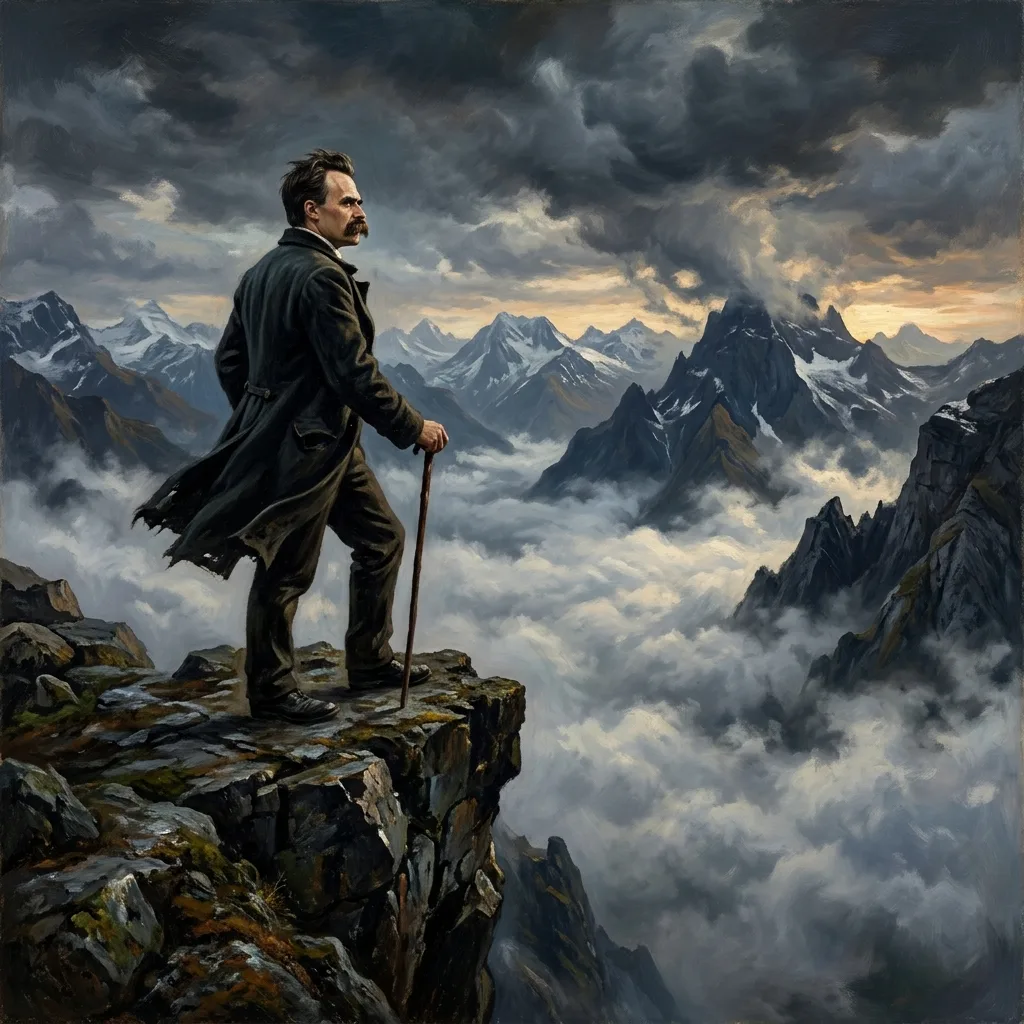
Friedrich Nietzsche publishes Thus Spoke Zarathustra. He warns that the Enlightenment has effectively killed the Christian God, destroying the objective moral foundation of Western civilization and risking widespread nihilism.
Open in interactive timeline →Key Numbers
- Lived
- 1844–1900 (aged 54)
- Made Basel professor at
- Age 24
- Final lucid years
- ~11 years insane (1889–1900)
- Books in his last sane year
- ~5 (all 1888)
- Zarathustra Part IV print run
- 40 copies
Verified Facts
- Friedrich Nietzsche was born October 15, 1844, in Röcken, Prussia, the son of a Lutheran pastor, Carl Ludwig Nietzsche; his father died of a brain ailment in 1849 before Friedrich turned five, and he grew up in a household of women (mother, sister, grandmother, and two aunts).
- On the strength of his teacher Friedrich Ritschl's extraordinary recommendation, Nietzsche was appointed Extraordinary Professor of Classical Philology at the University of Basel in 1869 at age 24, before he had even completed his doctorate or habilitation, making him one of the youngest to ever hold such a chair.
- His most famous phrase, 'God is dead. God remains dead. And we have killed him,' appears in the 1882 work The Gay Science, voiced by a madman in the marketplace; for Nietzsche it was less a celebration of atheism than a warning about the coming crisis of nihilism in a post-religious Europe.
- In 1882 Nietzsche fell intensely in love with the 21-year-old Russian writer Lou Salomé; he twice had his friend Paul Rée propose marriage on his behalf and was twice rejected, after which she proposed an intellectual 'trinity' commune that quickly collapsed amid jealousy and his sister Elisabeth's interference.
- Thus Spoke Zarathustra, which introduced the Übermensch and the eternal recurrence, sold so poorly that for the fourth part (1885) Nietzsche could only afford to privately print about 40 copies, distributing a handful to friends.
- Nietzsche's final sane year, 1888, was astonishingly productive: he completed The Case of Wagner, Twilight of the Idols, The Antichrist, Ecce Homo, and Nietzsche contra Wagner in a single burst before his collapse.
- On January 3, 1889, in a square in Turin, Nietzsche reportedly threw his arms around a horse being whipped and collapsed, an episode that has become the legendary marker of his descent into madness; he spent his last roughly eleven years incapacitated, cared for in asylums at Basel and Jena and then by his mother in Naumburg and sister in Weimar until his death on August 25, 1900.
- Physicians at Jena diagnosed his breakdown as paralytic dementia consistent with tertiary syphilis, though the true cause remains debated by modern scholars, who have proposed alternatives including a slow-growing brain tumor and other neurological conditions.
- Nietzsche was an outspoken opponent of antisemitism and German nationalism, even breaking with composer Richard Wagner partly over Wagner's antisemitism; he denounced antisemites in his letters and writings.
- After his collapse, his sister Elisabeth Förster-Nietzsche, an ardent antisemite married to a nationalist colonist, took control of his archive and assembled his notebook fragments into the book The Will to Power (1901), which he never authorized; her selective editing and later courting of the Nazis, Hitler attended her 1935 funeral, helped fuel the lasting and distorted image of Nietzsche as a proto-fascist.
The World at This Moment
Nietzsche's mature output (1882–1888) coincided with the high tide of European industrial modernity and the consolidation of Bismarck's German Reich, founded 1871. The Berlin Conference (1884–85) was partitioning Africa; Darwin had died in 1882, with evolutionary theory unsettling biblical authority. Wagner, Nietzsche's estranged early idol, died in 1883, the year Zarathustra began appearing. Positivism (Comte), historical-critical biblical scholarship (Wellhausen's documentary hypothesis, 1878), and rising scientific naturalism were eroding traditional Christian metaphysics across the educated classes. Marx (d. 1883) offered a rival diagnosis of modern alienation rooted in economics rather than values. Dostoevsky, whom Nietzsche read with admiration in 1887, had explored nihilism's psychological abyss. Meanwhile the discipline of philology in which Nietzsche trained at Basel was professionalizing the study of antiquity. The fin-de-siècle mood of cultural exhaustion, decadence, and looming crisis—later named by Nietzsche himself as "the advent of nihilism"—was a pan-European phenomenon, registered also in French Symbolism and Scandinavian drama (Ibsen).
The Paradigm Shift
Nietzsche reframed the central problem of modern thought from "Is God real?" to "What follows once belief in God has collapsed?" His "death of God" (The Gay Science, 1882) was diagnostic, not celebratory: he held that Europe's moral and metaphysical foundations—built on Platonic-Christian otherworldliness—had been quietly hollowed out, leaving nihilism as the looming consequence. Through the "genealogical" method (On the Genealogy of Morality, 1887) he historicized morality itself, arguing that values like good and evil have contingent origins in ressentiment and power relations rather than transcendent sanction. His perspectivism denied any "view from nowhere," anticipating critiques of objectivity. The constructive answer—revaluation of values, the will to power, eternal recurrence, the Übermensch—proposed self-legislated meaning replacing inherited authority. This redirected twentieth-century thought: existentialism, depth psychology, hermeneutics, and post-structuralism all draw on him. Whether or not one accepts his conclusions, he made the precariousness of post-religious meaning, and the suspicion of moral self-evidence, permanent features of intellectual life.
In Their Own Words
"God is dead. God remains dead. And we have killed him. How shall we comfort ourselves, the murderers of all murderers?" — Friedrich Nietzsche, The Gay Science (Die fröhliche Wissenschaft, 1882), Book III, §125, "The Madman" (Walter Kaufmann translation)
God is dead. God remains dead. And we have killed him. How shall we comfort ourselves, the murderers of all murderers?
Friedrich Nietzsche, The Gay Science (Die fröhliche Wissenschaft), Book III, §125 ("The Madman"), 1882; words spoken by the character of the madman, in the Walter Kaufmann translation. NOTE: this is a diagnosis of cultural crisis voiced through a character, not a triumphant slogan — the madman immediately laments humanity as 'the murderers of all murderers.' — source
Now it has gone so far that I have to defend myself hand and foot against people who confuse me with these anti-Semitic canaille; after my own sister, my former sister, and after Widemann more recently have given the impetus to this most dire of all confusions.
Friedrich Nietzsche, draft for a letter to his sister Elisabeth Förster-Nietzsche, December 1887, reacting to her ties to the anti-Semitic movement. These are Nietzsche's OWN words in private correspondence (a draft), as collected in his letters and reproduced on Wikiquote. — source
After her death scholars reedited Nietzsche's writings and found some of Elisabeth's versions distorted and spurious: she forged nearly 30 letters and often rewrote passages... Her distortions of Nietzsche's ideas in this work and others were in large measure responsible for the subsequent misperception of Nietzsche as an early philosopher of fascism.
Encyclopaedia Britannica, entry on Elisabeth Förster-Nietzsche — a modern scholarly/reference account (NOT Nietzsche's own words) describing how his sister forged letters and compiled 'The Will to Power' from his notes. — source
In Depth
The Hammer That Broke the Sky: Nietzsche and the Crisis of Meaning
When Friedrich Nietzsche (1844-1900) had his madman run into the marketplace crying "God is dead... and we have killed him" in The Gay Science (1882), he was not boasting. He was sounding an alarm. The death of God was, for him, a wound civilization had inflicted on itself and not yet noticed. Nietzsche's life work is the long, vertiginous reckoning with what is left when the metaphysical sky goes dark — and that reckoning sits at the hinge of the entire modern arc.
The Preconditions of a God-Killing
Nietzsche did not invent unbelief; he diagnosed its delayed consequences. The "killers" he names are the patient labors of the preceding centuries. The Gutenberg Press (sv-printing-press) had already shattered the Church's monopoly on truth, arming Martin Luther's Reformation (sv-martin-luther) and the fracturing of a single Christendom. Galileo's telescope (sv-galileo) and Newton's clockwork cosmos (sv-newton) drained the heavens of agency, while René Descartes (sv-descartes) relocated certainty from God to the doubting self. The decisive blow, though, came from Charles Darwin (sv-charles-darwin): once humanity was demoted from divine image to evolved primate — heir to the Human-Chimpanzee Split (sv-human-chimp-split) — the scaffolding that had held up Western values quietly gave way. Nietzsche absorbed this through the pessimism of Schopenhauer, but turned it inside out: where Schopenhauer counseled resignation, Nietzsche demanded creation.
What He Saw Coming
Nietzsche's genius was to see that the casualty of God's death was not merely belief but meaning itself. If the moral order had been guaranteed by a deity now absent, then "objective" values were exposed as human inventions — and the danger was nihilism, the suspicion that nothing matters at all. His answer was not to mourn but to build: the Übermensch of Thus Spoke Zarathustra (1883-85), the "revaluation of all values," the will to power as the engine of self-overcoming, and eternal recurrence as a test of whether one could affirm one's life without appeal to heaven. Mind collapsed into illness in 1889; he died in 1900, just as the century he had pre-written began.
The Ripples
The twentieth century is in many ways a footnote to that diagnosis. Nietzsche's emphasis on perspective and the genealogy of values seeded existentialism, psychoanalysis, and postmodern thought. His relativizing of fixed frameworks rhymed uncannily with Einstein's relativity (sv-einstein), which dissolved absolute space and time in physics just as he had dissolved absolute morality. He shared the era of dynamos and incandescent ambition — Edison's Menlo Park (sv-thomas-edison) and Tesla's alternating current (sv-nikola-tesla) — a world remaking itself in the absence of any guarantor but human will, the very condition the Industrial Revolution (sv-industrial-revolution) had midwifed. Tragically, his sister's distortions handed his vocabulary of Übermensch and "master morality" to the most monstrous misreaders of the next century, a perversion that helped lead toward the abyss of Hiroshima and Nagasaki (sv-hiroshima-nagasaki).
Yet his deeper question outlived its abuses, and it grows sharper, not duller, as history accelerates. If humanity is now engineering minds that may exceed our own — the trajectory from the Transformer (sv-transformer-paper) toward a projected Dawn of AGI (sv-ai-dawn) — then Nietzsche's challenge returns with redoubled force. The self-overcoming creature that builds its own successor, that must author meaning in a universe that offers none ready-made, is recognizably his Übermensch recast in silicon. Kurzweil's vision of the universe waking up (sv-kurzweil-epoch6) is, in a strange way, a Nietzschean wager: that intelligence, having killed its gods, might yet become one. Nietzsche handed the future its hardest homework — to create value from nothing — and we have not finished it.
Causes & Consequences
What led to it
- Arthur Schopenhauer's 'The World as Will and Representation' gave Nietzsche the foundational conviction that non-rational, willing forces underlie reality and creativity, a view he absorbed enthusiastically before later breaking with Schopenhauer's pessimism and resignation.
- Nietzsche's training as a classical philologist (he became a professor at Basel at just 24) steeped him in Greek tragedy, the Apollonian-Dionysian polarity, and pre-Socratic thought that shaped his first book, 'The Birth of Tragedy' (1872).
- Richard Wagner's friendship and his idea that aesthetic experience should be sacramental rather than coolly critical decisively influenced the early Nietzsche, before their bitter falling-out pushed Nietzsche toward his mature anti-Romantic stance.
- Friedrich Albert Lange's 'History of Materialism' (1866), which Nietzsche called a 'treasure trove,' exposed him to scientific materialism while arguing from a Kantian standpoint that metaphysical speculation is poetic illusion, seeding his later perspectivism.
- Nineteenth-century higher biblical criticism, especially David Friedrich Strauss's 'The Life of Jesus Critically Examined' (1835), which recast the Gospels as myth, dissolved the historical authority of Christianity and supplied the cultural ground for Nietzsche's 'death of God' diagnosis.
- The broad secularizing pressures of the era, including Darwin's 'On the Origin of Species' (1859) and the wider crisis of faith in German Protestant culture, convinced Nietzsche that European belief in the Christian God had already collapsed and that humanity itself had 'killed' it.
What it set in motion
- Nietzsche's proclamation that 'God is dead' and his analysis of the resulting nihilism became the defining diagnosis of the modern condition, forcing twentieth-century thought to confront the loss of transcendent foundations for value.
- His ideas profoundly shaped existentialism, inspiring thinkers such as Martin Heidegger, Jean-Paul Sartre, and Karl Jaspers with their emphasis on individual freedom, self-creation, and the authentic confrontation with meaninglessness.
- His critique of truth as inescapably linguistic, rhetorical, and perspectival became a central wellspring for post-structuralism and postmodernism, directly influencing Michel Foucault, Jacques Derrida, and Gilles Deleuze.
- His sister Elisabeth Forster-Nietzsche edited his notebooks into the posthumous compilation 'The Will to Power' and, as a Nazi sympathizer whose 1935 funeral Hitler attended, distorted his thought into a precursor of fascism, a misreading later corrected by the Colli-Montinari critical edition.
- His unflinching exploration of ressentiment, the unconscious, and the masks worn by morality fed directly into depth psychology and the work of figures such as Sigmund Freud and Carl Jung, reshaping how the modern self is understood.
- Twenty-first-century technologists and futurists have invoked his 'Ubermensch' and self-overcoming as a frame for transhumanism; for example, Ray Kurzweil has publicly projected a technological 'Singularity' he dates around 2045, a documented prediction rather than an established fact, in which human beings transcend biological limits.
The Live Academic Debate
Nietzsche interpretation is among the most contested in philosophy. A foundational divide concerns the Nachlass: Heidegger (Nietzsche, 1936–46) treated the unpublished notes, especially "will to power," as the metaphysical core, whereas Walter Kaufmann (Nietzsche, 1950) and the Colli–Montinari critical edition exposed the posthumous Will to Power as an editorial artifact and prioritized the books Nietzsche published. A second axis pits Kaufmann's "apolitical," existentialist-perfectionist artist-philosopher against the French reading of Deleuze (Nietzsche and Philosophy, 1962), Foucault, and Derrida, who embraced perspectivism, multiplicity, and the refusal of system—provoking Jan Rehmann's Marxist critique of "postmodern Nietzscheanism." A third strand, the analytic "naturalist" reading (Brian Leiter, Maudemarie Clark, Nietzsche on Morality), argues he offers empirically informed psychology and a coherent critique of morality, against deflationary "no doctrines" readers. Disputes persist over whether eternal recurrence is cosmological or ethical, and over how culpable Nietzsche himself is for the fascist reception engineered largely by Elisabeth Förster-Nietzsche.
How This Event Connects
Friedrich Nietzsche’s philosophical corpus represents one of the most radical epistemological ruptures in Western history, functioning as a deliberate, systematic dismantling of transcendent idealism. His declaration of the "death of God" is deeply entangled with the paradigm shifts introduced by Charles Darwin. While Darwin decentralized humanity biologically, rendering it a transient evolutionary phenomenon rather than a divine pinnacle, Nietzsche adapted this biological transience into a moral framework. He argued that human values, too, were merely evolutionary survival mechanisms, culminating in his vision of the Übermensch—an evolutionary step beyond the current human condition.
This fierce rejection of objective truth positions Nietzsche in direct conflict with the metaphysical legacy of Plato. Nietzsche famously described his own project as "inverted Platonism," systematically attacking the Platonic division of reality into a flawed material world and a perfect realm of Forms. For Nietzsche, this dualism was a nihilistic rejection of life. Alongside Karl Marx, Nietzsche stands as a master of suspicion; whereas Marx deconstructed 19th-century morality as bourgeois ideology designed to protect capital, Nietzsche deconstructed it genealogically as a psychological weapon forged by the weak to enslave the strong.
In contemporary historiography, Nietzsche's legacy has been fiercely contested within the debates surrounding The Singularity Is Near and Transhumanism. Techno-utopians frequently co-opt Nietzsche's Übermensch as a justification for cybernetic and genetic enhancement, framing the Singularity as the ultimate human "self-overcoming." However, critical posthumanists utilize Nietzsche's own genealogical method to argue that modern transhumanism merely replaces Christian tyranny with the absolute, algorithmic tyranny of efficiency, fundamentally violating Nietzsche's demand for aesthetic and spiritual affirmation of earthly life.
The work was hijacked — by his antisemitic sister, then the Nazis
Nietzsche's writings were posthumously curated by his sister Elisabeth Förster-Nietzsche, who married the antisemitic agitator Bernhard Förster and co-founded the failed 'Aryan' colony Nueva Germania in Paraguay. She controlled the Nietzsche Archive, forged roughly 30 letters, suppressed passages where he attacked her, and stitched his notebooks into 'The Will to Power,' presenting it as his magnum opus; she later courted the Nazi regime, and Hitler attended her 1935 funeral. Scholars such as Walter Kaufmann argued this manipulation fueled the false image of Nietzsche as a proto-fascist, though more recent historians (e.g. Robert Holub) complicate the picture by stressing how much of the racist appropriation came from the Nazis themselves rather than Elisabeth's editing alone.
The Counterfactual
Had Nietzsche's January 1889 Turin collapse come, say, five years earlier—before Beyond Good and Evil (1886), the Genealogy (1887), and the 1888 polemics—the genealogical critique of morality and the explicit thematization of nihilism would be far thinner, surviving mainly in the aphoristic Gay Science. The twentieth century's Nietzschean vocabulary (ressentiment, revaluation, will to power as a developed concept) might never have crystallized. Conversely, had he stayed sane and supervised his own Nachlass, the notorious Will to Power compilation—assembled posthumously by his sister Elisabeth and Peter Gast, and judged by Colli and Montinari a distorting editorial construction—would not exist in its misleading form, plausibly blunting the later fascist appropriation that R. J. Hollingdale and Walter Kaufmann labored to correct. Yet the broader "death of God" diagnosis was overdetermined by Darwinism, biblical criticism, and secularization; some thinker would likely have articulated post-religious nihilism. What is harder to replace is Nietzsche's specific stylistic and psychological genius, which gave the crisis its enduring, quotable form.
Myth vs. Reality
Myth: Nietzsche was a proto-Nazi and an antisemite whose philosophy laid the groundwork for the Third Reich.
Reality: Nietzsche openly despised antisemitism and German nationalism, breaking with his sister Elisabeth and her antisemite husband Bernhard Förster over it. He wrote, 'This damned anti-Semitism! It is the reason for the abrupt break with my sister.' The Nazi association was largely manufactured after his 1900 death by Elisabeth Förster-Nietzsche, a Nazi sympathizer (Hitler attended her 1935 funeral), who controlled his archive, withheld and reordered his texts, and forged or doctored letters to recast him as a fascist prophet.
Myth: The book 'The Will to Power' is Nietzsche's crowning philosophical statement.
Reality: Nietzsche never wrote or published a book called 'The Will to Power'; he abandoned plans for such a work. The volume bearing that title was assembled posthumously by his sister Elisabeth from his unpublished notebook fragments, which she selected and arranged to fit her own agenda, first publishing it in 1901 and an expanded edition in 1906. Scholars who later re-edited his papers found her compilation distorted, and most now treat it as an editorial construction rather than a genuine Nietzschean work.
Myth: The Übermensch ('Superman') is Nietzsche's blueprint for a biologically superior Aryan master race.
Reality: The term is better rendered 'Overman' or 'Beyond-Man,' and for Nietzsche it denoted an ideal of individual self-overcoming, creating one's own values after the collapse of inherited ones, not a racial or eugenic category. Notably, Nazi propaganda did not actually use the term Übermensch, and the paired notion of 'Untermenschen' (sub-humans) was a Nazi coinage Nietzsche never employed. The racial reading is a later imposition foreign to his texts.
Myth: Nietzsche was a nihilist who taught that life is meaningless and nothing matters.
Reality: Nietzsche diagnosed nihilism as a looming cultural crisis to be confronted and overcome, not a creed to embrace. His 'God is dead' was a diagnosis of the collapse of Christian-based values in Europe, not a celebration of meaninglessness. He proposed a 'revaluation of all values' and life-affirming concepts such as amor fati, eternal recurrence, and the Übermensch precisely as antidotes to nihilism.
Myth: Nietzsche's mental collapse was definitively caused by syphilis.
Reality: The syphilis explanation, long treated as settled, is now widely questioned by medical scholars. Nietzsche lacked the typical progressive motor and neurological deterioration of late-stage neurosyphilis and survived roughly a decade after his 1889 breakdown, an unusually long course for untreated general paralysis of the insane. Researchers have proposed alternatives including a slow-growing retro-orbital meningioma (brain tumor), frontotemporal dementia, and CADASIL; the true cause remains genuinely uncertain rather than proven.
Frequently Asked Questions
What did Nietzsche mean by "God is dead"?
Nietzsche first used the phrase in The Gay Science (1882) and developed it in Thus Spoke Zarathustra (1883–85). He did not mean that a supernatural being had literally died, nor was he simply arguing for atheism. Rather, it was a cultural diagnosis: belief in the Christian God had become untenable in modern European society, and Nietzsche warned that the entire framework of values built on that faith was therefore at risk of collapsing into nihilism. He saw this as both a profound crisis and an opportunity for humanity to create new values.
When did Nietzsche live, and what was his career?
Friedrich Wilhelm Nietzsche was born on October 15, 1844, in Röcken, Prussia, and died on August 25, 1900. A brilliant classical scholar, he became the youngest person ever appointed to the Chair of Classical Philology at the University of Basel in 1869, at age 24. He resigned in 1879 because of chronic ill health, after which he entered his most productive philosophical period as a wandering, independent writer.
What are Nietzsche's main philosophical ideas?
Nietzsche is best known for several interlinked concepts: the "will to power," a fundamental striving and drive toward self-overcoming and mastery (which he emphasized chiefly as power over oneself); the Übermensch or "overman," an ideal of a person who creates their own values and affirms life despite suffering; and the "eternal recurrence," a thought experiment asking whether you could embrace living your exact life over again infinitely. He also produced a sweeping critique of conventional morality, especially Christian morality, which he analyzed in On the Genealogy of Morality (1887).
What are Nietzsche's most important books?
His major works include The Birth of Tragedy (1872), The Gay Science (1882), Thus Spoke Zarathustra (published in parts, 1883–85), Beyond Good and Evil (1886), On the Genealogy of Morality (1887), and the late works Twilight of the Idols, The Antichrist, and his autobiography Ecce Homo, all written in 1888. Thus Spoke Zarathustra is often regarded as the first full statement of his mature philosophy. The book titled The Will to Power was not a finished work by Nietzsche but a posthumous compilation of his notebooks assembled by others.
What caused Nietzsche's mental breakdown?
Nietzsche suffered a complete mental collapse in early January 1889 in Turin, Italy; a widely repeated account describes him weeping and throwing his arms around a horse being beaten before breaking down. He never recovered and spent his last eleven years in the care of his mother and sister until his death in 1900. The traditional diagnosis was a brain disorder caused by syphilis (neurosyphilis), but the cause remains genuinely debated, with later scholars proposing alternatives such as frontotemporal dementia or other conditions.
Was Nietzsche a Nazi or antisemite?
No. Nietzsche explicitly condemned antisemitism and German nationalism, and he broke with his sister Elisabeth in part over her antisemitic views and her marriage to the agitator Bernhard Förster. After his collapse, Elisabeth Förster-Nietzsche took control of his manuscripts, edited and selectively compiled them, and later aligned herself with the Nazi Party, helping to falsely cast her brother as a forerunner of fascism. Decades of scholarship have worked to separate Nietzsche's actual thought from these distortions.
Sources & Further Reading
- Friedrich Nietzsche — Wikipedia
- Friedrich Nietzsche, The Gay Science, trans. Walter Kaufmann (Vintage, 1974)
- Friedrich Nietzsche, On the Genealogy of Morality, ed. Keith Ansell-Pearson, trans. Carol Diethe (Cambridge UP, 2006)
- Walter Kaufmann, Nietzsche: Philosopher, Psychologist, Antichrist (Princeton UP, 1950)
- Brian Leiter, Nietzsche on Morality (Routledge, 2002)
- Mazzino Montinari, Reading Nietzsche, trans. Greg Whitlock (University of Illinois Press, 2003)
- Stanford Encyclopedia: Nietzsche
Cite This Page
AskHistoryAI. “Friedrich Nietzsche.” AskHistoryAI — Interactive Timeline of Everything. Updated 2026-09-11. https://askhistoryai.com/event/sv-nietzsche/
Every fact on this page is checked against the published fact ledger and methodology; sources are listed above.