Tacitus: The Annals & Histories
The greatest, most cynical historian of the Roman Empire.
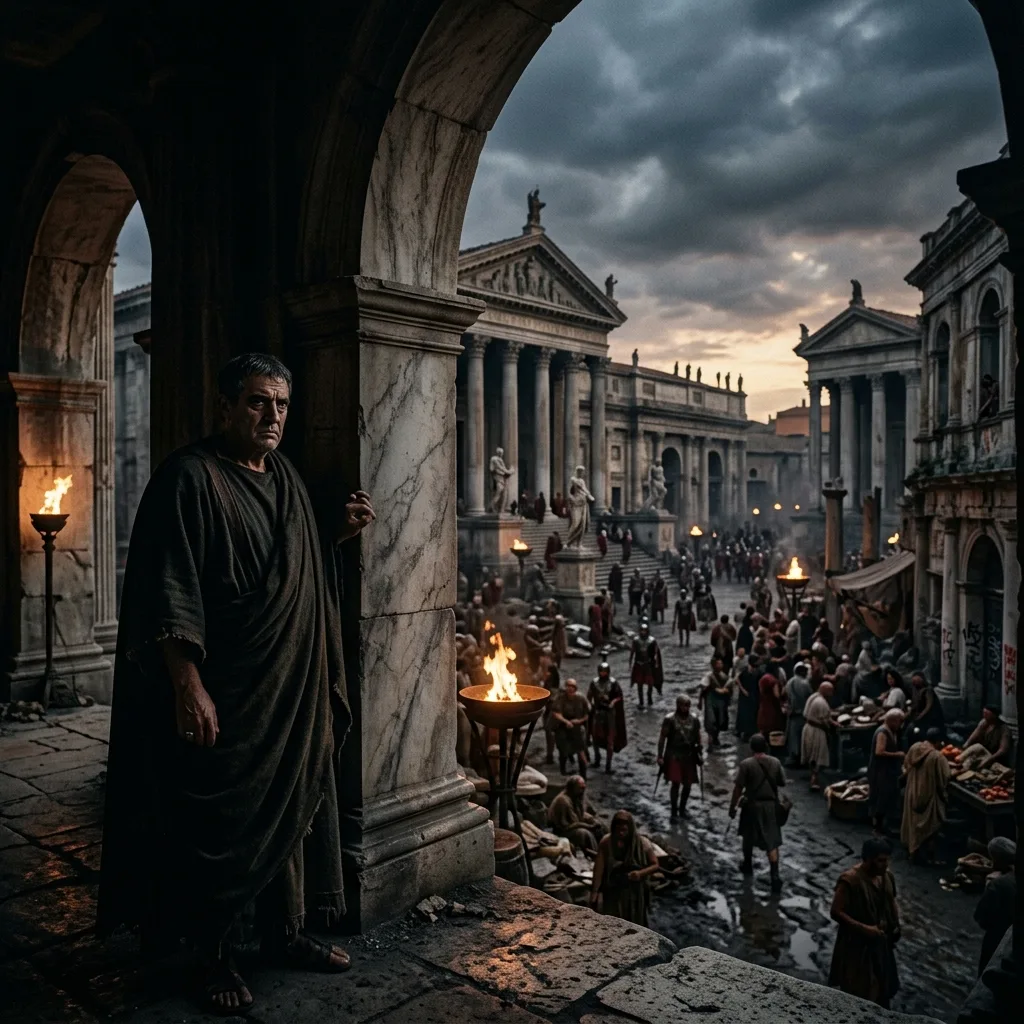
Publius Cornelius Tacitus is widely considered the greatest historian of antiquity. His major works, the "Annals" and the "Histories", brutally document the reigns of the Roman Emperors from Tiberius through Domitian with penetrating psychological insight and bitter cynicism.
Open in interactive timeline →Key Numbers
- Lifespan
- c. AD 56 - c. 120
- Original books (both works)
- ~30; only ~half survive
- Annals span
- AD 14-68 (Augustus' death to Nero)
- Histories span
- AD 69-96 (only 69-70 survives)
- Surviving copies of much of the text
- 2 medieval manuscripts
Verified Facts
- Publius Cornelius Tacitus (born c. AD 56, died c. 120) is regarded as the greatest historian and one of the finest prose stylists of the Latin language; his two major works, the Annals and the Histories, originally formed a single continuous narrative of the Roman Empire from the death of Augustus in AD 14 to the death of Domitian in AD 96.
- The Annals covered AD 14-68 (Tiberius through Nero) and the Histories covered AD 69-96, but together they survive only in part: of roughly 30 original books, only about half came down to us, and the Histories' surviving Books 1-4 and part of 5 cover barely two years (AD 69-70), the chaotic 'Year of the Four Emperors.'
- The text we have hangs by a thread of just two medieval manuscripts: the 'First Medicean' (Annals 1-6), copied in Germany around the mid-9th century, and the 'Second Medicean' (Annals 11-16 plus the surviving Histories), written at the Benedictine abbey of Monte Cassino around AD 1000-1100; both are now in the Laurentian Library in Florence.
- The losses are severe: Annals Books 7-10 are gone entirely, almost all of Book 5 and half of Book 11 are missing, and the gap erases nearly the whole reign of Caligula and the early years of Claudius.
- In Annals 15.44, describing how Nero scapegoated Christians for the Great Fire of Rome in AD 64, Tacitus writes that 'Christus,' the founder of the name, was executed under the procurator Pontius Pilate during the reign of Tiberius -- one of the earliest non-Christian references to Jesus and a key piece of historical evidence cited by scholars.
- Tacitus opened the Annals with his celebrated methodological motto that he would write 'sine ira et studio' ('without anger and partiality'), arguing he could be impartial precisely because he had not lived under or been patronized by the emperors he described -- a phrase still invoked as a standard for historians and journalists ('without fear or favor').
- His political career tracked the empire he chronicled: quaestor around AD 81, praetor in 88, suffect consul in 97 under Nerva (the first of his family to reach the consulship), and proconsul of the province of Asia around 112-113.
- As consul in 97 he reached the peak of his fame as an orator by delivering the funeral oration for the veteran statesman Lucius Verginius Rufus; in AD 100 he and his close friend Pliny the Younger jointly prosecuted Marius Priscus, proconsul of Africa, for corruption, winning the case.
- In AD 77 Tacitus married the daughter of Gnaeus Julius Agricola, the governor of Britain, whom he later memorialized in the Agricola (De vita Iulii Agricolae, c. AD 98) -- a biography of his father-in-law that was his first published work and remains the main source for Agricola's career.
The World at This Moment
Tacitus wrote under the "good emperors" Trajan and Hadrian, the Roman Empire at its territorial zenith—Trajan annexing Dacia (AD 106) and briefly Mesopotamia (AD 116). The Histories appeared c. AD 105–110, the Annals c. AD 115–120, both products of the cautious literary freedom Tacitus credits to the new regime (Agricola 3). Contemporaries included Pliny the Younger, his friend and correspondent, and the biographer Suetonius. Elsewhere, the Kushan Empire flourished in north India under Kanishka; Han China, recently reunified under the Eastern Han, pushed its Western Regions protectorate toward Central Asia under Ban Chao. Early Christianity was a marginal, persecuted sect—Pliny's letter to Trajan (Ep. 10.96, c. AD 112) shows a provincial governor uncertain how to prosecute Christians. Greek belletristic culture revived in the so-called Second Sophistic. Tacitus, a senator and consul (AD 97) who governed Asia, wrote from inside this imperial establishment, looking back with bitterness on the Julio-Claudian and Flavian autocracy he had survived.
The Paradigm Shift
Tacitus redirected the writing of political history by fusing annalistic chronicle with psychological and moral analysis of power. Where Livy narrated Republican grandeur, Tacitus anatomized despotism: the corrosion of senatorial liberty, the theatre of imperial dissimulation, the informer culture of the principate. His professed program—to write "sine ira et studio" (Annals 1.1)—established an enduring, if rhetorical, ideal of historiographical impartiality, even as his compressed, ironic, epigrammatic Latin made the historian a literary artist rather than a mere recorder. The famous verdict on the Pax Romana, "they make a desert and call it peace" (Agricola 30, in Calgacus's mouth), and his portrait of tyranny shaped later political thought: Renaissance "Tacitism" turned him into a manual of statecraft and reason-of-state read alongside Machiavelli, while Enlightenment writers from Montesquieu to the American founders invoked him as the great analyst of liberty's decay. His Annals 15.44 also became, by accident, the most cited non-Christian witness to the existence of Christ and to Nero's persecution.
In Their Own Words
"Inde consilium mihi pauca de Augusto et extrema tradere, mox Tiberii principatum et cetera, sine ira et studio, quorum causas procul habeo. ("Hence my purpose is to relate a few facts about Augustus—more particularly his last acts—then the reign of Tiberius, and all which follows, without anger and without partiality, the motives for which lie far from me.")" — Tacitus, Annals 1.1
In Depth
The Senator Who Diagnosed His Own Empire
Few writers have shaped how later ages judge power as profoundly as Publius Cornelius Tacitus (c. 56–c. 120 AD). A senator who climbed the standard ladder under emperors he despised—quaestor, praetor, consul in 97, and finally proconsul of Asia around 112—he wrote the Annals and Histories as a survivor's anatomy of how the Roman experiment with one-man rule corroded the institutions it claimed to preserve. To read him is to watch a civic mind reckoning, in chiseled and pitiless Latin, with the loss of the liberty his class once enjoyed.
The Preconditions of His Pessimism
Tacitus is unthinkable without the long collapse of the Roman Republic (sv-roman-republic). The constitutional order he mourned had been hollowed by the precedent of Sulla (sv-sulla) marching legions on the city, broken open when Julius Caesar (sv-julius-caesar) crossed the Rubicon, and refounded as a disguised monarchy by Augustus (sv-augustus). The Annals open precisely there—with Augustus's death—because Tacitus understood that the Principate was the original wound. His genius was to show how a republic dies not in a single coup but through a thousand acts of senatorial flattery, informer culture, and self-censorship. He had lived it: his career flourished under the terror of Domitian, and the guilt of complicity gives his prose its moral electricity.
He also stands inside a Greco-Roman tradition of inquiry that began when Herodotus (sv-herodotus) invented history as investigation. Where his contemporary Plutarch (sv-plutarch) wrote moralizing biography and his friend Pliny the Younger (sv-pliny-younger) wrote polished letters, Tacitus pursued causation, motive, and the psychology of fear. His professed method—to write sine ira et studio, "without anger or partiality"—is itself an inheritance of the analytical ethos that runs from Thales (sv-thales) and Aristotle (sv-aristotle) through the empirical temper of the ancient world.
The Ripples Forward
Tacitus's afterlife is enormous and double-edged. The Histories narrate the Year of the Four Emperors and the suppression that culminated in the Fall of the Second Temple (sv-second-temple); his lost later books once covered the era of the Great Fire of Rome (sv-great-fire), which he blamed Nero for exploiting. It is in Annals 15.44, describing how Nero scapegoated Christians for that fire, that Tacitus records Christus being executed under Pontius Pilate—the single most cited non-Christian witness to the historical Jesus, a passage that would echo through every later debate over Christianity's origins, from Eusebius (sv-eusebius) to the modern academy.
His monographs traveled even further. The Germania, an ethnography of the tribes beyond the Rhine, was rediscovered in the Italian Renaissance (sv-renaissance) and spread by the Gutenberg press (sv-printing-press)—then catastrophically weaponized by later German nationalists who read its "noble savages" as racial ancestors. Meanwhile, his unsparing portraits of tyranny became a school for republicans: the framers of the Federalist Papers (sv-federalist-papers) studied him as a manual on how free states decay into despotism, making this Roman cynic an unlikely tutor to the American Revolution (sv-american-revolution).
That is Tacitus's strange permanence. He believed history's purpose was moral memory—to ensure "that virtuous deeds not be silenced, and that crooked words and deeds fear the judgment of posterity." A man certain his civilization was sliding downward gave later, more hopeful ages their sharpest instrument for understanding power's seductions—proof that even a pessimist's clear eyes can illuminate paths he never imagined.
Causes & Consequences
What led to it
- Tacitus's own senatorial career — quaestor around 81, praetor in 88, and suffect consul under Nerva in 97 — gave him the insider's vantage on imperial politics, archival access, and statesman's perspective that shaped his histories.
- His direct experience of Domitian's reign of terror against the senatorial aristocracy (down to Domitian's death in 96) supplied the central preoccupation of his work: the conflict between liberty and one-man rule, first explored in the Agricola.
- The deaths of Domitian (96) and the accession of Nerva and then Trajan created a climate of relative freedom in which Tacitus, writing roughly between 100 and 120 CE, felt able to record imperial crimes that could not be safely written under the Flavians.
- Earlier Roman historians of the early empire — including Aufidius Bassus, Pliny the Elder (who continued Bassus), Cluvius Rufus, Fabius Rusticus, and Vipstanus Messalla on the year 69 — provided narrative sources Tacitus could draw on, compare, and criticize.
- Official documentary records in Rome, especially the acta senatus (minutes of senatorial proceedings) and the acta diurna (daily public gazette), gave Tacitus archival material on speeches, decrees, and trials for his account of the Julio-Claudians.
- Firsthand documents and memoirs available in Rome — such as a surviving speech of Claudius, the memoirs of Agrippina the Younger, and the military memoirs of the general Corbulo — furnished detail Tacitus wove into the Annals.
What it set in motion
- Tacitus's Annals became the single most important narrative source for the Julio-Claudian dynasty, and modern reconstructions of the reigns of Tiberius, Claudius, and Nero depend heavily on the portions that survive.
- The narrow survival of his text — Annals 1-6 in one ninth-century Fulda/Medicean manuscript and Annals 11-16 plus the Histories in a single eleventh-century Monte Cassino manuscript — made the Renaissance recovery of those codices, and Poggio Bracciolini's 1425 discovery of the minor works, foundational moments in classical philology.
- In the sixteenth and seventeenth centuries Tacitus inspired the political movement known as Tacitism, with scholars such as Justus Lipsius (whose Politicorum libri sex of 1589 fused Tacitean realism with humanist ethics) reading him as a manual for statecraft and reason of state.
- Enlightenment thinkers including Montesquieu, Voltaire, and Hobbes drew on Tacitus as a paradigmatic analyst of despotism, and through Montesquieu's theory of separated powers his anxieties about tyranny fed indirectly into the political thought of the American founders.
- The brief passage at Annals 15.44, describing Nero's scapegoating of Christians after the fire of 64 and noting that 'Christus' was executed under Pontius Pilate in Tiberius's reign, became one of the earliest and most debated non-Christian references bearing on the historical Jesus and the Neronian persecution.
- Tacitus's compressed, epigrammatic Latin style and his cynical, psychologically penetrating mode of imperial historiography set an enduring model for later historians' portraits of power, corruption, and political decline.
The Live Academic Debate
The central debate pits Tacitus-the-historian against Tacitus-the-rhetorician. Ronald Syme's monumental Tacitus (1958) treated him as a serious, prosopographically grounded historian, a disillusioned senator whose biases are intelligible and largely corrigible against other evidence. A.J. Woodman, especially in Rhetoric in Classical Historiography (1988), pressed a more radical view: ancient historiography was a fundamentally rhetorical, literary enterprise, so the question "what really happened" is often unanswerable and even misframed—Tacitus crafts scenes for effect. Most working historians now occupy a middle ground, reading Tacitus critically for fact while taking his artistry seriously (so the Woodman–Martin commentaries on Annals 3–4). A sharp, separate controversy surrounds Annals 15.44 on Nero's Christians: Brent Shaw (JRS 2015) argued the Neronian persecution is a later legend retrojected onto Tacitus's own era; Christopher Jones and others (NTS 2017) defended its historicity, while a minority (e.g., Richard Carrier) suspect the explicit "Christus…Pontio Pilato" clause is a Christian interpolation—a view most classicists reject.
How This Event Connects
Cornelius Tacitus is the supreme anatomist of Roman autocratic pathology, and his works are defined by a profound, melancholic obsession with the death of the Roman Republic. Historiographically, Tacitus utilizes the memory of the Republic not as a realistic political alternative, but as a moral benchmark against which he measures the degrading servility of the contemporary Senate. His brilliant \"Rhetorical History\" exposes the traumatic paradox of the Principate: the very military and political stability that preserved the empire inherently sterilized the chaotic freedom of speech and true eloquence that had defined the Republican era.
This dark, cynical analysis stands in stark contrast to the carefully curated optimism of his close friend and literary peer, Pliny the Younger. Methodologically, comparing Tacitus and Pliny reveals the fractured psyche of the Roman senatorial elite after surviving Domitian's purges. While Pliny actively constructed a public persona of a moderate, successful administrator collaborating with the \"good\" emperor Trajan, Tacitus retreated into history, projecting the trauma of his own survival onto the tyrannical reigns of Tiberius and Nero, utilizing biting irony and insinuatio to critique the autocracy Pliny outwardly praised.
Nowhere is Tacitus's dissection of tyranny more evident than in his account of The Great Fire of Rome. Tacitus provides the definitive, chilling narrative of Nero scapegoating the early Christians for the conflagration. The scholarly consensus emphasizes that Tacitus had no theological interest in Christianity; rather, he weaponized the horrific details of the persecution—describing Christians burned as human torches—to prove that Nero’s cruelty served only his own sadistic theatricality, not the public good. This passage remains the crucial intersection of Roman urban disaster, imperial paranoia, and the earliest external attestation of the Christian sect.
The Counterfactual
Had Tacitus not written—or had transmission failed—our picture of the early Empire would collapse into Suetonius's gossipy biographies, Cassius Dio's later epitomized Greek, and fragments. The danger was acute: the surviving text rests on a knife's edge. Annals 1–6 survive in a single ninth-century Carolingian manuscript (First Medicean, Laur. 68.1); Annals 11–16 and the extant Histories survive in one eleventh-century Monte Cassino codex (Second Medicean, Laur. 68.2). Had either perished—as much of Tacitus did (the whole reign of Caligula, the end of Nero, most of Tiberius's middle years are lost)—the detailed senatorial perspective on Tiberius, Claudius and Nero would have vanished. Absent Annals 15.44, secular corroboration of Jesus's execution under Pilate and of Christians in Neronian Rome would be far thinner, reshaping debates over Christian origins. And without Tacitus's model, early-modern "reason of state" theorists would have lacked their pre-eminent classical authority on the pathologies of one-man rule, weakening a lineage running to Montesquieu and beyond.
Myth vs. Reality
Myth: Tacitus was an objective, neutral historian because he promised to write 'without anger or partiality' (sine ira et studio).
Reality: Tacitus does open the Annals declaring he will write sine ira et studio, but scholars caution this was a conventional, formulaic claim of impartiality common in ancient historiography, not a guarantee of neutrality. In practice his narrative is shaped by a senatorial, aristocratic outlook that laments the erosion of senatorial auctoritas under the principate and embeds pointed criticism of monarchical power. Ronald Syme influentially portrayed Tacitus not as a detached chronicler but as a partisan figure who selectively emphasized events to critique imperial autocracy.
Myth: Tacitus wrote the Annals first, then the Histories, following the order of the events they cover.
Reality: The order of composition is the reverse of the chronology. Tacitus wrote and published the Histories first (roughly c. 100-110 CE), covering 69-96 CE down to the death of Domitian, and only afterward composed the Annals (dated to roughly 105-117 CE), which treat the earlier period from the death of Augustus in 14 CE through Nero. The Annals were his last major work even though they narrate the earlier era.
Myth: Tacitus titled his great work the 'Annals.'
Reality: The title 'Annals' is a modern convention that became established only around the 16th century, chosen because the work is structured year by year on an annalistic basis. Tacitus's own work began 'Ab excessu divi Augusti' ('From the death of the deified Augustus'), the heading preserved in the surviving manuscript tradition, and was transmitted under a title along those lines rather than as 'Annals.'
Myth: The famous passage where Tacitus mentions Christ executed under Pontius Pilate (Annals 15.44) is a later Christian forgery.
Reality: In the late 19th century the entire Christian episode was denounced as an interpolation forged in Tacitean style, but that sweeping claim won very few adherents and is rejected by the scholarly mainstream today. The passage is generally regarded as authentic. A separate, narrower debate continues over whether Tacitus drew on an independent Roman source or was repeating information that ultimately came from Christians themselves, since he does not name his source; some skeptics such as Richard Carrier press this point, but it concerns the passage's value, not its authenticity.
Myth: Tacitus's Annals and Histories have come down to us essentially complete.
Reality: Only roughly half of Tacitus's original output survives, and that survival hinged on a very small number of medieval manuscripts. Annals 1-6 survive through a single codex (the 'First Medicean,' produced in Germany, often associated with Fulda), while Annals 11-16 and the surviving books of the Histories depend on another single manuscript (the 'Second Medicean,' written at Monte Cassino). Annals 7-10 are lost entirely, parts of books 5 and 11 are missing, and the Histories break off in book 5, so most of the work's coverage of the later first century is gone.
Frequently Asked Questions
Who was Tacitus and when did he write the Annals and Histories?
Publius (or Gaius) Cornelius Tacitus (c. 56 - c. 120 CE) was a Roman senator, orator, and historian active under the emperors Trajan and Hadrian. He held a full senatorial career, including a suffect consulship in 97 CE and the proconsulship of Asia around 112-113 CE. He wrote the Histories first, roughly 100-110 CE, and then the Annals, generally dated to about 115-120 CE during and after Trajan's reign.
What is the difference between Tacitus's Annals and his Histories?
Although Tacitus wrote the Histories first, it covers the later period: the civil war 'Year of the Four Emperors' in 69 CE through the Flavian dynasty down to the death of Domitian in 96 CE. The Annals, written afterward, treats the earlier era of the Julio-Claudian emperors, from the death of Augustus in 14 CE through the reign of Nero ending in 68 CE. Together the two works form a continuous, though now incomplete, narrative of Rome from 14 to 96 CE.
How much of Tacitus's work survives, and how did it come down to us?
Only roughly half of Tacitus's major historical writing survives, and it depends on just two medieval manuscripts held in the Biblioteca Medicea Laurenziana in Florence. The 'First Medicean' (MS Plut. 68.1), written around 850 CE likely at the abbey of Fulda, preserves Annals books 1-6 (with a gap). The 'Second Medicean' (MS Plut. 68.2), written in the 11th century at Monte Cassino, preserves Annals 11-16 and the surviving books of the Histories; large stretches, including the end of the Annals and most of the Histories, are lost.
What does Tacitus say about Jesus and the Christians?
In Annals 15.44, while describing Nero's response to the Great Fire of Rome in 64 CE, Tacitus reports that Nero blamed a group called 'Christians.' He writes that the name derives from 'Christus,' who 'suffered the extreme penalty' under Tiberius at the hands of the procurator Pontius Pilatus, and that the movement, which he calls a 'pernicious superstition,' spread from Judaea to Rome. Many scholars regard this as among the earliest non-Christian references to Jesus's execution, though Tacitus is hostile and offers no independent detail beyond what was likely common report.
Is the passage about the Christians in Annals 15.44 authentic?
The mainstream scholarly view is that the passage is genuinely Tacitean, written in his characteristic style and consistent with his known disdain for foreign cults. A minority of scholars have argued that parts of it may be a later interpolation, noting that the charges are vague and that the fourth-century writer Sulpicius Severus preserves a similar account. There is also a separate, more widely debated question of whether Nero actually scapegoated Christians at all, which some historians, such as Brent Shaw, have challenged; but the dominant position remains that the text itself is authentic to Tacitus.
Why are the Annals and Histories considered so important?
Tacitus is the single most important literary source for the history of the early Roman Empire under the Julio-Claudian and Flavian dynasties, often preserving events and characterizations found nowhere else. His incisive, morally charged analysis of how autocratic power corrupts both rulers and the ruled has made the Annals an enduring study of tyranny and political decline. His brief notice on Christus also gives the works outsized significance for historians of early Christianity and the historicity of Jesus.
Sources & Further Reading
- Tacitus — Wikipedia
- Ronald Syme, Tacitus, 2 vols. (Oxford: Clarendon Press, 1958)
- A.J. Woodman, Rhetoric in Classical Historiography: Four Studies (London: Croom Helm, 1988)
- R.H. Martin and A.J. Woodman, eds., Tacitus: Annals Book IV (Cambridge University Press, 1989)
- Brent D. Shaw, 'The Myth of the Neronian Persecution,' Journal of Roman Studies 105 (2015): 73–100
- Christopher P. Jones, 'The Historicity of the Neronian Persecution: A Response to Brent Shaw,' New Testament Studies 63 (2017): 146–152
- Wikipedia: Tacitus on Christ
Cite This Page
AskHistoryAI. “Tacitus: The Annals & Histories.” AskHistoryAI — Interactive Timeline of Everything. Updated 2026-09-11. https://askhistoryai.com/event/sv-tacitus/
Every fact on this page is checked against the published fact ledger and methodology; sources are listed above.