Flavius Josephus: War & Antiquities
The indispensable, controversial chronicler of 1st-century Judea.
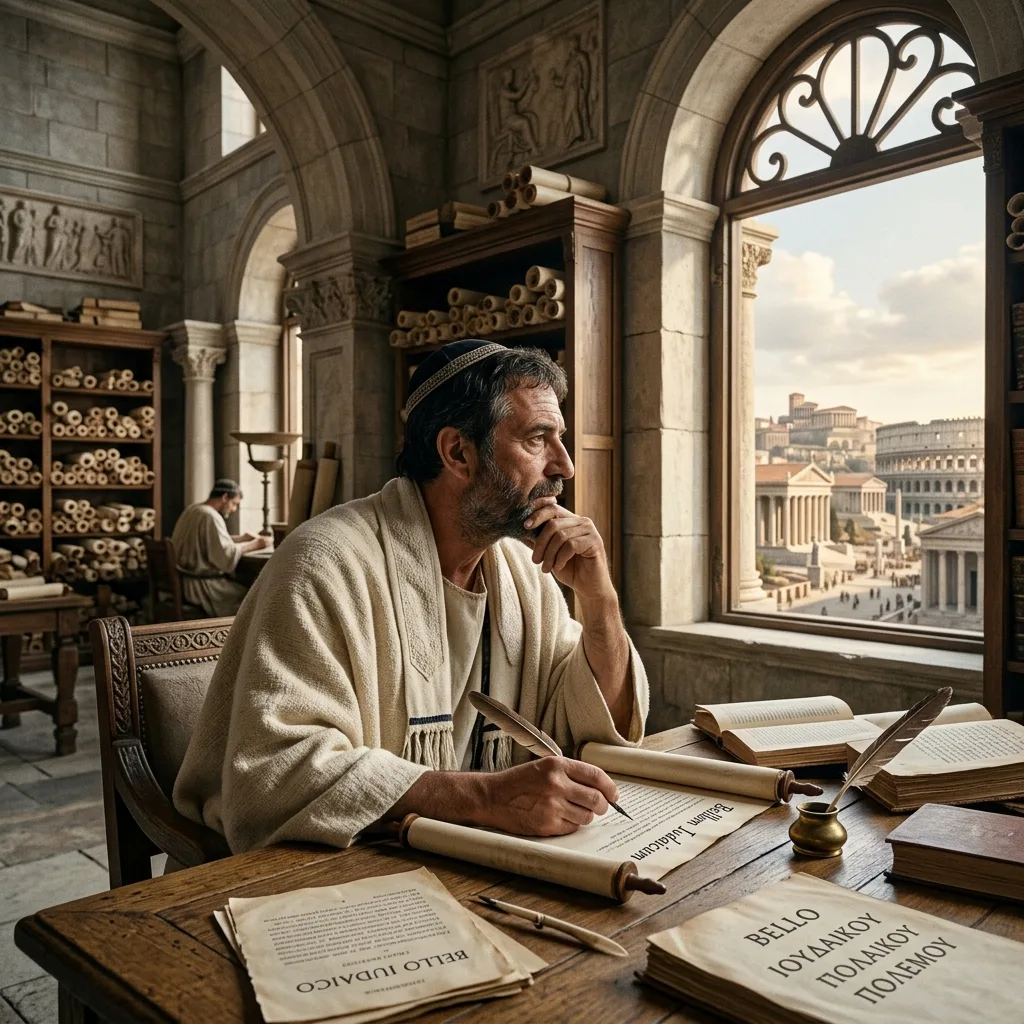
Titus Flavius Josephus, a Romano-Jewish historian and military leader, wrote "The Jewish War" (c. 75 CE) detailing the Jewish revolt against Rome, and later "Antiquities of the Jews" (c. 94 CE), a massive history of the Jewish people written for a Greco-Roman audience.
Open in interactive timeline →Key Numbers
- Antiquities of the Jews
- 20 books, ~93/94 CE
- The Jewish War
- 7 books, ~75-79 CE
- Span of Antiquities
- Creation to 66 CE
- Surviving corpus
- ~half a million words
- Jerusalem dead (his claim)
- 1,100,000
Verified Facts
- Born Joseph ben Matthias in Jerusalem around 37/38 CE into an aristocratic priestly family, he died in Rome around 100 CE; after defecting to Rome he took the name Titus Flavius Josephus, adopting the family name of his imperial patrons the Flavians.
- His earliest major work, 'The Jewish War' (Bellum Judaicum), spans seven books written roughly 75-79 CE; by his own account he first composed it in his 'paternal tongue' (Aramaic) and then produced the surviving Greek version, presenting the work to the emperor Vespasian.
- His magnum opus, 'Antiquities of the Jews' (Antiquitates Judaicae), was completed in twenty books around 93/94 CE in the 13th year of Domitian's reign, when Josephus was about 56, tracing Jewish history from the creation of the world down to the eve of the revolt in 66 CE.
- As Jewish commander in Galilee, Josephus held the fortified town of Jotapata (Yodfat) against Vespasian for 47 days before it fell on roughly 20 July 67 CE; he then hid in a cave with about 40 companions who made a suicide pact, and he survived by arranging the order of the lots so that he was among the last two left alive, then persuaded the other man to surrender.
- Brought before Vespasian as a prisoner, Josephus prophesied that the general would become emperor of Rome; when Vespasian was indeed proclaimed emperor in 69 CE, he freed Josephus, and Josephus interpreted Jewish messianic prophecy as pointing to Vespasian.
- In Rome he was rewarded with Roman citizenship, a pension, lodging in Vespasian's former house, and land in Judaea, and he enjoyed the favor of three successive Flavian emperors -- Vespasian, Titus, and Domitian -- under whose patronage he wrote.
- Book 18 of 'Antiquities' contains the 'Testimonium Flavianum,' a short passage about Jesus whose authenticity is heavily debated; the scholarly majority holds it is partly genuine but contains later Christian interpolations, while the Book 20 reference to 'James, the brother of Jesus who was called Christ' is regarded by most scholars as authentic.
- Josephus also reports John the Baptist in Book 18 of 'Antiquities,' making his works among the most important non-Christian sources for the historical context of first-century Judaism and early Christianity.
- His casualty figures are widely regarded as exaggerated: he claims 1,100,000 people died in the 70 CE siege of Jerusalem and 97,000 were taken captive, whereas the Roman historian Tacitus put the number besieged at 600,000; modern historians treat both numbers with skepticism, noting Josephus blamed the inflated totals on Passover crowds.
- His four surviving works -- 'The Jewish War,' 'Antiquities of the Jews,' the autobiographical 'Life' (Vita), and the apologetic 'Against Apion' -- total roughly half a million words and constitute the single most comprehensive primary source on ancient Jewish history to survive from antiquity, preserved largely because Christians valued his testimony.
The World at This Moment
Josephus wrote under the early Flavian emperors at the apex of Roman imperial power. The Jewish War appeared (c. 75-79 CE) just as Vespasian's son Titus celebrated the 71 CE triumph over Judaea and erected the Templum Pacis; the Colosseum, partly funded by Judaean spoils, opened in 80 CE. Jewish Antiquities was completed (93/94 CE) under Domitian, amid the fiscus Judaicus tax burden imposed on Jews after the Temple's destruction. In the same decades, rabbinic Judaism was being reconstituted at Yavneh (Jamnia) under Yohanan ben Zakkai following the loss of the sacrificial cult in 70 CE, while nascent Christianity was separating from its synagogue matrix—the canonical Gospels reaching their present forms. Contemporaneous Greco-Roman historiography flourished: Plutarch was composing his Lives, and Tacitus would soon write the Histories, whose fifth book offers a hostile Roman account of the Judaean war. Across Eurasia, the Kushan Empire bridged Rome and Han China along the Silk Road, while Han China itself, under the Eastern Han, projected power into Central Asia.
The Paradigm Shift
Josephus single-handedly preserved a coherent narrative of Second Temple Judaism and the catastrophe of 66-73 CE that no other source supplies. Without his four works—War, Antiquities, Life, Against Apion—the Hasmoneans, Herod the Great, the Jewish sects (Pharisees, Sadducees, Essenes), the Qumran context, and the siege of Jerusalem would survive only as fragments. He furnished the framework within which all later reconstruction of late-Second-Temple history proceeds (Steve Mason). Crucially, transmitted not by Jews but by Christians, his text became Western Christendom's standard "background" to the Bible and its near-only extra-biblical reference to John the Baptist, James the brother of Jesus, and—via the disputed Testimonium Flavianum (Ant. 18.63-64)—to Jesus himself. For over a millennium Josephus shaped how Europe imagined biblical antiquity and the fate of the Jews, the Temple's fall being read as providential. He also pioneered an apologetic ethnography defending Judaism's antiquity against Greco-Roman detractors in Against Apion.
In Their Own Words
"But now, what did most elevate them in undertaking this war, was an ambiguous oracle that was also found in their sacred writings, how, "about that time, one from their country should become governor of the habitable earth." — Flavius Josephus, The Jewish War (Bellum Judaicum) 6.312, trans. William Whiston
In Depth
The Turncoat Who Became History's Witness
Few figures in the ancient world straddle as many fault lines as Yosef ben Matityahu — the Jerusalem priest, failed rebel general, and Roman client who would publish as Titus Flavius Josephus. His two great works, The Jewish War (c. 75 CE) and the Antiquities of the Jews (c. 93–94 CE), are not merely chronicles. They are the hinge through which an entire vanished world — Second Temple Judaism, the Herodian dynasty, the politics of Roman Judea — survives at all. Without him, the first century would be a near-silence.
Preconditions: A World Built to Produce Him
Josephus stands downstream of a long convergence. The historiographical impulse he inherited descends from Herodotus (sv-herodotus), the first to treat human events as worthy of methodical inquiry, refracted through the Hellenistic learning that flowered after Alexander the Great (sv-alexander) and pooled in institutions like the Great Library of Alexandria (sv-library-alexandria). His apologetic project — explaining the Jews to a Greco-Roman readership — directly echoes Manetho (sv-manetho), who had narrated Egypt for the same audience, and parallels his contemporary Philo of Alexandria (sv-philo), who likewise translated Jewish thought into Greek categories.
But the deeper precondition was political. Josephus wrote inside the world made by Augustus (sv-augustus), whose principate had absorbed Judea as a client territory. The revolt he chronicled was the catastrophic failure of that arrangement, and the Fall of the Second Temple (sv-second-temple) in 70 CE is the gravitational center of his whole corpus. Captured at the siege of Yodfat in 67, he famously prophesied that Vespasian would become emperor — a prediction that, once fulfilled, bought his life and his name.
The Reshaping: A Single Witness to Many Worlds
What Josephus reshaped was memory itself. His patronage was compromising — he wrote for the very Flavian dynasty that had razed Jerusalem, and his War reads in part as an exoneration of Rome and an indictment of Jewish zealotry. Yet that bias is precisely what preserved him: Christian copyists, finding a Jew who blamed his own people, transmitted his manuscripts across centuries that lost nearly everything else.
The consequences ripple outward. His description of the Temple's destruction is the textual companion to the monument Titus built from its spoils — the Colosseum (sv-colosseum), financed by the Judean campaign. His narrative frames the grievances that would detonate again under Trajan's Kitos War (sv-trajan-kitos) and the Bar Kokhba Revolt (sv-hadrian-bar-kokhba), completing the rupture between Judaism and its homeland. And through the disputed Testimonium Flavianum and the more securely authentic reference to "James, the brother of Jesus who was called Christ," Josephus became the earliest non-Christian witness to the movement that Eusebius (sv-eusebius) would later canonize into ecclesiastical history — Eusebius himself quoting Josephus so extensively that he became the chief conduit of the Antiquities into the Christian Middle Ages.
Threads Forward
Josephus belongs to a remarkable generation of imperial-age writers who turned the early empire into a literary subject: the biographer Plutarch (sv-plutarch) and the senatorial historian Tacitus (sv-tacitus), who independently records the same Judean war and the same crucified founder. Together they form the documentary bedrock on which all later reconstruction of the first century rests. That a defector's apology should become indispensable scripture for both Jewish and Christian history is one of the quiet ironies of the record — proof that survival, not impartiality, is what ultimately governs what the past gets to say for itself.
Causes & Consequences
What led to it
- The First Jewish-Roman War (66-73 CE) and the Roman destruction of Jerusalem and the Second Temple in 70 CE created the catastrophic events that Josephus set out to chronicle in The Jewish War.
- Josephus's own background as a Jerusalem priest of aristocratic descent (the order of Jehoiarib, with a Hasmonean royal lineage on his mother's side) and his Pharisaic education gave him the literacy and insider knowledge of Judaism needed to write the works.
- Josephus's role as a Judean commander in Galilee, his surrender to the Romans at Yodfat (Jotapata) in 67 CE, and his survival made him a firsthand eyewitness to the war he later narrated.
- Flavian imperial patronage was decisive: after Josephus reportedly prophesied that Vespasian would become emperor, Vespasian freed him in 69 CE, after which Josephus took the family name Flavius, moved to Rome, and received citizenship, a pension, and lodging that financed all his writing.
- The established tradition of Hellenistic Greek historiography (writers like Polybius and Nicolaus of Damascus) provided Josephus the language, narrative models, and apologetic conventions through which he framed Jewish history for a Greco-Roman audience.
- The Hebrew scriptures and earlier Jewish texts, including the Septuagint translation, supplied the source material that Josephus paraphrased and expanded for roughly the first half of the Antiquities of the Jews.
What it set in motion
- Josephus's works became the single most important narrative source for first-century Judea, including the only detailed surviving accounts of the siege of Jerusalem, the burning of the Second Temple in 70 CE, and the mass death at Masada.
- Early Christians preserved and copied Josephus when most Jewish tradition neglected him as a traitor, so that all surviving manuscripts of the Antiquities descend from copies transmitted through the Christian library at Caesarea associated with Origen and quoted by Eusebius.
- The Testimonium Flavianum (Antiquities 18.3.3) became one of the most contested passages in ancient literature, generating centuries of scholarship over how much, if any, of its reference to Jesus is authentic versus later Christian interpolation, with the phrase 'he was the Christ' almost universally judged to be a Christian addition.
- The brief reference at Antiquities 20.200 to James 'the brother of Jesus who is called Christ,' accepted as authentic by most scholars, became a key non-Christian datum in modern debates over the historicity of Jesus.
- Josephus supplied later writers and modern historians with an indispensable framework for understanding Jewish sects (Pharisees, Sadducees, Essenes), Herodian politics, and the social world of Second Temple Judaism, shaping how the New Testament and rabbinic Judaism are contextualized.
- Josephus's apologetic claim that Greek philosophers like Plato had imitated Moses fed a long Jewish-and-Christian tradition of asserting Hebrew priority, an argument that modern scholars such as Russell Gmirkin have since explicitly inverted in arguing for Greek influence on the Hebrew Bible.
The Live Academic Debate
The fiercest controversy concerns the Testimonium Flavianum (Antiquities 18.63-64), Josephus's apparent paragraph on Jesus. Three camps persist: a minority (e.g., Tom C. Schmidt recently) defends substantial authenticity; a large mainstream, following Louis Feldman and John P. Meier, holds that an authentic core was Christianized by interpolation, with phrases like "he was the Christ" excised—Shlomo Pines's 1971 Arabic (Agapius) recension is invoked as a less-interpolated witness; a vocal minority (Ken Olson, Richard Carrier) argues the passage is wholesale Christian forgery, partly on Eusebian vocabulary. A second debate, advanced by Steve Mason, reassesses Josephus less as a transparent reporter than as a rhetorically sophisticated author with Flavian, priestly, and apologetic agendas, cautioning against mining him for "facts." A third strand interrogates his self-presentation—traitor, prophet, or pragmatic survivor—and the Jotapata cave episode (War 3.351-354), read by Jonathan Klawans and others against Roman and biblical prophetic conventions rather than as straightforward autobiography.
How This Event Connects
Flavius Josephus stands as the indispensable lens through which modern scholarship comprehends the traumatic intersection of Judaism and the Roman Empire in the first century. His most immediate and profound connection is to the Fall of the Second Temple. Josephus not only chronicled the catastrophic destruction of the Temple in 70 CE but actively negotiated the resulting theological and political fallout. His works represent the paramount attempt to explain Jewish antiquity and resilience to a triumphant Roman audience, attempting to preserve Jewish dignity in the smoldering aftermath of an apocalyptic military defeat.
Simultaneously, Josephus's historiographical project must be read in direct dialogue with the works of Tacitus: The Annals & Histories. Both authors navigate the treacherous political currents of Flavian Rome, employing sophisticated rhetorical strategies to survive autocracy. While Tacitus utilizes a cynical, \"objective\" veneer to dissect the corruption of the Roman imperial system from within the senatorial elite, Josephus employs \"figured speech\" and complex apologetics to defend his conquered people. Furthermore, both provide the crucial, contested earliest external references to the burgeoning Christian movement, making their texts the battleground for modern debates on early Christian origins and interpolations.
Finally, Josephus’s complex legacy directly foreshadows the explosive violence of Trajan & The Kitos War. Josephus’s desperate attempt to foster a hybrid Judeo-Roman identity ultimately failed to quell the profound ethnic and economic tensions in the diaspora. The horrific outbreak of the Kitos War under Trajan, fueled by the very Fiscus Judaicus and cultural disenfranchisement Josephus sought to mitigate, exposes the tragic limitations of his apologetic project, highlighting the deep-seated Roman-Jewish antagonisms that his texts attempted to paper over.
The Counterfactual
Had Josephus not survived Jotapata in 67 CE—where, by his own account, he escaped a suicide pact and surrendered to Vespasian, predicting his accession—or had his works not been preserved, the historical consequences would be severe. Tacitus (Histories 5) and a few rabbinic legends would leave only a thin, hostile, or legendary residue of the war; the destruction of 70 CE would lack any detailed eyewitness-derived narrative. The internal politics of Herodian and Hasmonean Judaea would be largely irrecoverable, and the sectarian landscape illuminating Qumran and Christian origins would be far murkier—the Dead Sea Scrolls (discovered 1947) would lack their indispensable narrative scaffold. For Christianity, the loss is acute: absent the Testimonium and the James and Baptist passages, the corpus of early extra-Christian testimony to Jesus would shrink to Tacitus, Suetonius, and Pliny. As Mason and Feldman stress, no surrogate source could replace him; modern reconstructions of the period would rest on speculation rather than continuous narrative.
Myth vs. Reality
Myth: Josephus was a contemporary eyewitness who met Jesus and recorded what he saw.
Reality: Josephus was born around 37 CE, several years after the crucifixion, and finished the Antiquities of the Jews around 93-94 CE, roughly six decades after Jesus's death. He could not have witnessed Jesus and was relying on earlier traditions and sources, as he was for almost all events outside his own lifetime. He was, at most, a contemporary of the earliest Christian movement, not of Jesus himself.
Myth: The famous passage about Jesus (the Testimonium Flavianum) is exactly what Josephus wrote and proves a non-Christian confirmed Jesus's divinity.
Reality: The mainstream scholarly view is that the passage in Antiquities 18 has been altered. Phrases such as 'he was the Christ' are almost universally regarded as later Christian interpolations, since Josephus was a committed Jew who never confessed Jesus as the Messiah. Scholars are divided between those who think a neutral core is authentic and a sizable minority who judge the whole passage a Christian insertion; it is not pristine first-century testimony.
Myth: Josephus converted to Christianity, which is why he wrote about Jesus.
Reality: Josephus remained committed to his Jewish faith throughout his life. Born into a priestly aristocratic family and self-identifying with the Pharisees, he shows no sign of Christian belief and interprets messianic prophecy in distinctly non-Christian ways (famously applying such hopes to Vespasian). The very 'Christian' tone of parts of the Testimonium is in fact one of the main reasons scholars suspect later editing, precisely because Josephus was not a believer.
Myth: 'Flavius Josephus' was his birth name, marking him as a Roman from the start.
Reality: He was born Yosef ben Matityahu (Joseph son of Matthias) in Jerusalem and commanded Jewish forces in Galilee during the revolt. After surrendering to Vespasian at Jotapata in 67 CE and later being freed once Vespasian became emperor, he adopted the imperial family name Flavius and received Roman citizenship. The name reflects his patronage by, and defection to, the Flavian dynasty, not his origin.
Myth: Josephus's account of the mass suicide at Masada is straightforward, archaeologically confirmed history.
Reality: Josephus is the sole ancient source for the Masada mass suicide, and his version contains details he could not have witnessed. Excavations led by Yigael Yadin found two palaces where Josephus described one, and other remains do not cleanly match a single coordinated act by all 960 defenders. Many scholars now treat the dramatic suicide narrative with deep skepticism, noting that archaeology can neither prove nor disprove it and that the story may be substantially shaped or invented by Josephus.
Frequently Asked Questions
Who was Flavius Josephus?
Josephus (born Joseph ben Matthias, c. 37 CE in Jerusalem) was a Jewish historian, priest, and military commander, and is our single most important source for first-century Judea. During the Great Jewish Revolt against Rome he commanded rebel forces in Galilee, but after his fortress fell he surrendered to the Romans, gained the patronage of the emperor Vespasian, and took the family name Flavius. He spent his later years in Rome writing the histories that survive today, including 'The Jewish War' and 'Antiquities of the Jews.'
What did Josephus write and when?
His two major works are 'The Jewish War,' a seven-book account of the revolt against Rome (66-70 CE) published around 75 CE, and the much larger 'Antiquities of the Jews,' a twenty-book history of the Jewish people from creation to the eve of the revolt, completed in 93 or 94 CE. He also wrote an autobiographical 'Life' and a defense of Judaism, 'Against Apion.' Together these works are a primary window into Jewish life, Roman politics, and the world of the early first century.
What does Josephus say about Jesus?
Josephus mentions Jesus twice in 'Antiquities of the Jews.' The longer passage (Book 18), known as the Testimonium Flavianum, describes Jesus as a wise teacher crucified under Pontius Pilate, while a brief passage in Book 20 refers to the execution of James, 'the brother of Jesus who was called Christ,' around 62 CE. These are among the earliest non-Christian references to Jesus and are widely cited as independent corroboration that he existed and was crucified under Pilate.
Is the Testimonium Flavianum (Josephus's passage on Jesus) authentic?
Most scholars hold that the passage is partially authentic: Josephus likely wrote something about Jesus, but later Christian scribes added or altered phrases. Overtly Christian statements such as 'He was the Christ' are nearly universally regarded as interpolations, since a Jewish writer like Josephus would not have affirmed Jesus as the Messiah. A minority of scholars argue the entire passage is a later Christian forgery, while the shorter Book 20 reference to James is considered authentic by the vast majority of specialists.
How reliable is Josephus as a historian?
Josephus is generally regarded as a competent historian by the standards of his day, drawing on official records, earlier writers like Nicolaus of Damascus, and his own experience; his descriptions of geography, the city of Jerusalem, and the Roman military are largely accurate and valuable. However, he wrote under Flavian patronage and had clear biases, flattering Vespasian and Titus and shaping events to legitimize the new dynasty and excuse his own conduct. Historians therefore treat his work as essential but read it critically, especially where he was personally involved.
How did Josephus survive when his comrades chose suicide?
After the Roman siege of Jotapata (Yodfat) fell in 67 CE, Josephus and about forty others hid in a cave and agreed to kill one another rather than surrender, drawing lots to determine the order. Josephus ended as one of the last two survivors and persuaded the other man to give up to the Romans instead. He then told Vespasian he was destined to become emperor; when that prophecy came true, Vespasian freed him. His convenient survival and defection led many to brand him a traitor and to suspect he had rigged the lots.
Sources & Further Reading
- Josephus — Wikipedia
- Steve Mason, Josephus and the New Testament, 2nd ed. (Hendrickson, 2003); and Mason (ed.), Flavius Josephus: Translation and Commentary (Brill, 2000- )
- Louis H. Feldman, Josephus and Modern Scholarship (1937-1980) (de Gruyter, 1984)
- John P. Meier, A Marginal Jew: Rethinking the Historical Jesus, vol. 1 (Doubleday, 1991), on the Testimonium Flavianum
- Tessa Rajak, Josephus: The Historian and His Society, 2nd ed. (Duckworth, 2002)
- Shlomo Pines, An Arabic Version of the Testimonium Flavianum and Its Implications (Israel Academy of Sciences, 1971)
- Read: The Works of Flavius Josephus
Cite This Page
AskHistoryAI. “Flavius Josephus: War & Antiquities.” AskHistoryAI — Interactive Timeline of Everything. Updated 2026-09-11. https://askhistoryai.com/event/sv-josephus/
Every fact on this page is checked against the published fact ledger and methodology; sources are listed above.