The Great Fire of Rome
The burning of the eternal city and the first persecution of Christians.
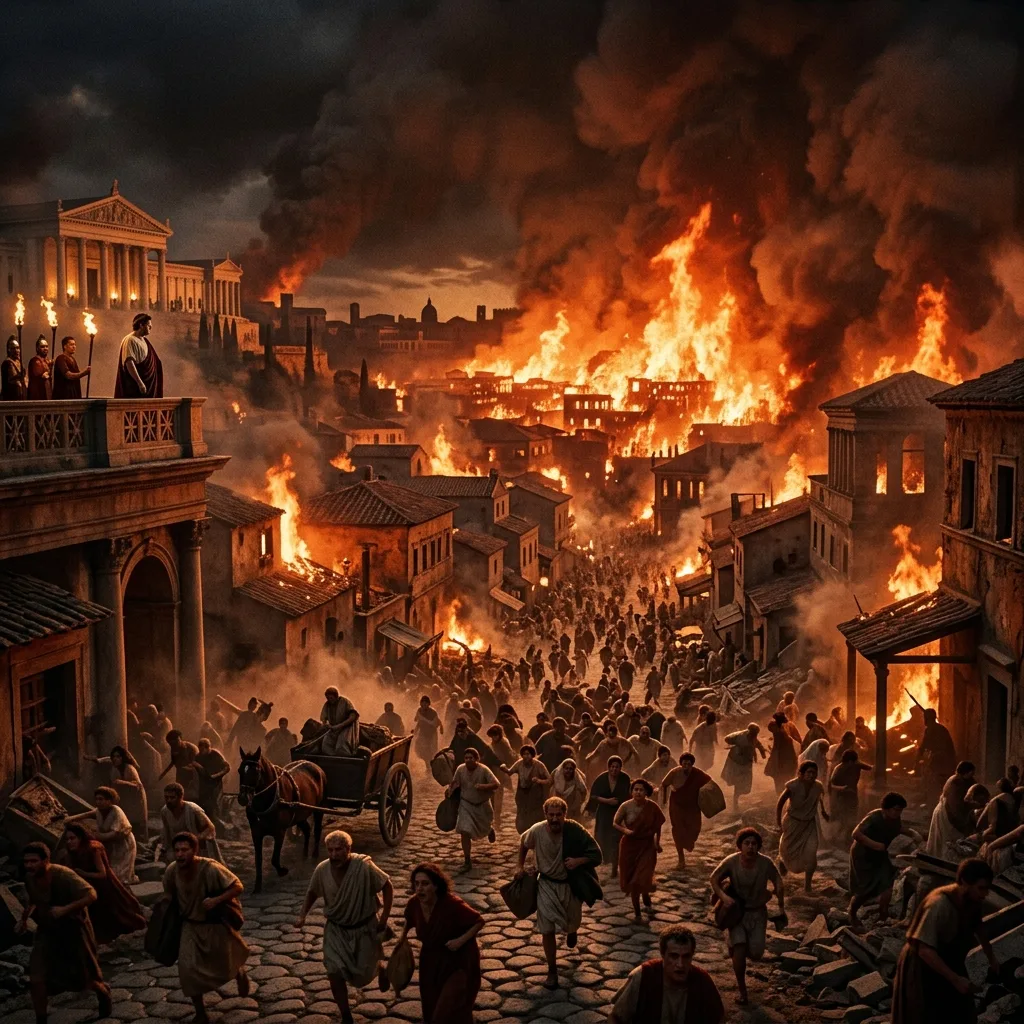
A massive urban fire breaks out in the merchant shops around the Circus Maximus, burning for six days and completely devastating the city of Rome during the reign of Emperor Nero.
Open in interactive timeline →Key Numbers
- Date it began
- Night of July 18-19, AD 64
- Duration
- 9 days (6 days, then a 3-day flare-up)
- City destroyed
- 10 of 14 districts (3 leveled, 7 ruined)
- Origin point
- Shops by the Circus Maximus
- Golden House footprint
- Up to ~250 acres of central Rome
Verified Facts
- The fire broke out on the night of July 18-19, AD 64, among the merchant shops packed with flammable goods at the southeastern end of the Circus Maximus, then raced through Rome's narrow, crowded streets fanned by the wind.
- According to Tacitus, our most reliable source (he was a child of about eight when it happened and drew on public records), of Rome's fourteen administrative regions only four escaped untouched: three were burned to the ground and seven were left in smoldering ruins.
- Tacitus reports the fire burned for six days before being checked at the foot of the Esquiline, then reignited and raged for three more days, for roughly nine days total of destruction.
- The famous image of Nero 'fiddling while Rome burned' is an anachronism: the fiddle (a bowed instrument) did not exist for another thousand years; the ancient claim was that he sang of the fall of Troy to the accompaniment of a lyre or cithara.
- Tacitus himself records the singing-Troy story only as a rumor and notes that Nero was at his villa in Antium, about 35 miles from Rome, when the fire began, returning to organize relief.
- Nero opened his own gardens and public buildings to the homeless, brought in food, and slashed the price of grain; he also enacted new building codes mandating wider streets, fire breaks, porticoes, and stone construction to prevent a repeat.
- To deflect persistent rumors that he had ordered the fire to clear land for his building plans, Nero blamed the Christians; Tacitus says he 'fastened the guilt' on them and inflicted exquisite tortures on a sect already hated for their 'abominations.'
- Tacitus (Annals 15.44) describes Christians being covered in animal skins and torn apart by dogs, crucified, or set alight to burn as torches lighting Nero's gardens by night, condemned not so much for arson as for 'hatred of the human race.'
- In the same passage Tacitus gives a rare pagan reference to Jesus, noting that 'Christus' was executed under Tiberius by the procurator Pontius Pilate, calling the movement a 'most mischievous superstition' that spread from Judaea to Rome.
- On the cleared land Nero built the Domus Aurea (Golden House), a sprawling palace-estate of up to roughly 250 acres with over 300 rooms, an artificial lake, and a ~120-foot bronze Colossus of Nero; after his fall the lake was drained for the Colosseum, which took its name from that nearby statue.
- Ancient testimony is divided: Suetonius and Cassius Dio (writing later) openly accuse Nero of arson, while Tacitus leaves the cause uncertain; most modern historians regard an accidental fire in so dense and combustible a city as essentially inevitable.
The World at This Moment
The fire erupted near the Circus Maximus on 19 July 64 CE and burned for roughly nine days, destroying or damaging ten of Rome's fourteen districts. Nero (r. 54-68) ruled a Mediterranean empire newly consolidated after Claudius's conquest of Britain (43 CE); his general Corbulo was campaigning against Parthia over Armenia, and the procuratorship of Judaea was deteriorating toward the revolt of 66. To the east, Han China under Emperor Ming was the Mediterranean's demographic peer; Buddhist tradition dates the religion's official arrival in China to roughly this generation. In India, the Kushan empire was coalescing along the trade routes that carried Roman gold east. Within the empire, the nascent Jesus movement was a small, legally ambiguous sect; Paul, by most chronologies, had recently reached Rome. The fire struck a metropolis of perhaps a million inhabitants packed into flammable timber-and-brick insulae, where conflagrations were endemic. Its scale, and the rumors it generated, made it the defining catastrophe of Nero's reign.
The Paradigm Shift
The fire's most consequential legacy was not architectural but religious and political. Tacitus (Annals 15.44) reports that Nero, to deflect suspicion that he had ordered the blaze, fastened guilt on the Christians, subjecting them to spectacular executions. This is the earliest securely datable instance of Roman state violence against Christians and the seed of the martyr tradition—later associated with the deaths of Peter and Paul—that became foundational to the Church's self-understanding. The passage is also a key non-Christian witness to the historical Jesus's execution under Pontius Pilate. Materially, the fire enabled Nero's sprawling Domus Aurea and a rebuilding program with wider streets, height limits, porticoes, and fire-resistant Gabine and Alban stone—an early instance of legislated urban fire safety. Politically, the conflagration and the resented expense of reconstruction corroded Nero's standing, contributing to the unrest that culminated in his suicide in 68 and the extinction of the Julio-Claudian dynasty, plunging Rome into the civil war of 69, the "Year of the Four Emperors."
In Their Own Words
"Therefore, to scotch the rumour, Nero substituted as culprits, and punished with the utmost refinements of cruelty, a class of men, loathed for their vices, whom the crowd styled Christians. Christus, the founder of the name, had undergone the death penalty in the reign of Tiberius, by sentence of the procurator Pontius Pilatus." — Tacitus, Annals 15.44 (early 2nd century CE), trans. John Jackson, Loeb Classical Library
In Depth
The Fire That Made a Scapegoat
On the night of 18 July AD 64, fire broke out among the merchant stalls clustered around the Circus Maximus and raced through the crowded wooden tenements of Rome. It burned for six days, was checked, then flared again for three more. When the ash settled, ten of the city's fourteen districts had been scarred and three leveled entirely. The Great Fire was, in one sense, the predictable failure of a city that had grown faster than it could govern itself — the dense, flammable capital that the Roman Republic (sv-roman-republic) had built and that Augustus (sv-augustus) had inherited and monumentalized. But its lasting significance lies less in what it destroyed than in whom it was blamed upon.
A City Built to Burn
Rome's vulnerability was structural. The Republic's relentless expansion and the imperial consolidation under Augustus had drawn perhaps a million people into a labyrinth of timber insulae with no zoning, no firebreaks, and a water system never designed for catastrophe. Modern historians are now largely agreed that Nero did not order the fire: the rumor that he cleared ground for his Domus Aurea collapses on geography, since the palace rose on the far side of the Palatine from the blaze. The contemporary record even credits Nero with a relatively swift relief effort and with rebuilding to wider, safer specifications. The fire was a disaster of urban scale, not of imperial malice — yet malice is what the populace suspected.
The Invention of a Persecuted People
To deflect that suspicion, Nero, as Tacitus reports in Annals 15.44, "contrived culprits" — and his verb, subdidit, leaves no doubt the charge was fabricated. He fastened the blame on the Christians, a small and obscure sect, who were rounded up and killed with theatrical cruelty: torn apart by dogs, crucified, or coated in pitch and set alight as living torches in Nero's gardens. Tacitus, no friend of the sect, recorded that the savagery was so excessive it stirred public pity. This Neronian persecution is the first documented Roman assault on Christianity. Church tradition, preserved later by Eusebius (sv-eusebius), places the deaths of both Peter and Paul within this same wave of repression. Whatever the precise facts, AD 64 became the founding trauma of Christian memory — the moment the movement acquired its martyrs and, with them, the durable idea that to die under Rome was to bear witness.
That idea would prove world-shaping. The persecutions that followed under Trajan (sv-trajan-kitos), Hadrian (sv-hadrian-bar-kokhba), and Marcus Aurelius (sv-marcus-aurelius) — and the apologetics they provoked from figures like Justin Martyr (sv-justin-martyr) — only sharpened the conviction that suffering authenticated faith. The arc bends, improbably, from Nero's garden to Constantine's conversion (sv-constantine-legal) and finally to Theodosius (sv-theodosius) outlawing the very paganism in whose name the Christians had first been condemned.
Ripples in Stone and Memory
The fire reshaped Rome physically as well as religiously. Nero's rebuilding and his extravagant Domus Aurea fed the resentment that ended his reign; when the Flavians seized power, they pointedly returned that seized land to the people, draining his lake to build the Colosseum (sv-colosseum). The fire thus stands at the hinge of the Julio-Claudian collapse and the Flavian order that erupted, within a generation, in the eruption of Vesuvius (sv-pompeii) and the fall of the Second Temple (sv-second-temple).
Above all, the Great Fire endures because of who told its story. Tacitus (sv-tacitus), writing half a century later, transformed a municipal catastrophe into a moral indictment of tyranny — and in doing so handed later Christianity its origin myth of innocent blood. The flames were local and brief; the scapegoating outlived the empire that invented it.
Causes & Consequences
What led to it
- By 64 AD Rome was a vast, densely packed city whose poorer inhabitants lived in multi-story wooden tenements (insulae) crammed along narrow, winding streets, conditions that made any fire nearly impossible to contain once it spread.
- Daily life depended on open flames for cooking, heating, and lighting in buildings that often lacked proper kitchens or chimneys, so small fires were a routine and constant urban hazard in the capital.
- The fire is reported by Tacitus, Suetonius, and Cassius Dio to have begun in the shops surrounding the Circus Maximus, where merchant stalls adjoined stables and were stocked with highly flammable goods such as oil, fabric, and fodder.
- Emperor Augustus had established the Vigiles in 6 AD as a force of seven cohorts of fire-watchmen and firefighters, but this brigade was designed for ordinary blazes and proved wholly inadequate against a wind-driven conflagration of this scale.
- Strong summer winds during the sweltering July heat fanned the flames through the cramped districts, accelerating the spread before any organized response could take hold.
- A small but growing community of Christians already existed in Rome and was viewed with suspicion and hostility by the broader populace, making them an available target for blame once disaster struck.
What it set in motion
- The fire destroyed or severely damaged ten of Rome's fourteen districts over roughly six to nine days, leaving much of the imperial capital in ruins and a large portion of the population homeless.
- To deflect rumors that he had ordered the fire, Nero blamed the city's Christians and subjected them to brutal public executions, an episode Tacitus records as one of the earliest documented persecutions of Christians by the Roman state.
- Nero seized a vast swath of the cleared land in central Rome to build his lavish Domus Aurea (Golden House), a palace complex whose extravagance deepened elite resentment and became a lasting symbol of imperial excess.
- The enormous cost of reconstruction and of the Domus Aurea strained the imperial treasury, contributing to currency devaluation and confiscations that alienated the Senate and provincial governors and helped set the stage for the revolt that drove Nero to suicide in 68 AD.
- Nero used the rebuilding to impose new urban regulations, including wider streets, height limits, fire-resistant stone and brick construction, and firebreaks, reforms that reshaped Roman city planning.
- After Nero's fall, the Flavian emperors dismantled the Domus Aurea and returned its grounds to public use, most famously draining its artificial lake to build the Colosseum (the Flavian Amphitheatre) on the reclaimed land.
The Live Academic Debate
The central debate concerns Nero's culpability. Ancient testimony splits: Suetonius (Nero 38) and Cassius Dio assert Nero ordered the fire to clear ground for building, while Tacitus, our fullest and most careful source, leaves the question open and notes Nero was at Antium when it began, returning to organize relief. Most modern historians—including Miriam Griffin (Nero: The End of a Dynasty, 1984) and Anthony Barrett (2020)—regard deliberate arson by Nero as improbable, attributing the blaze to accident amid Rome's endemic fire risk, while acknowledging the rumors' political potency. A second, sharper controversy surrounds the Christian persecution passage (Annals 15.44): scholars debate whether Tacitus's reference reflects authentic Neronian events or anachronistically retrojects later second-century categories of "Christian." Brent Shaw provoked extensive discussion arguing the Neronian persecution may be largely unhistorical; critics such as Christopher Jones have defended the traditional reading. The debate turns on terminology, Tacitus's sources, and the legal status of Christians circa 64.
How This Event Connects
The historiography of the Great Fire of Rome in 64 CE is fundamentally intertwined with the complex, often hostile literary tradition of the Senatorial elite, most notably preserved in the works of Tacitus. For centuries, the narrative of a megalomaniacal Nero deliberately burning his capital to construct the Domus Aurea was accepted as historical fact. Modern scholarship, heavily reliant on severe source criticism, recognizes this as a profound distortion. Tacitus's Annals provides the most nuanced, yet highly debated, account of the disaster, particularly regarding the subsequent execution of a marginal sect identified as Chrestianos. Cutting-edge debates center on whether Tacitus was accurately recording the first imperial persecution of Christians, or anachronistically projecting early 2nd-century prejudices backward to further emphasize Nero's cruelty and subversion of Roman justice.
Methodologically, urban historians and archaeologists have fundamentally reshaped our understanding of the fire by moving beyond biased literary accounts. Forensic fire modeling and stratigraphy demonstrate that the conflagration was almost certainly accidental, exacerbated by the dense, flammable topography of the ancient city. In this regard, the Great Fire serves as a vital structural parallel to the Eruption of Mount Vesuvius. Both events expose the extreme vulnerabilities of Roman urbanism when confronted with sudden, catastrophic devastation. However, while Pompeii was entombed, Rome required immediate, massive reconstruction, forcing Nero into an aggressive economic posture that included the first major debasement of the silver currency, fundamentally breaking the fiscal stability originally established by Augustus.
The political and architectural fallout of the Great Fire ultimately provided the subsequent Flavian dynasty with a perfect canvas for imperial propaganda. Following Nero's forced suicide and the chaotic Year of the Four Emperors, Vespasian and his sons actively sought to distance themselves from Julio-Claudian excess. By systematically dismantling Nero's Domus Aurea and draining its massive artificial lake to facilitate the Construction of the Colosseum, the Flavians executed a brilliant piece of spatial propaganda. The Colosseum was not merely an entertainment venue; it was a physical manifestation of the new regime "giving Rome back to the people," permanently transforming the scar of the Great Fire from a symbol of Neronian tyranny into the ultimate monument of Flavian legitimacy.
The Counterfactual
Had Rome not burned, or had Nero not scapegoated the Christians, the trajectory of early Christianity might look markedly different. The Neronian persecution supplied the movement with its archetypal Roman martyrs and helped frame Rome as the eschatological "Babylon" of Revelation; absent it, the church's adversarial self-positioning toward the imperial state might have crystallized later or differently. Anthony Barrett (Rome Is Burning, 2020) argues the disaster and its ruinously expensive aftermath were a genuine turning point in undermining Nero, implying that without it the Julio-Claudian line might have endured longer, deferring the 69 CE civil wars. Counterfactual caution is warranted: fires were chronic in Rome, persecution of Christians was arguably inevitable given their legal vulnerability, and dynastic instability had structural causes beyond one fire. Still, the specific conjunction—catastrophe, rumor, and an emperor seeking a culprit—gave the persecution its timing and its enduring symbolic charge, which no other single event obviously supplies.
Myth vs. Reality
Myth: Nero fiddled while Rome burned.
Reality: The fiddle (and the entire bowed-string viol family) did not exist in antiquity; it was not developed until roughly the 11th century, so Nero could not have played one. The image derives from a later mistranslation and embellishment of Tacitus, who reports only a rumor that Nero sang of the destruction of Troy, likely accompanying himself on a lyre or cithara. Crucially, Tacitus (Annals 15.39) states this was an unverified rumor, and the most lurid versions come from the later, hostile writers Suetonius and Cassius Dio rather than from eyewitnesses.
Myth: Nero was in Rome watching the city burn and did nothing.
Reality: According to Tacitus, Nero was at his villa in Antium (modern Anzio), about 35 miles south of Rome, when the fire broke out. He returned to the city and organized relief: opening the Campus Martius, public buildings, and his own gardens to shelter the homeless, importing grain and bringing supplies up from Ostia, and reducing the price of grain. Whatever his other faults, the contemporary record credits him with active disaster response, not passive spectatorship.
Myth: Nero deliberately started the fire to clear land for his Golden Palace (Domus Aurea).
Reality: This was a rumor circulating in Rome at the time, which Tacitus reports but does not endorse; he explicitly leaves the cause uncertain. Modern historians generally regard a deliberate imperial arson as unproven and improbable. Rome's dense, timber-framed insulae, narrow streets, and shops full of flammable goods near the Circus Maximus, combined with summer winds, made catastrophic fire common and largely accidental. The fire likely began by accident in shops near the Circus Maximus, and Nero's later building on cleared land is what fueled, rather than confirmed, the suspicion.
Myth: The fire destroyed all of Rome.
Reality: Tacitus records that of Rome's fourteen administrative regions, three were completely destroyed and seven were severely damaged, while four were left untouched. The blaze burned for roughly six days (with a renewed outbreak afterward), and while devastating, it did not level the entire city. Popular claims that it wiped out 'all of Rome' or fixed casualty figures overstate the (genuinely incomplete) ancient evidence.
Myth: Nero's mass persecution of Christians as scapegoats for the fire is a securely established historical fact.
Reality: Tacitus is the sole early source tying the fire to a punishment of Christians; Suetonius mentions Nero punishing Christians but does not connect it to the fire. The episode is the subject of active scholarly debate: Brent Shaw ('The Myth of the Neronian Persecution,' Journal of Roman Studies, 2015) argued the evidence is too weak to support a state-directed persecution, while Christopher Jones (New Testament Studies, 2017) defended the general credibility of Tacitus's account, with Shaw replying again. The traditional narrative may be substantially accurate, but its certainty and especially its later legendary embellishments should be treated with caution rather than as settled fact.
Frequently Asked Questions
When did the Great Fire of Rome happen and how long did it last?
The fire broke out on the night of 18-19 July AD 64, beginning among the merchant shops near the Circus Maximus, Rome's chariot stadium. According to the historian Tacitus, who was a child during the event, it raged for roughly six days before being contained, then flared up again and burned for several more days. Of Rome's fourteen districts, only four escaped untouched: three were leveled completely and the remaining seven were left badly damaged.
Did Nero really start the Great Fire of Rome?
There is no reliable evidence that Nero set the fire, and most modern historians regard it as an accident, of the kind common in a dense city built largely of timber. Suspicion arose partly because Nero later seized burned land to build his lavish palace, the Domus Aurea, fueling rumors he wanted to clear the ground. However, the fire also destroyed Nero's own existing residence, the Domus Transitoria, which weakens the case against him. Tacitus reports the rumors but does not endorse them as fact.
Did Nero fiddle while Rome burned?
No. The image of Nero 'fiddling' is a later myth and is impossible literally, since the violin would not be invented for roughly another 1,500 years. According to Tacitus, Nero was not even in the city when the fire began, but at his villa in Antium (modern Anzio) on the coast. The ancient sources do contain a tradition that Nero sang of the fall of Troy during the disaster, but accounts differ and Tacitus presents it only as a damaging rumor.
Why did Nero blame the Christians for the fire?
To deflect popular suspicion that he was responsible, Nero pinned the blame on Christians, a small and unpopular group, and had many of them brutally executed. This is described by Tacitus in his Annals (15.44), one of the earliest non-Christian references to Christians and to Christ's execution under Pontius Pilate. Tacitus himself disliked the Christians but treated them as scapegoats, suggesting they were punished less for arson than for being objects of public hatred. Some scholars debate whether the persecution was truly tied to the fire or has been exaggerated in later tradition.
How reliable are our sources for the Great Fire of Rome?
No eyewitness or primary documents about the fire survive. Everything comes from three later Roman historians: Tacitus, Suetonius, and Cassius Dio. Tacitus is generally considered the most reliable because he was alive (though only a young child) at the time and wrote with comparative care, whereas Suetonius and Dio wrote later and are more openly hostile to Nero. Because all three were writing under or about a despised emperor, scholars treat their more damning claims with caution.
What changed in Rome after the fire?
The disaster left large parts of the city in ruins and, by ancient accounts, thousands dead and great numbers homeless. In rebuilding, Nero introduced stricter building regulations: wider streets, height limits, the use of fire-resistant stone and brick over timber, and requirements aimed at slowing the spread of future fires. He also appropriated a vast tract of cleared land to construct the sprawling Domus Aurea ('Golden House'); after his death, later emperors reused that ground for public works, including the Colosseum, which was built on the site of the palace's artificial lake.
Sources & Further Reading
- Great Fire of Rome — Wikipedia
- Anthony A. Barrett, Rome Is Burning: Nero and the Fire That Ended a Dynasty (Princeton University Press, 2020)
- Miriam T. Griffin, Nero: The End of a Dynasty (Yale University Press / Batsford, 1984)
- Edward Champlin, Nero (Harvard University Press, 2003)
- Brent D. Shaw, 'The Myth of the Neronian Persecution,' Journal of Roman Studies 105 (2015), 73-100
- Tacitus, Annals, Book 15.38-44 (Loeb Classical Library, trans. John Jackson)
- PBS: Nero and the Great Fire
Cite This Page
AskHistoryAI. “The Great Fire of Rome.” AskHistoryAI — Interactive Timeline of Everything. Updated 2026-09-11. https://askhistoryai.com/event/sv-great-fire/
Every fact on this page is checked against the published fact ledger and methodology; sources are listed above.